

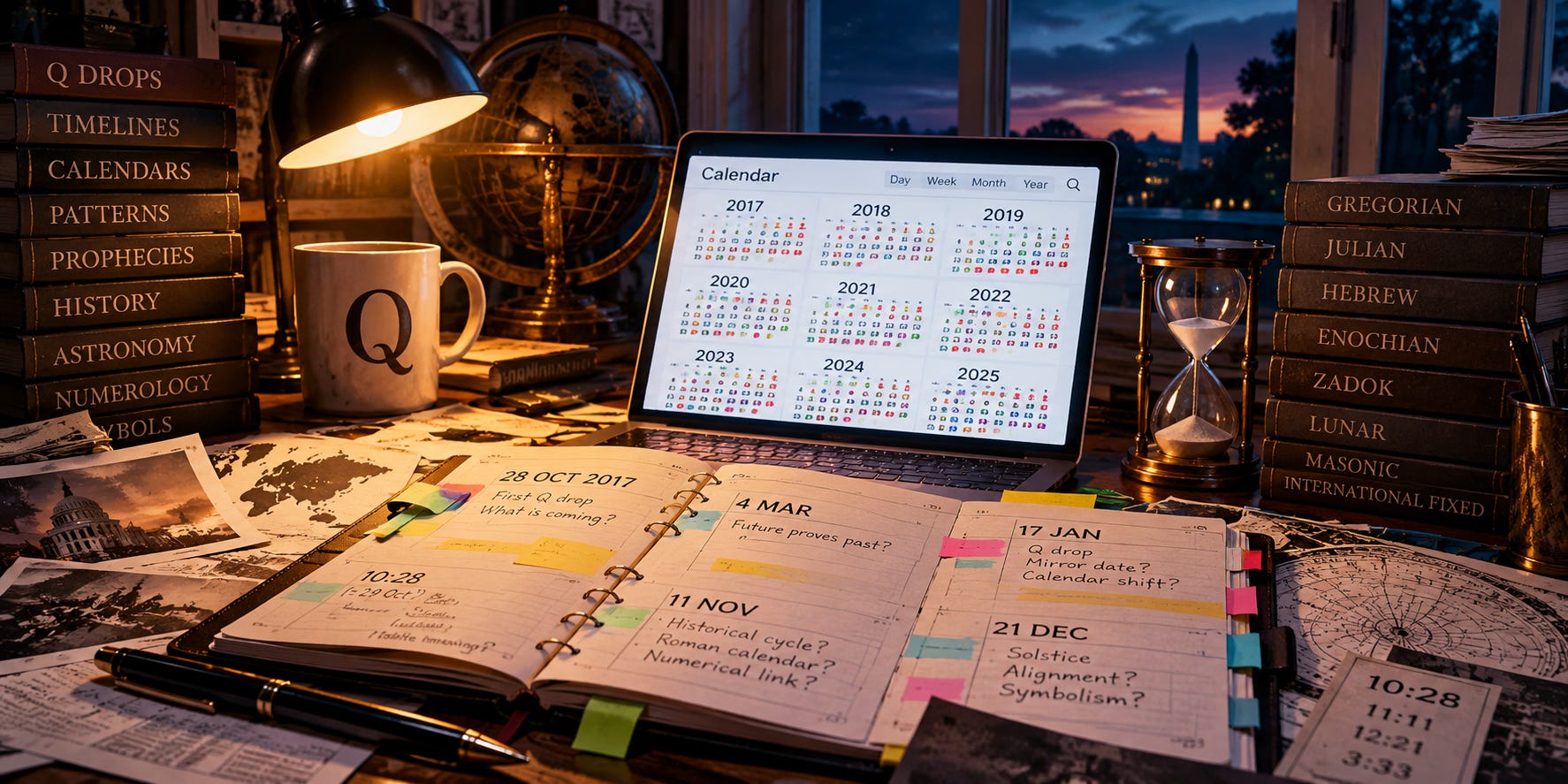
I recently published a tranche of my old Twitter/X posts concerning the Q phenomenon (also referred to as QAnon via the hijacked label). A subsequent review suggests that I missed some material that ought to have been included, so there may be a second edition.
My purpose is to arm researchers, journalists, historians, and the merely curious with the raw material needed to examine the extraordinary period we have lived through since the first Q drop, nine years ago today.
What was said at the time is a matter of historical record. What it meant, and how we should interpret it now, is another question entirely. Modern AI makes it much easier to explore large collections of material without having to read every entry individually.
Today I am continuing that archival effort with something rather more peculiar.
I am publishing a curated extract from my personal Google Calendar, containing just under 16,000 records accumulated across nine years of engagement with Q and the wider information war.

A calendar that isn’t quite a calendar
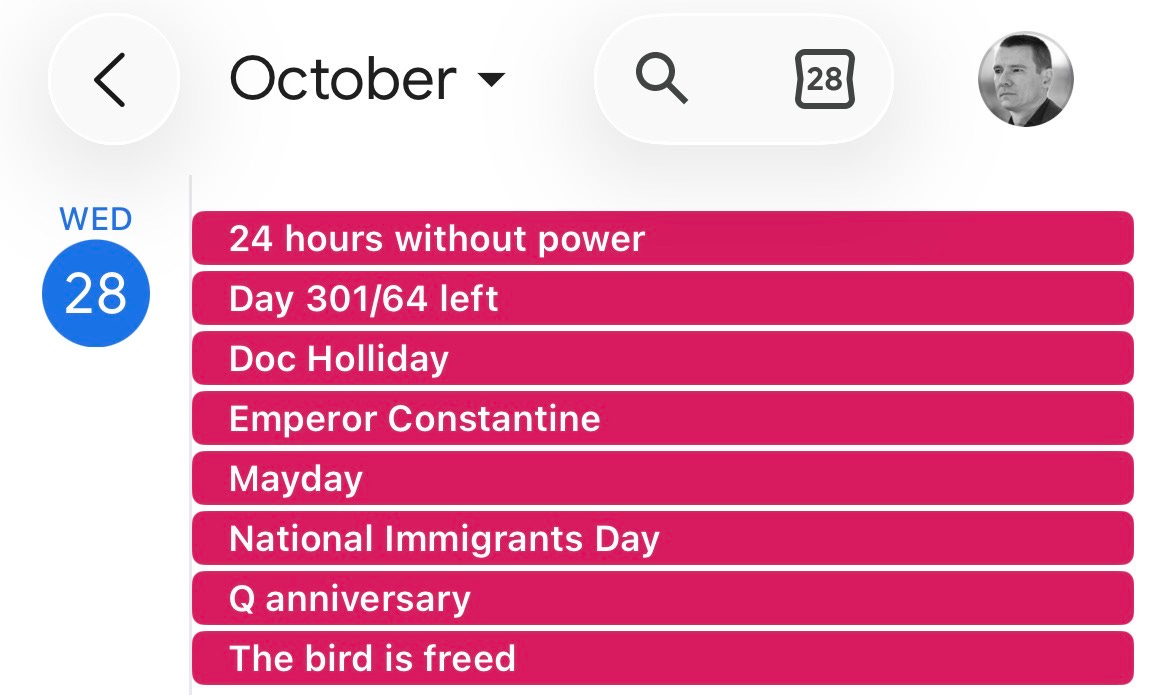
For many years, whenever I have encountered something online—mostly on social media—with a plausible date embedded in it, I have created a corresponding entry in my main calendar. Below are today’s entries as shown on my iPhone.
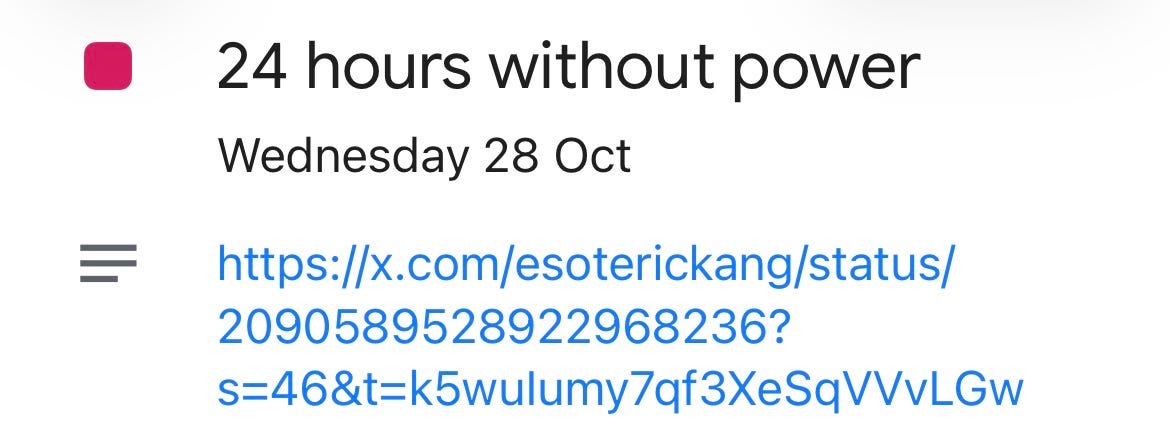
And expanding a particular one leads to this entry:
Which in turn leads to this David Schwartz (former Ripple CTO) post from 2019 on 28th October, reposted by another account that specialises in this kind of data:
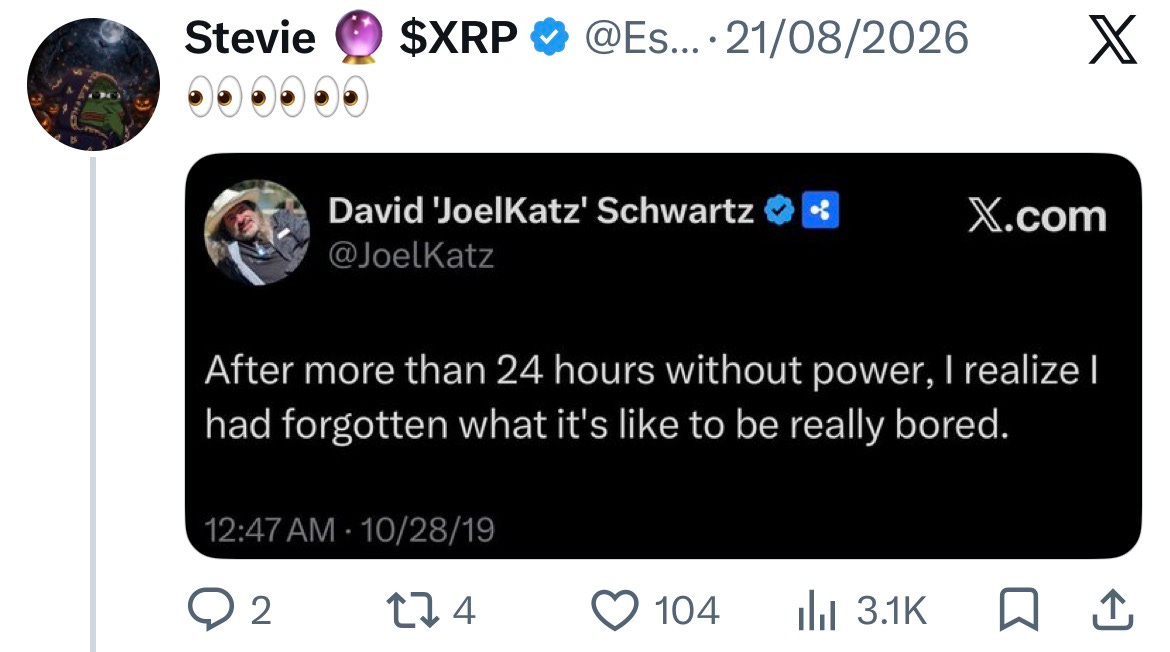
This example illustrates how an older post, subsequently recirculated, can be indexed against its original day (28th) and month (10th) rather than the date on which I encountered it.
Typically, the resulting calendar record of my own consists of a short descriptive title, together with a link to the source material in the description field.
I have spent today separating this public research corpus, covering 28 October 2017 to the present, from approximately 5,300 personal and private calendar records accumulated over a much longer period.
The result is an unusual historical artefact: a record not merely of information encountered, but of one person’s attempts to recognise temporal patterns within it.
Most entries relate to a particular day and month, but are placed in whichever calendar year was convenient at the time. Some genuinely refer to a specific year. Others concern astronomical events, historical anniversaries, unusual numerical coincidences, or quotations from Q drops associated with the same day of the year.
The important distinction is that the calendar records an association I noticed, not necessarily an event I expected to happen.
It is not a conventional diary, nor a schedule of predictions. It is closer to a working index of possible temporal signals.
Future proves past?
One of the central ideas encountered in Q research is that future proves past: the possibility that information disclosed earlier acquires significance only after subsequent events.
In principle, this could provide a means of demonstrating foreknowledge without revealing operational secrets in advance. The precise event would remain obscure until it occurred, at which point the earlier material might become intelligible.
Whether particular examples genuinely demonstrate foreknowledge, rather than coincidence, selective interpretation, or retrospective pattern-matching, is a separate evidential question.
For instance, the establishment of a bank by Ripple this week was (I claim) foreseen to the day by anonymous online sources, once you understand the method and pattern of date encoding. Yet the precise event being anticipated could not be known in advance.
That is the fascinating asymmetry of “future proves past”: the date can be signalled without revealing exactly what will happen on it, yet the association between an earlier image and the eventual event becomes clear once the event occurs. Only afterwards can the earlier information be reconstructed and its possible significance recognised.
By collecting this data, I have been trying to establish patterns that might give me a clue about what is coming, and when.
The failures dominate the successes!
That is worth saying plainly. An archive of possible signals is not a catalogue of verified predictions. Indeed, the unsuccessful and ambiguous associations may be just as revealing as the apparent successes.
The many ways to encode a date
A further complication is that dates are not necessarily expressed in the Gregorian calendar.
Possible references can involve the Julian, Hebrew, International Fixed, lunar, Enochian, Zadok, or other calendrical systems, alongside astronomical cycles and more esoteric conventions.
There are also countless numerical encodings, substitutions, inversions, offsets, and mappings. I will not attempt to catalogue them here.
A time such as 10:28 might be cast from time to date, giving 28 October, but could equally suggest 28 January, or even 28 December (DECem). Similarly, 02:31 might be interpreted as 13 February, read “backwards”. Other associations involve offsets between calendar systems, such as the 13-day difference between Gregorian and Julian dates, or the days omitted during historical calendar reforms.
It is my intuition alone that determines whether raw source material might contain an intended date reference, and which encoding or format might be involved. This is necessarily subjective!
Most entries use the “trivial” mapping of a past date (day/month) to the same day/month in a future year. Other numerical sequences can admit many competing interpretations. I generally choose the most obvious reading, forwards, rather than exhaustively exploring every possible permutation. Even straightforward screenshots can introduce ambiguity when both the day and month are twelve or less, because American and British date conventions differ.
The more possible encodings and transformations there are, the easier it becomes to find a match retrospectively. That is why the failures, ambiguities, and discarded interpretations matter just as much as the apparently successful matches.
Any one interpretation may be wrong; yet the same message appearing on the same mapped day across multiple independent sources is a stronger signal.
I have inevitably made mistakes. Some entries will be misclassified, some associations will be weak, and others will be impossible to reconstruct without their original context. Timings around midnight can easily create off-by-one-day errors when looking at US posts from the UK, for instance.
Importantly, placing a reference on a particular date in my Gregorian calendar does not establish that the underlying source intended that date, or even that it intended a date reference at all.
The archive preserves my recognition of a possible connection.
What the archive can tell us
I suspect many citizen researchers have quietly maintained calendars, notebooks, spreadsheets, or private collections of similar material.
What may be less common is the obsessive accumulation of thousands of entries over such a long period, including relatively weak or unconventional associations that might otherwise be discarded.
The value of this archive is therefore not confined to whether any individual date interpretation proves correct.
The titles alone offer a vocabulary of concerns: the events, institutions, personalities, symbols, narratives, and expectations that attracted attention during this period.
The links, where they remain accessible, provide routes back to contemporary source material. Some will have disappeared, changed, or become inaccessible. That loss is itself part of the archival problem.
And the collection as a whole offers something rather different from an account written in hindsight.
It documents a sense-making apparatus in operation, while the meaning of the information being encountered remained unresolved.
Researchers can ask what patterns were noticed, how expectations developed, which interpretive methods were used, and whether any apparent successes survive rigorous comparison against the much larger population of unsuccessful associations.
The archive does not answer those questions. It provides material with which to investigate them.
An invitation to independent analysis
I will publish a separate analysis of what this collection might reveal about fifth-generation warfare, particularly the use of information whose apparent meaning is initially uncertain and may change as subsequent events unfold.
For now, I want to make the underlying material available without imposing a comprehensive interpretation upon it.
The downloadable Excel workbook contains the curated records alongside supporting documentation explaining the structure, provenance, and limitations of the extract. A technical note follows below.
The original calendar contained personal information that was excluded from this release. The published extract is intended to contain only material suitable for public research, although readers should still exercise appropriate care when following external links or redistributing third-party content.
You are welcome to download, examine, analyse, and share the dataset, with attribution to Martin Geddes, A ‘pequliar’ calendar covering nine years of Q, 28 October 2026. Please identify any additional filtering or transformations you apply, and distinguish the original records from your own interpretations.
I would welcome corrections, discoveries, and independent analyses—including those that challenge the assumptions underlying my collection.
After all, the purpose of publishing an archive is not to compel agreement about what it means.
It is to make the evidence of what we were thinking, noticing, and trying to understand available to those who come after us.
Technical note on the download
This download contains 15,968 selected records from a calendar that served several purposes simultaneously. Separating the research material from ordinary personal use required more than identifying political subjects or finding entries with links.
The resulting corpus contains several overlapping kinds of material:
Source-linked research notes. These form the bulk of the collection: typically an all-day Twitter/X entry with a short title and a link to something encountered online. The assigned date records an association I made with that material. The title may be a quotation, a paraphrase, a topic label or my interpretation; those possibilities are not systematically distinguished.
Public events and reference dates. These include political proceedings, speeches, rallies, sporting events, astronomical phenomena and other publicly observable occasions. Their inclusion does not necessarily imply an encoded message or an anticipated development. Some supplied reference points against which other material could be compared. A Trump rally entry, for example, might concern a public event being watched rather than my attendance.
Historical anniversaries and recurring associations. Some entries mark earlier events, commemorations or dates considered relevant to the research. An anniversary placed in a later year should not be read as a claim that the original event occurred in that year, or that something would necessarily happen on its anniversary.
Numerical and calendrical working notes. These include countdowns, day counts, intervals, mirrored dates, alternative-calendar references and other symbolic or arithmetic associations. They are part of the apparatus used to organise and explore the material. They should not automatically be counted as independent source observations or separate predictions. Numbers preserved in an original title are also distinct from the date calculations subsequently added to the spreadsheet.
Prospective or speculative associations. Some entries record a possibility attached to a date: an anticipated announcement, disclosure, political development or other event. Their presence establishes that I recorded the association, not that its interpretation was correct or that the anticipated event occurred. The wording does not always reveal how seriously I regarded a possibility.
Short labels and cryptic reminders. Some records consist of a name, phrase, abbreviation, number or symbol, sometimes without a supporting link. Their meaning may have been obvious to me when entered but cannot now be fully reconstructed. Some were explicitly retained as research material despite that uncertainty.
These are descriptions of the collection, not mutually exclusive categories assigned to every row. The workbook’s “Selection basis” column describes how an entry was included; it is not a comprehensive classification of its content.
How the separation was made
The review examined both patterns and exceptions. An all-day entry with a social-media link was a useful research-note pattern, but could also describe something personal. Conversely, an entry without a link—or one entered with a time—could still belong to the research corpus.
Names, appointments, travel, household tasks, financial administration and recurring arrangements helped identify personal material. Ambiguous abbreviations and apparently public subjects sometimes required my explanation. Topic alone was insufficient: political wording could occur in a personal entry, while sport could appear solely because of its relevance to my research.
The governing preference was to prevent personal material entering the public corpus, even at the cost of excluding some potentially relevant research entries. Where an unclear entry might be personal and its meaning could not be recovered, leaving it outside the release was preferable to achieving exhaustive coverage.
What “original data” means here
There are three layers to distinguish:
the underlying source material;
my calendar record of it, which may already embody an interpretation; and
the later classification and calculations used to prepare this release.
“Original” in the workbook refers to the calendar record as preserved in the export. It does not mean an unmediated observation, a verified account of the linked source, or necessarily the entry's wording when first created.
The file preserves assigned dates alongside creation and modification timestamps. Those timestamps help establish when calendar objects existed, but the export contains no edit history: it cannot reconstruct earlier wording or earlier assigned dates. Nor does a convenient year used to hold a day-and-month association necessarily identify an intended prediction year.
The workbook’s Read me and Field guide explain the fields, calculations, selection provenance and privacy omissions in more detail.

Thank you, Martin, for your continued efforts to help us interpret and understand the Times we are living through. It is interesting to compare your approach to analysis of prior Q posts and news headlines with Clif High's efforts at analysis of weighted words and current themes scraped from the Internet, most recently discussed here: https://rumble.com/v7gpc40--beyond-alta-with-clif-high-and-jean-claude-oct-11-2026.html?e9s=src_v1_ucp_f