


I am not the only person with a background in formal methods—using mathematical techniques to prove software correctness—who has applied that way of thinking outside its original domain. My former telecoms colleagues extended it into network performance science, making breakthroughs there. My university tutorial partner has gone further still, modelling the limits of what economic thought can, in principle, determine.
In this article, I apply the same underlying discipline—constraining failure in order to determine what can succeed—to political systems.
The key move is to define a boundary between states that are feasible and those that are not:
Within the feasible region there remain degrees of freedom, and therefore room for meaningful questions of intention and values. That is where legitimate political debate occurs.
At the boundary, choice collapses: there is no longer a question to resolve, only a constraint to obey.
Beyond that boundary, debate becomes delusional—policies are being proposed for conditions that cannot occur or be sustained.
This boundary between the feasible and the infeasible gives rise to the idea of an impossibility theorem. Such a theorem does not tell us which choices to make within the feasible space, and therefore says nothing directly about what constitutes good governance. What it does is determine whether a proposed mode of governance is meaningful at all.
The canonical example is Arrow’s Impossibility Theorem, which places hard limits on what voting systems can achieve. The move here is to extend that style of reasoning one level deeper:
to take a precise model of how systems collapse under load,
and use it to delineate the limits of political systems themselves.
Wouldn’t any designer of a voting system want it to satisfy a few basic, seemingly uncontroversial conditions?
If everyone prefers one option, that option should win.
No single individual should be able to dictate the outcome.
And the ranking between any two options should remain unchanged by the presence of a third, irrelevant alternative.
These are not radical demands. They are the minimum one would expect of any procedure meant to reflect genuine collective choice.
Kenneth Arrow’s Impossibility Theorem proves that no voting system can satisfy all three simultaneously.
The result is usually read as a technical limitation of democratic design — an awkward trade-off to be managed inside the mechanics of voting. That reading is too narrow.
Arrow’s theorem is not a quirk of voting procedures. It is the first visible symptom of a deeper structural constraint:
no collective decision system can fully reconcile the preferences it aggregates without generating contradiction.
The failure surfaces at the level of aggregation, but its root lies elsewhere.
In the framework developed here, Arrow identifies an impossibility at the layer of governance, where rules attempt to order competing claims. What the theorem does not examine is what happens when those rules themselves come under pressure.
No political system operates permanently at equilibrium. Over time, all systems are subjected to pressures sufficient to test their stabilising structures.
The present model therefore extends the analysis beyond equilibrium conditions. It examines how authority behaves under load — when crises, conflicts, or accumulating pressures exceed a system’s ability to sustain its own rules and procedures.
Where Arrow demonstrates a static impossibility in preference aggregation, this framework reveals a dynamic one:
the inevitable descent of authority when it remains subject to revision by the very system it is meant to bind.
What Arrow shows mathematically in calm conditions, this model explains operationally under pressure.
This is not a new theory of politics. It proposes no better form of governance and takes no position on the familiar disputes—democracy versus authoritarianism, left versus right, state versus market.
Those debates all occur inside a space that is already assumed to be viable. The purpose here is different: to define a boundary condition on that space itself. It identifies the limits within which any collective decision system can remain coherent at all.
More precisely, it describes a load-bearing constraint on collective decision systems. It asks what kinds of structures can survive pressure, and which cannot—regardless of their stated principles or institutional design.
As such, it does not tell us what is good. It does not rank ideologies or prescribe outcomes. It tells us only what is possible—and, more importantly, what is not.
In that sense, it functions as a meta-theory. Like an invariant in engineering or economics, it operates in one direction only:
it can rule out systems that cannot work, but it cannot certify those that can.
Where the constraint is violated, failure is guaranteed.
Where it is satisfied, the question of what to build remains open.
The central idea is to distinguish what is feasible from what is not:
(Feasible) Any political system operates inside a region of states that can be sustained under load. Within this region there remain degrees of freedom: different policies, priorities, and trade-offs are possible. This is the domain of legitimate political debate.
(Infeasible) Outside that region the situation is fundamentally different. States cannot be maintained, policies cannot function, and proposed outcomes have no stable realisation. Debate here is not merely unresolved — it is ungrounded. It concerns conditions that cannot occur or persist under any implementation.
Between these two regions lies a boundary:
In the interior of the feasible region there is genuine choice.
At the boundary itself, choice collapses into constraint: there is no longer a meaningful question to resolve, only a limit that must be respected.
Beyond it, claims cease to be meaningful because they refer to states that cannot be sustained.
Political disagreement is therefore only meaningful inside the feasible region.
This is the role of an impossibility theorem. It does not tell us which choices to make within the feasible space. It defines the boundary itself and, in doing so, rules out entire classes of claims as incoherent.
To make the boundary operational we must locate where any political system actually stabilises under pressure. The Field Manual supplies precisely this tool: a layered model of authority running from immediate behaviour up to what functions as ultimate authority.
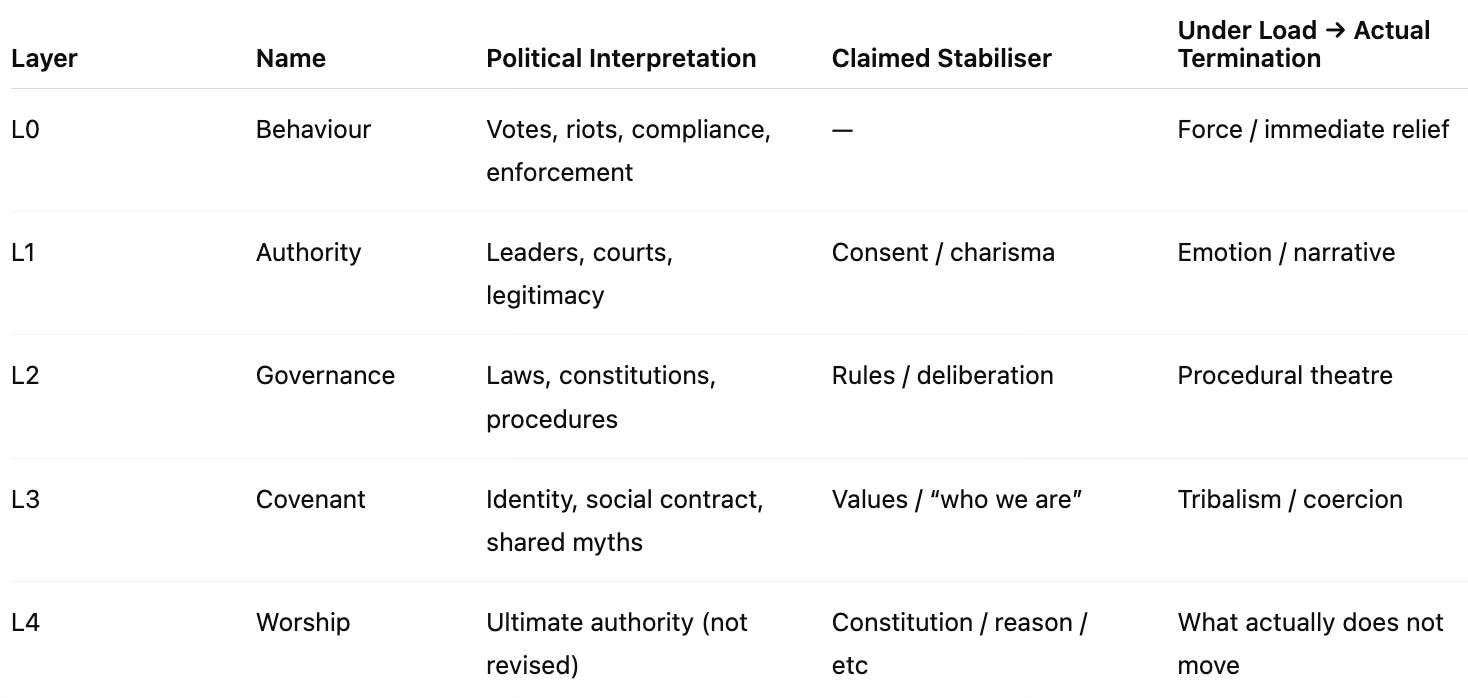
The table above maps these layers onto political systems:
At the lowest level (L0) is behaviour: votes, compliance, enforcement, riots, or outright force. This is where systems terminate when nothing higher can be sustained — the immediate relief of tension.
Above it sits authority (L1): leaders, courts, and perceived legitimacy. Under pressure these frequently resolve into emotion, narrative, or perceived alignment rather than any consistent principle.
Governance (L2) comprises laws, constitutions, and procedures. Most political theory and institutional design operates here, assuming that well-crafted rules and deliberation can stabilise collective choice. Under load, however, this layer often becomes procedural theatre — rules are bent, reinterpreted, or selectively enforced to restore short-term coherence.
Covenant (L3) is the level of identity, shared myths, and the social contract — the sense of “who we are” that binds the system across time. When intact it supports governance; when fractured, systems fall back on tribal alignment or coercion.
At the highest level (L4) is worship — not in any religious sense, but as the operational category of what is not subject to revision within the system. Political systems commonly claim to anchor this in constitutions, reason, the will of the people, or historical necessity. The test, however, is not what is declared, but what actually survives pressure.
This distinction between claimed and operative stabilisers is critical. Systems routinely assert grounding at higher layers while in practice terminating far lower when tested. A constitution may be treated as ultimate authority in principle, yet in crisis its interpretation shifts, its constraints are bypassed, and decisions are driven by immediate necessity rather than binding rule.
Political science tends to focus on Layers 1 and 2 — authority and governance — analysing institutions, incentives, and procedures.
Political stability, however, is decided at Layers 3 and 4: whether covenant holds and whether worship is truly operative under load.
Because each layer depends on the stability of the one above it, failure propagates downward in sequence from L4 to L0 — and what we experience as political crisis is nothing more than the system descending to the lowest level that can carry the load.
The layered model yields one central, testable claim.
Any political system that leaves its source of authority revisable by the system itself will, under sufficient load, descend until it terminates at the lowest level capable of resolving tension.
This is not a contingent failure of particular institutions or leaders; it is a structural property. When higher-order commitments can no longer be sustained, they are not enforced — they are abandoned. The system does not stop; it descends.
In the terms of the Field Manual, systems resolve higher-order contradictions at the first level of descent that can carry the load. What cannot be sustained at covenant (L3 — “we stand for this”) or governance (L2 — “this is the law”) is pushed down into authority (L1 — “I decide”), and ultimately into behaviour (L0 — “this is my gun pointed at you”).
This reframes the role of political ideologies. They are not competing solutions to the problem of order.
Political ideologies are competing proposals for where the system should terminate when pressure exceeds the capacity of its higher layers.
Liberalism, libertarianism, Marxism, and their variants differ in which layer they claim should stabilise the system. Yet they share one decisive property: each ultimately leaves authority inside the system — and therefore subject to renegotiation under load.
In this sense, all self-grounding political systems are parliamentary. They differ only in where they allow the parliament to reconvene when pressure rises.
This perspective reframes political ideologies as termination strategies. They are not competing solutions to the problem of order. They are competing proposals for where the system should terminate when pressure exceeds the capacity of its higher layers:
Liberal democracy claims stability at Layer 2 (governance): procedures, rules, and deliberation are treated as sovereign. Under load, however, those procedures are reinterpreted, suspended, or selectively enforced. Emergency powers are invoked, narratives managed, and the outward form of process preserved long after its substance has eroded. The system descends into contests over authority (L1) and raw behaviour (L0).
Libertarianism claims stability at Layer 1 (authority): individual sovereignty and self-ownership. Yet the individual who authors the rule retains the power to revise it. Under pressure, self-binding commitments dissolve into preference, and then into immediate relief of tension. Self-sovereignty collapses into raw behaviour (L0).
Marxism claims stability at Layer 3 (covenant): collective alignment, class consciousness, or historical necessity. Yet the collective remains a deliberative parliament capable of internal contestation and revision. Under load, voluntary unity cannot be sustained and must instead be enforced through centralised authority and coercion — precisely the mechanisms the ideology sought to transcend. The system descends.
In every case the pattern is identical.
Each ideology nominates a different layer as its point of final stability, yet all ultimately leave authority inside the system — and therefore subject to renegotiation under load. They differ only in where they permit the parliament to reconvene when pressure rises.
A similar pattern appears in more recent political forms, such as
technocratic (e.g. Federal Reserve/ECB, COVID-era health policy) and
identity-based systems (e.g. Diversity, Equity, Inclusion frameworks, or the Indian caste system).
Both attempt to locate stability at Layer 3 (covenant), but with updated grounding: expertise and data, or shared identity and group membership, are treated as the new basis of collective alignment.
Technocracy claims that objective knowledge and expert administration can transcend political conflict. Yet expertise remains open to interpretation, contestation, selection bias, and institutional capture. Under load, the system descends into contests over authority (L1) and enforcement (L0).
Identity-based systems claim that shared experience or group belonging can provide a stable foundation for legitimacy and coordination. Yet identity is inherently prone to fragmentation, internal hierarchy, and redefinition. Under load, the system likewise descends into authority and coercion.
In both cases the structural limitation is identical to before. Neither removes the source of authority from within the system itself. What is presented as neutral expertise or authentic shared identity resolves, under pressure, into the familiar questions of who decides and how compliance is secured.
Arrow’s theorem can now be seen in its proper place.
It demonstrates that governance (L2) cannot consistently order authority at Layer 1. Even under idealised conditions — fully specified rules and rational actors — no voting system can produce a stable, coherent aggregation of individual preferences without contradiction.
This is already a failure of stabilisation in equilibrium.
The extension is straightforward: if governance cannot stabilise authority even in calm conditions, it cannot do so under pressure. Under load the rules themselves become contested: interpretations shift, exceptions multiply, and procedures are bent or suspended to restore short-term coherence.
In other words, Layer 2 does not merely fail to stabilise Layer 1 — it becomes unstable in its own right.
Arrow’s theorem is therefore not an isolated paradox of voting theory. It is the mathematical shadow of the deeper structural failure:
governance cannot ground authority when both remain inside the same revisable system.
Political crisis is descent under rising load — from the cathedral to the jungle.
In structural terms, it is the progressive failure of higher layers (covenant and worship), and the system’s collapse into behaviour as the only remaining load-bearing level.
As pressure mounts — whether from economic stress, external threat, internal division, or loss of legitimacy — the system is forced to test what actually binds it. The descent follows a fixed sequence:
Layer 4 (worship) is tested first: what functions as ultimate, non-revisable authority. If it can be questioned, traded off, or reinterpreted, it collapses.
Layer 3 (covenant) fractures next. The shared sense of “who we are” ceases to bind the system. Alignment gives way to competing identities, factions, and interests.
Layer 2 (governance) becomes contested. Rules are no longer accepted as given; they are reinterpreted, bypassed, or selectively enforced. Procedure shifts from constraint to instrument.
Layer 1 (authority) fragments. The question of who legitimately decides is reopened. Competing claims to legitimacy emerge.
Layer 0 (behaviour) dominates. Outcomes are determined by whatever can be enforced or sustained in the moment — compliance, exit, coercion, or raw force.
In the language of the Field Manual, “the parliament reconvenes” the moment grounding can no longer be sustained. What was previously fixed is reopened for renegotiation under pressure.
Crisis, therefore, is the reopening of authority.
This leads to a reinterpretation of sovereignty.
Every political system distinguishes — whether explicitly or implicitly — between
what it claims as the source of authority and
what actually binds behaviour under load.
These are not always the same:
Nominal sovereignty is what is declared: the constitution, the people, the rule of law, the market, or the collective will. It is the publicly stated foundation inside the system.
Operative sovereignty is what actually determines outcomes when pressure rises. It is revealed not in doctrine, but in constraint — in what cannot be overridden, deferred, or renegotiated.
No system is ultimately stabilised by what it declares. It is stabilised only by what it cannot revise.
This is the function of Layer 4 (worship) in the Field Manual. Not in any metaphysical sense, but as a strictly operational category: whatever is not subject to revision within the system’s available capacity under load.
The distinction is decisive. Many systems assert grounding at L4 — in constitutions, reason, popular will, or historical necessity — while still retaining the practical ability to reinterpret or suspend those commitments when tested. In such cases the claimed foundation is not operative. Authority has not truly left the system; the parliament remains sovereign.
If authority can still be renegotiated under pressure, it has not left the system.
This is not an ideological prescription. It is a structural constraint:
without a fixed point outside the system’s own capacity for revision, there is no stable anchor.
Under sufficient load the system will descend, as load will eventually exceed the system’s capacity to sustain higher layers.
What follows from this constraint is unavoidable.
For a political system to stabilise, the source of its authority must lie outside the system’s own capacity for revision. It must be something the system cannot reinterpret, override, or renegotiate under load.
This does not identify what that ultimate authority is. It only defines its required properties.
It cannot be:
a procedure
a collective decision
an identity group
or any construct whose meaning can be revised by the system itself
Whatever satisfies this role must be external to the system’s deliberation, and not subject to its control. In other words, it must bind the system without being bound by it.
This places the argument within the broader class of meta-theoretic reasoning.
In engineering, invariants define conditions that must hold for any system to remain coherent. In economics — as in the raw net worth framework mentioned above — certain transformations are simply impossible. If they appear to occur, the economic model itself is invalid; it is outside of the realm of debate.
These are not conventional theories. They do not describe detailed behaviour or prescribe optimal outcomes. They operate in one direction only: they expose what cannot be sustained.
The same principle applies here.
This framework does not prove that any particular political system is stable or desirable. It does not prescribe which institutions to adopt or which values to prioritise.
It simply identifies an entire class of systems that cannot stabilise under load:
Where authority remains inside the system and subject to revision, collapse is not a risk — it is a structural certainty.
Where this condition is avoided, stability becomes possible, though never guaranteed.
The result is deliberately asymmetric:
It can falsify but not validate.
It can rule out the impossible, but it cannot select among the feasible.
This is the proper role of a meta-theory: not to resolve political debate, but to bound the space in which it can meaningfully occur.
The implication is stark. Failure is not a matter of poor design, corruption, or mismanagement. It is inherent in its construction.
Any political system that grounds its authority in procedures, collective will, identity, or internal consensus is structurally incapable of long-term stability.
It is not merely imperfect. It cannot, in principle, stabilise over time.
Political science has a clearly defined domain. It can analyse incentives, compare institutions, model behaviour, and debate values within an assumed framework. It excels at describing how systems behave inside the space of what is possible.
What it cannot do is resolve the problem of authority when that authority remains inside the system it is meant to govern.
Where the source of authority is itself revisable, no amount of procedural refinement, institutional design, or normative argument can produce lasting stability. The system retains the power to reopen its own foundations — and under sufficient load, it will.
This is not a failure of political science, but a limit of its scope. It operates primarily within Layers 1 and 2 — authority and governance — and has no tools to anchor what lies above them.
Consequently, political debate conducted inside self-referential systems cannot determine its own ground—it can only move within it.
All such debate is therefore underdetermined.
The constraint is not ideological.
It is structural.