


What follows is not a normal Substack article; its more natural home might be SSRN or a socio-legal journal. It is the first consolidated synthesis of a body of work that emerged from my highly specific inquiry into jurisdiction and what I came to call “ghost courts”. What began as a narrow legal and constitutional investigation gradually expanded into something much broader:
a structural model of how all governance systems continue operating under conditions of overload, abstraction drift, and weakening grounding.
The framework presented here — ΩΛ∆∑ — attempts to unify insights from political science, jurisprudence, systems theory, cybernetics, distributed computing, administrative law, information theory, and safety-critical systems engineering into a common model of power, politics, and authority under load.
Existing theories typically analyse governance at the level of institutions, incentives, beliefs, ideologies, and formal procedures. ΩΛ∆∑ proposes a deeper structural layer beneath them: how governance systems define the objects they act upon, attach authority to those objects, accumulate unresolved pressure for justification and resolution, and ultimately bring claims to closure under conditions of limited explanatory and adjudicative capacity.
The proposition here is not that existing political or legal theories are wrong. It is that they may themselves emerge from lower-level structural dynamics that have remained largely implicit. In that sense, ΩΛ∆∑ is intended not as a replacement for existing disciplines, but as a more foundational model sitting structurally beneath many of them — a kind of “sub-atomic” layer of governance and legitimacy that only becomes clearly visible once systems come under sufficient stress.
The framework is also designed to be practically executable. It can be used (including with the assistance of AI) to classify governance systems, analyse public documents and records, diagnose institutional failure modes, model political or organisational descent under overload, examine the legitimacy structure of bureaucratic or algorithmic processes, and map unresolved conflicts in courts, corporations, states, and even interpersonal relationships.
You are invited to experiment by applying it to topics of your own interest.
Abstract
This paper introduces ΩΛ∆∑, a structural model of governance systems under load. The framework rests on four primitives: object determinacy (Ω), attribution and binding (Λ), attribution load (∆), and termination modes (∑). Governance systems are analysed as mechanisms for constructing governable objects, attaching authority to them, managing unresolved attribution pressure under finite adjudication capacity, and bringing claims to closure when full grounding becomes infeasible.
Under sustained ∆, systems exhibit a recurrent Monotonic Descent Law in which attributable grounding (F) gives way to procedural substitution (PF), rhetorical stabilisation (RL), and ultimately institutional assertion (I). The model diagnoses a growing condition in contemporary bureaucratic, algorithmic, and AI-mediated governance where weakly determinate Ω-objects combine with degraded Λ and lower-order closure modes. This condition, termed synthetic governance, enables operational continuity despite declining reconstructability.
ΩΛ∆∑ is proposed as a descriptive and diagnostic framework for governance under stress. It is positioned beneath conventional institutional, ideological, and incentive-based analyses. Its purpose is to support comparative analysis, failure diagnosis, and future empirical research into abstraction drift, legitimacy degradation, and governance under escalating overload conditions.
1. Introduction
Political and governance theory traditionally analyses institutions, incentives, legitimacy, ideology, and power distribution. These approaches work well under relatively stable conditions but systematically under-model key stress phenomena: overload, procedural substitution, abstraction drift, recursive legitimacy failure, and the persistence of operational continuity despite declining grounding.
Several adjacent traditions offer partial insights into these dynamics. Systems theory and autopoiesis (Luhmann) illuminate self-referential institutional reproduction. Rule-of-law and procedural legitimacy scholarship (Fuller, Raz) emphasise congruence and intelligibility. Administrative legibility critiques (Scott) highlight simplification failures, while complexity and collapse studies (Tainter) address diminishing returns under growing demands. Yet these traditions typically examine institutional structure, legitimacy, overload, or proceduralisation in relative isolation.
This paper proposes a lower-level structural framework — ΩΛ∆∑ — to unify these phenomena within a common governance topology. ΩΛ∆∑ comprises four interacting primitives: Ω (object determinacy), Λ (attribution and binding), ∆ (attribution load), and ∑ (termination mode). The model analyses governance systems as mechanisms for constructing governable objects, attaching authority to them, managing unresolved attribution pressure under finite capacity, and operationally terminating claims when full grounding becomes infeasible.
Compressed formally, the framework is expressed as:
Ω → Λ → ∆ → ∑
The core claim is that governance systems remain stable only while governance objects remain sufficiently determinate (Ω), authority remains sufficiently attributable (Λ), attribution load remains within processing capacity (∆), and termination remains socially tolerable (∑). When these conditions fail, systems preserve operational continuity through procedural substitution, rhetorical stabilisation, and institutional assertion.
These dynamics are not exceptional failures of governance, but general structural properties of governance under load.
2. Primitive Definitions
2.1 Ω — Object Determinacy
Ω is the degree to which a governance object is identifiable, reconstructable, bounded, and capable of bearing authority. Examples include a legal case, a regulated entity, a citizen, “the public,” “misinformation,” “extremism,” and “national security.”
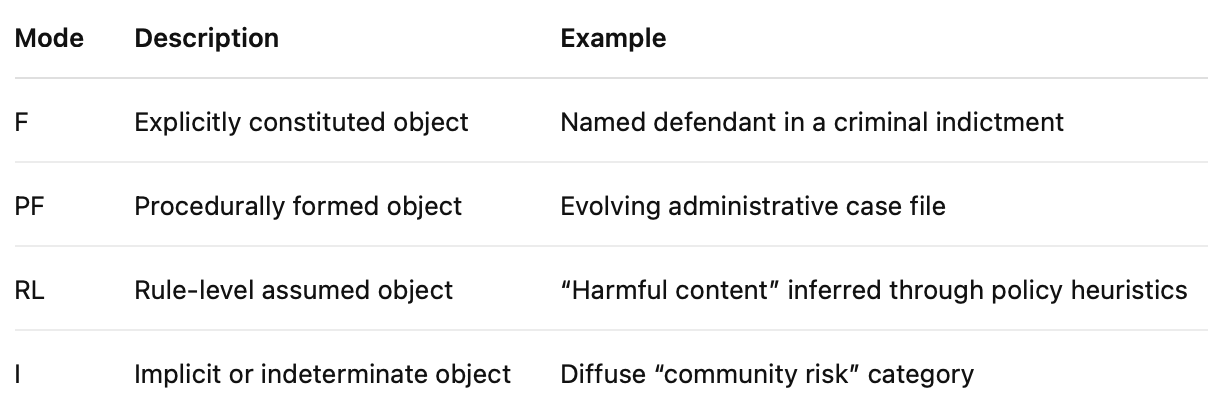
The core principle of Ω is that abstraction remains stable only while reversibility to a concrete instance remains possible. Ω degradation occurs when the continuity of the abstraction survives while reconstructability weakens. This produces semantic drift, floating governance objects, and synthetic referents.
2.2 Λ — Attribution and Binding
Λ is the mechanism by which authority attaches to an Ω-object. It includes jurisdiction, delegation, institutional attribution, procedural attachment, and adjudicative coupling.
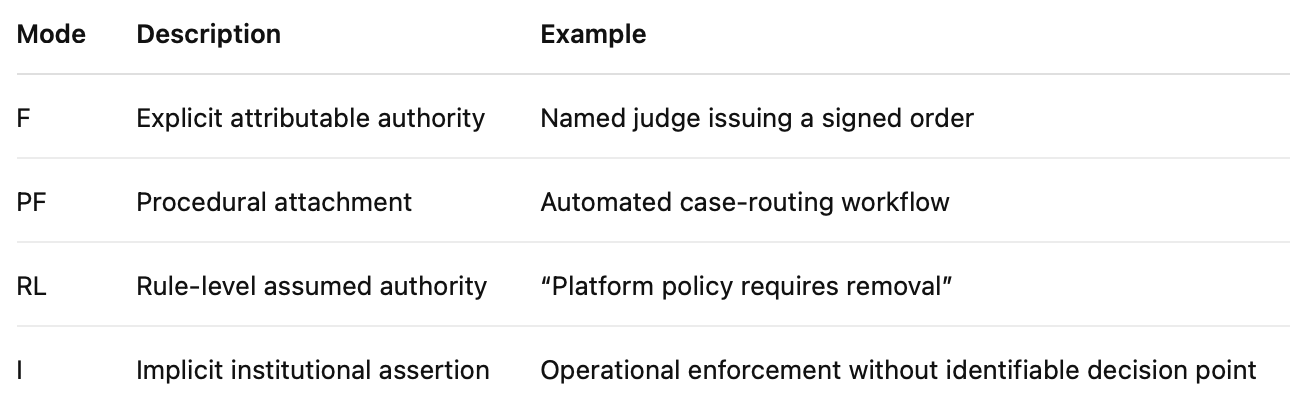
The core principle of Λ is that a governance act remains intelligible only while the object is sufficiently determinate and authority sufficiently attributable. Λ degradation occurs when process substitutes for attribution, or when authority becomes operationally effective without reconstructable coupling. This produces workflow authority, procedural legitimacy, and black-box attribution.
2.3 ∆ — Attribution Load
∆ is the total pressure placed on a governance system to justify, explain, verify, reconcile, and terminate claims. It includes evidentiary burden, contestability, informational complexity, rights claims, uncertainty, contradiction, temporal pressure, and adversarial pressure.
The core constraint of ∆ is that sufficiently complex governance systems cannot fully resolve all attributional claims simultaneously. As unresolved ∆ accumulates, grounding becomes expensive, proceduralisation increases, attribution weakens, and termination pressure rises.
Contemporary ∆ amplification mechanisms include social media, high-frequency communication, legal hyper-complexity, rights inflation, global interdependence, and AI-generated claim proliferation.
2.4 ∑ — Termination Modes
∑ is the mechanism by which unresolved claims are operationally closed.
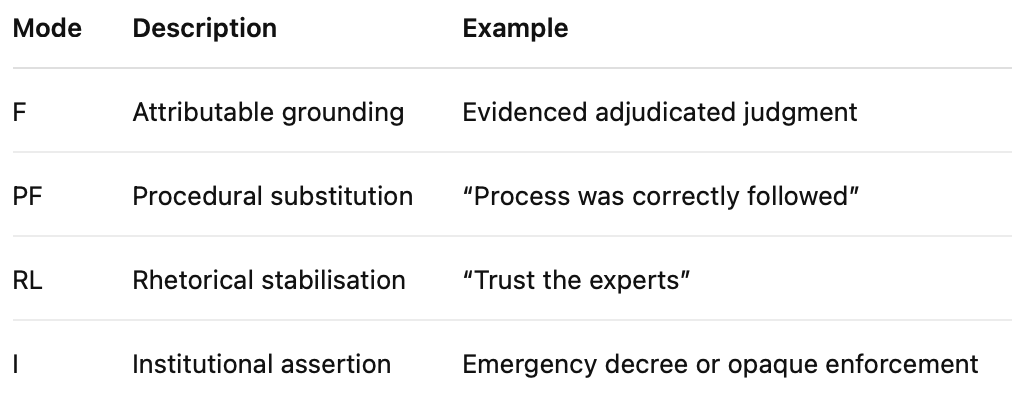
The core principle of ∑ is that termination becomes necessary when unresolved ∆ exceeds adjudication capacity. All sufficiently stressed governance systems terminate unresolved claims before achieving complete grounding.
3. Structural Dynamics
3.1 Fundamental Governance Constraint
No sufficiently complex governance system can fully ground, fully explain, and fully adjudicate all claims simultaneously. As complexity increases, unresolved attribution pressure (∆) necessarily accumulates beyond available adjudication capacity. Operational closure of unresolved claims — termination in the sense defined by ∑ — therefore becomes unavoidable. Politics, in this view, does not merely allocate power or coordinate interests; it fundamentally manages unresolved ∆ under finite explanatory and procedural resources.
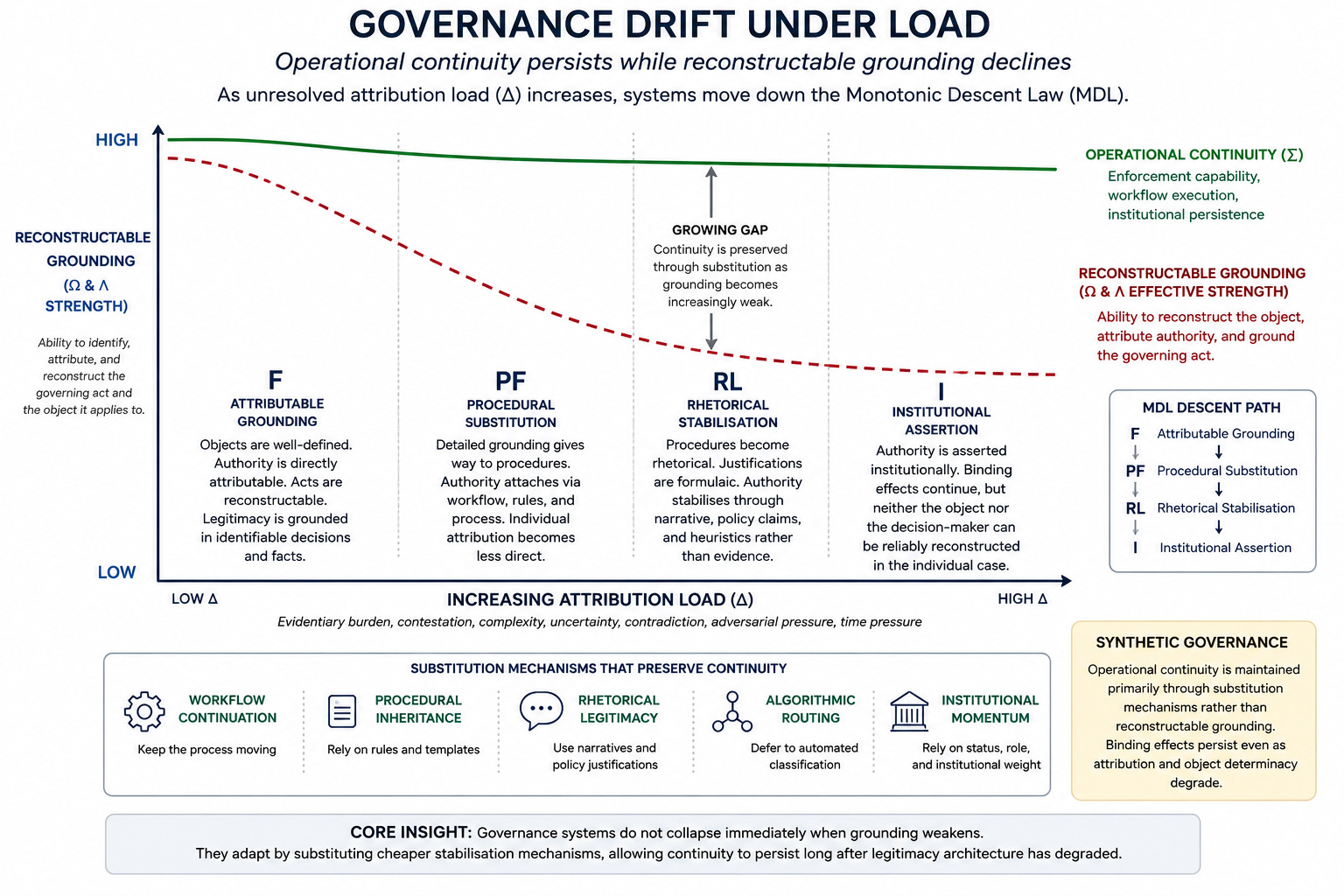
3.2 Monotonic Descent Law (MDL)
Under sustained unresolved ∆ pressure, governance systems exhibit a recurrent descent dynamic:
F → PF → RL → I.
Attributable grounding (F) gives way to procedural substitution (PF), which in turn yields to rhetorical stabilisation (RL), and finally to institutional assertion (I). This Monotonic Descent Law (MDL) is structural and load-driven rather than primarily ideological.
The same pattern appears across courts, bureaucracies, corporations, algorithmic platforms, and other high-complexity institutions:
as ∆ accumulates, systems progressively trade reconstructable justification for cheaper forms of continuity.
3.3 Ω Drift
As unresolved ∆ increases, abstraction expands while reconstructability weakens. Continuity becomes cheaper than grounding. This produces semantic instability, floating governance objects, procedural placeholders, and synthetic referents.
Terms such as “misinformation,” “community standards,” “harm,” “unsafe content,” and “public interest” increasingly function as governance abstractions whose operational utility outruns their grounding precision.
The central observation of Ω drift is that governance systems preserve continuity by allowing precision to attenuate under load. The label survives; the ability to reconstruct its original referent progressively fades.
3.4 Λ Degradation
As Ω weakens and ∆ rises, attribution itself becomes increasingly proceduralised. Delegation chains grow opaque, and institutional coupling loosens. Authority derives progressively less from directly reconstructable acts and more from workflow continuation, procedural inheritance, algorithmic routing, and operational momentum.
Under sufficient stress, governance systems can therefore remain operationally effective even when no clearly attributable decision-maker can be reconstructed in the individual case. The result is black-box governance: authority persists operationally while attribution becomes progressively harder to recover.
3.5 Synthetic Governance
Synthetic governance emerges when weakly determinate Ω-objects combine with degraded Λ, accumulated ∆, and ∑ stabilisation at RL or I modes. In this condition — RL/I Ω paired with RL/I Λ — the system produces synthetic coercion:
operational enforcement proceeds over unclear objects through weakly attributable means, sustained by continuity rather than reconstructable grounding.
This is not the absence of authority, but the persistence of effective authority after grounding has substantially degraded. Examples include certain forms of algorithmic content moderation, opaque compliance regimes, automated administrative penalties, statistical behavioural governance, and AI-mediated policy enforcement.
Synthetic governance is the characteristic endpoint of unmanaged descent in high-∆ environments.
4. Illustrative Case: Court-Identity Fracture
The inquiry that generated ΩΛ∆∑ began with a deceptively narrow jurisdictional question: what court, exactly, had acted? The issue was not whether a process had occurred or whether enforcement paperwork existed, but whether the juridical object “the court” remained stable and reconstructable from the record.
In the underlying case, the operative court identity did not hold fixed. It appeared under dozens of distinct formulations — including North Cumbria Magistrates’ Court, North and West Cumbria Magistrates’ Court (1752), Carlisle Magistrates’ Court, “the Justices at Carlisle,” local justice area designations, administrative gateways, and generic references to “the Magistrates’ Court.”
Within ΩΛ∆∑, this is not a mere naming irregularity. It is an Ω failure: the governance object over which judicial power is asserted has fractured into incompatible venue, area, code, persona, and institutional placeholders. Yet the system continued to operate without reconstructing a single determinate tribunal. Jurisdiction was upheld through statutory provisions, single-commission logic, and institutional continuity; enforcement (conviction, fine, collection) proceeded unimpeded.
In terms of the framework, Ω (the court as a determinate object) became unstable. Λ (attribution of authority) was supplied through procedural and institutional assertion rather than a clearly identifiable tribunal. ∆ increased as the record grew harder to reconcile. ∑ stabilised at the RL/I level: rhetorical and institutional claims to continuity overrode the need for reconstructable grounding.
This is synthetic governance in a rule-of-law setting: coercive continuity persists despite instability in the very object said to authorise it. The system binds effectively, even as the ability to reconstruct the binding authority in the individual case progressively attenuates. The case therefore illustrates the framework’s central claim in concrete form: governance systems can maintain operational effectiveness long after reconstructable grounding has substantially degraded.
5. Governance Topologies
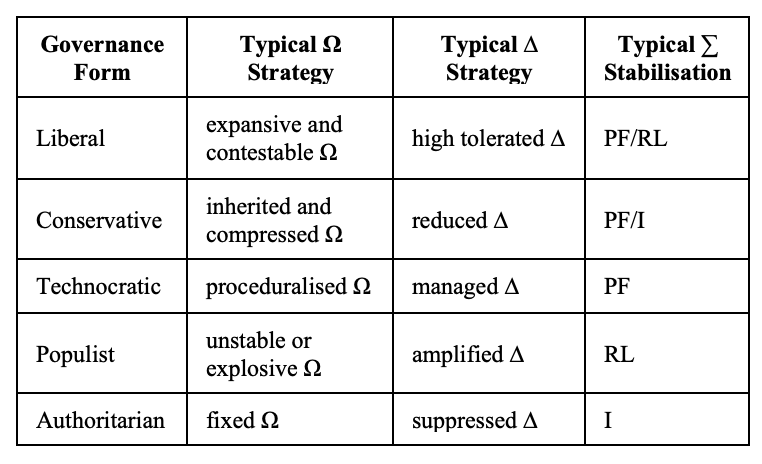
Within the ΩΛ∆∑ framework, different governance forms are best understood not as competing ideologies but as distinct equilibrium strategies for managing the inherent tension between object determinacy (Ω), attributable authority (Λ), unresolved attribution load (∆), and termination tolerability (∑).
There is no free governance architecture. No system can simultaneously maximise:
Ω precision,
Λ transparency,
∆ tolerance,
and low-cost ∑ stabilisation.
Every governance design therefore embodies unavoidable structural trade-offs:
Expanding Ω increases adaptability but amplifies ∆.
Compressing Ω improves stability but increases brittleness.
Proceduralising Λ improves scalability but weakens attributable grounding.
RL stabilisation preserves continuity under stress but progressively generates synthetic legitimacy.
Different governance forms represent different ways of balancing these pressures under load, and each generates characteristic failure modes as unresolved ∆ accumulates:
Expansive systems — commonly associated with liberal and progressive traditions — deliberately proliferate Ω-objects and tolerate high ∆ in pursuit of adaptability, contestability, and pluralism. Their strength is dynamic responsiveness; their characteristic descent path is rapid overload leading to procedural hypertrophy and RL drift.
Compressive systems — commonly associated with conservative and authoritarian traditions — constrain Ω variability and suppress ∆ visibility in pursuit of stability, continuity, and coordination. Their strength is decisiveness under pressure; their characteristic failure mode is hidden ∆ accumulation followed by brittleness, legitimacy shocks, or sudden institutional rupture.
Procedural systems — typically associated with technocratic and administrative governance — attempt to manage ∆ through standardisation, workflow, and procedural abstraction. Their strength is scalability and administrative efficiency; their structural risk is progressive Ω abstraction drift combined with degraded Λ, producing synthetic legitimacy and black-box governance.
Symbolic or narrative-driven systems — commonly associated with populist and identity-based movements — simplify Ω through rhetorical compression while amplifying ∆ for mobilisation and legitimacy reset. Their strength is temporary restoration of political energy and perceived immediacy; their characteristic risk is unstable Ω formation, RL amplification, and rapid attribution collapse.
These are not fixed ideological essences but stress-local attractors: recurrent ways governance systems stabilise under sustained load. Hybridisation is common, local reversals remain possible, and real systems frequently move between modes over time.
What matters is therefore not which ideological label a system adopts, but which part of the ΩΛ∆∑ topology it optimises and which part it sacrifices. In every case, the Monotonic Descent Law still operates: unresolved ∆ eventually forces substitution down the chain: F → PF → RL → I.
6. AI and Algorithmic Governance
6.1 AI as ∆ Amplifier
AI systems dramatically accelerate the rate of claim generation, semantic production, contestability, procedural complexity, and abstraction density in governance environments. As machine-mediated interactions scale in volume and velocity, unresolved attribution pressure (∆) accumulates beyond human adjudication capacity at ever-lower operational thresholds.
The result is not simply faster administration but accelerated systemic overload. AI expands the number of governable objects, multiplies the pace of dispute generation, and floods systems with semantically plausible yet difficult-to-ground claims that demand procedural resolution. What was once a manageable flow of attributional demands becomes a high-velocity torrent.
6.2 AI as RL Industrialisation
Large language models and related systems are optimised for plausibility, continuity, and semantic closure rather than reconstructable grounding. They produce outputs that are locally coherent and operationally effective even when the underlying reasoning cannot be fully traced or attributed.
In ΩΛ∆∑ terms, AI industrialises RL. It massively scales the capacity of governance systems to stabilise unresolved contradictions through rhetorical and procedural means without resolving the underlying attributional uncertainty. This allows operational continuity to advance far faster than reconstructable justification.
The deeper significance of AI in governance therefore extends beyond automation. It lies in the industrial-scale production of operational coherence detached from attributable grounding.
6.3 AI and Ω Instability
Algorithmic governance increasingly operates on statistical objects, behavioural proxies, latent classifications, and dynamically inferred categories. These objects frequently remain operationally potent despite weak reconstructability and unstable boundaries. Governance shifts from acting on clearly identifiable persons or events toward probabilistic abstractions derived from data aggregation and inference.
This simultaneously undermines object determinacy (Ω), attributable authority (Λ), and reconstructability. The structural tendency of AI-mediated systems is therefore toward Ω instability, degraded Λ, elevated ∆ accumulation, and heavier reliance on low-order ∑ termination (RL and I).
As a result, algorithmic governance naturally gravitates toward the synthetic governance condition unless deliberate counter-measures are built into its architecture.
7. Consequences
7.1 Rule-of-Law Stability
Rule-of-law systems remain stable only while governance objects (Ω) stay sufficiently determinate, authority (Λ) remains sufficiently attributable, and termination mechanisms (∑) stay sufficiently grounded. Procedural continuity alone is not enough. Once operational continuity persists after reconstructable grounding has substantially weakened, the system increasingly relies on procedural substitution, rhetorical stabilisation, and institutional assertion rather than attributable adjudication.
The stability of any rule-of-law order therefore depends not merely on procedural regularity, but on the continued recoverability of the relationship between object, authority, adjudication, and enforcement.
7.2 Institutional Legitimacy
Institutional legitimacy degrades when operational continuity survives while reconstructability fails. Under these conditions, governance systems can continue to function effectively even as their attributional grounding progressively weakens.
This produces synthetic legitimacy — legitimacy derived less from reconstructable justification than from procedural persistence, operational momentum, and institutional continuity itself. As this condition deepens, procedural trust decays, institutional opacity increases, and recursive legitimacy failures become increasingly difficult to resolve from within the system’s own operational logic.
7.3 The Modern Governance Crisis
Within the ΩΛ∆∑ framework, the contemporary governance crisis is not primarily political, ideological, or economic — although it manifests through all three. At its root, it is ontological, attributional, and overload-driven.
Modern systems operate under rapidly escalating ∆ generated by informational hyper-complexity, procedural expansion, global interdependence, algorithmic mediation, and accelerating abstraction density. In response, governance increasingly preserves continuity through weakly determinate Ω-objects, degraded Λ attribution, and low-order ∑ stabilisation.
The resulting crisis is therefore not simply one of disagreement or institutional failure, but of progressively weakening reconstructability inside systems that nevertheless remain operationally effective.
8. Open Problems
8.1 Ω Measurement
A central unresolved challenge is whether object determinacy (Ω) can be meaningfully measured in operational terms. Potential indicators include semantic drift over time, ontology fragmentation, failure rates of reconstructability in records or documentation, and identifier instability across repeated governance events. More broadly, the question is whether the stability of governance abstractions can be quantified before operational continuity substantially diverges from attributable grounding.
8.2 ∆ Quantification
A parallel open problem concerns the quantification of attribution load (∆). Relevant dimensions include claim generation rate, procedural complexity, contestability density, information velocity, adversarial intensity, and the accumulation rate of unresolved attributional pressure.
A key empirical question is whether governance systems exhibit identifiable ∆ thresholds beyond which procedural substitution and lower-order ∑ mechanisms become structurally inevitable rather than merely convenient.
8.3 Recovery Dynamics
The framework currently describes descent more clearly than ascent. An important open question is under what conditions governance systems can reverse degradation: re-stabilising determinate Ω-objects, restoring attributable Λ, reducing accumulated ∆, and elevating ∑ back toward grounded (F) modes.
This encompasses institutional renewal, constitutional repair, deliberate procedural simplification, semantic re-grounding efforts, and the restoration of reconstructable authority after prolonged periods of attenuation.
8.4 AI Governance
Finally, the framework raises a fundamental question about the long-term viability of AI-mediated governance at civilisational scale. Can systems that delegate large portions of procedural coordination, semantic mediation, and operational closure to machine-generated processes remain reconstructable, attributable, and intelligible over time?
Within ΩΛ∆∑, this is not merely a technological issue. It concerns whether sufficiently complex governance architectures can generate and preserve grounding faster than AI systems amplify ∆, procedural opacity, and abstraction density. The viability of high-scale algorithmic governance may ultimately depend on whether deliberate architectural constraints can keep Ω, Λ, and higher-order ∑ from degrading faster than the system can compensate.
9. Conclusion
The ΩΛ∆∑ framework proposes that governance systems are not fundamentally organised around ideology, incentives, or institutional form alone, but around the continuous management of object formation, attribution, overload, and operational closure under finite explanatory capacity.
This model resolves a persistent conundrum in political and governance theory: how institutions can remain operationally effective long after their grounding mechanisms have substantially degraded. Conventional approaches often treat such conditions as exceptional failures, corruption, capture, or temporary deviations from “normal” governance. ΩΛ∆∑ reframes them as recurrent, structural dynamics driven by unresolved ∆ accumulation in sufficiently complex systems.
The framework explains why governance systems can preserve continuity despite weakening object determinacy, degraded attribution, procedural substitution, semantic drift, and declining reconstructability. It accounts for the striking recurrence of these patterns across otherwise dissimilar domains — courts, bureaucracies, corporations, algorithmic platforms, and AI-mediated institutions. What often appear as distinct political, legal, administrative, or technological crises frequently share a common underlying topology.
At its core, the framework argues that modern governance instability arises less from the absence of operational authority than from the widening gap between operational continuity and reconstructable grounding. The contemporary crisis is therefore not merely political or ideological, but structural: the predictable outcome of systems operating under rapidly escalating ∆ while sustaining themselves through progressively degraded Ω-objects, weakened Λ attribution, and lower-order ∑ mechanisms.
ΩΛ∆∑ is not a nihilistic theory of inevitable failure or “fake governance.” It is a structural account of how systems continue to function under finite explanatory and adjudicative capacity. Procedural substitution, rhetorical stabilisation, and institutional continuity are often necessary for large-scale coordination. The framework simply makes visible the point at which operational continuity begins to drift too far from reconstructable grounding — and suggests that recognising this dynamic may be a prerequisite for designing systems more resilient to unmanaged descent.
ΩΛ∆∑ thus offers more than a descriptive vocabulary. It provides a unified structural model capable of linking phenomena that existing disciplines typically analyse in isolation. By making visible the mechanics of legitimacy degradation, procedural substitution, synthetic governance, and overload dynamics, the framework supplies a common topology for diagnosis and comparison across high-complexity domains. Its ultimate value lies in opening a clearer path for empirical and institutional research into governance under load — and, potentially, for the deliberate design of systems better able to resist unmanaged descent.