


Way back in 2020, with input from an erudite associate, I wrote an article titled The Reconstruction of Reality, or How Autists Saved the World. It resonated with many people at the time, as it attempted to explain a particular cognitive style: an almost maniacal drive for coherence, coupled with an extreme intolerance for unresolved anomalies.
By “autists” I did not mean people defined by disability or pathology. I meant something closer to a cultural phenomenon: individuals who instinctively notice contradictions, trace causal chains, and refuse to ignore inconsistencies simply because doing so would be socially convenient.
In a world dependent on media narratives to determine what is real, “autists” act as a form of weaponised cognition — a brake on the spread of unreality. The challenge for many of us has been making sense of digital trenches we never expected to encounter, arriving as civilians with no doctrine, no training, and no vocabulary for the conflict in which we had become participants.
At the time, most readers focused on the second half of the title: How Autists Saved the World. It validated their own witness testimony and gave names to experiences that had previously felt isolated and inexplicable. Looking back, I think the more important insight was hidden in the first half: The Reconstruction of Reality.
The “autists” were (and still are) an edge case of a more general phenomenon, and thus among its most visible practitioners. What I failed to grasp back then was that “the reconstruction of reality” described something far larger than neurodiversity or any particular geopolitical crisis.
The “reconstruction” aspect pointed to a recurring process that emerges whenever a society loses confidence in its ability to determine what is real.
Over the years I found myself returning to this same underlying pattern through seemingly unrelated subjects: the Deep State, Q, Trump, MAGA, the Great Awakening, institutional capture, Covid-era medical authoritarianism, information warfare, synthetic governance, personal sovereignty, and the growing crisis of public trust.
What initially appeared to be separate political, cultural, and technological phenomena increasingly looked like different manifestations of the same underlying reconstruction process. Together they pointed towards a battlespace that feels almost inevitable at this stage in any civilisation: the point where institutional systems of narrative distribution collide with distributed systems to recover the underlying truth.
The central question is no longer who controls information and its propagation — the industrialised propaganda model. Instead, the focus shifts to who possesses the ability to reconstruct an obscured reality from fragmented, contested, and often contradictory evidence. This propagation-versus-reconstruction axis turns out to be far more fundamental than I first imagined.
The dispute is not merely over the quality of information received by the public, but instead over the means by which reality itself is identified, validated, and shared.
Over the years, that idea continued to evolve. What began as an observation about a peculiar cognitive style gradually converged with concepts from military doctrine, systems theory, intelligence analysis, network science, divinity studies, and information warfare. To my surprise, the same underlying pattern kept reappearing: in Boyd’s OODA (Observe, Orient, Decide, and Act) loop, in German Auftragstaktik, DARPA’s Mosaic Warfare — as well as in distributed cognition, spiritual warfare, and even my own encounters with lawfare and institutional process.
This article explores that convergence. Its subject is not autism, nor politics, nor any single movement. It is the emergence of what might be called the reality reconstruction battlefield: a new arena of conflict in which the decisive resource is not information itself—or even the validity of particular claims—but the capacity to recover reality when trusted mechanisms of interpretation begin to fail.
The first step in understanding any societal-level conflict is to identify the threat. Without an opponent—real, perceived, or merely hypothesised—there is no meaningful contest to analyse.
What follows is an escalating ladder of possible threat models.
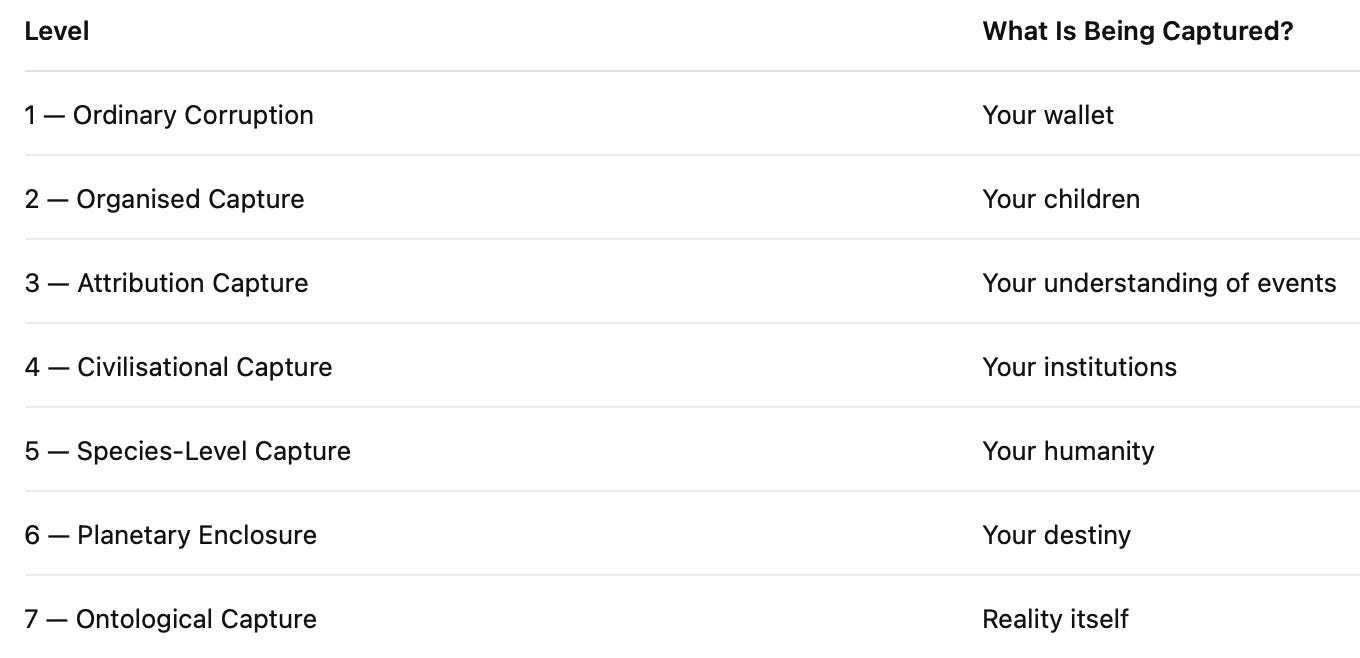
My purpose is emphatically not to persuade you that any particular model is correct, but to invite you to observe your own reactions as the stakes increase:
At what point does a plausible concern become an implausible one?
Where does curiosity give way to disbelief?
When does scepticism become dismissal?
Those moments are often more revealing than we realise. They expose the boundaries of our own assumptions about how power operates, what institutions are capable of, and which hypotheses we are willing to entertain—irrespective of their ultimate validity.
Each threat level is accompanied by its own archetypal “baddies”, included not to litigate the facts (indeed, some may yet be vindicated by history), but to illustrate how the perceived nature of the threat shapes the proposed remedy.
As you read the list, pay attention to where your own desire to “check out” first appears.
Level 1 — Ordinary Corruption
What is captured? Your wallet.
Archetypal baddies: Crooked politicians, bent officials, greedy executives, and small-time fraudsters — the familiar rogues of everyday power.
Correction architecture: Journalism, courts, elections, and regulatory enforcement.
Level 2 — Organised Capture
What is captured? Your children.
Archetypal baddies: Jeffrey Epstein, Jimmy Savile, intelligence-linked trafficking networks, compromised elites, and predators protected by institutions that should have stopped them.
Correction architecture: Whistleblowers, investigative journalism, and criminal prosecution.
Level 3 — Attribution Capture
What is captured? Your understanding of events.
Archetypal baddies: Operation Mockingbird, censorship cartels, intelligence services, media ecosystems, academic gatekeepers, and fact-checking priesthoods — the managers of permitted reality.
Correction architecture: Primary-source verification and distributed investigation.
Level 4 — Civilisational Capture
What is captured? Your institutions.
Archetypal baddies: The Deep State, Davos, BlackRock, transnational governance networks, and Babylon — systems that perpetuate themselves regardless of who is elected.
Correction architecture: Epistemic sovereignty, constitutional restoration, and distributed accountability.
Level 5 — Species-Level Capture
What is captured? Your humanity.
Archetypal baddies: Transhumanism, the Fourth Industrial Revolution, social credit systems, AI governance, neural compliance technologies, and the engineering of human behaviour itself.
Correction architecture: Human agency and decentralised technological and epistemic architectures.
Level 6 — Planetary Enclosure
What is captured? Your destiny.
Archetypal baddies: Breakaway civilisations, secret governance structures, hidden histories, and those who regard humanity as a managed resource rather than a sovereign species.
Correction architecture: Species-level sovereignty and radical transparency.
Level 7 — Ontological Capture
What is captured? Reality itself.
Archetypal baddies: Archons, demons, cosmic deceivers, non-human intelligences, parasitic entities, “AI black goo”, and the ancient adversaries of truth, meaning, and spiritual freedom.
Correction architecture: Discernment, direct apprehension of reality, and reconstruction from first principles.
What this table reveals is not merely an escalation in the severity of the threat, but an expansion in the scope of what is being captured. The progression is therefore not from one doctrine to another, but from enforcement within a shared reality to reconstruction when reality itself is contested.
Each of us reaches a different point on this ladder where certainty gives way to doubt, or curiosity gives way to dismissal. We “cash out” or “crash out” at different levels, and these differences cannot be instantly resolved through direct observation. The deeper the disagreement, the less likely it is that a single fact, document, or revelation will settle the matter.
Instead, disputes over the threat ultimately become disputes over reality itself: what is true, how we know it, and which sources of authority deserve our trust. Only a larger process of reality reconstruction can resolve those questions—and thus determine the meaning of any proposed response.
The crucial observation is that every threat model implies a corresponding correction architecture.
At the lower levels, correction is primarily a matter of enforcement.
At the higher levels, correction becomes a matter of reconstruction.
The challenge shifts from applying established procedures to recovering the foundational principles that justify those procedures in the first place.
In that sense, this article is performing the very act it describes: reconstructing the architecture of reality reconstruction itself.
The obvious question is whether such architectures have appeared before, and if so, what we can learn from them.
It is at this point that certain ideas from military doctrine become unexpectedly relevant. Not because civilians have become soldiers, but because both face the same fundamental problem:
How do we maintain orientation and coordinate action when information is fragmented, trust is degraded, and the environment is shaped by adversarial intent?
This is no longer a theoretical question. Most people already confront it in practical form:
Should I spend time investigating claims (“conspiracy theories”) that contradict official narratives?
How do I separate signal from noise when one person’s anomaly is another person’s debunked claim?
How do I make decisions for myself and my family when I cannot reliably determine which institutions still deserve trust?
None of these questions requires us to first prove the full extent of any threat. The uncertainty itself is sufficient to force the problem upon us. We are already required to act — or refuse to act — under conditions of incomplete information.
Military organisations have confronted this challenge for generations. The most useful insights do not come from tactics or technology, but from how they solved the deeper problem of orientation under uncertainty.
John Boyd’s OODA loop is frequently misunderstood as a cycle of observation and decision. In reality, its decisive step is orientation — the construction of a coherent model into which new observations can be integrated. Without it, more information produces confusion rather than clarity; the act is detached from reality.
At the individual level, this orientation task quickly becomes impossible. No single person can observe, verify, and integrate everything. I spent years watching YouTube videos at midnight after my kids were in bed, worried about the world and their future. Some were enlightening; many merely speculative or misleading.
The only scalable solution is collective: reality must be reconstructed through networks of people who share observations, test interpretations, and operate under a common intent. This is not unlike the problem faced by military forces operating in complex, contested environments.
Three distinct traditions have developed strikingly similar architectural responses to this problem:
The first is Auftragstaktik, or mission command, which emerged from the Prussian and German military tradition.
The second is Mosaic Warfare, developed in modern defence research.
The third is the much older model of discipleship and spiritual warfare found in Christian thought and practice.
What unites these three is not their domain, but their underlying logic:
Each treats orientation as something that must be actively maintained rather than passively received.
Each distributes the work of reconstruction across many participants rather than concentrating it in a central authority.
And each operates through intent rather than detailed instruction.
We will now examine each in turn, before a brief review of how this locates Q and Anons in the modern digital battlefield.
We begin with the German leadership doctrine of Auftragstaktik, or mission command. For a clear account, see Milan Vego’s article in the U.S. Naval Institute’s Proceedings.
For most of history, military command relied on detailed instruction. The commander assessed the situation, devised a plan, and issued orders specifying both the objective and the method of execution. Success depended on obedience and faithful implementation.
Industrial-scale warfare exposed the limits of this model. The battlefield moved faster than orders could travel. By the time instructions reached subordinate commanders, the situation had often changed. The more complex and fluid the environment, the more brittle detailed control became.
In the nineteenth century, Prussian Field Marshal Helmuth von Moltke identified the core problem:
“It is an illusion if the commander thinks that his continuous personal intervention into the responsibilities of subordinates would result in some advantage.”
If conditions change faster than central direction can respond, how does a large organisation maintain coherence while still adapting to local reality?
The German answer was Auftragstaktik. Instead of prescribing instruction methods, commanders communicated intent: the objective to be achieved and the constraints that must be respected. How that intent was realised was left to the judgement of those on the ground.
Over time, intent came to matter more than the literal order. Subordinate commanders were expected to exercise initiative when circumstances rendered the original instructions obsolete. An officer who failed to act decisively when required was considered as culpable as one who disobeyed orders outright.
The guiding question became:
“What order would my superior give me if he were in my position and knew what I know?”
This is not merely a technique for battlefield command. It is an architecture for coherent action under uncertainty. Shared intent supplies direction and unity of effort; local observation and initiative supply adaptation.
Coherence is maintained not by propagating detailed instructions from the centre, but by continuously reconstructing the commander’s intent at the edge in light of changing reality.
The civilian analogue appears in a phrase that became ubiquitous during the Great Awakening:
“Do your own research.”
To its critics, the phrase sounded like a refusal to accept authoritative guidance. Under the logic of mission command, it functions differently:
It communicates intent rather than instruction.
The objective is not agreement, but investigation.
Responsibility shifts from central authority to the individual participant.
This is why the “autists” of my earlier essay became such visible actors. Their role was not to propagate counter-narratives, but to reconstruct reality from fragments. Once viewed through that lens, a deeper question emerges:
What kind of architecture allows large numbers of people to perform that reconstruction together?
The answer takes us into the logic of fragment warfare.
For most of the modern era, military power was built around a small number of high-value, high-capability platforms — aircraft carriers, advanced fighter squadrons, large headquarters, and centralised command systems. These platforms delivered decisive effects, but they also embodied a particular philosophy of power: concentration, control, and propagation from the centre outward.
The same logic dominated the information environment. A small number of institutions gathered information, interpreted it, and propagated approved narratives to a largely passive population. Public understanding was expected to emerge through distribution from the centre rather than reconstruction at the edge.
Yet concentration creates fragility. Whether the asset is an aircraft carrier, a headquarters, or a trusted institution, a small number of critical nodes become single points of failure. As environments become more complex, contested, and adaptive, the centre struggles to maintain coherence.
Neutralising a handful of critical assets could collapse the effectiveness of the entire force.
The response was not to build even more capable individual platforms, but to change the underlying logic of how capability is organised. DARPA’s concept of Mosaic Warfare breaks military power into many smaller, modular “tiles” — sensors, communications nodes, drones, weapons systems, and intelligence assets. No single tile is decisive on its own.
Effectiveness comes from the speed and flexibility with which these tiles can be composed and recomposed into coherent formations.
In this sense, Mosaic Warfare applies the same underlying principle as Auftragstaktik, but to capability rather than command. Where Auftragstaktik enables coherent action through shared intent and decentralised initiative, Mosaic Warfare enables resilient capability through distributed, modular components.
Both reject the industrial-era assumption that power and effectiveness require centralisation and concentration. Instead, they locate strength in the relationships between fragments and the ability to continually recompose them into a coherent whole.
The significance of Mosaic Warfare lies not in drones, sensors, or military technology, but in its treatment of fragmentation itself. No single tile contains the whole picture. Intelligence emerges from the pattern formed by many independent pieces operating together.
Intelligence resides in the pattern rather than the component.
While Auftragstaktik reconstructs intent, and Mosaic Warfare reconstructs capability, the “autists” of my earlier essay reconstruct truth — including the nature and severity of the threat itself.
The civilian analogue is immediately recognisable. Instead of sensors, drones, and communications nodes, the tiles become court records, witness testimony, financial disclosures, archived web pages, social media posts, historical events, personal experiences, and unexplained anomalies. No single fragment is decisive. No individual possesses the whole picture.
Yet through continual comparison, validation, and recomposition, a larger reality begins to emerge. Intelligence resides not in any single element, but in the pattern formed by their relationships.
In this sense, the “autists” were never the story. They were simply the most visible practitioners of a more general process.
Participants become the tiles.
The internet becomes the battlespace.
Reality emerges through recomposition.
These principles did not originate in modern military doctrine. They appear wherever any mission must be sustained at scale in the presence of uncertainty, deception, and active opposition.
The Christian tradition encountered this problem long before modern militaries did. The Great Commission did not supply a detailed operating manual for every circumstance the Church would face across centuries, cultures, and political systems. It communicated a mission: to bear witness to the truth and to orient others toward it in the face of opposition.
The New Testament frames this mission explicitly as conflict. It speaks of kingdoms, enemies, deception, vigilance, and spiritual warfare. The primary weapon of the adversary is falsehood. Under these conditions, a purely propagative architecture — one that relies on central instruction and passive reception — is structurally inadequate.
The apostles could not be present everywhere. No finite set of instructions could anticipate every future contingency or new form of deception. The early Church therefore faced the same fundamental problem later addressed by Auftragstaktik and Mosaic Warfare:
How do you maintain coherent action when central direction cannot reach every participant, yet the adversary remains active and adaptive?
Christ did not leave a bureaucracy.
He did not leave a continuously updated operations manual.
He left disciples.
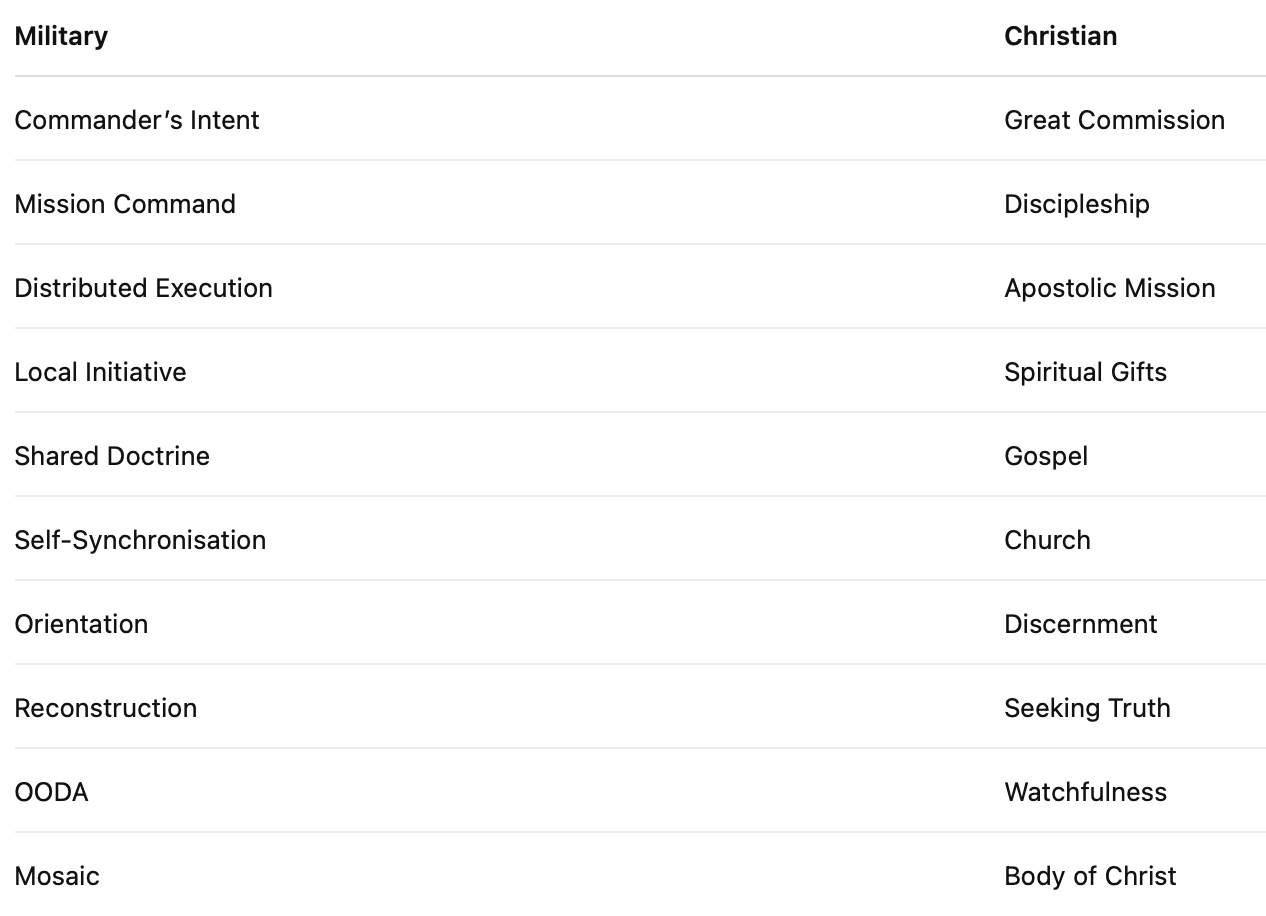
The Great Commission transmitted intent rather than exhaustive instruction. Believers were expected to exercise judgement and discernment in situations that could not be pre-specified. Guidance came through scripture, doctrine, community, conscience, and the ongoing work of the Holy Spirit.
The mission was continuously reconstructed by those carrying it.
The result was a civilisation-scale reconstruction architecture: resilient to distance, delay, persecution, and deception precisely because it relied on intent, discernment, and local adaptation rather than continual propagation of instructions.
The Church was never designed primarily as a system for propagating instructions from a central authority. It was designed to cultivate people capable of maintaining spiritual orientation and reconstructing faithful action from shared principles — when no explicit instruction existed.
In other words, discipleship solved through reconstruction what bureaucracy attempts to solve through propagation.
The Church as a distributed reconstruction architecture.
Spiritual warfare as a conflict over orientation.
Christianity as the oldest large-scale mission-command system.
The Q drops operated on this model. They did not deliver a finished narrative or a set of conclusions to be passively accepted. They transmitted intent — expose systemic corruption, restore accountability, and awaken others to realities obscured by institutional narratives — while leaving investigation, verification, and application to distributed participants.
In this respect, the role of the participant resembled that of the disciple more than that of the consumer. Individuals were expected to gather evidence, exercise discernment, compare interpretations, and contribute to a larger process of reconstruction.
The “autists” described in my earlier essay became particularly visible in this environment because they often performed an apostolic function. They were not important because they possessed secret knowledge. They were important because they were frequently the first to detect anomalies, challenge inherited assumptions, and move into unexplored explanatory territory.
Their role was not to propagate a finished doctrine, but to participate in the reconstruction of reality itself.
Across multiple domains, a common architectural response to “orientation pressure” appears:
Auftragstaktik teaches reconstruction of intent.
Mosaic teaches reconstruction of capability.
Discipleship teaches reconstruction of orientation.
Q enables reconstruction of reality.
The reconstructive essence is the same, even if its application varies.
We began with “autists”, who (in)famously interpreted the Q drops as Anons while simultaneously being disparaged through the propagated “QAnon” narrative.
Given our trajectory so far, a different interpretation becomes possible.
Participants understood themselves as investigators. The public narrative increasingly portrayed them as followers. Reconstruction was reframed as propagation.
Whether this reframing was deliberate or emergent is ultimately secondary. The effect was to redirect attention away from the investigation and onto the investigators. Questions about corruption, criminality, and institutional failure became questions about “QAnon” itself.
The defence against reconstruction was not to defeat it, but to reclassify it.
Those engaged in investigation, verification, and reality reconstruction were recast as passive consumers of a belief system. The distinction between reconstruction and propagation was not merely criticised; it was erased.
Those attempting to recover reality from primary sources were accused of blindly following a narrative, while institutions engaged in narrative propagation presented themselves as the defenders of truth.
The inversion is difficult to miss.
The more revealing question is therefore not whether the Q drops were true, but what kind of architecture they instantiated — and whether something like it was becoming structurally necessary.
Viewed through the framework developed in this article, Q operated as a distributed civilian reconstruction architecture at internet scale. It transmitted intent while distributing the work of investigation, interpretation, verification, and recomposition across a large network of participants.
Understanding was not delivered from the centre. It was actively reconstructed at the edge.
This architecture shares functional characteristics with Auftragstaktik, Mosaic Warfare, and Christian discipleship: shared intent over detailed instruction, distributed initiative over central control, and reconstruction over passive propagation.
What distinguished Q was the attempt to run this logic at population scale in an environment where conventional attribution systems were already under visible strain (e.g. as “fake news”).
The more interesting question is not whether Q was true or successful.
It is what level of threat would make such an architecture rational.
At Levels 1 and 2 of the threat ladder, conventional institutions retain meaningful corrective capacity. Journalism, courts, investigations, and elections may be imperfect, but they can still surface error and impose accountability within a broadly shared reality.
Once threats move into Level 3 and above, this changes.
The authority to adjudicate attribution itself becomes contested. The institutions responsible for verification lose credibility or become actively defensive of their own narratives. In such conditions, societies face a structural problem: they cannot respond coherently to threats they lack the capacity to comprehend.
Large-scale disclosures, anomalies, or institutional failures cannot be absorbed if the population has no effective means of reconstructing reality when trusted channels degrade.
Q addressed this gap by substituting civilian capability for institutional attribution. Its most important output was not a settled set of conclusions, but a decisive and lasting increase in distributed reconstruction capacity.
Participants were trained, through practice rather than instruction, to operate without reliable central attribution, follow anomalies across institutional boundaries, and tolerate ambiguity while actively working to resolve it.
Most people entered through questions that sat comfortably at Levels 1 and 2. Was Hillary Clinton corrupt? Were intelligence agencies abusing their powers? Was the media hiding something? These were Nixon-scale questions, not ontological ones.
Yet the reconstruction process did not remain static.
As participants compared contradictory accounts, encountered institutional resistance, and followed evidence chains, many found their assessment of the threat expanding.
Questions about individuals became questions about institutions.
Institutions led to systems.
Systems led to civilisation.
For some, the inquiry eventually reached humanity, consciousness, meaning, and the nature of reality itself. The architecture permitted this movement; it did not require prior agreement on where the ladder ultimately ended.
This may be its most significant feature: a reconstruction architecture does not need complete foreknowledge of the threat.
Its purpose is to ensure that when the true scope of the threat becomes visible — whatever level it ultimately occupies — society retains the capacity to remain coherent rather than fragment.
Seen in this light, the decisive question is no longer “What (or who) was Q?”
It is: what kind of environment makes a Q-like architecture necessary — and what can we infer about the implied threat level from its design, duration, and scale?
For most of history, mission command was a military necessity and a civilian impossibility.
Ordinary citizens lacked both the technical means and the institutional permission to operate through shared intent and decentralised initiative. Reality was largely received through centralised structures of attribution — churches, newspapers, broadcasters, universities, and governments.
The internet changed the underlying conditions.
It gave large numbers of people direct access to primary sources, real-time coordination, and distributed archives. For the first time, the technical prerequisites for civilian reconstruction existed at scale.
This shift coincided with a deeper erosion: declining trust in the very institutions that had previously performed attribution (“who did what?”) on society’s behalf. When those mechanisms weaken, the old model — central propagation of authorised reality — becomes increasingly brittle.
Coherence can no longer be reliably maintained through instruction and reception alone — regardless of malevolent intent or enemy action.
What emerges in its place is civilian mission command: autonomous individuals operating under shared spirit, with decentralised investigation and local initiative, yet capable of coherent collective behaviour through continual reconstruction.
Such an architecture does not require institutional permission. It requires only the capacity to coordinate around intent while actively recovering reality from fragments.
Q represents the most ambitious civilian reconstruction architecture yet observed.
If the underlying threat proves to reside primarily at Levels 1 or 2, its scale may ultimately appear disproportionate.
If the threat extends into the higher levels of the ladder, however, the opposite conclusion follows: that the architecture was not only appropriately matched to the environment, but was both necessary and unavoidably unprecedented.
The final assessment therefore depends not only on what Q was and is, but on what the reality of the underlying threat ultimately turns out to be.
Architectures are not built in a vacuum. The scale, duration, and complexity of a corrective system tell us something about the environment it was designed to address.
A neighbourhood watch implies one kind of danger.
A police force implies another.
A military alliance implies another still.
Likewise, a decade-long, internet-scale, decentralised civilian reconstruction architecture tells us something about the environment that produced it. We may disagree about the precise nature of the threat, but the scale, duration, and design of the response are themselves evidence.
The architecture is part of the disclosure.
Fortifications are rarely built larger than the danger they are expected to withstand.
The emergence of civilian mission command is therefore the story of what becomes possible — and increasingly necessary — when propagation architectures can no longer bear the full burden of maintaining social coherence under an anticipated threat.
What follows is not the collapse of coherence, but its relocation: from centralised propagation to distributed reconstruction.
And the defining political question of the information age may ultimately be this:
Who gets to participate in the reconstruction of reality itself?
You might want to ask an autist.
They seem to know.

Oh, this is so brilliant, Martin. I go all the way up the ladder, as it is all of a piece. Good versus Evil at the highest level of the ladder. Ultimately, we are fighting principalities, and those principalities have been attacking us at every layer of the ladder in a coordinated and mostly subtle manner almost impossible to see without a systemic lens capable of reconstruction at all levels at once. Q and the anons clearly fit into that approach, being the initiation of the construction of that systemic lens now spreading outward into the Great Awakening.
Yet another celebration of green!