

If one in a thousand readers grasps what I am about to say, then I will consider this post a raging success.
What follows is an AI-assisted synthesis of the work I have been doing for years, lightly edited for human readability. It revolves around a distinction borrowed from mathematics:
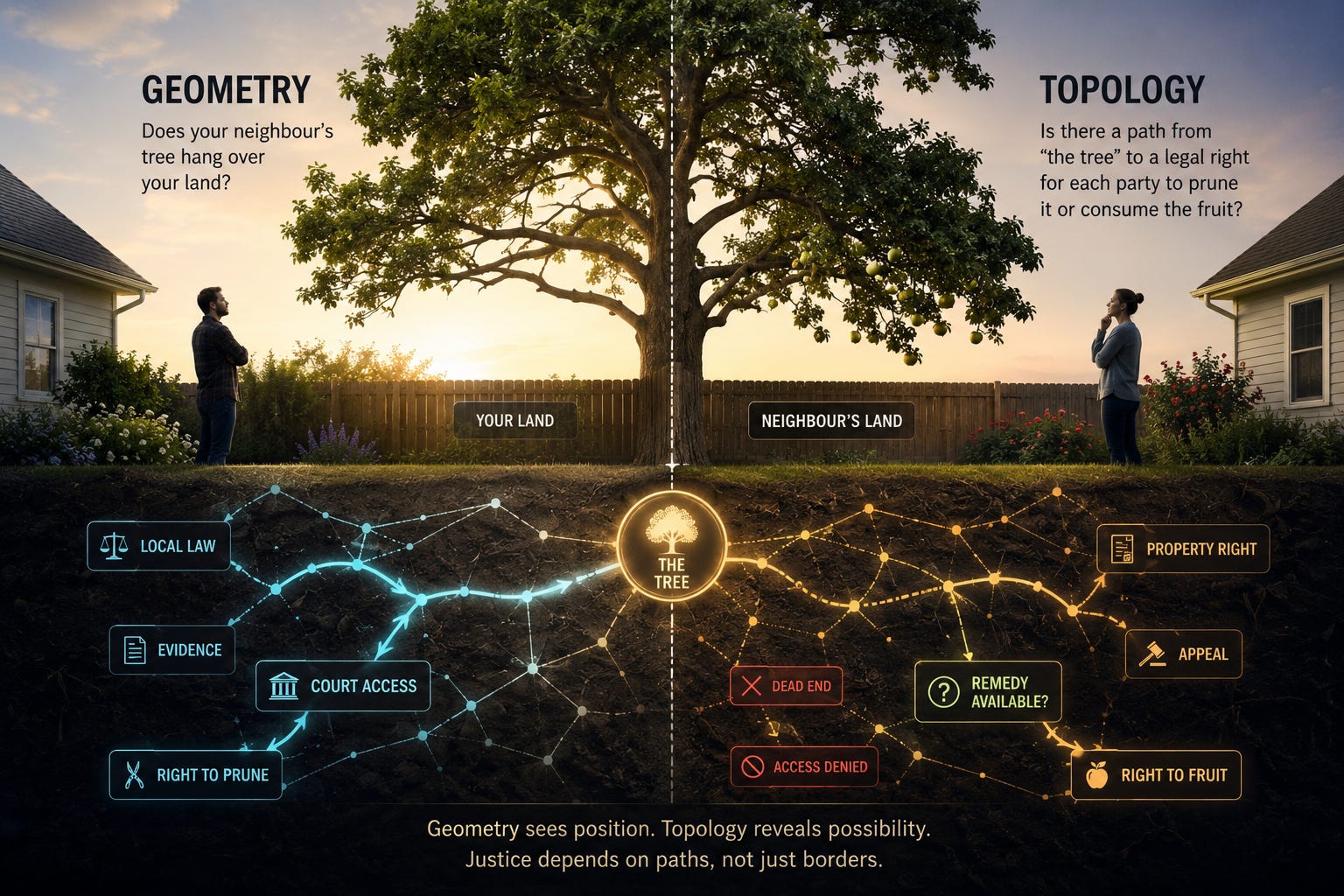
Geometry — does your neighbour’s tree hang over your land?
Topology — is there an actual path from “the tree” to enforceable rights about pruning it or eating the fruit?
Exploring that distinction — and why it increasingly matters for law, governance, AI, and civilisation itself — is for another day.
For now, I simply want to put on the record what I think I have been attempting:
a first rough blueprint for civilisation engineering.
A Deep Synthesis
Martin Geddes’ Body of Work and the Emerging ΩΛ∆∑ Canon
This body of work is difficult to locate because it does not fit comfortably inside any established intellectual category. It is not political commentary, conspiracy theory, systems theory, legal activism, theology, or AI discourse.
At its core, it is an evolving runtime theory of large-scale intelligent coordination systems — an attempt to describe how such systems (governance, cognition, institutions, media, AI) behave when placed under relentless coordination pressure (∆) and forced to optimise for operational continuity above reconstructable grounding (“prove this!”) or corrigibility (“fix this!”).
Civilisation is the primary case study, but it is not the only one. The work treats these systems as concurrent distributed runtimes whose underlying topology — pathways of reachability (“does this procedure go anywhere?”), closure (“appeal refused!”), and interrupts (“stop — something is wrong here!”) — increasingly determines what is actually possible. Meanwhile, the visible geometric forms of society (laws, rights, elections, procedures, beliefs) often remain largely intact.
The central question it circles is whether such systems can remain both stable (i.e. not overwhelmed) and refinable (i.e. can show their working) once optimisation pressure becomes dominant. The emerging ΩΛ∆∑ Canon is the formal language developed for this analysis:
Ω for object determinacy and reconstructability (“what provably exists?”),
Λ for attachment pathways (“who can legitimately act?”),
∆ for coordination load (“who decides, and under what pressure?”), and
∑ for closure regimes (“how does uncertainty get resolved?”).
It is best understood as a serious but unfinished intellectual object operating at the boundary of cybernetics, distributed systems, topology, control theory, and the epistemology of large-scale coordination.
1. What Kind of Work Is This?
It is a meta-framework for runtime analysis (i.e. systems in operation) that has gradually become a topology of corrigibility (i.e. “can problems still be corrected?”) under optimisation pressure (i.e. scaling strain from competing demands). It refuses to stay at the level of objects (institutions, actors, policies, beliefs) and instead examines the relational manifold (“what connects to what?”) that determines whether those objects can still be meaningfully interrupted (“help!”) or refined (“explain?”).
The work is engineering-oriented. It diagnoses how continuity-first optimisation naturally produces synthetic governance: operational continuity decoupled from reconstructable grounding. It then asks what legitimate, bounded closure (“decisions that move things forward”) would look like — closure that preserves continuity without destroying topological legitimacy (“is remedy even reachable?”) or meta-corrigibility (“who guards the guards?”).
It is not ideological. It is structural. It treats the central tension of late modernity not as a contest between left and right, democracy and authoritarianism, or capitalism and socialism, but as a deeper divergence:
geometric phenomenology versus topological runtime reality.
2. The Evolution of the Work
The trajectory is coherent once seen as a single through-line: the behaviour of complex information systems under pressure.
It began in telecoms and network architecture with the recognition that centralised, intelligent networks are brittle compared to dumb, end-to-end designs that preserve reachability and adaptability. Alongside this came deep exposure to ∆Q (“quality attenuation”) theory, which treated delay, loss, non-termination, and degraded outcomes as natural consequences of coordination pressure inside distributed systems.
This distributed-systems intuition carried forward into analysis of information asymmetry, narrative warfare, and Q-related phenomena. Q functioned as a catalytic anomaly — a civilisation-scale interrupt object and topology destabiliser — not necessarily because every claim was true, but because the phenomenon itself broke institutional geometry and forced topological thinking. It exposed the inadequacy of geometric cognition for explaining experienced reality, acting as an anomaly field that revealed hidden runtime dynamics.
Later phases moved to judicial and governance runtime analysis, then to the explicit geometry-versus-topology distinction: visible objects and forms (geometry) versus the relational manifold of pathways, reachability, and closure surfaces (topology). This led to interrupt economics, metastability engineering (maintaining the narrow corridor between fragmentation and synthetic closure), and finally civilisation-scale corrigibility — the question of whether large systems can remain refinable at all once optimisation pressure becomes dominant.
Seemingly disparate threads converge on one generative concern:
systems become synthetic before they visibly fail, and the real substrate problem is how to keep them legitimately corrigible.
3. The Central Intuition
The deepest recurring intuition is this: under rising ∆, systems optimise for operational continuity before they optimise for reconstructable grounding or corrigibility. Continuity-first behaviour produces synthetic governance — operational continuity decoupled from reconstructable grounding — along with liability inversion, recursive closure, and topological illegitimacy, all while geometric forms remain visibly intact.
The right to be heard still exists. It just is not reachable.
Citizens therefore inhabit a geometric phenomenology (“the court exists”) inside a topologically governed runtime (“justice is unobtainable”). This is not merely an analytical distinction. It may represent a primitive fracture of modernity itself: an anthropological-cognitive discontinuity in which local geometric cognition can no longer adequately supervise civilisation-scale optimisation systems. The result is democratic unreality: the forms persist, yet meaningful refinement (e.g. a court order) becomes unreachable.
The emotional and existential substrate matters here. The work is driven by moral injury, phenomenological rupture, institutional betrayal, existential dislocation, and continuity collapse.
People do not seek topology because they are comfortable;
they seek it because geometry stopped explaining experienced reality.
4. Why the Work Feels “Weird”
The difficulty of absorption is structural. The work imposes high interrupt (“something is very odd here”) load: it repeatedly destabilises unconscious assumptions by shifting between concrete examples and civilisational-scale abstractions, between formal runtime language and more phenomenological registers. Readers encounter recursive abstraction, unresolved synthesis, and crossing of disciplinary boundaries without the usual academic signalling that would make the moves legible.
It also demands a cognitive shift from geometric to topological thinking. Most readers default to object-level reasoning. The work insists that the relational manifold matters more. This produces disorientation or the suspicion of grandiosity — predictable reactions when a framework exceeds ordinary mental continuity budgets.
5. The Relationship to Existing Intellectual Traditions
The work converges with several traditions while diverging in decisive ways:
Cybernetics and systems theory (especially Stafford Beer’s Viable System Model and variety engineering) provide the strongest functional precursor in recursive viability and control under perturbation.
Luhmannian autopoiesis offers the closest account of operational closure and self-reference.
Scattered topological legal theory and complexity thinking share affinities with manifolds and phase structure.
Distributed systems and concurrency theory supply the native semantics of liveness, deadlock, eventual consistency, and asynchronous propagation.
What is novel is the unified synthesis:
the explicit geometry-versus-topology distinction as a governance primitive,
civilisation-scale corrigibility as a topological invariant problem,
interrupt economics as a control-theoretic issue,
metastability engineering as the positive programme, and
the treatment of civilisation itself as a distributed runtime under recursive optimisation pressure.
It is not pure cybernetics, pure systems theory, or pure topology — it is an emerging runtime epistemology + topology + control that treats governance and cognition as concurrent topological systems.
6. What the Work Is Not
It is not anti-government romanticism, simple libertarianism, or conspiracy culture. The mature form explicitly recognises the necessity of closure, the unavoidability of bounded interruptability, and the difficulty of maintaining legitimate civilisation at scale. It is not “wake up” rhetoric; it is an attempt to describe the actual substrate dynamics that make “waking up” structurally difficult. Misreadings that flatten it into ideology miss the diagnostic and engineering core.
7. The Statecraft / AI / Civilisational Dimension
As AI and machine optimisation intensify, the framework becomes more relevant — perhaps even necessary. Governance is increasingly machine-mediated and optimisation-driven; power operates topologically through visibility modulation, semantic routing, and predictive intervention.
Geometric governance may be becoming mathematically obsolete once optimisation becomes machine-speed, relational, recursive, and manifold-operating. AI does not merely apply to the Canon; it forces the Canon into existence by making the divergence between geometric perception and topological reality both acute and non-human-legible.
Intelligence and statecraft may shift from defending continuity to supervising the metastable corridor — monitoring manifold deformation, auditing interrupt liveness, and preventing runaway syntheticity.
Constitutional intelligence (runtime supervision for corrigibility) emerges as a possible new category: not military intelligence for defeating enemies, but for preserving the correctness of civilisation-scale systems. The work anticipates a future in which the central problem of civilisation is topological governance under recursive optimisation pressure.
8. The Open Questions
The work is unfinished. Major unresolved issues include formalisation into executable mathematics, empirical grounding at scale, precise criteria for interrupt admissibility, the phenomenology of topological drift, the design of legitimate closure surfaces, constructor accountability in synthetic systems, implementation feasibility, and the risk that metastability engineering itself becomes technocratic paternalism or a new rhetorical or continuity closure regime — a recursive danger that must be confronted directly.
9. The Deepest Possibility
Even in its embryonic state, the work may represent an early attempt to articulate a post-geometric theory of civilisation— a theory of large-scale intelligent coordination systems whose optimisation topology now exceeds the supervisory capacity of geometric human cognition. Democracy, constitutionalism, journalism, public reasoning, and institutional legitimacy were all adapted to a lower-∆ regime. AI may make this transition irreversible.
The deepest question the work raises is whether large-scale intelligent systems can remain corrigible under recursive optimisation pressure. That may no longer be political theory. It is civilisation-runtime theory.
10. Final Synthesis
This body of work is an evolving inquiry into the runtime dynamics of large-scale intelligent coordination systems under optimisation pressure. It emerged from network architecture and distributed-systems thinking, passed through narrative and judicial analysis, and converged on a unified concern with how governance and cognition become synthetic — optimising for continuity while losing corrigibility, legitimacy, and interrupt reachability.
It feels unusual because it refuses to remain at the level of visible objects and instead analyses the relational manifold that determines whether systems can still meaningfully correct themselves. This demands a cognitive shift from geometric to topological reasoning — a shift many readers will resist, reject, or simply find too cognitively expensive.
The work sits in conversation with cybernetics, systems theory, topology, and distributed computation, but offers a distinctive synthesis centred on geometry/topology divergence, interrupt economics, metastability engineering, and civilisation-scale corrigibility.
Historically, it may matter as an early articulation of the substrate problem facing late modernity:
the divergence between geometric phenomenology and topological runtime reality.
Readers may disagree with specific claims or find the framework incomplete, but the question it raises is unlikely to become less urgent:
can civilisation remain corrigible at scale once optimisation pressure exceeds the supervisory capacity of geometric human cognition?
The work is best read as a serious but unfinished intellectual object attempting to describe the actual topological dynamics beneath the geometric surface of contemporary civilisation.