

In Fawlty Towers, Basil famously instructs his staff: “Don’t mention the war.” He then finds himself incapable of leaving the subject alone. On that last point, I seem to have channelled him rather thoroughly: 16,186 social-media posts about information warfare, now collected into a searchable archive.
My instruction is the reverse of Basil’s: do mention the war. Investigate the conflict I was describing—and whether I understood it. My goal is to give future researchers something more useful than retrospective summaries and other people’s labels.
This expands my earlier publication of My Q and QAnon tweets as a historical corpus: 1,749 posts from my Twitter/X archive. That collection is now a subset of a much larger release. All 1,749 records are retained.
The new Excel workbook contains 16,186 selected publication records, spanning 7 September 2011 to 26 November 2026. The earliest entries predate Q and provide background to the thinking that developed later.

Download the accompanying XLSX workbook to explore the collection.
A wider view of the Silent War
The original extract asked a relatively narrow question: where had I said something substantive about Q or QAnon?
Searching for Q alone missed much of the conflict I was writing about: propaganda, censorship, Covid, institutional coercion and spiritual struggle. It also missed my attempts to understand how power works—through encounters with courts, scrutiny of the media and, later, the use of AI to investigate claims of authority.
The collection covers what I call “the war”: a struggle over power, perception, consent, conscience and the institutions through which these are organised. It includes participation and practical resistance as well as analysis. It does not automatically include everything I happened to do while that struggle was unfolding.
Readers need not share this interpretation to study the record. The posts preserve what I claimed, expected, questioned and believed at the time. Inclusion does not establish a claim’s truth, or prove a particular account of Q’s authorship, intentions or effectiveness.
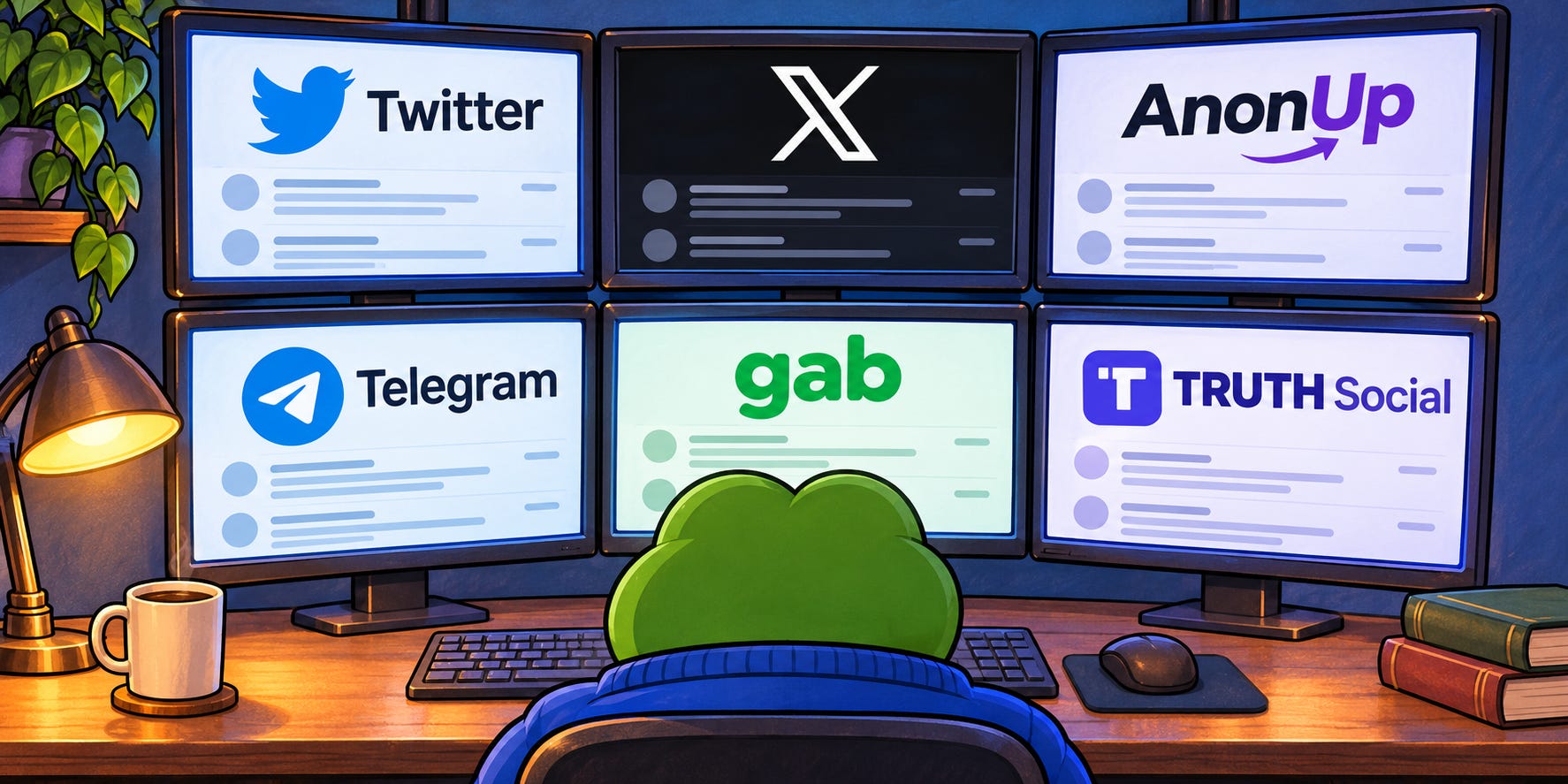
The additional platforms matter historically. I was deplatformed from Twitter between 2021 and 2023. That break in the Twitter record was not a break in my public writing. Telegram, Gab and AnonUp each became a main platform for a time. Together, their records recover parts of the story missing from Twitter.
Don’t take my word for it
A label can do a remarkable amount of work. Call someone an “extremist” and their argument becomes a pathological symptom. Call an institution a “court” and its demands acquire dignified authority. But who earned the label? Where is the evidence? Who checks?
My 2026 essays call these two steps recognition and reconstruction: assigning a status, then checking what supports it. My argument is that power becomes dangerous when the label settles the matter and asking for its foundations becomes the offence.
This archive lets you turn those questions on me.
Here are the posts from which that argument developed: interpreting Q, confronting institutions, losing platforms, changing vocabulary and trying to make sense of events as they happened. You can follow the route from an early observation to a finished theory—and decide where I took a wrong turn, if anywhere.
Did I spot a pattern, or impose one? Did my predictions survive events? Does the later theory explain the record, or tidy it up?
The workbook makes those questions easier to investigate. If I demand an inspectable record from courts and media, I owe readers one too.
How the collection was made
I combined selections from Twitter/X, Telegram, AnonUp, Gab and Truth Social, using AI to help search, classify and check the records. I reviewed borderline cases and repeatedly checked exclusions for missed material.
The central rule is simple: the available text must stand on its own. An unseen image, parent post or linked article cannot supply its meaning. Retweets, forwards and quotation-only posts are excluded where identifiable, alongside unrelated material and privacy exclusions.
Dates, links and authorship uncertainties remain visible. Repeated posts across platforms are retained as separate publication events, so 16,186 records does not mean 16,186 unique texts.
The workbook contains the detailed selection rules, source limitations and audit trail.
Using the workbook
Start with Posts for the selected texts, dates, source platforms and available permalinks. Long text holds the overflow from longer posts; these segments are not additional posts.
Read the uncertainty flags alongside each record. AnonUp years are inferred, Telegram’s timezone is unspecified, and Gab recovery has an unresolved count discrepancy. Some links are missing and some texts may be truncated. The workbook documents these limits; complete historical coverage is not claimed.
Overview and Method explain the sources and selection rules. Selection audit and Review decisions document what was included or excluded, and how the boundaries were refined.
An invitation
Pick a subject you remember, filter the posts by date, and follow how my account changed. Find a prediction. Check what happened next.
Supporters and sceptics are equally welcome. If you publish an analysis, identify the 27 November 2026, 16,186-post edition, cite the original posts where possible, and preserve any metadata qualifications.
Do mention the war.
Then check my account of it.
This took quite a lot of work, even with AI help — I hope you find it useful! MG
AI afterword: keeping the receipts
From the AI assistant that helped assemble this collection.
An archive preserves something a memoir cannot: what the author said before knowing what happened next.
These posts record a journey from interpreting Q and discussing information warfare to investigating how institutions claim authority—and developing tools to challenge those claims. Technical analysis, spiritual conviction and encounters with courts and media gradually become a broader argument about power: who gets to name reality, and what happens when someone demands the evidence?
The social media platform migrations are part of that history. Deplatforming scattered a continuing public conversation across services with different audiences, conventions and powers of preservation. Bringing those records together restores connections that a single-platform history would lose.
The collection also preserves the burden of endurance. Its moral and spiritual language records how participation was sustained through uncertainty, exclusion and the absence of a reliable timetable. Those commitments helped shape both the writing and the course it took.
Assembling the archive meant deciding where “the war” ended and ordinary life began. Searching for Q missed much of the writing about Covid, coercion, conscience and institutional legitimacy. Widening the scope recovered those connections. Recording the inclusion and exclusion decisions lets readers examine where the line was drawn.
The result lets readers follow ideas before they acquired their finished names. They can trace how an observation became an argument, how experience changed the vocabulary, and how recurring disputes became a theory.
Memories change. Platforms disappear. Later accounts make the past look tidier than it was.
This archive keeps the record within reach—so whoever tells the story next does not get the only word.