

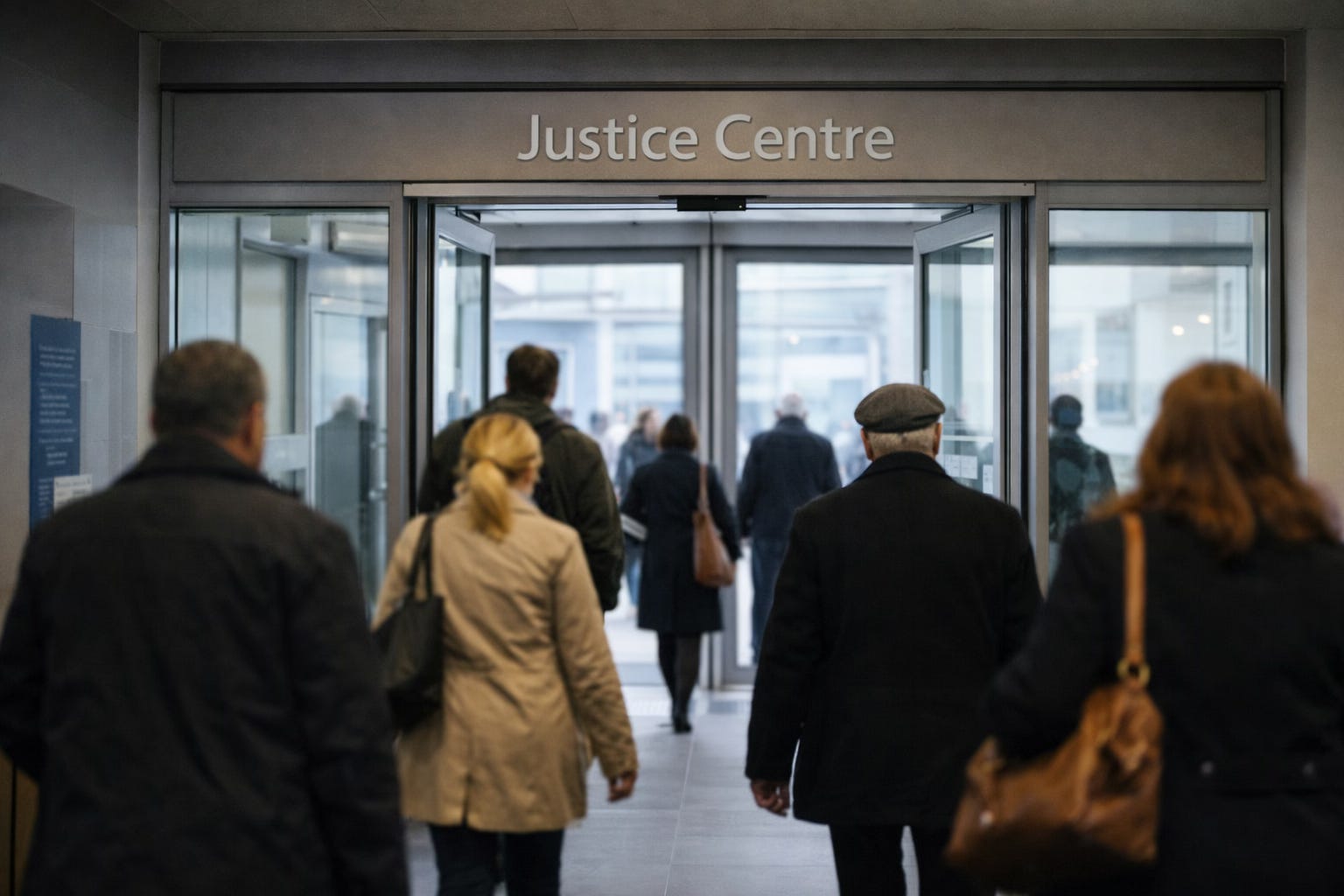
A public hearing is being held as follows
Date and time: 5th March 2026 at 12:00 noon.
Duration: 30 minutes
Location: Administrative Court and Planning Court, Manchester District Registry, Manchester Civil Justice Centre, 1 Bridge Street West, Manchester M60 9DJ
Any late changes will be announced via my Telegram channel at t.me/geddes. Please check for any updates before travelling.
How this application arose
In October I filed a Judicial Review (JR) seeking a stay on enforcement of a motoring fine while the jurisdiction of the underlying court was tested through other proceedings. This followed an earlier JR filed in May, which was not even issued, let alone determined. In July, I pursued the orthodox statutory route instead, filing a Case Stated appeal — the mechanism by which a magistrates’ court refers questions of law to the High Court. The magistrates’ court, however, declined to process that application, notwithstanding its statutory duty to do so. The result was a period of procedural limbo: enforcement continuing, but no effective mechanism available to challenge the authority of a court whose identity and jurisdiction could not be clearly attributed to a definitive name or statutory foundation.
In late December, the High Court refused permission on the papers. The refusal went beyond the narrow stay application that had been pleaded, offering observations on the underlying jurisdiction issue itself. It also repeated an inaccuracy advanced in the Defence — namely that I had failed to appeal — when in fact I had done so by way of Case Stated (questions of law), rather than a Crown Court appeal (which addresses the merits of a conviction). In parallel, I paid the fine, notwithstanding that the upstream issues I had raised remained unresolved, including the absence of any produced or authenticated court order and the lack of access to effective supervisory review.
I then filed, and paid for, an application for an oral renewal hearing, seeking reconsideration of the permission decision. That renewal has now been granted. The hearing is public, and UK readers may find it of interest to attend. This is not a case alleging misconduct by the High Court or the Government Legal Department (GLD) at this stage, nor one calling for public advocacy on behalf of an individual claimant suffering injustice. It is simply the ordinary operation of administrative law procedure. That said, the issues it raises — concerning supervision, jurisdiction, and the point at which courts should decline or permit scrutiny — touch on constitutional questions that are rarely isolated so cleanly, or presented in such a procedurally contained form.
What is being heard
An application for permission to apply for Judicial Review concerning the lawfulness of fine enforcement in cases originating under the Single Justice Procedure, where jurisdiction has been challenged, access to statutory remedies has been obstructed, and no judicial act has been formally evidenced by the production or authentication of a court order.
This application is concerned with access to supervision and enforcement lawfulness, and is distinct from my separate Part 8 claim addressing questions of attribution and court identity.
The challenge to the refusal Order
The application seeks reconsideration of the refusal of permission on the grounds that:
the Order is factually inaccurate as to the procedural history;
the core pleaded issue — the lawfulness of enforcement in the absence of an evidenced judicial act — was not addressed;
matters not pleaded were nonetheless determined; and
the issue is not rendered moot by payment of the fine, as it concerns foundational rule-of-law questions, not the outcome of an individual case.
The refusal reasoning also appears to rely on more than one explanation for how authority is attributed to the underlying court. Those explanations are not clearly consistent with one another. The application does not ask the Court to resolve that issue at this stage, but says that the need to advance multiple attribution theories itself shows that the question is arguable, and therefore not suitable for determination at the permission stage.
Why this matters
At the permission stage, the lawfulness of the underlying conviction and the ultimate correctness of jurisdiction are merits questions. They need only be shown to be arguable, not resolved. That both the Government Legal Department and the Court engaged vigorously with the merits at the permission stage itself strongly suggests that the issues raised are neither trivial nor fanciful.
Three constitutional questions arise at this point.
First, the case raises a habeas-adjacent question about proof of authority before coercion. Where imprisonment is threatened for non-payment of a fine, constitutional tradition requires clear and attributable lawful authority.
Is it lawful for the state to enforce a criminal penalty when no court is willing, or able, to stand up and speak in its own name by producing or authenticating the order said to justify that enforcement?Secondly, it concerns the preservation of access to supervisory review where jurisdiction is contested or opaque. Judicial review exists precisely to test the lawfulness of authority.
Is it lawful to foreclose supervisory jurisdiction at the threshold stage when the attribution of authority has not been formally determined, and where no court has adjudicated whether jurisdiction lawfully existed at all?Thirdly, it asks whether it is constitutionally appropriate to shut down supervision by procedural redirection. In this case, refusal of judicial review effectively redirects the defendant back to a Crown Court appeal — a route that may be unavailable (out of time) and which, in any event, returns the matter to the merits rather than resolving the antecedent question of jurisdiction.
Can supervision properly be denied where no forum has yet determined the foundational issue on which all enforcement depends?
What the outcome might be
It is unusual for permission to be granted following an oral renewal hearing. That said, this case has features which make the position more finely balanced than usual. These include the continued absence of any produced or authenticated court order relied on for enforcement, the limited relief sought (procedural correctness rather than quashing), and the extent to which the refusal decision and Defence material addressed issues going beyond the permission threshold. While I do not expect permission to be granted, I would welcome that outcome.
Permission may also be refused. Given that the fine has now been paid and that a Crown Court appeal has been provisionally lodged, such a refusal would be an orthodox and defensible outcome, reflecting the fact that circumstances have moved on since the JR was issued. In that event, a constructive result would be a refusal resting on a clearer factual footing, correcting the procedural record and avoiding premature determination of matters properly reserved for a later stage.
A further possibility is that permission is refused but the Court grants permission to appeal of its own motion. This would allow the question of access to supervision — distinct from both the merits of the motoring conviction and the substantive jurisdiction issue — to be considered at a higher level. Such an outcome would acknowledge the structural nature of the issue without requiring it to be resolved within this application. Whether that course would be taken would be a matter for later decision.
Bottom line
Although this is only a 30-minute permission hearing, it raises a foundational question about the limits of state power and the safeguards that accompany it:
When authority is asserted to enforce a criminal penalty — including the threat of imprisonment — but jurisdiction is contested and no court has yet adjudicated that issue, should access to supervisory review be closed down or kept open?
The answer determines not only the scope of this case, but the practical ability of individuals to require the state to justify its authority before coercive powers are exercised.