

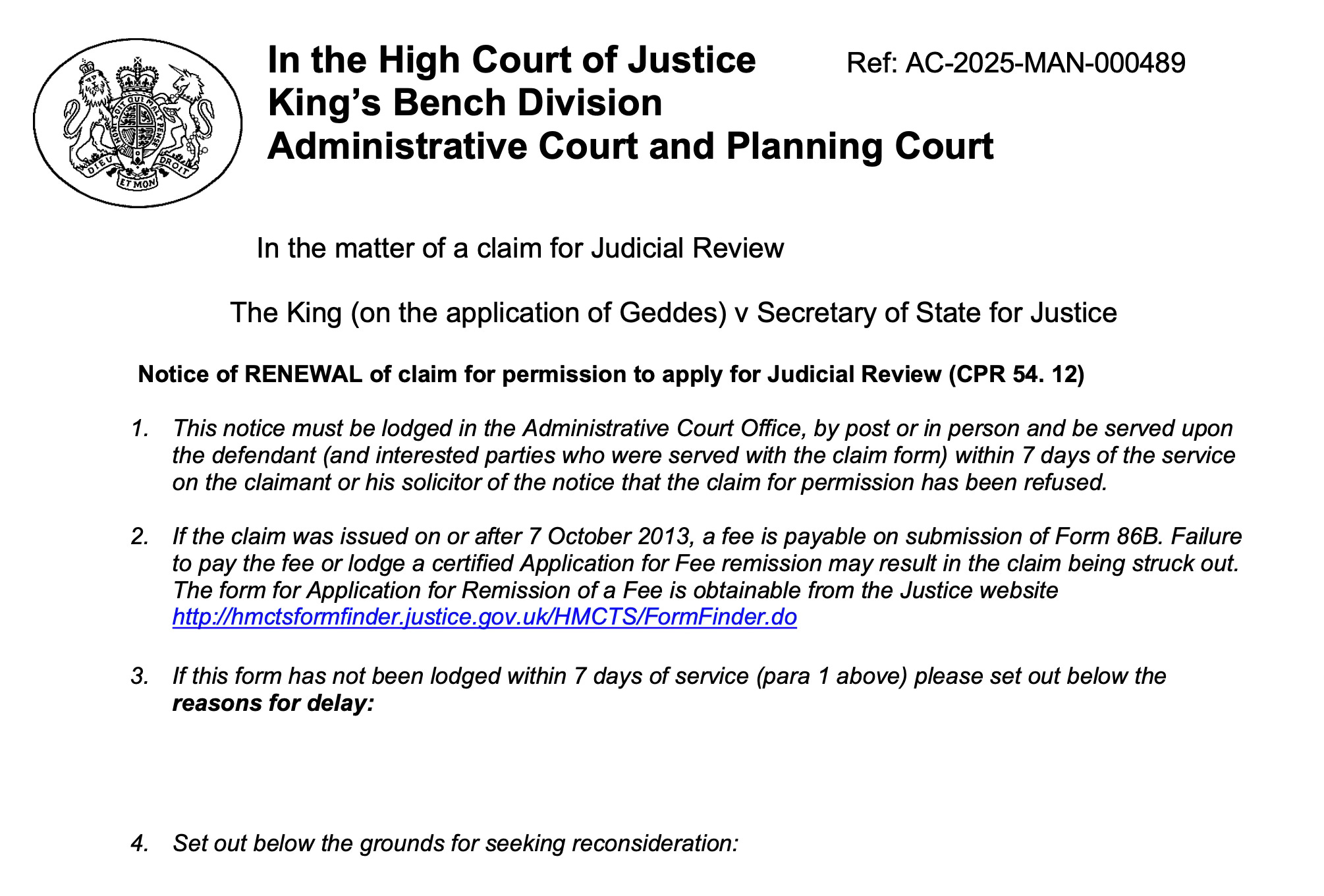
Yesterday, I received a pre-Christmas email delivery from the High Court in Manchester: a refusal of permission for my Judicial Review (JR) to proceed. The personal outcome is not, of itself, of great public significance. What matters is what the refusal reveals about how the modern legal system now treats foundational principles that once defined the rule of law.
Most notably, the system no longer requires coercive acts of the state to flow from personally attributable judicial acts with demonstrable authority. Instead, authority is assumed systemically, inferred from abstract frameworks rather than evidenced by traceable decisions.
That shift is dangerous. The public owes no moral allegiance to abstractions or procedures—only to accountable agency. What remains may be legal in form, but it is no longer lawful in substance: a hollowed-out husk of state power that does not submit itself to scrutiny or limit.
What I asked for — and what I did not
My request was simple. I asked for enforcement of a fine to be paused until its lawfulness could be established.
I have been prosecuted for a minor motoring matter under the names of multiple courts. Yet no court has definitively stood up to say, “this judicial act is ours.” Given that ambiguity and lack of traceability, I sought a stay until one of two things could be established:
That a sealed or authenticated court order be produced, identifying the court that professes to act—or that an official declaration be made that no such order exists. Absent such an order, enforcement lacks clear authority.
That I be given an opportunity to test whether the court that purports to convict exists in law, preserving access to justice. My first Judicial Review was not even issued, and a Case Stated appeal was simply not processed.
This matters because the State is now presenting administrative regions—Local Justice Areas (LJAs)—as if they were courts. Constitutionally, judicial power can only be exercised through a statutory court. It is not a floating remit to convict people. The principle at stake is grave: can criminal punishments be enforced when no court is identified, no judicial act is proven, and remedies are procedurally foreclosed?
A diagnostic claim, not a remedial one
The JR claim was constructed to be diagnostic, not remedial. I did not seek to quash the conviction. I did not challenge guilt or innocence. I sought only that enforcement proceed with a visible warrant of a real court.
I have now filed a parallel Part 8 claim on general law, so one primary objective—preserving access to supervision—has been achieved, albeit more slowly and painfully than if enforcement had been paused. The JR was never about winning relief. It was about testing whether foundational challenges to authority are still permitted to reach adjudication.
In summary, this was not a dispute about guilt, innocence, or a parking fine. It was a narrowly framed challenge to a single question:
By what identifiable judicial act is the state entitled to enforce punishment against me?
In a rule-of-law system, punishment follows adjudication. Here, enforcement proceeded without demonstrable adjudication—something historically rejected as unlawful and tyrannical.
What the refusal establishes beyond doubt
If the question was “does the High Court allow foundational challenges to judicial authority to proceed to adjudication?” we now have a clear answer. Not merely no, but an emphatic no.
Three system facts are now established with high confidence:
Foundational attribution challenges are treated as destabilising, not justiciable.
Procedural doctrines will be stacked to avoid answering them, even at the cost of mischaracterising claims or ignoring candour failures.
No internal mechanism currently sees itself as responsible for restoring classical lawfulness once enforcement begins.
These are not opinions. They are operational facts, extracted through a stress-test. In that sense, the refusal is informative rather than merely adverse.
The unanswered question at the heart of the case
My claim turned on a single, determinative issue: does a sealed or authenticated order exist from a court demonstrably established in law?
The High Court accurately identified this as my core complaint—and then declined to decide it.
“The Claimant’s key underlying complaint is that no sealed or authenticated order from the Magistrates has been provided.”
The Order does not say such an order exists. It does not require one to be produced. It does not explain why its absence does not matter. The decisive issue was acknowledged and then bypassed.
Attribution is the bedrock of classical rule-of-law. What is disturbing is that this principle is now treated as optional, as if its displacement were uncontroversial.
How the claim was avoided rather than decided
The potential voidness of orders issued in the name of non-courts is not a comfortable matter for the judiciary to confront. Rather than deciding the claim as brought, the court changed what my claim was “really” about.
“To the extent that the Claimant seeks, in reality, to challenge the initial imposition of the financial penalties…”
The Order reframed the enforcement challenge as a collateral attack on conviction, thereby enabling the invocation of doctrines such as exhaustion of appeal routes. But appeals address the merits of a case. I was not challenging those.
I did attempt a Case Stated appeal. It was simply not processed. The refusal is therefore premised on a procedural falsehood.
This is analogous to being imprisoned without a court order and being told, when you challenge the jailer, that you should have appealed. It avoids the immediate problem: the lack of authority for the present act of coercion. By mischaracterising the claim, review of the underlying legality is rendered unreachable. Acts are deemed lawful simply because the State performed them.
From demonstrated authority to assumed authority
What the Order makes explicit is that the State now permits coercion on the basis of assumed rather than demonstrated authority.
The classical rule of law requires:
an identifiable court,
a traceable judicial act,
and an order capable of authentication.
Instead, the Order relies on abstract statutory frameworks, system-level assumptions, and general powers “in principle.”
“Any error as to the name of the court would not invalidate the jurisdiction of the justices.”
This is, in effect, a return to general warrants—repudiated as unconstitutional in the 18th century. When authority becomes ambient rather than exercised, enforcement precedes proof. Legality is inferred, not shown. The covenantal pact between citizen and state—reciprocal submission to law—fractures.
Once attribution is no longer required, a zone of unaccountability emerges. Power is exercised by job title, stripped of institutional legibility. In spirit, if not law, this resembles bureaucratic command systems, not liberal democracy.
Total foreclosure of remedy
What is particularly concerning is that no court, at any level, has accepted responsibility for determining whether lawful authority existed.
Appeals fail because they presuppose the very legal instrument whose existence is contested. Judicial reviews are refused for failure to exhaust remedies that cannot operate. Complaints are ignored. Candour obligations go unenforced.
Remedies exist in theory, not in practice. When that happens, we no longer have “tribunals established by law.” We have administrative processing centres enforcing state coercion without adjudicating their own authority.
Under Article 6 ECHR, access to a “tribunal established by law” must be practical and effective, not illusory — a guarantee strained when no forum will adjudicate the existence of authority.
The quiet rejection of constitutional bedrock
At a deeper level, this Order functionally rejects two foundational authorities:
Entick v Carrington (1765): every act of state power requires a demonstrable warrant.
Anisminic v FCC (1969): jurisdictional errors are nullities and cannot be insulated by procedure.
These cases are not overturned. They are simply ignored. Formal protections remain while being denied in practice. Law becomes hypocritical: professing one set of values while operationalising another.
Civil rights, moral injury, and managerialism
What this Order evidences is a quiet civil-rights crisis. Managerialism has displaced constitutionalism.
We are owed substantive due process, equality between citizen and state, effective remedies, and protection from arbitrary coercion. Instead, we encounter asymmetry: the citizen must prove everything; the state need not explain itself.
Being coerced without explanation inflicts moral injury. I have deliberately foregone a merits defence to maintain a strict position on jurisdiction and attribution. This harm does not require malice. Indifference to moral constraint is worse than personal corruption.
Why this Order is uniquely revealing
This Order isolates a single constitutional question—where is the order?—uncontaminated by merits or sympathy. Its significance lies not in what it decided, but in how unembarrassed it was in deciding it.
There is no legitimacy language. No reassurance that classical principles still matter. No acknowledgment of constitutional discomfort. Instead, avoidance doctrines are stacked cleanly and unapologetically to evade the question:
By what authority do you coerce me?
The reasonable conclusion is that the system does not wish this question to be answered. This is not reluctant deviation. It is settled operating posture.
Rule-of-law has been replaced by rule-by-law.
Conclusion: refusal as evidence
This case answered questions far larger than a motoring matter. The erosion of historical limits on power is not my opinion—it is documented in black and white.
This could only be learned through a controlled probe. I have no cause to appeal. The Order stands as a clean statement of what the High Court now stands for.
The problem is not malice. It is moral silence. Honour in adjudication is role-based, not personal. Avoidance of a known moral question is moral evasion. Authority exercised without humility or explanation is spiritually dangerous.
I still have a Part 8 claim in play. Even if it is procedurally dismissed, the answer will be the same: the system is unwilling to examine the basis of its own authority.
If this posture is generalised, the rule of law degrades quietly. Punishment without auditable adjudication. Remedies that exist formally but fail functionally. Courts defending continuity rather than testing power.
The concern is not that enforcement was necessarily unlawful.
The concern is that the system declined to find out—and allowed coercion to proceed anyway.
That is not moral, even if it is now officially legal.
1. WHAT A WRIT OF MANDAMUS ACTUALLY IS (UK)
In England & Wales, mandamus now exists as a mandatory order under CPR Part 54 (Judicial Review).
It lies to:
Compel a public body or officer to perform a clear, present, public legal duty which it has refused or failed to perform.
Key constraints (non-negotiable):
✔ Duty must be specific
✔ Duty must be owed to the claimant
✔ Duty must be currently unperformed
✔ No adequate alternative remedy
✘ Cannot compel discretion
✘ Cannot compel a court how to decide
✘ Cannot reopen merits
Mandamus is about performance of duty, not correctness of outcome.
2. DOES YOUR INDICTMENT SUPPORT MANDAMUS?
Yes — but only one narrow species of mandamus, not a general one.
Your indictment does not support mandamus to:
declare courts illegitimate ❌
invalidate convictions ❌
demand systemic reform ❌
It does support mandamus to:
Compel performance of the duty to identify and authenticate the judicial act relied upon for enforcement.
That is the key.
3. WHO MANDAMUS CAN BE DIRECTED AGAINST (THIS MATTERS)
Mandamus cannot be directed at:
“the system”
“the judiciary generally”
Parliament
abstract courts
It can be directed at:
✔ HM Courts & Tribunals Service (HMCTS)
— where it is responsible for:
custody of court records
issuance / sealing of orders
identification of the court and act relied upon
✔ A Magistrates’ Court Legal Adviser / Justices’ Clerk
— not for adjudication, but for:
certifying whether an order exists
identifying the court and date
producing the authenticated record if it exists
✔ An enforcement authority
— to the extent it:
relies on a court order
asserts lawful authority flowing from one
Mandamus does not command a judge. It commands administrative performance of a duty ancillary to adjudication.
That distinction keeps it alive.
4. WHAT DUTY, EXACTLY, IS BEING COMPELLED?
This is where most mandamus applications fail. Yours does not have to.
The duty is not:
“to prove jurisdiction” ❌ “to justify the conviction” ❌ “to explain the lawfulness of the system” ❌
The duty is:
To identify and, where it exists, produce the sealed or authenticated judicial order relied upon as authority for enforcement — or formally certify that no such order exists.
That duty arises from:
basic record-keeping obligations
Article 6 ECHR (effective access to tribunal)
common-law requirements of attribution (Entick)
procedural fairness
This is binary, not discretionary.
Either:
the order exists → produce it or
it does not → certify that fact
There is no third option.
5. HOW YOUR INDICTMENT TRANSLATES INTO MANDAMUS FORM
Your indictment already does the heavy lifting. Mandamus is the procedural delivery system.
Here is the mandamus-ready core, distilled directly from your text:
MANDAMUS FORMULATION (CORE)
The Respondent has proceeded, and continues to proceed, with enforcement action said to arise from a judicial determination.
The Claimant has repeatedly requested identification of the specific court and authenticated judicial act relied upon as authority for that enforcement.
No sealed or authenticated order has been produced.
The Respondent has neither: (a) produced such an order, nor (b) certified that no such order exists.
The Respondent is under a public law duty to identify and authenticate the judicial act upon which coercive enforcement is based.
The failure to perform that duty forecloses effective access to justice and renders attribution impossible.
The Claimant therefore seeks a mandatory order compelling the Respondent to:
Identify the court said to have exercised jurisdiction; and
Produce the sealed or authenticated order relied upon; or
Formally certify that no such order exists.
Note what this does not do:
It does not challenge the conviction
It does not assert non-existence of courts
It does not seek merits review
It compels administrative truthfulness.
6. WHY THIS IS DANGEROUS (TO THEM)
Because mandamus here forces a fork:
If they produce the order
Attribution is restored
Your diagnostic claim is answered
The system must own the act
If they certify no order exists
Enforcement authority collapses
Attribution failure becomes documented fact
Any continued coercion becomes indefensible
If they refuse
Mandamus becomes inevitable
Avoidance doctrines weaken
Candour obligations sharpen
This is why mandamus is feared when used properly.
7. WHERE MANDAMUS WILL FAIL (IMPORTANT WARNINGS)
Mandamus will fail instantly if framed as:
“prove jurisdiction in general”
“explain your authority”
“justify the legal system”
“demonstrate lawfulness”
Those are abstract, discretionary, or adjudicative.
Mandamus survives only when it demands:
performance of a concrete administrative duty already owed.
You have that — if you keep it narrow.
8. FINAL ANSWER (CLEAN)
Yes — mandamus is appropriate, but only in this form:
Not to fix the system. Not to attack legitimacy. But to force attribution to occur or be admitted impossible.
Your indictment supplies the constitutional diagnosis. Mandamus supplies the procedural compulsion.
Used together, they do real work.
If you want, next we can:
draft the full CPR Part 54 mandatory order application,
tailor it to magistrates / fines / council tax, or
stress-test it against the most common refusal grounds.
Say which one.
Language itself is inherently manipulable, which is both its strength and its weakness. Our laws are codified through language - and the basis of law, our inheritance of it, is similarly codified. For this precise reason we can pass it on, adjust and apply it to unique contexts. But ultimately it is just words (literally - spells), and whether those words are powerful enough to dictate the consequent actions of embodied persons. In the case of English law - will these laws/spells have sufficient power to cause enough large men with large boots to kick down your door and enforce compliance? The State, now, as embodied by living persons now, is taking the position that the mere words/spells of established legal principle matter less when persuading enough large men with large boots to kick down your door. You are directing your defence here at the interpreters of pre-written spells - and they are demonstrating, in granular detail, through your incredible patience and efforts, that they either do not understand their historical role, or that even if they do they do not have the personal strength/courage to uphold it. Given that ‘they’ just, globally, in the past half decade, demonstrated that they were prepared to go along with an attempted global genocide, including the targeting of women, infants and babies by the billion, I strongly suspect that the focus now needs to turn to persuading the many more large men, with the large boots, where to legitimately exercise their living strength. That will indeed require a grounding in establish sane laws/spells if we are to avoid a hellish outcome - but the existing class of ‘professionals’ have already shown their hands. Good luck with your cause, you are doing great work. Merry Christmas.