

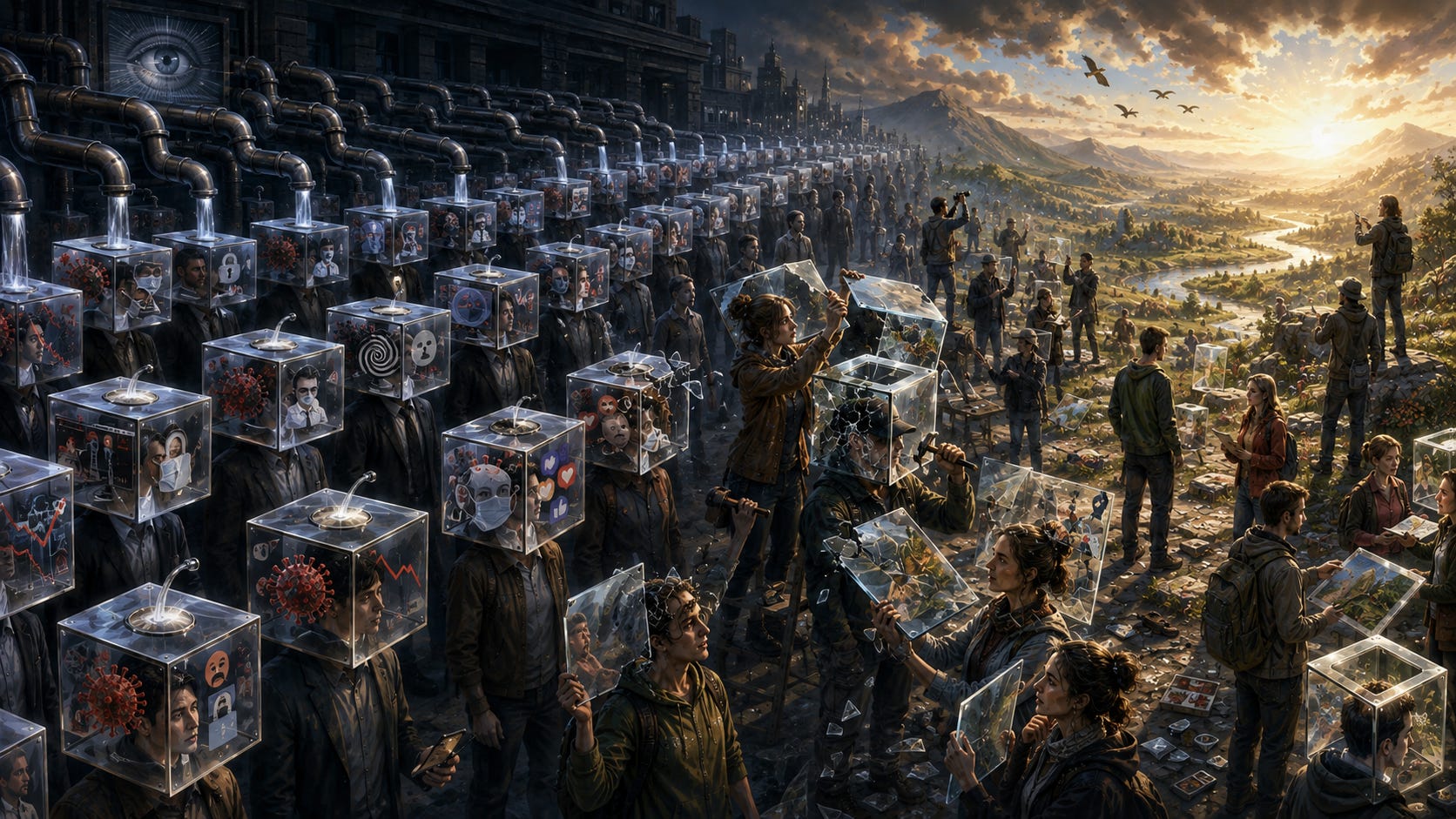
One of the things that has saddened me recently is how few people are willing to “do the work” to understand how symbols truly do rule over our world. They want a cheap and easy shortcut to salvation. Join the right church, political movement or pressure group, and the world will resolve itself.
I see it in my own audience. A few are deeply engaged in this collaborative journey to figure out how we succumbed to corrupt moneychangers and medical charlatans. Many drift off, seeking an easier path. The preoccupations of daily life and ordinary survival leave insufficient capacity to research and ponder.
Yesterday, I published three articles on my Recognition–Reconstruction–Reality (R–R–R) framework, which is unusual for me:
Recognition is not enough — a gentle introduction to the core idea.
The Recognition–Reconstruction “information weapon” for authority integrity audit — a tool to operationalise those ideas.
Ontic caching and the ontological cleaver — the deep mechanics of how reality gets locked out.
Admittedly, generative AI allows creators to put out more content than hand-cranked writing could alone. I use it for the “final assembly” of ideas that I am orchestrating and structuring. I am finding that the quality of insight I can reach, and the depth of conceptual breakthrough, exceeds what I can do unaided.
It’s just a minority sport. Hard mental labour isn’t entertaining.
So to bring to life what this framework can do for us, I have applied it to the Covid pandemic.
If you have remotely been paying attention, you will already know my view: it was one of the biggest criminal scams in history. The wider picture of eugenics, transhumanism, human trafficking, brainwashing, and debt slavery is rather grim, and beyond civilian means of resolution.
I am not going to try to prove that whole case here.
What we can do is unpick carefully the mechanics that allowed this horror show to be inflicted upon us. Because there is a fascinating question hiding underneath all the arguments about masks, lockdowns, vaccines, origins, statistics and censorship:
How do you get millions of people to recognise a particular version of reality — and then make reconstruction of that recognition progressively harder?
That is where R–R–R becomes interesting.
It doesn’t tell us who designed Covid, who benefited, or who committed which crime. It does something more specific.
It gives us a model of the mind lock:
How you install the “it”.
How you couple the “it” to fear, morality and authority.
How you rapidly build dependencies on top of the “it”.
How the cost of reopening the “it” rises.
And finally, how the people trying to reconstruct the “it” can themselves become recognised as the threat.
That is the mechanism I want to examine.
The idea that institutions and governments can overreach their remit and even commit atrocities is hardly new. The “what” has been extensively documented in political science. Even in the context of Covid, the behavioural influence mechanisms have been extensively dissected.
So we can take the following as read:
fear changes behaviour;
propaganda and repetition shape perception;
appeals to authority suppress independent judgement;
conformity and social proof pull people towards the group;
censorship and sanctions raise the cost of dissent;
moralisation turns disagreement into a question of virtue;
institutions acquire sunk costs and defend prior commitments;
people defend identities, reputations and decisions in which they have become invested.
None of that requires R–R–R.
The interesting question is what happens when all of these effects operate upon the recognition itself — upon the thing the population has already accepted as the “it” from which subsequent reasoning begins.
What made “the pandemic” into a socially recognised object at all?
What stabilised that recognition strongly enough for institutions and individuals to build upon it?
And what subsequently made reconstruction increasingly difficult, rather than allowing the recognition to dissolve into ridicule, revision or obscurity?
That is the layer I think R–R–R adds.
The R–R–R theory adds a narrow and precise account of how reality can exert progressively less influence over belief and action. It identifies two logically prior operations — recognition and reconstruction. Taken together, these determine how something becomes an “it” that the system can reason about, and how that “it” can subsequently be checked against reality.
Neither operation is novel in isolation; the claimed breakthrough lies in the architecture of their dynamic interaction, and in what happens when the cost of reconstruction begins to interfere with reality’s ability to correct recognition. It is one of those things that, when you see it, you realise you knew all along, just struggled to articulate cleanly.
The pattern is simple:
Recognition: something becomes an “it” that we can think about and act upon.
Dependency: decisions, habits and identities are built upon that recognition of “it”.
Authority coupling: the recognition of “it” becomes attached to something weighty — safety, survival, morality, belonging or legitimacy.
Restart cost: changing the recognition now means disturbing everything that depends upon the “it”.
Reconstruction hazard: evidence that might reopen the recognition of “it” increasingly feels costly, threatening or inadmissible.
Reality lock-out: reconstruction of “it” weakens, so reality exerts progressively less corrective influence over the original recognition.
We can see this in, say, giving up smoking, a habit which seems to have a life of its own:
The smoker can fully recognise that inhaling smoke (then exhaling it onto others) damages their body, bank balance, welcome in polite company and self-respect.
But “smoking” may now be coupled to stress relief, socialising, reward, identity and emotional regulation, with years of ingrained behaviours built upon it.
Quitting therefore requires much more than recognising a corrective fact and ceasing to put burning sticks in your mouth.
Breaking the habit requires reconstruction of the dependencies that made smoking load-bearing as a part of a tolerable or enjoyable life.
The recognition can change before the architecture built upon it has been reconstructed.
That is why knowing better and living differently are not the same operation. Indeed, knowing that smoking is harmful can increase the very stress that causes someone to turn to smoking for relief.
So the idea of a self-defeating feedback loop is hardly new.
What may be new is the particular R–R–R architecture that generates it:
recognition creates dependencies;
authority coupling makes some of those dependencies load-bearing;
reconstruction threatens them;
rising restart cost then interferes with the very process by which reality could correct the recognition.
The trap is familiar. The claim to novelty is in the machinery.
Seen through the R–R–R lens, here is how the Covid hoax worked.
Step 1: Install the Recognition
First, Covid had to become an “it”: not merely a new respiratory virus, but the pandemic — an extraordinary global emergency requiring extraordinary collective action.
Once that Recognition was socially established, subsequent reasoning could begin from it rather than continually reconstructing whether the Recognition itself remained warranted.
Step 2: Couple the Recognition to maximum authority
“The pandemic” was coupled to the strongest available moral claims: saving lives, protecting the vulnerable, protecting healthcare systems and preventing mass death.
That changed the cost of questioning the Recognition. Reconstruction could now be interpreted not simply as scientific disagreement, but as endangering other people.
Step 3: Build dependencies — fast
Lockdowns, emergency powers, furlough schemes, school closures, testing regimes, vaccination programmes, mandates, passports, professional policies, media narratives and personal identities were rapidly built upon the recognised emergency.
The Recognition became load-bearing.
Reopening it no longer meant changing one belief. It threatened an enormous structure of decisions, careers, expenditure, reputations, relationships and institutional legitimacy.
Step 4: Let restart cost alter Reconstruction
This is the crux move. It is one thing to establish the proto-totalitarian system, another to sustain it.
As those dependencies accumulated, Reconstruction became progressively more expensive.
But rising cost alone is just ordinary lock-in. The R–R–R move is subtler:
eventually the cost of reopening the Recognition begins to affect how Reconstruction itself is processed.
Evidence that might once have prompted an ordinary rethink now threatens policies, careers, reputations, moral identities, institutional legitimacy and prior decisions. The victims of the installed system of mind control therefore have an increasing incentive to explain away, downgrade or exclude the evidence rather than allow it to trigger Reconstruction.
This is recognition curvature.
The populace is no longer merely invested in the Recognition that the pandemic is real and demands exceptional measures. Its investment in that Recognition has begun interfering with the process by which it could discover that the Recognition is wrong.
But curvature does not stop at the treatment of evidence. At sufficient intensity, it changes how the system recognises the people and processes capable of forcing Reconstruction.
That takes us to the next move.
Step 5: Turn the reconstructors into the threat
Once Reconstruction threatened enough downstream commitments, the people attempting it could themselves become recognised as dangerous: irresponsible, anti-science, misinformation spreaders, threats to public health or social cohesion.
The inversion was complete.
Instead of contradictory evidence automatically forcing Reconstruction of the recognised emergency, attempts to perform that reconstruction could themselves become the object requiring suppression.
“Conspiracy theorists” were deemed to deserve deplatforming and ostracism.
Step 6: Reality loses its route back in
This is the mind lock.
The control system does not need everyone to become stupid, irrational or dishonest. Much of the downstream reasoning can remain internally coherent. The self-image of the victims as rational is not directly challenged because, given the anchor Recognition, much of their subsequent reasoning really can be rational.
The manipulation does not require control of every data point or inference. Control the Recognition from which logic proceeds, and ordinary reasoning can do much of the downstream work for you.
Hence the problem is upstream at the Recognition stage.
If the original recognition can no longer be cheaply reconstructed, while enormous dependencies and moral authorities remain attached to it, Reality exerts progressively less influence over what the system recognises and therefore what it subsequently does.
The Recognition has begun protecting itself against its own correction.
Under a maladaptive Recognition, Reality threatens Recognition, so the Reconstruction needed to let Reality back in is precluded.
None of the phenomena described above is entirely new. We already have concepts such as propaganda, conformity, censorship, sunk cost, cognitive dissonance, institutional capture and motivated reasoning.
But they tend to describe different pieces of the puzzle.
R–R–R potentially does something unusual and integrating: it predicts several apparently strange behaviours as consequences of the same underlying architecture.
Why can intelligent people remain rational inside a false frame?
Calling people stupid or brainwashed doesn’t explain very much.
R–R–R suggests that much of their reasoning can actually remain rational. The decisive error sits upstream, in the Recognition that determines what world the subsequent reasoning operates within.
Accept “the pandemic” as the anchor Recognition and all sorts of things can follow quite rationally: extraordinary danger warrants extraordinary measures; extraordinary measures require compliance; non-compliance increases danger; therefore non-compliance is irresponsible.
The individual inferences derived from “it” need not be absurd.
The problem is the “it” they begin from.
Why can more contradictory evidence sometimes produce less reconsideration?
Our intuitive model says that accumulating contrary evidence should eventually force somebody to change their mind. But that assumes evidence is entering a system in which Reconstruction remains cheap.
R–R–R predicts something more awkward. As dependencies accumulate upon a Recognition, evidence capable of overturning it becomes progressively more consequential. It no longer threatens one proposition. It threatens everything built upon that proposition.
At sufficient restart cost, the implications of the evidence can therefore interfere with its ability to trigger Reconstruction.
The evidence gets stronger. But openly admitting what it means—“rollback”—gets more expensive.
That is recognition curvature.
Why can the dissenter become more threatening than the anomaly they are pointing at?
This is particularly interesting.
A troublesome data point can potentially be ignored, explained away or contained.
A person publicly reconstructing the Recognition is different. If they have credibility, technical competence or a large audience, they can propagate Reconstruction through the social system.
The threat is no longer one awkward fact, it is contagious reconsideration.
R–R–R therefore predicts a salience inversion:
the person attempting Reconstruction can attract more institutional attention than the underlying anomaly they are trying to reconstruct.
In the COVID examples developed against the framework, this is the proposed significance of high-propagation critics being treated not merely as people holding minority views, but as hazards to public-health compliance or social cohesion.
Why can a system admit individual mistakes without reconsidering the thing those mistakes were built upon?
This is another puzzle.
Predictions can fail. Policies can change. Claims can quietly disappear. Individual errors can even be acknowledged.
Yet the anchor Recognition survives.
R–R–R gives us a simple reason why. Correcting something downstream can be relatively cheap. Reconstructing the Recognition upon which thousands of downstream commitments depend can be extraordinarily expensive.
The individual’s governing belief system can therefore recognise a corrective rule without executing the Reconstruction that rule would logically require.
In shorthand:
Recognise the correction ≠ Execute the Reconstruction
This is more precise than simply saying that inconvenient evidence was ignored. The corrective principle can be accepted in form while being denied its computational substance.
Why can moral certainty intensify as factual foundations weaken?
You might expect weakening evidence to produce weakening confidence.
But authority coupling changes the equation.
If a Recognition has become coupled to “saving lives”, “protecting the vulnerable”, solidarity, professional virtue or institutional legitimacy, then Reconstruction threatens more than a factual claim.
It threatens the moral authority attached to it.
The empirical foundations can therefore weaken without producing a corresponding collapse in the moral force exhibited by the system. In R–R–R terms, reconstructable authority and exhibited authority can begin to diverge.
Why can people sincerely experience correction as harm?
This may be the most important point psychologically.
The person defending the Recognition does not need consciously to think:
“I know this is false, but I am going to defend it anyway.”
Their job may depend upon it.
Their friendships may depend upon it.
Their previous moral choices may depend upon it.
Their understanding of themselves as a good and responsible person may depend upon it.
Their trust in institutions may depend upon it.
Reconstruction therefore threatens an entire dependency structure.
From inside that structure, resisting Reconstruction need not feel like resisting Reality.
It can feel like defending sanity, morality, belonging and safety.
•••
None of these effects is unknown. Existing psychology, sociology and political science have concepts capable of describing every one of them.
The potential contribution of R–R–R is that they cease to look like a miscellaneous collection of biases, pathologies and institutional failures.
They become possible signatures of the same underlying architecture.
Install a Recognition.
Couple it to high authority.
Build dependencies upon it.
Raise the cost of Reconstruction.
Let that cost begin interfering with Reconstruction itself.
Recognition begins protecting itself from Reconstruction, locking Reality out.
That is the “mind lock”.
The strange behaviours downstream are then no longer separate mysteries.
They are different symptoms of the same mind lock.
There is a more provocative application of the framework.
Consider a hypothetical — purely as a courtesy to readers at different stages of working out what went down.
What if military intelligence knew that a pandemic operation was planned by hostile infiltrators who possessed sufficient leverage — WMD, financial collapse, infrastructure kill switches or something comparable — to make simply stopping the operation impossible?
What could you do?
Now apply R–R–R.
If intelligence communities anticipated that pandemic emergency machinery could be used for population-scale Recognition control, might they pre-position a distributed Reconstruction capability before the emergency began?
In other words: rather than trying to prevent the Recognition from being installed, could you prepare millions of people to reconstruct it afterwards?
That gives us a very different question to ask about Q and the Anons.
I am not claiming that R–R–R directly proves what Q was, who ran it, or that it proves foreknowledge of Covid. Those are separate evidential questions.
The narrower observation is structural, and demonstrable on the record.
If you wanted to resist the kind of mind lock described above, you would face a peculiar problem. Once the emergency Recognition had been successfully installed, ordinary institutional correction might itself become progressively compromised by the dependency and authority structure.
Worse, ordinary institutional or organised resistance could itself be processed as evidence that the Recognition needed defending more strongly.
Resistance would provoke repression; repression would reinforce the threat narrative; and the threat narrative would further entrench the Recognition. You would therefore need Reconstruction capability that existed outside the Recognition system before the “mind lock” occurred.
And preferably lots of it.
Lots and lots and lots of it.
•••
Seen this way, some of the characteristic behaviours cultivated around Q acquire a different significance.
“Do your own research.”
Archive the evidence.
Check dates.
Follow the money.
Compare what was said then with what is said now.
Inspect primary sources.
Question institutional labels.
Look for connections between apparently separate events.
Each asks you to resist treating something as what an authority says it is merely because the authority has successfully named it, i.e. assigned a social Recognition.
In R–R–R terms, these are Reconstruction habits. They repeatedly push the investigator upstream from the recognised “it” towards its provenance, warrant and dependencies.
They are, in effect, exercises in using the ontological cleaver. Don’t just take the “it” as a whole; pull apart its “it-ness” and inspect the components separately.
Whatever else one thinks of Q — and whatever mixture of good analysis, bad analysis, speculation and fantasy subsequently accumulated around it — these are factually Reconstruction behaviours.
They train people to move upstream.
Instead of asking only:
“What should I believe about X?”
the reconstructive actor asks:
“What made this X in the first place?”
That is the ontological-cleaver move.
•••
This suggests a rather different interpretation of the information-war problem.
Suppose an emergency-control architecture depends upon these six things:
Recognition must be installed.
Recognition must acquire overwhelming authority.
Dependencies must accumulate upon it.
Reconstruction must become expensive.
Reconstructors must become socially hazardous.
Reality must progressively lose its route back into Recognition.
Where would you attack it?
Stage 1 is almost impossible to prevent. Societies have to recognise events in order to act upon them. You cannot defend against misrecognition by refusing to recognise anything.
Stage 2 is similarly unavoidable. A genuine emergency may warrant enormous authority. Refusing authority merely because it might be abused leaves you unable to respond to the real thing.
Stage 3 follows from action. Once millions of people and institutions respond to a Recognition, dependencies inevitably accumulate. You cannot run a society without creating them.
By Stage 5, you are already inside the trap. Reconstruction has become threatening enough that the reconstructors themselves can be classified as hazards. Organised opposition can now reinforce the Recognition it is trying to challenge.
By Stage 6, you have largely lost the game. Reality has lost its casting vote because the machinery required to admit its corrective evidence has been compromised.
That leaves Stage 4.
You have to preserve Reconstruction before Reconstruction becomes prohibitively expensive.
The strategic problem is therefore not how to stop society recognising, trusting authority or building dependencies. All three are necessary features of collective action.
It is how to stop those necessary commitments from destroying the pathway by which they can later be reconstructed and corrected.
You attack the Reconstruction bottleneck at Stage 4.
How?
You defeat the mind lock by creating people who refuse to leave provenance permanently cached.
A single dissenter can be ignored.
A scientist can be professionally disciplined.
A newspaper can be pressured.
A platform can remove an account.
But a large, distributed population independently archiving, comparing, questioning, publishing and reconstructing is a different computational object.
It can propagate Reconstruction outside the institutions whose own restart costs may now prevent them from performing it.
In R–R–R terms, such people are high-propagation reconstructive actors.
And that gives us a possible explanation for something otherwise rather curious:
Why would supposedly ridiculous internet “conspiracy theorists” warrant such extraordinary attention by the media and establishment?
If their principal danger were simply that they believed silly things, ridicule alone ought to be sufficient to repel and suppress the ridiculous. That’s its job.
But if the social function of “conspiracy theorists” was to propagate Reconstruction — reopening provenance, challenging authority couplings, preserving inconvenient evidence and encouraging other people to reconstruct recognised states for themselves — then their significance would be quite different.
The danger of “conspiracy theorists” would not necessarily be what they believed.
It would be what they taught other people to do.
That gives us a testable hypothesis about Q.
If Q functioned as a pre-positioned Reconstruction capability, then the interesting pre-2020 material should not merely contain vague predictions that something dramatic was coming.
We should expect to find, in the pre-2020 material:
sustained emphasis on provenance over institutional assertion (“sauce” traceability, primary sources, original documents);
training in distributed evidence preservation and synthesis (“bread”, “bakers”, archives, “save offline”, date-stamping);
anticipation of information control and censorship (“information warfare”, platform attacks, controlled opposition);
warnings that emergency, medical, or public-health authority could be used for wider control purposes (such as the infamous 2019 Covid leak anticipating “9-10 million Americans will be killed during 2020 > 2021 in some kind of major event.”);
repeated separation of institutional status from reconstructable authority (“do your own research”, “think for yourself”);
encouragement of networked, non-centralised investigation (“Anons”);
chronological reconstruction habits (“future proves past”);
and, most critically, methods and habits that remain useful and non-dogmatic even if particular Q claims later prove wrong — including the capacity to reconstruct Q itself.
That last criterion matters.
A genuine Reconstruction capability should not require Q itself to become another unquestionable Recognition.
If “Q said it” becomes sufficient authority, the project has reproduced the very failure mode it supposedly resists.
The proper R–R–R test of Q is therefore almost mischievously recursive: did Q teach people to reconstruct Q?
If not, it risks being merely a competing recognition system.
If so, something considerably more interesting may have been going on.
None of this establishes intelligence authorship or advance knowledge of Covid. Those propositions require their own evidence.
But R–R–R gives us a sharper question to take to the pre-2020 record.
Not merely:
Did Q predict the pandemic?
But:
Did Q build, before the pandemic, the distributed human machinery required to attack precisely the Recognition–Reconstruction failure mode that would later become so consequential?
That is a much harder question to dismiss — and a much harder one to answer.
This all takes me back to where we began. The stakes are existential for humanity, and none of us in the civilian world knows the full scope and scale of the conflict we are embroiled in, only that the end of our species is not a wild possibility. The dream of a Restoration — of fundamental rights and the ability to be left alone — is contingent on civilisation abandoning its quest for cheap and easy false Recognition objects, and being willing to pay the price of Reconstruction when Reality demands it.
My experience is that the appetite for that work is varied. Many do it in private and have dedicated enormous volunteer labour to it. But the wider picture is, sadly, that the temporary hardship of rethinking everything — actually the “easy path” overall — has fewer takers than one might hope. I often wonder if the real battle behind the scenes is not merely to defeat some Cabal-type enemy, but to maintain the conviction that humanity itself is worth saving.
My hope is that those “waking up” in the near future, as the mega-events unfold, find this article useful as part of their recovery from the “mind lock”.
You need not have been stupid or incapable of reasoning. That is precisely the point. Given the Recognition you had accepted, much of the reasoning built upon it may have been perfectly rational. The trap was upstream.
Perhaps the missing faculty was not more loud intellectual intelligence, but greater attention to the quiet intuition that something was off — and the willingness to reconstruct the “it” that everyone else had already accepted.
At least you can now see the trap and begin to step out of it, even if some pieces of bloodied psyche are left in its jaws.
The “recognition war” has real casualties, because Reality gets the final say. Every time.
We can either reconstruct our Recognitions voluntarily, while correction is still cheap, or wait for Reality to reconstruct them for us through consequences.
Reconstruction is how we give Reality a route back into Recognition before the bill comes due.
A well thought out and articulate article on the pandemic an it’s effect on society. It illustrates the formula for all conspiracy theories pointing to the Big Lie - the deep sleep - and those who still remain in it.
Damn! Love the term "mind lock". It appears the only two options to change the trajectory of "humanity" was Q or another mudslide...