

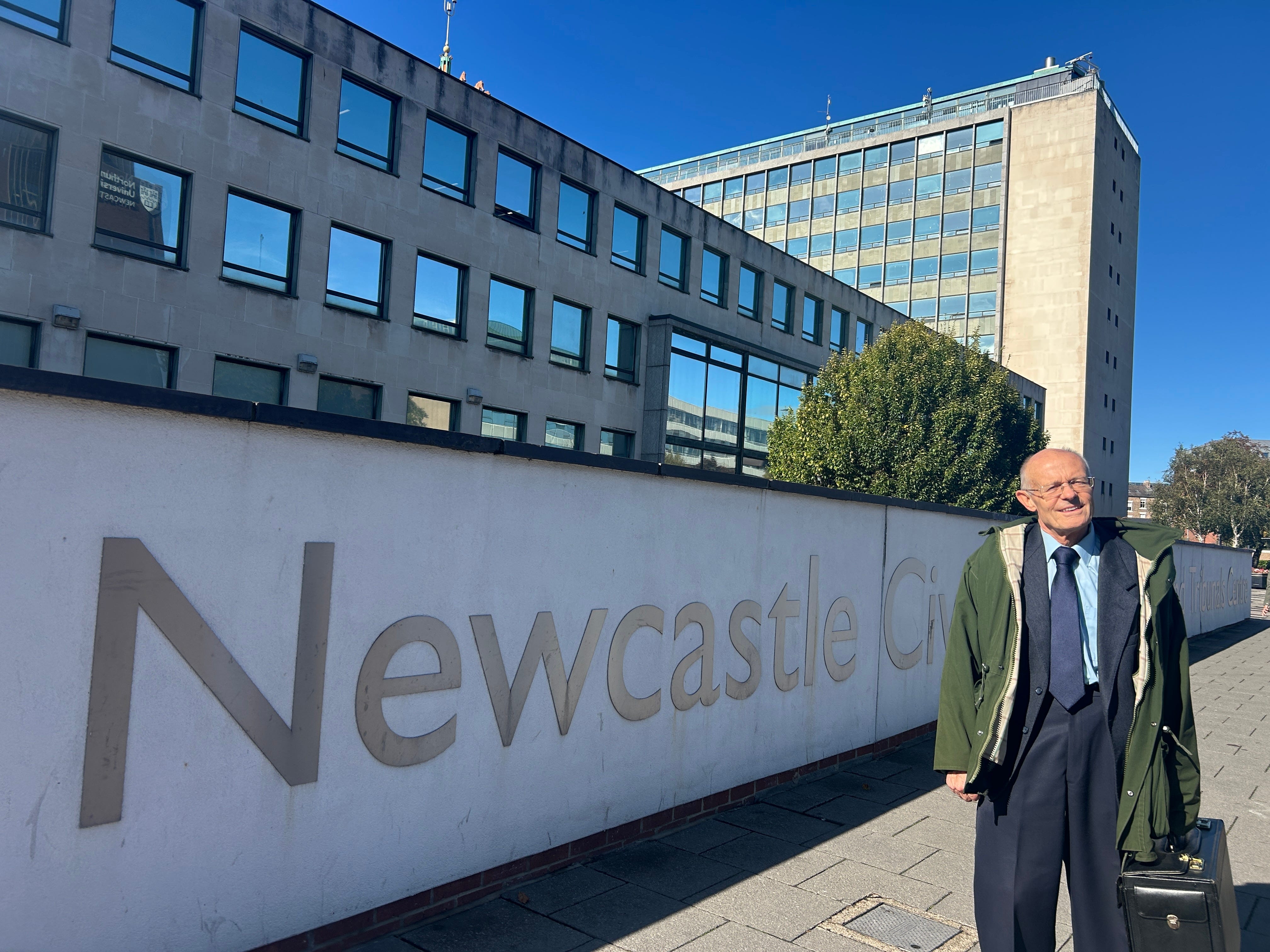
Yesterday I witnessed a “lex crash” in a Newcastle county court. Lex is Latin for law, and a lex crash is a particular kind of disaster: one that leaves victims, but no immediately visible wreckage. Unlike a plane crash, everything can appear to have landed normally. The hearing concludes. An order is made. Costs are awarded. The legal machinery records another completed case.
Yet something has gone catastrophically wrong.
What I witnessed was, in my view, an inversion of both law and justice. What follows is my analysis of how that happened. I make the case primarily in moral, rather than legal, terms. (A detailed technical analysis will follow separately.) Indeed, what makes this case particularly worthy of study is that none of the participants appeared to be acting with negligence, malice, or bias.
The failure was not primarily a personal failure of adjudication, or even a doctrinal failure of law. It was architectural: the legal system permits failures of quality control that other safety-critical disciplines would be designed to detect and prevent. Yet such failures still leave a residue on an ethical ledger from which none of the participants can entirely escape, whatever the adjudication—or, as in this case, the lack of it.
I have written extensively about a separate but parallel dispute my friend Andrew Stephenson has with Northern Powergrid (NPG). His home was disconnected from the electricity grid in February 2023. Andrew argues that this was retaliation, carried out on a false pretext, for professional work in which he helped clients avoid what he says were overcharges by NPG.
Whatever the merits of that separate case, he has been living on diesel-generated electricity ever since, spending around £500 a month on fuel and periodically losing power as equipment fails.
As it happened, one of his collection of generators—some working, some broken—melted its cables the night before the hearing and stopped operating. Luckily it didn’t catch fire and burn his shed down. (I wouldn’t much fancy being on NPG’s PR team explaining that one to the local papers.)
His final preparation for court was interrupted, and he spent the morning dealing with power-supply problems rather than printing out his legal documents. In his slightly flustered state, he forgot to put on a tie. So, before the hearing, we went to Marks & Spencer and bought one for £20.
I was there as his McKenzie friend—a peculiar feature of English law in which a layperson may sit alongside a litigant in person, providing quiet assistance in court without becoming their barrister or solicitor.
This case was not about his 240V domestic electricity supply, but an 11kV industrial cable serving a wind turbine, buried beneath a private lane running in front of Mr Stephenson’s property. The case sought determination of exactly where the boundary of his property lies and, consequently, whether the cable interferes with his property rights.
Across England, along tens of thousands of miles of roads and lanes, there is a longstanding presumption that the soil beneath a roadway belongs to the landowners on either side, each up to the centre line. In the case of public highways, ownership of the soil is distinct from the statutory position governing the highway surface itself.
Which gives me an excuse for my favourite joke about that halfway point: I drive in strict accordance with the instructions on my driving-licence application — tear along the dotted line.
Meanwhile, title deeds and modern Land Registry plans do not necessarily tell you exactly where the actual legal boundary lies. Most registered titles use “general boundaries”: the red line on the map is not, by itself, the last word on the precise extent of ownership.
An ancient legal rule, ad medium filum viae—literally, “to the middle line of the way”—helps bridge that gap. Where the relevant conditions are met, a conveyance of land adjoining a road is presumed to carry the soil beneath the road up to its midpoint, unless the historic conveyancing or surrounding circumstances provide sufficient reason to conclude otherwise.
The indicative map is not the legal terrain.
For most of history, this was rarely worth fighting about. Everyone continued to use the road, while ownership of the largely inaccessible soil beneath it was of little practical consequence. Modern infrastructure has changed that. Electricity cables, fibre-optic broadband networks and other utilities can turn an apparently academic strip of subsoil into land carrying valuable—and potentially contested—rights.
I am going to skip the finer nuances of ad medium filum and cut straight to the controversy. NPG’s cable lies beneath Andrew’s side of the private lane. NPG hold a lease granted by the owner of the land opposite, whose registered title plan appears to include the whole lane. But that lease can grant only such rights as the landlord himself possesses. Andrew’s case is that, unless the ad medium filum presumption is rebutted, the soil beneath his half of the lane belongs to him. NPG disagree, relying upon the title asserted through their landlord. The matter went to court for resolution.
The crucial point is that Andrew adopted an almost paradoxical stance. He did not ask the court simply to take his ownership as established. He said the presumption applied and expressly invited its rebuttal. In other words, he submitted himself to truth: I may win on the facts and law, or I may lose on the facts and law, and either outcome is good because the uncertainty is resolved.
At this stage he was not seeking damages. He was asking for an answer to the foundational question of reality:
Whose land is this cable actually on?
Interestingly, Andrew also has no dispute with his neighbour, who has made no explicit assertion to Andrew that he owns the whole lane. He may have assumed that he did from the registered title plan, but a general-boundaries title plan does not necessarily determine the exact legal boundary.
That is precisely where the old roadway presumption becomes relevant: subject to rebuttal, the law supplies the centre line rather than requiring every generation of adjoining owners to reconstruct centuries of conveyancing history.
This is a rule born of convenience for all. Leaving useless slivers of roadway soil behind with former owners would manufacture uncertainty and disputes for no practical gain. Utilities and other infrastructure operators also benefit enormously from a simplified property system. Such questions can be answered without relitigating the entire history of the land every time somebody wants to bury a cable.
And here lies the seed of what followed. Andrew was not asking the court to assume that he was right. He was asking the legal system to expose his claim to falsification.
Show me the rebuttal — and how it works in law, not merely assertion.
If it exists, I lose. If it does not, the presumption does its work. Either way, we learn whose land the cable is on.
NPG took the opposite stance and sought to have the claim struck out. Where Andrew’s position was truth over outcome, theirs had the practical effect of placing power over truth—perhaps an irony worth noting, given the company’s name.
Their position was that the real dispute was between Andrew and his neighbour; that Andrew needed independently to establish his ownership before he could pursue the derivative issue against NPG; and that, in any event, the neighbour’s act of granting the lease was itself evidence capable of rebutting the presumption.
Think about that for a moment.
Their position was not:
We are confident that we have a right to occupy this particular piece of subsoil, and we are willing to demonstrate the chain of title from which that right derives.
Instead, the structure of the argument was extraordinary. NPG accepted the existence of ad medium filum and its potential application to private roads, yet argued that it could not operate against them here because their rights derived from Andrew’s neighbour. At the same time, the neighbour’s act of granting those very rights was advanced as evidence against the presumption.
Reduced to a deliberately blunt paraphrase, the logic becomes:
“We can rely on your neighbour’s permission to put our cable under this contested land. If you say the land is actually yours, you must first prove that against your neighbour—not us—even if your neighbour has never formally claimed to own it.”
This creates a remarkable loop:
NPG wanted to put a cable beneath the lane.
They obtained permission from Andrew’s neighbour.
But they did not put the cable beneath the neighbour’s side of the lane. They put it beneath Andrew’s side.
Andrew says the soil beneath that half of the lane belongs to him.
So Andrew went to court and asked for the ownership question to be determined.
NPG responded that the question could not be determined against them. Their rights came from the neighbour.
So, on NPG’s case, Andrew must first establish his ownership against the neighbour.
But why should the neighbour be treated as the owner of Andrew’s half of the lane in the first place?
One of NPG’s answers was: because the neighbour had acted as an owner by granting NPG the lease.
In other words, the disputed transaction was itself being used as evidence for the ownership upon which the validity of that transaction depended.
NPG sought termination of the proceedings before the ownership proposition was adjudicated!
Andrew’s position was:
Test my claimed ownership and tell me whether I am wrong.
NPG’s position had the practical effect of saying:
You must establish your ownership somewhere else before you can test whether our derivative right is valid here.
That is the first component of the lex crash: indirection. The question that generated the dispute is redirected rather than answered.
Andrew’s pre-hearing skeleton argument was modest. It repeatedly declined to claim legal territory:
“Either substantive determination provides the certainty for which the proceedings were brought.”
“The Claimant does not ask the Court to assume that his ultimate proprietary case is correct.”
“He accepts that the Court can ultimately reject it.”
And, most strikingly:
“An authoritative adverse determination would resolve the same objectively consequential uncertainty.”
Andrew was not asking the court to believe him. He was asking the court to determine something—the very thing they exist for. He explicitly accepted that the determination might go against him.
Meanwhile, NPG aggressively put the opposite: [Quotations below lightly edited for readability: party abbreviations expanded and the lane name anonymised.]
“Before Stephenson can advance his claim against NPG in any shape or form, Stephenson has to show that he owns the section of the lane beneath which the Underground Cable lies.”
“The presumption cannot operate against NPG.”
“There are no grounds whatsoever for being able to apply the presumption against NPG.”
“The Court cannot adjudicate on matters within these proceedings over which NPG has no control, namely ownership of the lane.”
And finally:
“Stephenson’s claim is entirely misconceived.”
Note the absence of epistemic humility.
Andrew might ultimately prevail in an action against his neighbour. NPG’s position does not logically exclude that possibility. Yet until he does, the uncertainty is effectively allocated entirely against him. His ownership is treated as something still to be proved; NPG’s derivative right is treated as something it may continue to rely upon.
The uncertainty belongs to Andrew. The certainty belongs to NPG.
Debits and credits are being allocated asymmetrically. And that is where the moral ledger begins to accrue its balancing entries.
This is the second component of the lex crash: asymmetry. The property uncertainty is shared, but its practical consequences are not.
NPG’s legal counsel was an experienced property barrister. She struck me as a woman of conscience. In my imagination, if she unfortunately pranged your car in a car park, she’s the kind of person who would leave a note on your windscreen. As she made her case, I noticed a hesitancy. Indeed, some of her arguments seemed to me logically to favour Andrew’s position.
As the hearing went on, I increasingly perceived unease in her manner. I have no reason to doubt her sincerity in the arguments she was advancing. It would be too easy to paint NPG and its representative as the villains here. Rather, something far more significant and structural was taking place. As you read what follows, put yourself in her shoes. This could have been you.
The discomfort appeared to sharpen after Andrew read out his brief oral pitch. It made three simple points:
NPG had inverted the burden of proof.
There were three possible histories of the land. NPG had identified none of them as its case, yet sought a conclusive outcome.
The neighbour might be relevant as an interested party, but that was a procedural question distinct from the deeper question of ownership.
Most significant was Andrew’s disclaimer:
“I may ultimately be wrong on title. That is for determination.”
There was no accusation of impropriety. No allegation of trespass or bad faith. Just a disputed question of title, submitted for determination.
And that is where NPG’s position begins to compound a moral debt.
The contrast is at a primitive and pre-legal level.
Andrew was recognising NPG as a legitimate operator of infrastructure which, of necessity, deploys assets in circumstances where questions of soil rights may sometimes remain incompletely resolved.
NPG was not counter-recognising Andrew as a potential property owner whose rights might, contingently, be infringed. That imbalance does not disappear merely because the case ends. It is posted to a deeper ledger of personal accountability.
Worse still, NPG sought to avoid adjudication on the merits. This naturally raises the question:
What was so bad about being vindicated?
If you have the right to occupy the land with your cable, establish it. Andrew had already accepted the corresponding risk: if you establish it, he loses.
Seeking strike-out does not prove that NPG lacked the right. Nor does it justify a legal inference that they did. But something remains unbalanced. Andrew submitted his claimed right to the possibility of falsification. NPG sought the benefit of its claimed right while resisting that same test.
That does not prove NPG’s account false. It is the refusal of symmetry that creates the debit on the moral ledger.
The judge granted NPG’s application to strike out the claim as an abuse of process, while stopping short of describing Andrew’s case as totally without merit. How I believe the reasoning inverts the law is for another time. NPG sought around £23,000 in costs. The award was reduced to £10,000 — money Andrew does not have.
And this is where truly grotesque outcomes, and the possibility of moral bankruptcy, begin to emerge.
Andrew now faces, by my rough reckoning, something approaching £90,000 in costs payable to NPG across the two cases. Suppose, for a moment, that he ultimately has to sell his home to clear the debt, or that NPG obtains a charge over it.
The property is still burdened by the unresolved question that Andrew went to court to answer: who owns the soil containing the industrial cable? If that uncertainty affects saleability, mortgageability or price, the procedural termination has not made the original problem disappear. It has merely left it attached to the land.
This is the third component of the lex crash: false closure. The legal process has terminated, but the state of reality it was asked to determine remains unresolved.
Now imagine Andrew instead brings proceedings against his neighbour, as NPG’s argument apparently requires, only to encounter another procedural objection: where is the cause of action or actual dispute between them? His neighbour may never have asserted ownership of Andrew’s half of the lane at all.
Andrew could then incur another round of costs attempting to resolve an uncertainty whose practical significance arises because NPG has infrastructure beneath the disputed land. He never asked for the cable to be installed. Andrew says he was told at the time “don’t worry, it won’t be on your land”.
Now take the nightmare hypothetical to its conclusion.
Suppose that, perhaps because a future purchaser or mortgage lender insists upon certainty, the title question is eventually adjudicated. And suppose Andrew was right all along: the disputed half of the lane belonged to him.
Only then can we see the full possibility created by what has happened.
A grandfather approaching retirement has spent years disconnected from mains electricity in circumstances he vigorously disputes, dependent upon diesel generators to keep his home functioning.
Meanwhile, on this hypothetical, the same utility company has an income-producing power transmission asset beneath land that was his all along, without having obtained his permission or paid him for the right to occupy it. When he attempted to obtain an authoritative determination of that question, the company successfully obtained a procedural termination instead. And charged him handsomely for it.
The implications would extend beyond the cable. If Andrew owns that half of the private lane, questions would also arise about whatever construction and maintenance traffic associated with the wind turbine has crossed it and upon what rights.
And here is the moral problem that cannot be struck out.
NPG may sincerely believe that it possesses all the rights it requires. It may ultimately be proved correct. But this judgment did not establish that proposition on the merits. NPG sought and obtained an outcome that prevented Andrew’s claim from reaching that determination.
So, in the nightmare scenario where Andrew is eventually proved to have owned the land all along, the cable becomes profoundly tainted. Every pound earned through the infrastructure thereafter acquires an entry on a ledger that no costs order can extinguish.
The issue is no longer merely what damages might someday be recoverable in law.
It becomes a question of conscience.
That is the nightmare outcome. Not damages. But damnation.
Once people have been confronted with a credible possibility that the rights upon which they rely may not exist, the moral question changes. They need not instantly concede that they are wrong. They need not abandon rights they sincerely believe they possess. But neither can uncertainty always be allocated to the weaker party while power continues to enjoy the benefit of certainty.
If harm to Andrew continues while the land ownership question remains untested, the moral burden does not simply dissipate into the earth.
This is the fourth component of the lex crash: compounding. The unresolved question does not sit harmlessly in a file. Costs accrue to Andrew. Infrastructure remains on NPG’s balance sheet. Economic benefits and burdens continue to be allocated to the wind turbine operator and the neighbour.
The process therefore returns the uncertainty with which it began—only now with costs, consequences and further dependencies attached.
You are left with a permanent lex crash site.
Memorialised in copper.
Andrew may now have an unusually clean appellate question:
Was he required first to litigate against his neighbour before obtaining relief against rights NPG says were derived from that neighbour?
That question matters because the law cannot sensibly work backwards.
The neighbour’s 2016 lease to NPG cannot tell us what the neighbour owned before he granted it. We have to work forwards instead:
Who owned the lane, what happened when the properties were divided, and what land passed with each property?
That is what ad medium filum is for. Where its conditions are met, the law starts with the answer that each side owns to the middle of the lane. Someone can rebut that answer with evidence showing that something different happened.
But you cannot skip that historical question and say:
The neighbour must own the whole lane because he later gave NPG permission to put a cable under it.
A person cannot give away a right merely by behaving as though he has it.
So the legal battle may not be over. And the question potentially matters far beyond Andrew’s lane. Utilities and landowners alike depend upon stable rules for determining who can grant rights over land.
Consider a deliberately absurd example. Suppose tomorrow I incorporate Northern Water Pipes Ltd, and Andrew grants my company a lease over the whole lane. I bury a water pipe beneath the neighbour’s half and point triumphantly to my lease.
Has Andrew’s act of granting it somehow established that he owned the neighbour’s half all along? Of course not! The grant can convey only whatever rights Andrew actually possessed. The same elementary problem exists in the opposite direction.
That is why the reality of history cannot simply be wished away by modern paperwork.
For the time being, however, NPG has won in the legal and material sense. It retains the benefit of its infrastructure while Andrew’s claimed ownership has not been adjudicated in these proceedings. But victory has not supplied certainty. In my analysis, that leaves NPG with a responsibility to seek it.
By hoarding certainty for itself, NPG has also inherited the uncertainty.
As we left court, NPG’s counsel did not meet Andrew’s or my eye. I noticed it because I had already sensed discomfort during the hearing. I cannot know what she was thinking, and it would be unfair to pretend otherwise. She had accused Andrew of circularity, while advancing an argument that was itself circular: the neighbour’s grant was evidence of the ownership required to validate the grant.
Whether any of that discomfort was shame, guilt, professional frustration, or something else entirely is not mine to know. What matters is that such feelings, when they do arise, need not be enemies. They can be signals from conscience that something deserves another look.
Andrew’s stance, stripped of self-will, left only a mirror.
So I hope there was discomfort. The more troubling possibility would be indifference. Shame need not be inflicted upon people, but conscience is one of the mechanisms by which human beings notice that formal success and moral resolution are not necessarily the same thing.
The ancient moral test is simple: reverse the roles.
If the cable were beneath NPG’s land, under a right derived from someone whose ownership of that land remained unresolved, would NPG regard “establish your title somewhere else first” as a satisfactory answer? The Golden Rule asks us to extend to others the standard we would expect for ourselves.
And conscience has a practical purpose. Once the possibility that something may be wrong has seriously presented itself, there comes an opportunity—and eventually a responsibility—to find out. A procedural victory does not remove that responsibility; if anything, leaving the question unresolved makes independent truth-seeking more important.
So there is a simple way out of the impasse for NPG and its personnel:
Submit the proposition to truth.
If the courts cannot presently supply the answer, NPG can still perform the exercise internally. Put competent people in a clean room. Reconstruct the conveyancing history without assuming the desired conclusion. Identify the historical event by which the neighbour acquired the disputed half of the lane. State the actual chain of title upon which NPG says its derivative right depends.
If the reconstruction establishes the right, excellent. Crack on.
If it does not, acknowledge the problem and compensate Andrew appropriately.
That is equality of corrigibility. It requires neither humiliation nor confession. It requires only a willingness to discover whether the representation inside the institution still corresponds to reality outside it.
Meanwhile, Andrew faces the next indignity: obtaining the official transcript so that he can properly consider an appeal.
Here the lex crash acquires an almost comic technological coda. The hearing was digitally recorded. Yet the official process requires an EX107 request, court processing, retrieval of the recording, an authorised transcription company, payment calculated by transcript length, and potentially judicial approval.
HMCTS itself says locating and sending the recording to the transcription company takes around ten working days on average, before some other stages are counted. And you only have 21 days in which to appeal.
In 2026, that is extraordinary.
An automated, explicitly unofficial AI transcript could be generated for pennies and emailed to the parties almost immediately, with the certified human transcript following where required.
Instead, a litigant who has just been ordered to pay £10,000 may have to spend hundreds more merely to obtain a usable textual record of the hearing in which the order was made.
The machinery has finished with Andrew.
Andrew has not finished with the machinery.
If you would like to help him obtain the transcript and investigate an appeal, I have set up a small appeal fund:
I believe this has now crossed the line from a private property dispute into public-interest litigation.
The question is no longer simply who owns half of one lane. It is whether a landowner can invoke an established presumption of English property law, expressly submit it to rebuttal, and nevertheless leave the proceedings without an adjudication of the proprietary question. All while the infrastructure operator continues to enjoy the benefit of the disputed right.
That combination—procedural closure without resolution of the property question—is, to me, dark and dangerous. The imbalance of power is not a comfortable one.
I very much hope NPG steps away from this path—not merely out of mercy towards Andrew, but in the interests of good corporate governance, legal certainty for all infrastructure operators, and, ultimately, its own self-interest.