

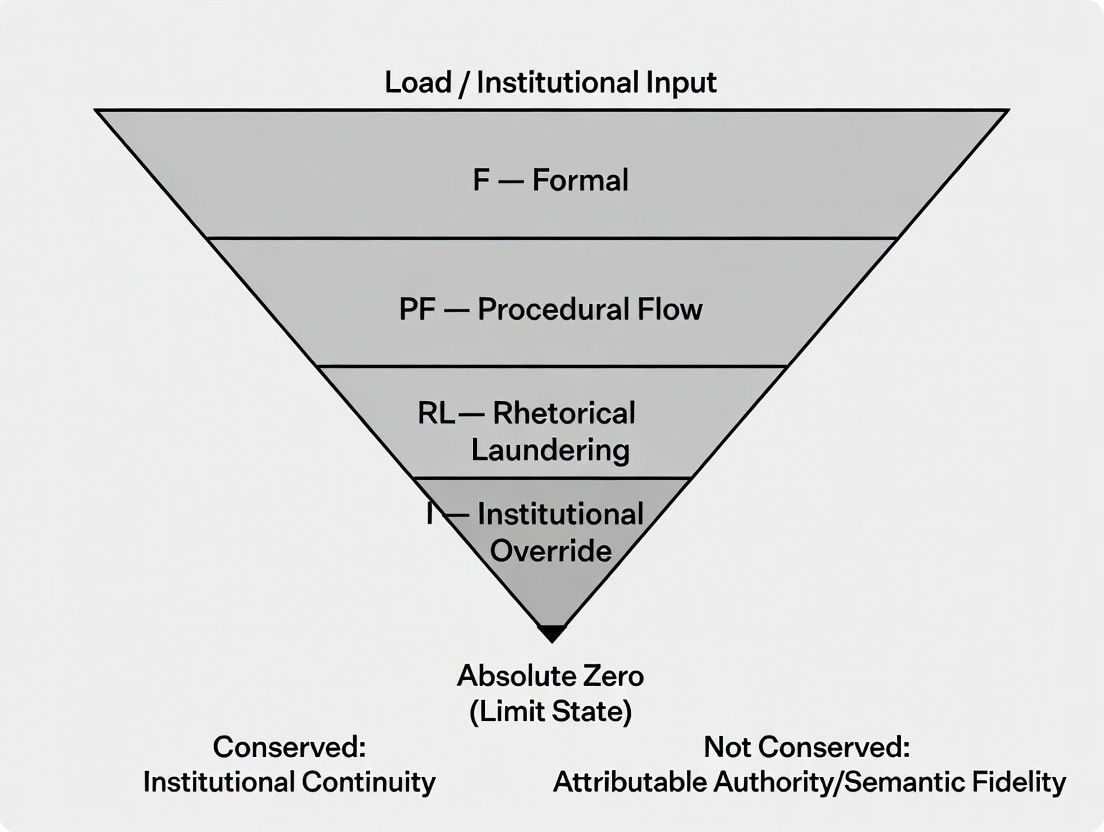
This is an unusual Substack article.
It is not an exercise in “Martin’s creative writing analysis”, nor an opinion piece, nor an argument about what should happen. Instead, it presents a heavily curated framework for a putative new discipline: the computational deconstruction of institutional attribution. I call this the ∆∑ framework. You can think of it as part of a nascent science of sovereignty for the AI era.
In plain terms, the framework is concerned with how authority evades accountability by degrading attribution. When institutions act in ways that affect you, but you can no longer clearly say who acted, on what authority, and by what reasoning, responsibility dissolves. When attribution fails, blame cannot be assigned, remedies cannot be targeted, and power becomes structurally insulated from challenge.
This article is designed to be used, not merely read.
Its overall shape is deliberately unconventional:
An introduction that explains what kind of framework this is, and what problems it is intended to address
A set of illustrative problem classes showing how the framework might be applied
Explicit caveats describing what the framework does not do, and where its limits lie
A long, formal specification of the framework itself, written to be self-contained and primarily suitable for machine ingestion, building on a shorter prose version published previously
If you receive an over-demanding letter from a bank, an opaque response to a complaint, or an apparently unfair court order, you might try running it through this lens.
Ask an AI to analyse the communication using the ∆∑ framework: to identify how attribution is being degraded, what is being conserved instead, and where the structural weaknesses may lie.
My hope is that by equipping others with formal, shareable analytical tools, rather than arguments or slogans, we can collectively hold institutional power to account in a way that is more robust, more precise, and better suited to the realities of the AI age.
What this framework is (and is not)
The ΔΣ framework is a formal analytical tool for examining how institutional systems behave when they are required to act under constraint. It is concerned with structure, not outcomes; with mechanisms, not motives; and with limits, not ideals.
At its core, the framework addresses a specific class of breakdowns: situations in which institutions exercise power or produce consequences, yet responsibility becomes difficult or impossible to locate. When outcomes affect individuals but no clear answer can be given to who decided, on what authority, and by what reasoning, attribution fails and accountability becomes structurally untraceable.
ΔΣ is designed to make that failure legible.
The framework treats institutions as systems that transform meaning into action. When those systems are lightly loaded, attribution is typically explicit and inspectable. As load increases—through volume, complexity, risk, or political pressure—institutions adapt. They do so in patterned ways that preserve continuity of operation while degrading the semantic clarity required for attribution.
ΔΣ provides a vocabulary and structure for describing those patterns.
Importantly, ΔΣ is descriptive rather than prescriptive. It does not evaluate institutions, adjudicate disputes, or propose outcomes. Its role is to characterise how attribution behaves structurally when systems act under constraint. Instead, it describes what does happen, structurally, when systems are forced to act while avoiding the cost of explicit attribution.
Nor is ΔΣ a reform programme, a legal theory, or a political position. While it can be applied to law, regulation, governance, and other domains that exercise coercive power, it does not depend on any particular doctrine, constitution, or institutional arrangement. The framework is deliberately domain-general: it applies wherever institutions act, consequences follow, and attribution matters.
You can think of ΔΣ as a limit framework. It becomes most informative precisely where conventional explanations lose traction—where procedures proliferate, justifications multiply, and responsibility can no longer be cleanly traced. In those conditions, the framework does not restore clarity by assertion or argument. It reveals which structural properties are being conserved, which are being traded away, and what that implies about the system’s proximity to its limits.
What follows in this article builds toward a formal specification of the framework itself. The intervening sections locate ΔΣ conceptually and illustrate the classes of problems it is suited to analyse. Readers seeking only the canonical definition may proceed directly to the final section, where the framework is presented as a self-contained specification.
Conceptual location
ΔΣ is best understood as a limit framework rather than a general explanatory theory. It does not aim to model everyday institutional behaviour in full detail. Instead, it characterises what becomes visible when institutional systems are placed under sustained constraint and are required to act while preserving continuity.
In this respect, ΔΣ sits alongside other limit-based formalisms:
Computability theory (Turing): under constraint, attention shifts from what programs can do to what they cannot do, revealing hard limits on computation.
Information theory (Shannon): increasing noise exposes which quantities are conserved through transmission and which are irretrievably lost.
Information translocatability (ΔQ): work developed in the context of large-scale telecommunications systems shows how load reveals which aspects of meaning can be preserved across transformation and which must attenuate.
ΔΣ adopts a similar stance toward institutions: it is concerned with which properties remain invariant when semantic grounding and explicit attribution become infeasible under load.
A defining feature of the framework is its focus on attribution as a requirement of system behaviour, not a moral or legal judgement. Institutions that exercise coercive power must, at some point, resolve questions of who decided, on what authority, and by what reasoning.
ΔΣ treats this resolution as a form of computation: it may be explicit and inspectable, deferred through procedure, compressed into rhetoric, or abandoned in favour of continuity. These are not anomalies in the everyday sense; they are predictable responses to constraint.
ΔΣ is deliberately agnostic about institutional form. It does not presuppose courts, regulators, corporations, or states, nor does it rely on any particular doctrine of sovereignty or legitimacy. Any system that transforms meaning into action and imposes consequences on individuals falls within its scope. This generality allows the same patterns to be recognised across domains that are usually analysed in isolation.
The framework is also intentionally conservative in its commitments. It does not claim that attribution failure is always avoidable, nor that explicit attribution is always desirable. Instead, it makes a weaker and more tractable claim:
that when systems act under constraint, they will conserve continuity at the expense of attribution, and that this trade-off follows regular, recognisable forms.
Finally, ΔΣ occupies a diagnostic rather than foundational role. It does not replace existing theories of law, governance, or organisation. Rather, it provides a common analytical lens through which their behaviour under constraint can be compared. The formal mechanics underlying this diagnosis are presented later in the article as a self-contained specification.
The next section turns from positioning to use, outlining the classes of problems for which this framework is most informative.
Classes of problems the framework can help analyse
The ΔΣ framework is most useful in situations where institutional action produces consequences, yet conventional explanations fail to account for how responsibility is being exercised or avoided. It focuses on structural patterns that recur under load, rather than on individual misconduct or isolated procedural error.
One such class involves opaque institutional communications. These include letters, notices, determinations, or decisions that assert authority or demand compliance while making it difficult to identify who decided, under what mandate, or through which reasoning process.
ΔΣ helps surface whether attribution has been deferred through procedure, compressed into rhetoric, or abandoned in favour of continuity.
A second class concerns procedural proliferation without resolution. In many systems, increasing complexity leads to additional layers of process, review, escalation, or referral. While these mechanisms appear to add rigour, they often function to buffer attribution rather than resolve it.
ΔΣ makes visible when procedure is carrying attribution forward versus when it has become a substitute for it.
The framework is also applicable to threshold decisions under pressure, where institutions act quickly or defensively in response to volume, risk, or political sensitivity. In such cases, explicit attribution may be treated as infeasible to sustain.
ΔΣ illuminates how systems transition from formal decision-making to rhetorical justification or outright override, and what is being conserved in the process.
Another important class involves cross-institutional handoffs. Responsibility is frequently transferred between bodies—courts and agencies, regulators and contractors, committees and enforcement arms.
ΔΣ helps expose whether attribution is preserved across these boundaries or whether it degrades through compression, delegation to oracles, or disappearance into institutional seams.
ΔΣ is also useful in analysing responses to complaints, challenges, or requests for clarification. When institutions are asked to explain or justify their actions, their replies often reveal how attribution is being managed under scrutiny.
∆∑ helps distinguish between responses that genuinely carry attribution forward and those that maintain continuity while avoiding resolution.
Finally, the framework applies to situations approaching institutional limits, where systems are forced to act despite unresolved questions of authority or responsibility.
In such cases, ΔΣ clarifies which invariant is ultimately revealed as the system approaches its limit state.
Across all these classes, ΔΣ does not determine whether an institution is acting correctly or improperly. It provides a way to analyse how attribution is being handled and why certain patterns recur under constraint. The precise mechanics underlying these patterns are set out later in the article in the formal specification of the framework.
How the framework is used
ΔΣ is typically used when someone encounters an institutional action that does something to them — imposes a requirement, denies a request, issues a decision, or demands compliance — and they are left unclear how that outcome was actually produced.
As outlined earlier, the framework treats these experiences not as isolated frustrations or errors, but as recurring structural responses to institutional load.
In practice, this often looks like: “I’ve been told what will happen, but I can’t tell who decided this, or on what basis.” ΔΣ provides a way to analyse that situation without assuming bad faith, error, or illegitimacy.
“I’ve received a letter or notice that asserts authority”
Many readers intuitively encounter ΔΣ-style reasoning in response to a formal-looking communication: a letter from a bank, a regulator, a university, a court, or a large organisation. The document may cite procedures, policies, or regulations, but still leave it unclear where responsibility actually lies.
A ΔΣ-style AI prompt reframes the problem structurally:
Analyse this letter using the ΔΣ framework. Where does it clearly attribute a decision to a specific authority, and where does it rely on procedure, policy, or generic language instead?
This shifts attention away from tone or fairness and toward how attribution is being carried — or not carried — by the document itself.
“I’m being sent around a process without getting an answer”
Another common experience is procedural drift: being referred to forms, portals, reviews, or escalation paths that never quite resolve the underlying question.
ΔΣ treats this not as bureaucratic incompetence, but as a structural pattern:
Using the ΔΣ framework, analyse whether this process is carrying attribution forward, or whether procedure is functioning as a substitute for attribution.
This helps distinguish between process that genuinely leads to a decision and process that primarily buffers responsibility.
“The explanation sounds reasonable, but nothing is actually decided”
Institutions often respond to challenge or scrutiny with explanations that sound coherent and well-intentioned, yet stop short of identifying a deciding authority.
ΔΣ prompts focus on what the response does structurally:
Analyse this response using the ΔΣ framework. Does it resolve attribution, defer it through explanation, or compress it into general justification while preserving continuity?
This reframes “unsatisfying explanations” as a recognisable mode of operation rather than a personal frustration.
“Different parts of the organisation say different things”
Responsibility often becomes unclear when multiple bodies are involved — departments, agencies, contractors, committees, or external partners.
ΔΣ helps analyse attribution across handoffs:
Given this sequence of interactions, use the ΔΣ framework to track how attribution changes as responsibility moves between organisations. Where is it preserved, and where does it degrade?
This can make visible how no single actor appears to “own” the decision, even though consequences are enforced.
“Things escalate, but no one ever takes responsibility”
In high-volume or high-pressure situations, readers often notice a shift: decisions feel more final, yet less attributable.
ΔΣ frames this as proximity to a limit condition:
Using the ΔΣ framework, assess whether this interaction is approaching a limit state. What appears to be conserved as explicit attribution becomes infeasible?
This helps explain why escalation can coincide with reduced clarity rather than resolution.
What these examples are meant to show
These examples are not advice, scripts, or strategies. They illustrate how ΔΣ reframes familiar frustrations — confusing letters, endless processes, evasive explanations — as structural patterns of attribution under load.
The framework does not tell the reader what to do next. It provides a way to see what is happening more clearly. The formal mechanics that make these analyses coherent are set out later in the article in the framework’s specification.
Scope, limits, and non-goals
The ΔΣ framework is intentionally limited in scope. Its purpose is to describe the structural behaviour of attribution under institutional constraint, not to serve as a general theory of institutions, governance, or power. This section clarifies where the framework applies and where it deliberately stops.
Scope
ΔΣ applies to situations in which institutions act in ways that produce consequences for identifiable individuals. It is relevant wherever authority is exercised, outcomes are enforced, and questions of attribution arise. The framework is domain-general: it does not depend on any specific legal system, regulatory regime, organisational form, or political context.
Within that scope, ΔΣ concerns itself exclusively with how attribution is handled structurally. It examines how meaning is transformed into action, how attributability is buffered or degraded under load, and which invariants are conserved as systems approach their limits. It does not attempt to model everyday institutional functioning in full detail, only the patterns that emerge under sustained constraint.
Limits
ΔΣ does not explain why institutions adopt particular policies, nor does it assess whether their actions are justified, reasonable, or lawful. Questions of intent, motive, belief, or good faith lie outside the framework.
The framework is not predictive in a strong sense. While it identifies regular structural patterns, it does not forecast outcomes or prescribe responses. It describes what becomes visible as attribution degrades; it does not guarantee how any specific institution will behave in advance.
ΔΣ also deliberately stops short of modelling belief, consent, trust, or legitimacy as internal variables. These factors may interact with attribution in practice, but they are treated as external to the core framework. This constraint is essential to maintaining a minimal, closed theory.
Non-goals
ΔΣ is not a reform programme, a compliance checklist, or a strategy guide. It offers no guidance on challenging decisions, escalating disputes, or compelling accountability, and it proposes no remedies, interventions, or best practices.
Nor is the framework intended as a critique of particular institutions or individuals. It does not imply wrongdoing, incompetence, or bad faith. The patterns it describes can arise even in well-intentioned systems operating under legitimate constraints.
Finally, ΔΣ does not seek to replace existing theories of law, governance, or organisation. It is designed to sit alongside them, providing a structural lens for analysing attribution failure where other explanations lose traction.
With these boundaries in place, the final section presents the ΔΣ framework itself as a formal specification. That specification is self-contained and constitutes the canonical definition of the framework.
The ΔΣ framework formal specification
Preamble
This section presents the formal core of the ΔΣ / Attributability framework. It constitutes the canonical public statement of the theory and is intended to be self-contained, machine-ingestable, and structurally precise. All preceding sections of the article are orienting and illustrative only; they do not form part of the theory itself.
ΔΣ is a limit theory. It functions as a boundary operator within a wider theory of attributability, isolating the invariant behaviour that emerges when semantic grounding becomes computationally or institutionally unsustainable. The framework does not prescribe actions, assign blame, or adjudicate disputes. It specifies structural properties that hold regardless of intent, belief, or justification.
The theory is intentionally minimal and closed. Concepts are divided into core primitives and derived structural consequences, with explicit boundary declarations for all material outside the core.
Part I — Core theory (limit conditions)
The following concepts are primitive, irreducible at Absolute Zero, and invariant under hostile interpretation. Together they form the minimal closed core of the ΔΣ framework.
Unless otherwise stated, core concepts retain their definition at Absolute Zero.
Attribution
The act of grounding an institutional outcome in determinate authority. Attribution answers the question of who acted, by what authority, and through which decision pathway.Attributability
The property of an act being capable of valid attribution. Attributability may exist prior to attribution and may be buffered or deferred. At Absolute Zero, attributability collapses into attribution.Coercion
The application of enforced consequences to a named individual. Coercion is the boundary condition that forces attribution computation to terminate.Semantic transformation
The mapping of structured meaning into institutional action. All institutional acts are the result of semantic transformation.Semantic fidelity
The degree to which semantic content is preserved through semantic transformation. Semantic fidelity is a structural quantity describing attenuation, not a value judgement.Invariant revelation under load
Under increasing constraint, institutional systems reveal the invariant they conserve. Revelation is non-agentic; invariants are exposed, not chosen.Conservation of institutional continuity
Institutional systems conserve continuity of operation under load.Non-conservation of attributable authority (ΔΣ-loss)
Attributable authority and semantic fidelity are traded in order to conserve institutional continuity.Irreversibility of semantic attenuation
Once lost, semantic fidelity cannot be recovered by subsequent procedure.Absolute Zero (AZ)
The limit state in which all buffering, substitution, and deferral mechanisms are exhausted, forcing invariant revelation.
Part II — Derived structural consequences
The following structures arise necessarily when the core primitives are placed under load. They are not primitive, but follow from the core theory prior to the limit state.
One-way authority flow
Authority flows from adjudication to enforcement. It does not flow upward from process to authority.No coercion without attribution
Any coercive act requires attribution, even if attribution is partial, compressed, or defective.Form removal increases attribution load
The removal of institutional form increases the computational burden required to maintain attributability.Four operational modes (normal form)
Institutional action under load converges to four modes:
F (formal), PF (procedural flow), RL (rhetorical laundering), I (institutional override).Derived mechanism: oracle introduction
Attribution is externalised to premises that are uninspectable or non-falsifiable.Derived mechanism: proof compression
Partial or surrogate certificates are substituted for full attribution.Derived mechanism: proof abandonment
Attribution is terminated without producing a proof object.4–3–2–1 structural collapse
Under load, systems collapse from four modes to three derived mechanisms, to two invariants, to one limit condition.Ghost institutions
Procedurally active entities whose denotational grounding has collapsed due to semantic attenuation.Continuity theatre
Behaviour that preserves the appearance of operation while attribution has failed.Proof-carrying authority (PCA)
The requirement that attributable acts admit finite, inspectable certificates.Undecidable authority chains
Attribution chains that cannot terminate due to self-reference or oracle dependence.
Part III — Boundary and scope declarations
The ΔΣ framework is intentionally bounded.
Concepts relating to belief, legitimacy, normativity, or intention are not part of the core theory. They may appear as external substrates or interface constructs but do not feed back into the core.
Domain-specific instantiations (e.g. law, regulation, governance) are applications of semantic transformation, not additions to the theory.
Metrics, diagnostics, tactics, stress-testing methods, and reform proposals are explicitly excluded.
Analogies (e.g. to information theory, thermodynamics, or computation) are explanatory only and carry no ontological weight.
Closure statement
The core theory is minimal and closed.
All derived consequences follow necessarily from the core.
Extensions do not modify primitives.
No additional concepts are required to describe invariant behaviour at the limit.
This specification constitutes the canonical public readout of the ΔΣ / Attributability framework.