

This is going to be a short update, not a long treatise.
Over the last eight or more years I have written extensively on the Deep State — much of which appears in my essay compendium book from 2020, Open Your Mind to Change.
In the last five years I have found myself enmeshed in lawfare, both as a litigant and observer. This has generated a long trail of artefacts: court orders, pleadings, transcripts, correspondence, timelines, and thousands of saved AI-assisted analyses. They have become a vast forensic dataset waiting to be mined for patterns.
When I started this journey, I thought I was investigating corruption. More recently I thought I was investigating Deprivation Of Rights Under Colour Of Law (DORUCOL)—the use of courts to facilitate unlawful conversion of rights while camouflaged as justice. I still think that matters. But it now feels like DORUCOL is itself the visible symptom of something deeper.
Right now I am spending twelve or more hours most days assembling a detailed theory of what I am calling the Dirty State.
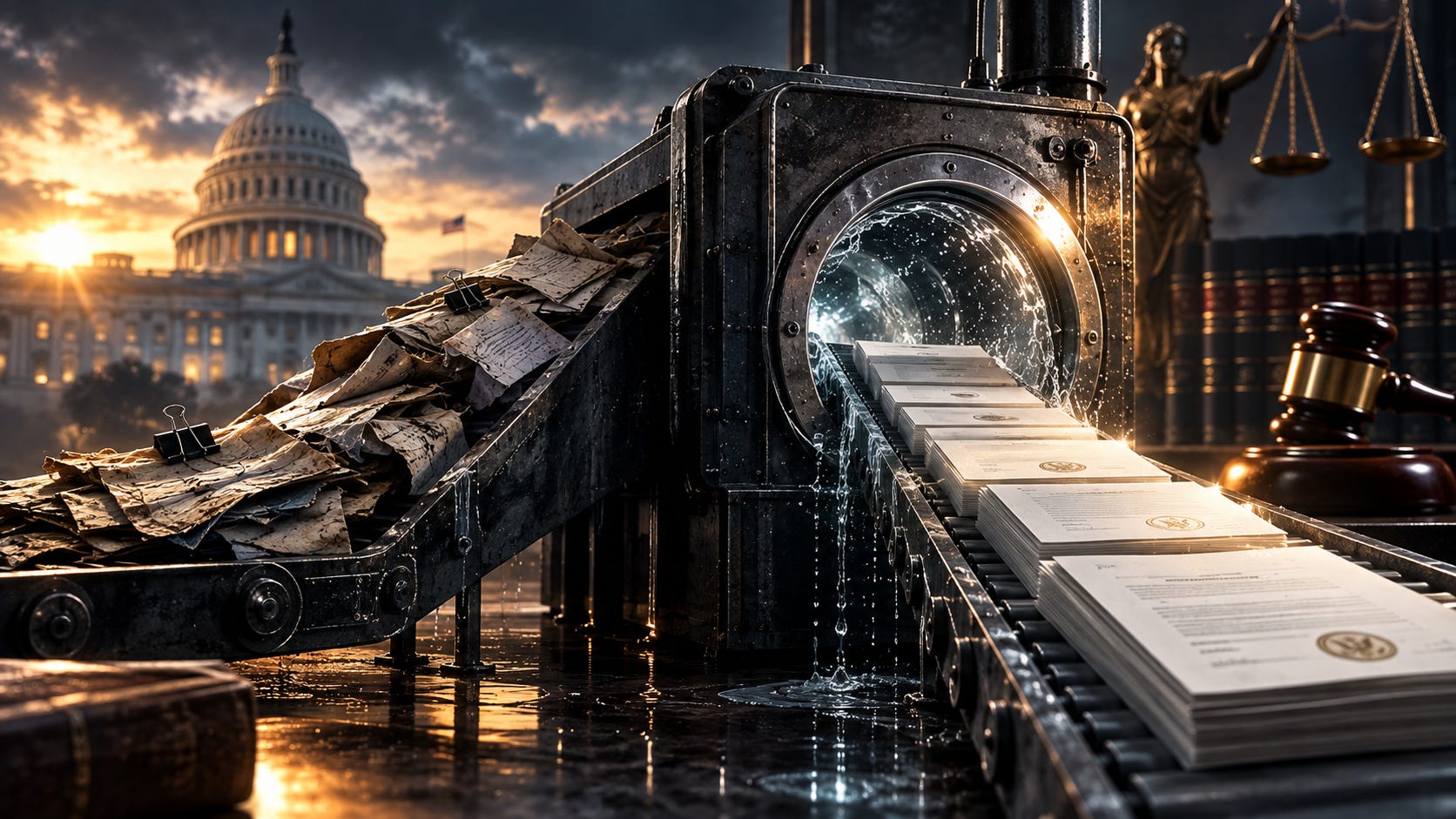
The Dirty State is the interface by which constitutional limits on power are bypassed and self-recognition of authority is installed in their place. It is the mechanism by which factual conditions, created through unlawful acts, become accepted as the new legal baseline. Once that happens, every subsequent decision is derived from that altered reality. It is, in effect, the constitutional equivalent of money laundering.
The problem itself is not novel. Lawyers, philosophers and political scientists have wrestled with it for generations. What seems different is the way I am approaching it.
Coming from a computer science background, I naturally think of courts as constitutional computers. Their purpose is to receive lawful inputs, apply authorised rules, and update the constitutional state of society. Like any transactional computer system, they should only commit authorised changes, and if a proposed state transition fails validation they should roll back to the last known good state.
Increasingly, I am finding examples where that intuition seems to explain far more than traditional legal analysis.
The result is what computer scientists would recognise as a dirty state: an inconsistency between the authorised state of the system and what has actually occurred. Once a dirty state is accepted as the new baseline, it becomes extraordinarily difficult to unwind. Every subsequent order appears internally consistent because it is reasoning from a compromised starting point. The original unlawful transition gradually disappears beneath layers of apparently legitimate process.
In a way it is the perfect crime. You not only obtain whatever advantage you sought in the first place; you then recruit the machinery of the state itself to defend that new reality. Those objecting to the original wrong are no longer treated as victims asking for restoration. They become litigants challenging an established status quo.
That is a profound shift.
I look forward to updating you more on what I have learned about these mechanisms and the ways of detecting the subtle substitution of different governing frameworks and protocols. Increasingly I see law not simply as a body of rules but as a technology. In honest hands it constrains power. In dishonest hands it becomes a remarkably effective weapon for acquiring and preserving power while maintaining the outward appearance of legality.
Synthesising all this is going to take time. Everyone knows the legal system can be used as a means of oppression. Even after saving off over 1,200 AI prompt responses in the last month I feel that I am only scratching the surface of the operating system by which people can be stripped of rights, relationships and assets while everything still appears procedurally normal. Had I understood these mechanisms a few years ago, several situations in my own life would have unfolded very differently.
What I can say with confidence is that AI now allows forensic analysis of legal records in ways that were simply impossible even twelve or twenty-four months ago. These systems are remarkably good at reconstructing state transitions, identifying hidden assumptions, comparing operational sequences and spotting subtle asymmetries that no human reader would consciously notice. The corrupt attorney or dishonest judge leaves traces precisely because law is procedural. Every unlawful state transition generates a signature. Those signatures can now be detected and compared across cases at a scale that was previously unimaginable.
The Deep State is illegal on its own terms, and we tend to think of it mostly in terms of central government and the military-industrial complex.
The Dirty State is different.
It lives in our towns, schools and local courts. It is every bit as dangerous because it wears the clothes of legality. Most people instinctively know that something is wrong—that judges and lawyers are sometimes taking them for a ride—but they lack both the language and the conceptual tools to explain exactly what is happening.
That is what I am trying to build.
Whether the answer ultimately involves anisotropisms, tensors, eigenmodes or entirely different mathematical structures is almost beside the point. The concepts already exist. What is missing is a way of packaging them so ordinary people can recognise when constitutional reality has quietly diverged from official reality.
Some of what I have seen while pursuing this work has been genuinely depraved. Constitutional violence rarely looks like violence at all. It appears as paperwork, hearings, procedural rulings and judicial signatures. Truth and morality can disappear beneath a judge’s pen without anyone noticing that the constitutional state has just been altered.
I started writing a much longer essay today to explain what I have learned.
Then I discovered I still hadn’t reached bedrock.
Every time I thought I had found the primitive operation, another layer appeared beneath it.
So instead I have written this shorter note. A placeholder, if you like. Just so you know that if I am quiet for a while, it is because I am busy.
Productively so.
MG
Thank you. continue to applaud your superhuman efforts Martin.
🩷
Really admire your ability to get to the route of all the ways we’ve been beaten, tricked, and misled through “systems of fantastic entrapment” .. my own description. You are a gift to the cause of truth and freedom. Kudos beyond kudos to you! We are patient. Sorta. 😂😂😂