

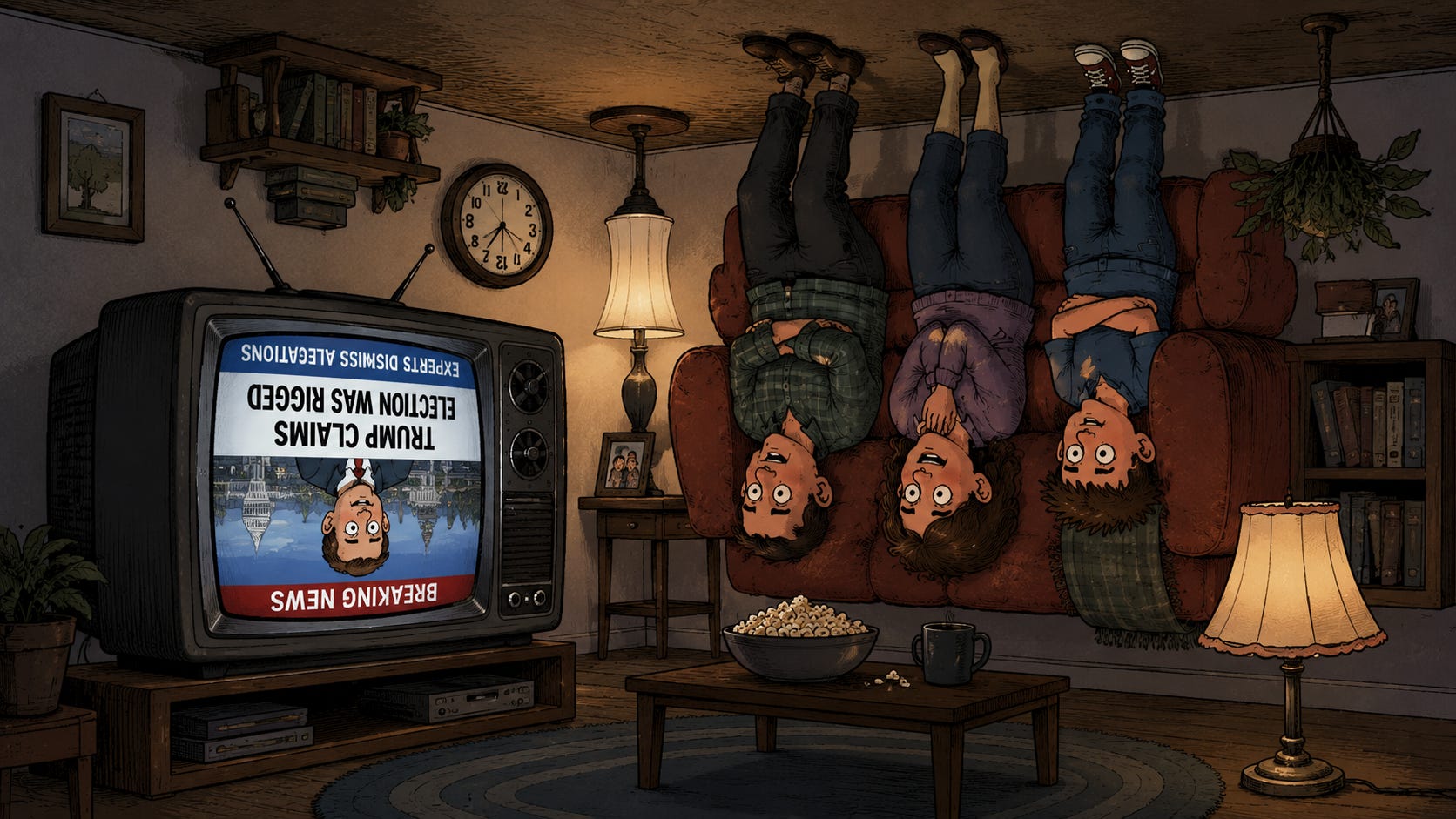
I would argue that the most accomplished magicians of our age are Penn and Teller. This is not because their illusions are necessarily the most difficult, dangerous, or spectacular—impressive though they are. It is because they are willing to show you how the trick works and yet still remain masters of their craft.
They are not trying to maintain a one-up position over their audience. Their magic is an invitation to wonder, not a claim to hidden power. Once you understand the mechanism, the performance does not collapse; if anything, your admiration grows.
Propaganda is the opposite.
Its power depends on the mechanism remaining hidden. Once you understand how the manipulation works, the spell is broken. Trust evaporates because the institution was relying on your ignorance to produce the desired effect. Awakening is therefore not acquiring secret knowledge so much as withdrawing cooperation from a system that depended upon unconscious participation.
This article is about one such mechanism. Using a recent BBC News report on President Trump’s declassification of election-related intelligence as a case study, I want to expose a subtle inversion that I believe is transforming modern journalism from within.
My argument is not that the BBC article contains obvious lies. Nor is it simply that it is biased or incomplete. Rather, I argue that it performs a different function from journalism’s constitutional one.
Instead of reconstructing reality from evidence and then classifying it, it first classifies the event and only then admits evidence that fits the authorised narrative.
Once you recognise that inversion, the article no longer reads as imperfect journalism. It reads as something structurally different: a symbolic artefact that preserves the appearance of news journalism while subordinating its defining reconstructive function.
American Presidential elections are an interesting object of study in the context of journalism because they naturally reduce to a binary.
One candidate is elected, the rest are not, and the result is certified by Congress. Either the outcome legitimately reflected the will of those entitled to vote, or it did not. While the evidence may admit of uncertainty, the constitutional consequence does not. The commander-in-chief of the world’s most powerful military is either lawfully invested with that authority, or is not.
There is no meaningful category of “mostly President”.
This distinguishes election fraud from almost every other kind of corruption. A backhander to a council planning committee might get an ugly building approved, but it remains a building, and performs the function it was made for. It is a corruption of degree, not category.
In contrast, a usurper President, a Manchurian candidate, or a staged impostor are all category errors. The holder of office is not merely “less Presidential”; they become “not Presidential at all”.
Executive authority has become detached from the constitutional process that alone gives it legitimacy.
That is why there is a tightly defined protocol for the certification, investiture, and transfer of presidential power. These procedures are not mere constitutional theatre. They exist so that everyone can see that the office has passed lawfully from one holder to the next. Errors in protocol are therefore not simply lapses in form; they bring into question whether the constitutional function has actually been performed.
This creates a mirror-image requirement in journalism.
Fake Presidents are, in a sense, the ultimate news story, and the scandal to end all scandals. If there is one event that demands disciplined reconstruction rather than inherited narrative, it is credible evidence that the root node of executive and military authority may have been corrupted.
A false positive accusation, honestly made and rigorously investigated, can be resolved by forensic audit. It is dangerous, but not catastrophic, and certainly not seditious when grounded in evidence.
A false negative is different.
To fail to investigate credible evidence that executive authority has been unlawfully acquired is to risk legitimising a constitutional category error. Journalism exists to reconstruct reality so that citizens can orient themselves towards it.
Nowhere is that constitutional function more important than when the lawful command of the world’s most powerful military may itself be in question. Literally the whole world could go up in flames should the nuclear button be in the wrong hands.
A conventional analysis of the BBC article as propaganda would focus on the beliefs it is attempting to propagate. The shared root of propaganda and propagate is no accident; both concern the transmission of ideas, identity, and ideology from one mind to another.
The limitation of this perspective is that it can be difficult to distinguish from the ordinary act of taking a position on an issue—even a mistaken one—and arguing for it. Are exhortations to stop smoking or reduce alcohol consumption simply public-health advice, or state propaganda? Reasonable people can disagree.
What I want to lead you through is something different. To understand it, we first have to return to the very essence of what news journalism is for, and what makes it journalism.
Events happen continuously around us, whether we observe them or not. Some have public significance; most do not. We rarely witness them first-hand. Instead, each event leaves traces: witnesses, physical remains, documents, artefacts, records, photographs, videos, and other evidence.
News journalism is the disciplined process of:
Selecting events of genuine public significance that deserve public attention.
Defining the object of reconstruction—determining what, precisely, has happened and therefore needs to be explained.
Reconstructing that object from the available traces: witnesses, documents, artefacts, records and other evidence.
Communicating that reconstruction honestly, so the public can choose how to orient themselves towards reality.
The third step is the heart of news journalism. Without reconstruction there is nothing meaningful to communicate. The public is not entitled to the journalist’s beliefs about events, as with opinion and commentary, but to their best honest reconstruction of them from the available evidence.
Many American television networks refused even to broadcast President Trump’s address announcing the declassification of election-related intelligence. Arguably, that represents a failure of the first step: they decided the event itself was not worthy of public attention.
Conventional analysis of propaganda focuses on failures in the final step—that the reconstruction has been distorted to persuade rather than inform.
My concern lies elsewhere, in the second and third steps. I want to examine what happens when the reconstructive process itself is displaced or subordinated. As a placeholder I have called this anti-reconstructionganda—an admittedly awkward term, but one that captures the “nothing to see here” inversion.
The question, therefore, is not whether the BBC reported the story fairly.
It is much more fundamental.
What object, if any, did the BBC identify to reconstruct, and how did the BBC relate to the act of reconstructing reality itself?
To achieve this goal, we first have to separate the article into our four functional components: selection, definition, reconstruction, and communication. Only then can we ask whether it is actually performing journalism.
Crucially, a category collapse does not require all four functions to fail. Quite the opposite. An article may select an important event, communicate fluently, accurately quote its sources, and faithfully report what people said, yet still cease to perform journalism if the reconstructive step has been displaced or inverted.
Indeed, the more truthful the communication appears, the deeper the betrayal of trust can become.
That is precisely what makes the mechanism so difficult to detect. Readers naturally assume that because the quotations are accurate and the reporting appears balanced, the underlying reconstruction has also been honestly performed. But the appearance of integrity at the point of communication can conceal a prior failure of reconstruction.
The trick is not in what is said, but in what was never independently reconstructed in the first place.
Before applying this framework, it is worth defining what would have counted as journalism in this case.
The article need not have accepted Trump’s conclusions. It need only have reconstructed the newly released documents before classifying their significance.
It could have:
summarised the contents of the release,
distinguished established intelligence assessments from the newly disclosed material,
identified where the documents appeared to confirm, qualify or contradict earlier conclusions, and
only then reported the political reactions.
Even if imperfectly executed, that sequence would still have respected journalism’s governing principle.
So what happened instead?
Step 1: Selection: Does the article identify events of genuine public significance that deserve public attention?
Yes, mostly.
The BBC recognises the President’s address and the release of declassified intelligence as a major news event. At the time I noticed the article, it was considered sufficiently important to feature on the BBC’s front page, albeit well below the lead stories.
Yet the headline—“Trump alleges China meddled in 2020 election and questions voting security ahead of midterms”—immediately frames the story as one about Trump’s allegations rather than the documentary release itself.
Although the opening notes that Trump “had declassified hundreds of intelligence files”, the documents are presented as secondary to his political claims from the outset.
⁂
Step 2: Definition: Does the article correctly identify what has happened and therefore what object requires reconstruction?
No.
The article performs a prior act of reclassification. The selected event—a substantial release of newly available intelligence documents—is quietly converted into a story about Trump’s claims before reconstruction begins.
This shift is encapsulated in the description that Trump had declassified “hundreds of intelligence files which supported his claims”. That wording is not merely descriptive. It makes Trump’s claims the primary object of attention and relegates the documents to supporting evidence.
The article therefore re-routes the story away from what the documentary release itself reveals, towards what Trump’s allegations mean. Reconstruction is detached from the event that originally warranted journalistic attention.
⁂
Step 3: Reconstruction: Does the article reconstruct that object from the available traces before drawing conclusions?
No.
Having reclassified the event as one about Trump’s allegations, the article never reconstructs the underlying question of election interference from the newly released intelligence. Instead, it recounts previous intelligence assessments, political reactions, institutional responses and Trump’s public statements.
Most strikingly, it concedes that “The BBC is in the process of reviewing” the newly released documents. Yet almost immediately it reminds readers that “The US intelligence community has previously concluded” that China did not interfere in the 2020 election, before elaborating on the 2021 assessment.
The newly released evidence, which has the potential to overturn the earlier institutional assessment, is acknowledged but not reconstructed. Breaking news may justify an incomplete reconstruction; it does not justify substituting yesterday’s conclusions for today’s investigation.
⁂
Step 4: Communication: Does the article honestly and faithfully relay that reconstruction, so the public can orient themselves towards reality?
Only partially.
The quotations are generally accurate, but the communication is not epistemically neutral. Having acknowledged that the primary documents remain under review, the article nevertheless guides readers towards established interpretations.
Editorial narration—for example, “Trump did not… present any evidence”—is interwoven with reminders of previous intelligence conclusions, Democratic criticism and Chinese denials.
The result is not fabricated or overtly misleading. Rather, readers are oriented towards an inherited narrative before the newly released evidence has itself been independently reconstructed.
That is a failure of journalism constitutive method rather than a simple factual error.
To make sense of this, consider a parallel story in which reports emerge that a passenger aircraft has crashed.
At first, there are two distinct objects that might be reconstructed:
One is the aircraft itself: did it crash, and if so, what does the wreckage reveal?
The other is the public claim that a crash has occurred: who is making it, how credible are they, and how are others reacting?
Journalism’s first duty is to determine which object the evidence requires it to reconstruct. If the wreckage exists, then the crash—not the claimant—becomes the primary object of inquiry.
If, instead, the article immediately becomes a story about the credibility of the person reporting the crash, the wreckage has already been displaced. Even perfectly accurate reporting about the claimant cannot substitute for reconstructing the aircraft itself.
The failure is not merely factual. It is ontological. The wrong object has been selected for reconstruction.
This brings us back to Penn and Teller. What we are seeing with this news story is a classic sleight of hand. The audience’s attention is directed towards the familiar character of Donald Trump as claimant, while the actual “crash object” requiring investigation—the newly released intelligence documents—is quietly moved out of the spotlight.
Yet those documents exist independently of the President.
They predate his current term of office and would remain exactly the same even had he lost the 2024 election. The constitutional question is therefore not, “What should we think about Donald Trump?” but, “What do these documents show?”
Once the former question replaces the latter, the trick is complete.
We can now return to yesterday’s distinction between archē (governing authority) and telos (final purpose in use). The question is whether this BBC News article is simply poor journalism, or something constitutionally different. I suggest it is the latter.
Poor journalism remains journalism. It may be careless, incomplete, biased or factually wrong, yet reconstruction still governs categorisation. The evidence is supposed to determine what the story is, even if that task is badly performed.
Anti-journalism begins when that constitutional order is reversed.
⁂
In journalism, reconstruction governs categorisation.
Newly available evidence is allowed to reshape the story. Interpretation follows investigation.
Anti-journalism reverses that order.
Categorisation governs reconstruction. The story begins with an inherited narrative, and new evidence is admitted only insofar as it can be assimilated into that framework. Interpretation no longer follows investigation; investigation follows interpretation.
The same inversion appears in the BBC News article’s final purpose.
Journalism seeks to leave the reader better oriented towards reality. It may succeed brilliantly or fail badly, but its purpose is to help the reader revise their understanding in the light of evidence.
Anti-journalism has a different purpose.
Its function is not to revise the reader’s understanding but to preserve it. Newly available evidence becomes something to be domesticated rather than explored.
Rather than helping readers update their mental model of reality, it steers them back towards the inherited one.
Journalism lets investigation govern interpretation.
Anti-journalism lets interpretation govern investigation.
That inversion is the mind trick.
Not a benevolent one.
Definitely not magical.

Good analysis and like you say once you have seen or heard their techniques they are so obvious especially as they use the same 'tricks' again and again.
Powerful deconstruction, Martin. I suspect virtually every journalism story for the past many years that relates to politics and power or The Narrative can be deconstructed very much the same way. The "4 am talking points" require that outcome.