

I can imagine that, for many readers, long treatises into obscure concepts like prolegomenal category integrity and recognition-reconstruction theory are akin to slow mental torture reminiscent of their worst days in high school. So let me take a different tack on what I assert is an important thing to understand, as enemies are exploiting our inability to distinguish what something is from what it claims to be.
I have just returned home from an extended visit with my parents, with my ex-pat brother also in attendance. Neither my own children nor his were around. This setup was, in its own way, like being transported back to the 1980s, when the four of us were the sole occupants of the house. While I can remember where we lived beforehand, having been born in 1971, we moved into the property in 1975—the same year my brother arrived—so he can recall nothing else.
Those who have been following me on social media over the years will be aware that I am quite keen on chocolate, in the same way a heroin addict is quite keen on recreational pharmaceuticals. If the price of transient happiness from sugar and cocoa is diabetes, decay, and disability—followed by death—that is a small penalty to pay for the joy of shooting up, sorry, chewing up a yummy bar or two of confectionery. I have my strict orthodox hedonist principles to defend, after all!
I have therefore conducted a lifelong study of these treats via sustained experimental sampling, with deep field expertise stretching back into the 1970s and 1980s.
⁂
Throughout my school career I was fuelled by packed lunches made by my mother. Standard ingredients were ham and honey sandwiches, an apple, Battenberg cake, and Rowntree’s KitKats.
Since that time the world has moved on, and brands change. An original MacBook is very different from a contemporary Apple laptop. The experience of a “digital BMW” is not like that of an old electro-mechanical one. And Rowntree’s was sold to Nestlé, who have, as is entirely their right, evolved both the product and their wider portfolio.
Change, clearly, is not the same thing as loss of identity.
A MacBook is still a premium computing experience for creative uses. A BMW retains the aura of a machine built around the driver. And the chocolate bars of our childhood live on, with recognisable brands and geometry. A Toblerone is always triangular; anything else and it becomes a Toblernone.
Which raises a deceptively difficult question:
How much change can an object undergo before continuity of the name ceases to establish continuity of the thing?
In the case of the KitKat bar, there is a particular quality it has, just as Kellogg’s Rice Krispies would cease to be “that thing” if they no longer snapped, crackled, or popped. The “foundational” foil-wrapped product had four chocolate-covered wafer fingers in one slab, which you broke off, ideally one at a time. Fourness also favoured sharing. There was a certain Willy Wonka-esque anticipation of the wonder to be found beneath the red-ribbon outer wrapper.
And, as practice makes perfect, that was a manoeuvre I performed hundreds of times.
The conceptual move here is that I am quietly defining KitKat-ness via the physical affordance of the object and the ritual around it: expectation, unwrap, reveal, break, eat, repeat, satiation. So feeling a little snackish, a multi-pack of KitKats lying on the Oldies’ sideboard was hard to resist. Plastic outer wrap is ordinary packaging. The format of two bars in a KitKat over four was long-ago accepted as normal. One can also tolerate and accept changes in recipe and taste over time.
Yet this object in my hand produced an immediate and visceral “reject”.
No, make that “REJECT!!!”.
I don’t think there is a word that quite captures the proprioceptive equivalent of disgust. When we put something into our mouth and it is unexpectedly bitter or otherwise “bad”, we spit it out without making a conscious decision. The dimensions, weight, and texture of this neo-KitKat object were so “off” that I just put it down and refused to consume it—which, given my tastes, is saying something.
It was like being asked to eat a Lego brick or drink emulsion paint.
There’s no inner debate.
Just: no,
NO!!!
⁂
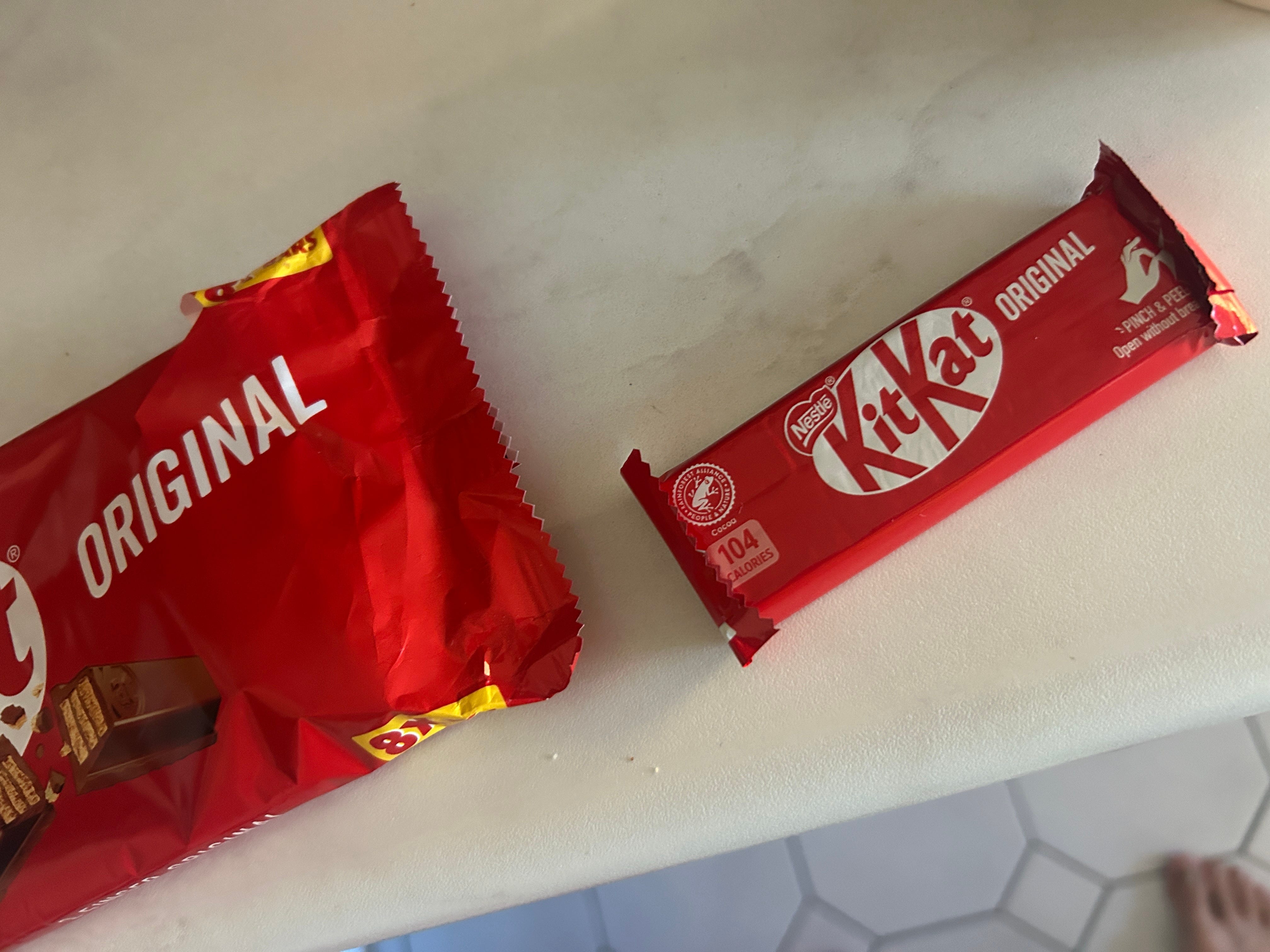
Making it worse was the claim on the packaging: “ORIGINAL”. Now, it didn’t occur to me that this might simply be in contrast to flavours other than plain milk chocolate—say orange or mint. I read it as a claim to continuity with the object I knew from childhood.
Me and chocolate go back a long way.
Yet this thing felt like a lump of light, squishy, slimy plastic unfit for human consumption. The essential “break-worthy” structure of the “classic” solid bar-slab KitKat had been lost somewhere in the miniaturisation and product-optimisation process. The over-glossy plastic wrapper—not foil and paper—completed the “no deal” blockage.
So I tweeted the above header image with the comment:
I put it back in the pack and refused to eat it. If you are going to blatantly lie about “original” then I don’t trust you enough to consume it. It’s not an “original” KitKat at all. The muscle memory is of a different object. “ShitKat” or “KatShit” maybe!
It was only on reflection that I realised there was actually a deeper lesson here beyond nostalgia or gluttony. Cory Doctorow some years ago coined the term enshittification to describe the process by which platforms lure users in with a good experience and then progressively degrade it as they extract more value from the relationships they have created.
The concept has since been enlarged to encompass much of the shrinkflation, skimpflation, and quality degradation we encounter in consumer packaged goods. A KitKat that isn’t as good as it used to be, but is still recognisably a KitKat, could therefore be called a ShitKat.
But that’s not what I am focused on here. What interests me is the point at which degradation ceases to be a statement about the quality of a thing, and becomes a question about whether it is still that thing at all.
⁂
My 2014 MacBook Pro had a MagSafe connector and SD card slot. My 2020 MacBook Pro lost both. My 2025 MacBook Air has MagSafe back, but not the SD card slot; that’s thousands of dollars more. It gets a bit better, or a bit worse, in each generation.
One might argue that Apple has, to some degree, “enshittified” some of its products. The counter-argument is that it has simplified them: buy a dongle if you want more capability or capacity for peripherals. We can argue endlessly about whether these changes made the product better or worse.
But there is no serious question about whether it is still a MacBook. Even the far more fundamental transitions between processor architectures—PowerPC, Intel, and then Apple silicon based on ARM—did not break category integrity. The underlying technology changed radically while the identity of the object survived.
The point is not the magnitude of the change, but whether the change destroys properties that are constitutive of recognition. A processor architecture is largely invisible to the MacBook experience; the weight, rigidity, snap, and break ritual of a KitKat are not.
⁂
BMW is embroiled in a similar controversy right now after pushing an unsolicited Spider-Man movie promotion onto the displays of customers’ cars. That ownership is becoming “transport as a service” is hardly news: BMW has already experimented with subscriptions for hardware such as heated seats. Cars are increasingly computers on wheels and, unsurprisingly, are beginning to inherit the business models—and pathologies—of tech.
Yet the complaint remains that this is bad BMW. Nobody seriously suggests that the appearance of an unwanted advert on the dashboard means the vehicle has ceased to be a BMW. If anything, the outrage arises precisely because people possess a strong prior conception of what a BMW is, and advertising inside a privately owned premium car violates that expectation.
But it doesn’t affect the braking, steering, or handling. The machinery that makes a BMW a BMW remains intact.
In contrast, while Nestlé unquestionably owns and controls the KitKat brand, the object no longer maps cleanly onto the experience. For me, it is broken at the very first step of anticipation and expectation. The feedback is somatic: this is not what it seems to be. A lizard brain signal of distrust is triggered; “beware”. The touchy-feely version of it smelling like stale gorgonzola cheese or rancid butter.
We have good reason to possess such responses. Putting something into your mouth is an unusually high-stakes act. Something can look like food yet smell, feel, or taste subtly “off”, and the resulting rejection can precede any conscious analysis of what is wrong. I have literally done the “Kathmandu salad” misadventure in person, and once is enough. Slapping “Nestlé of Nepal” branding on it wouldn’t fix that for me; it would merely put Nestlé’s brand equity at risk.
⁂
This is all a rather long run-up to reintroducing some of the concepts I have been espousing recently as fundamental and important, arising from my analysis work in law, geopolitics, psychology, and theology. The “aha!” is that when we accept the invitation to recognise something as “this kind of thing”, we immediately import an ontology—i.e. an account of what is said to exist—that constrains all the reasoning that follows.
Mistakes in that initial recognition can therefore be extraordinarily consequential. A MacBook makes you safely productive; a lookalike CrookBook steals your data and sells it off. Worse, if we refuse to revisit the recognition when subsequent observations mismatch reality, we can become trapped in a kind of “cognitive well” from which it is increasingly difficult to escape.
So the real question is whether the object in my hand was:
A KitKat, defined by sufficient alignment with the shared meaning constructed between buyer and seller.
A ShitKat, being a degraded version of that thing, but still sufficiently aligned with the mutual expectation to remain recognisably a KitKat.
A KatShit, retaining the name and residual properties of the category, after too much of what originally gave that category its meaning, value, and purpose has receded.
A ShitKat still has the Kat; a KatShit is just… you get the point. So a ShitKat still passes the category test: “worse than expected” is not the same proposition as “not the expected kind of thing.”
KatShit is different. Enough sweet-brown surface continuity remains—the geometry—to solicit the old recognition, but not enough constitutive tactile continuity—the topology—remains to warrant it.
⁂
In this instance, there is a deeper issue in play, relating to the values “field” that selects between those possible “product portfolio” continuities. Apple and BMW can stretch their brands in many directions. AppleCare is an insurance product, yet it does not require a separate financial-services brand partner to make sense of it. BMW can introduce front-wheel drive, SUVs, and electric propulsion and still remain close enough to whatever constitutes BMW-ness to be recognisably BMW.
But there are limits. Apple cannot plausibly claim that an iPhone is an Apple Newton. It has lineage from the Newton and may inherit ideas from it, but it is not that thing. And BMW cannot simply declare its cars crash-proof, because crash-proofness is not a property the underlying objects possess. Brand authority can determine what something is called; it cannot manufacture continuity or properties that reality does not supply.
In both cases, reality constrains recognition.
Which brings us back to that troublesome word on the KitKat wrapper: ORIGINAL.
When Nestlé puts “ORIGINAL” on the packet, it is doing something stronger than merely writing KitKat™. The term “KitKat” can accommodate evolution, whereas “ORIGINAL” explicitly invites a recognition of historic continuity. And not just any continuity with the past, like where it was manufactured. The implicit claim is continuity with the thing already recognised by the buyer—not merely whatever continuity the brand owner chooses to assert.
My cumulative experience of KitKat is itself part of the reality against which I recognise the “ORIGINAL” claim. Nestlé can control the trademark; it cannot dictate the output of my own recogniser.
That brand recognition experience is not an abstraction supplied by Nestlé; it was constructed through hundreds (thousands?) of my own encounters with the physical product over time. Indeed, the accumulated recognition of KitKat-ness among consumers (“guzzlers”) is part of what gives the brand its value.
The brand did not create that recognition by declaration; the product had to earn it through experience.
To an ordinary consumer, that brand continuity may encompass flavour, shape, ingredients, packaging, texture, weight, snap, and the familiar ritual of breaking off a finger. But beneath all of those individual properties lies the stronger claim that matters here:
The core thing has survived the changes.
That is precisely the brand recognition proposition my hand rejected.
⁂
A KitKat is not just a geometric bar of cocoa-flavoured fat and sweetener over a wafer. It is an experience, carrying an expectation of the same “anticipation to satiation” experiential loop. The failure mode is like those $5,000 electric toy cars for rich kids that may sport a Porsche logo. However beautifully made, and even if officially licensed by Porsche, they are not the same thing.
If you cannot close the door behind you, and your head sticks out of the top, it cannot deliver the Porsche experience.
But Porsche doesn’t do a salesroom switcheroo, substituting an off-road electric toy for an on-road grown-up flat-six, and then demand that you recognise the result as “ORIGINAL”. The point of a toy Porsche is it isn’t seeking to “identify as a Porsche”; everyone knows it is a child’s aspirational plaything that flatters the “real deal”.
This is where I believe Nestlé crossed the line from ShitKat to KatShit. The packaging is asking me to privilege its symbolic assertion over the contrary verdict of my own sensory system: this mouth-thing is not registering as a trustworthy eat-thing.
That conversion isn’t happening.
Indeed, the demand itself exposes the inversion. Normally the object supplies the experience from which the brand earns its recognition. Here, I am being invited to let the brand supply the recognition, and then impose it back upon the object, despite the experiential mismatch.
The direction of control between brand and consumer has reversed.
⁂
Time to switch to didactic mode, as the chocolate has now done its job. The general principle is that recognition lets us act without reconstructing reality from scratch over and over. Category integrity is what makes that shortcut safe.
Here is how the KitKat failure maps onto the various frameworks I have been developing.
In terms of the General Prolegomena, the neo-KitKat has, for me, lost category integrity with the socially constructed brand because its core tactile properties have been compromised. There are no three-wheeled Porsches, no matter how well engineered. There is no micro-mushy KitKat, no matter how well baked and coated.
All brands are lossy compressions of reality. But for a brand to retain its value, enough of that underlying reality must remain recoverable and reconstructable from the brand. The KitKat brand continues to solicit recognition as being “the thing”, yet the failure of that recognition (“ORIGINAL” not original) imposes a recomputation cost on EVERY Nestlé-branded product I subsequently encounter.
So I can no longer safely assume that the “Nestlé” token corresponds sufficiently to the broader reality of “trusted foodstuffs” from which it itself claims parent continuity; it is sucked into the same “field of manipulation and domination for profit” as KitKat. The shortcut has failed, like a snapped truss in a bridge. It cannot support any semantic load.
What previously required only recognition of the brand token now requires a whole chain of cognitive work: recognition and detection of the mismatch, reconstruction of what the object actually is and whether it can be trusted, and re-recognition of everything downstream contaminated by the “anti-trustmark” of Nestlé.
There is a surprisingly deep model inside that last phrase:
A trustmark says: I recognise the source, therefore I need to inspect the object less.
An anti-trustmark says: I recognise the source, therefore I need to inspect the object more.
Same recognitional salience, but opposite epistemic consequence.
A ShitKat is a problem for the KitKat brand manager.
A KatShit is a problem for Nestlé and its whole supply chain.
What I am introducing here is the idea that cognition—and particularly cognition upon which we subsequently act—depends upon accurate shortcuts through cached recognisers. We cannot reconstruct reality from first principles every time we encounter it.
None of us reads the ingredients list of every product on each purchase, and then traces those all back to source.
Instead…
…we recognise a thing,
…we inherit everything previously established about that kind of thing, and then
…we proceed.
But those recognisers sit in networks of dependency. When an important recogniser becomes corrupted (a “KatShit” false claim), the recomputation cost is not localised to the object that exposed the failure. It propagates through everything whose recognition depended upon it, or shares the same failure mode.
To “get” the idea, consider the common trope:
“There has to be a pandemic because all these professionals cannot be wrong.”
That phrase illustrates the recursive danger.
“Professional”, “doctor”, “scientist”, “journal”, “public-health agency”, “government”, “newspaper” and “international institution” may appear to provide multiple independent recognitions of the underlying reality. But if those recognisers themselves depend upon one another, or are coupled to the same root recogniser, then their apparent agreement cannot simply be multiplied into independent evidence.
A network of mutually reinforcing recognisers can produce enormous confidence while ultimately inheriting from a much smaller—and potentially mistaken—set of observations.
The same dependency problem appears in a brand portfolio.
KitKat, Nescafé, Maggi and the rest may look like separate recognition tokens, but they inherit recognition capital from a common parent: Nestlé. That coupling works wonderfully while the parent mark supplies trust. It becomes a correlated liability when one product gives the consumer reason to re-recognise the parent itself.
Recognition capital accumulated in the Nestlé brand can therefore be spent to increase financial capital, but doing so carelessly introduces a correlated ruin risk for the former.
⁂
So a “recognition bug” in Nestlé’s “trust-token network”—here triggered by “ORIGINAL” as what I regard as a counterfeit continuity claim—has effects far beyond the immediate blast radius of semantic collapse around the adjacent ShitKat product. The failure propagates. A single KatShit can spoil a container-load of coffee, confectionery, and condiment products sitting on neighbouring shelves.
The error is therefore not simply that I was asked to trust a “fake” recognition token—“ORIGINAL”. The deeper error is Nestlé failing to reconstruct the dependency graph behind the recognition capital it is spending.
Decades of accumulated consumer experience—the 1970s and 1980s chocoholics included—helped create the trust now compressed into both the KitKat and Nestlé marks.
Once one of those tokens conspicuously fails to reconstruct back to the expected reality, the failure propagates upwards into the parent brand and then sideways across everything that depends upon it.
That changes the cognitive shortcut.
Before: Nestlé → recognise → trust.
After: Nestlé → recognise → wait → reconstruct → verify → decide.
And that means the damage isn’t merely, “Martin didn’t eat one KitKat needing restocking.” Nestlé itself has lost some of its ability to function as an epistemic compression mechanism.
Its mark previously saved me cognitive work; now it creates cognitive work.
And me writing this article now just multiplied that consequence a thousandfold and more. QED.
⁂
You might have distrusted Nestlé before due to its many past scandals. But now you have a language of recognition, reconstruction, and reality to describe the architectural failure in its brand and marketing strategy. And the real issue isn’t Nestlé at all, or milk-chocolate KitKats, important as they are in my life.
The issue is that the pattern repeats over and over in every domain.
If it’s turtle shells all the way down—recognition—then it’s turtle bellies all the way up—reconstruction back through those dependencies. Reality is when the turtles stack straight.
The Nestlé turtles are off-balance. The “brand stack” can’t hold to the same height; it’s too “bent”.
But it isn’t just confectionery.
Is it:
a “court order” with certain properties, whether good or bad;
a “bad order” due to defects, but still recognised as a court order; or
“not really a court order at all” due to having an improper purpose and failing to follow the core protocol of law, retaining only its surface lexicon and appearance?
I leave it as an exercise to the reader to discover the slang parallels to ShitKat and KatShit in other domains.
⁂
In each case, there is a perversion of attribution:
Present recognition—“ORIGINAL”—is being borrowed from an antecedent reality: the KitKat of the 1970s and 1980s.
The contemporary real object—the neo-KitKat—inherits recognition earned by earlier objects through the accumulated experience of childhood chocolate.
But the chain from that recognition back to present physical reality has weakened or broken.
In terms of Recognition–Reconstruction:
The wrapper supplies one recognition—ORIGINAL KITKAT—while my tactile system supplies another recognition—not that thing.
The mismatch forces costly reconstruction: what changed, when did it change, what does “ORIGINAL” now mean, and which reality actually earned the recognition being invoked?
Then the reconstruction propagates—to other products under the same brand, and to other people who see the disconnect.
And in terms of corrigibility, the crucial question is whether the symbolic system yields when reality contradicts it.
My hand did. The packaging didn’t.
If you’ve been reading my articles over the last few months, and have felt perplexed about the complexity and terminology, then I hope this bit of fun simplifies it for you.
You don’t need a vast vocabulary, or computer science concepts. Just the right questions:
Is it the thing?
A bad version of the thing?
Or an imposter claiming to be the thing?
Recognition proposes.
Reconstruction tests.
Reality decides.
That’s it.
🍫
An enjoyable and well-structured essay that was easy to digest ! Here is what I found on the Internet regarding Nestle changing its KitKat formulation: "In July 2026, Nestlé announced a major KitKat recipe change in European markets from September 2027. The new wafer will be crisper, with a subtle hazelnut tone, while maintaining the same cocoa content cocoaradar.com. The goal is to broaden appeal to consumers who prefer darker, more complex flavours without reducing cocoa share. The UK version will remain unchanged, as its “burned caramel” notes already suit local tastes. This comes after years of cocoa price volatility...". Always remember: the "M" in Marketing stands for Manipulation of perception !
I've mostly avoided contact with AI, but am now wondering if AI not provide a perfect training ground/playground for practicing and exploring your R-R-R model.
My wife, who has used AI a great deal for research, reports that ChatGPT always begins with the culturally-approved Recognition, and that it takes her repeated queries in order to force the machine to acknowledge the necessary Reconstruction, and to allow Reality to effect the "itness" of it's original claim.
By her own account, she has become quite proficient at this, and tells me tales of high adventure in how she got the machine to admit she's right, and even "praise" her for her accomplishment.
Thanks again, Martin.