I grew up with the sound of a garage door opening late at night.
My childhood bedroom was above the garage, and a 1970s Ford Escort could just fit inside. My father would often arrive home around eleven after his late shift maintaining Boeing 747s at Heathrow. Sometimes he returned earlier than expected, and came to my bedroom for a chat. Perhaps the aircraft had been repaired and released back into service. Or perhaps the fault was sufficiently serious that it could not be returned to service that night.
The smell of Swarfega and kerosene pervaded my youth.
I didn’t know it at the time, but I was growing up alongside one of the defining disciplines of modern civilisation: safety engineering. My father was a Licensed Aircraft Maintenance Engineer. Sometimes his work seemed lower-status than that of the engineers who designed aircraft. Yet maintenance engineers also designed and certified custom repairs for damage sustained by aircraft in service.
[Note this point in the essay: 🥪 — there’s a reason.]
The objective was not to eliminate any possibility of an air accident. That can only be achieved by banning air travel, and all that would do is displace the risk onto other modes of travel. Success means keeping risk within tolerable bounds. My father was known at work as someone you tapped for a job that needed to be done thoroughly. If you wanted “quick and dirty”, he wasn’t your man.
I am his son.
My career pathway took me into computers, then telecoms, and now law. “Software engineering” is often a misnomer: it is a highly numerate craft discipline, and very skilled in its own way, but actual safety engineering is relatively uncommon and specialist. My degree training was in formal methods of proof of software correctness, an extreme minority sport with only a handful of commercial organisations practicing it worldwide. I often wondered how I would find gainful employment after university!
The last few years have seen me get involved in many legal cases, both my own and those of other people. We bring our upbringing with us everywhere, consciously or otherwise. Lots of men are curious about how things work, and like to tinker and construct. My own bias is towards how things break, and their behaviour under stress and load. My telecoms career explored the transition zone between safety engineering and performance engineering; the subtle difference does matter.
I asked you to note (🥪) where I took a break to have a sandwich with my host today, who runs a small business. She had a painful experience with an employment tribunal recently and a delinquent employee. I didn’t know about it when I started writing this article!
As she described it, the other party had missed important procedural deadlines, yet the dispute continued, consuming time and judicial resources, as well as causing her stress that distracted from running the business. I don’t know enough about the case to judge whether the tribunal’s decisions were legally justified. But my engineering instinct immediately asked a different question:
Why wasn’t the procedural problem detected and resolved upstream, before it consumed scarce adjudicative capacity?
In telecommunications, we call this admission control and load shedding. A system that cannot distinguish valid demand from defective demand risks overwhelming its most expensive and constrained resources.
Yesterday I sat beside the Thames with another friend enjoying a pint of Guinness and reviewing the failures of the legal system. His “aha!” is that the law is corrupted and inverted via status and capacity conversions. You might be dealing with a bank that has multiple possible roles it can occupy, and its duties vary depending on which one it assumes. An act under one status might be lawful, yet the same act under another status is prohibited. Playing games with status and capacity allows the rules to be manipulated and evaded.
This morning I was giving feedback to a friend on an appeal, where a court treated a matter yet to be adjudicated as implicitly already resolved (adversely to his claim), resulting in a reasoning loop: its output was being fed into its input to justify the output again.
You don't need to be a law professor or understand anything about jurisprudence to recognise that as a defect. It is already structurally incompatible with what an ordinary observer would consider compatible with valid law. This is the exact boundary I care about: between coherent law, and something that is only law-shaped.
Many of us have stories of unsatisfactory encounters with the justice system.
This is where we return to my opening.
My father had a little official ink stamp that went into the log book when he signed off a repair, the paperwork equivalent of a court order.
He could not send an aircraft out of the hangar just because the log book said “fit to fly”. It actually had to have the substance of airworthiness behind it, not merely the signifier. Drift between the representation and reality could send hundreds of people to their deaths at violent speeds.
It’s very hard to cover up an air crash.
It’s easy to miss that a law (“lex”) crash has happened.
The question I have, therefore, is not how we can engineer law to be better on its own terms.
It is how we establish what makes law genuinely law, and detect when something presented as law fails to satisfy those conditions.
The ink of the order isn’t what makes it law.
Something else is.
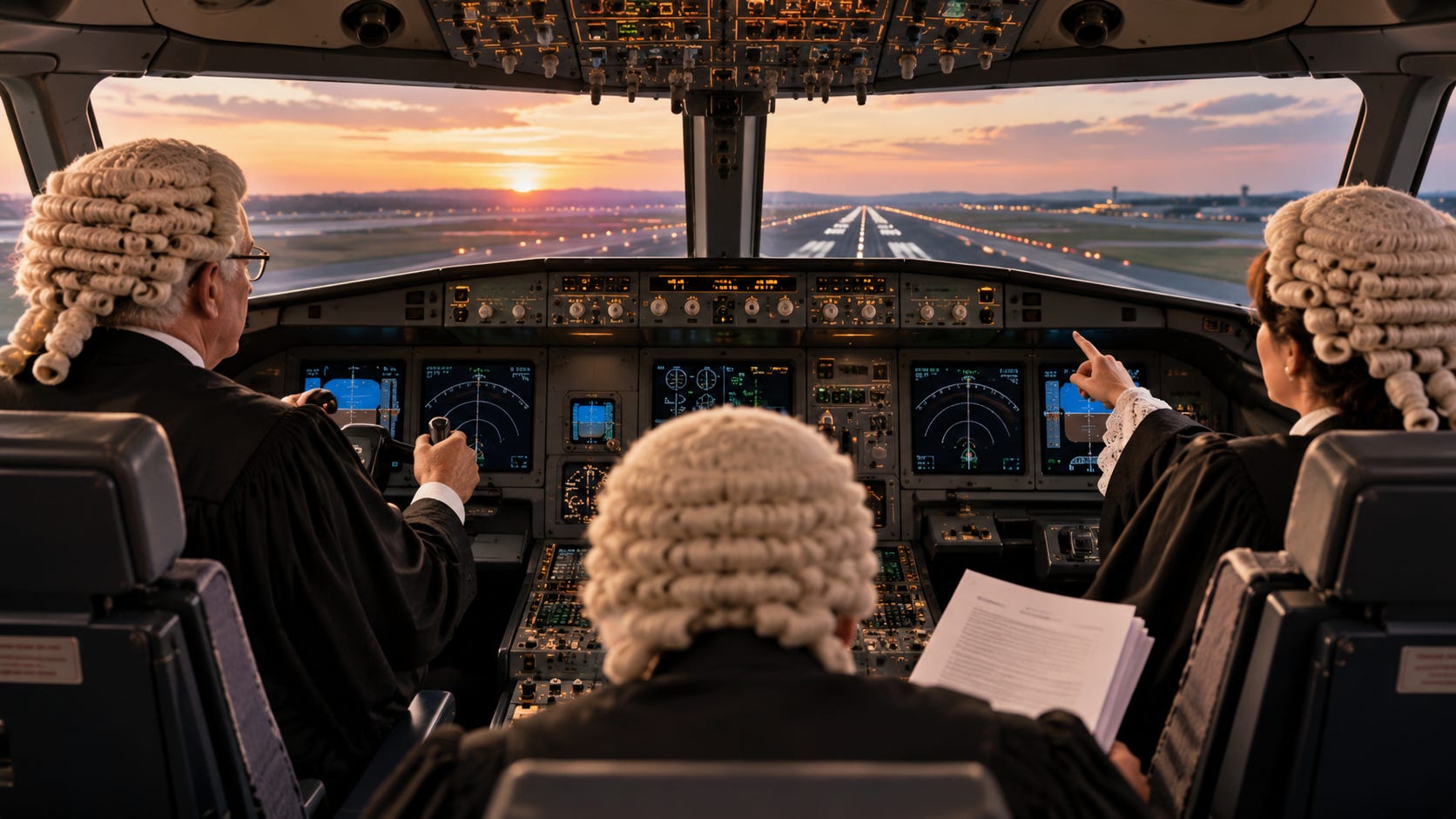
What I am proposing is that engineering concepts can be applied to law in two very distinct modes.
The first, as seen with typical computational law initiatives, aims to optimise the practice of law within its existing boundaries. We can “compute” standing, jurisdiction, procedural compliance, etc. — and do it with far greater throughput and precision than ever before.
This is the equivalent of evolving a Lockheed Constellation prop plane into a Boeing 707 jet.
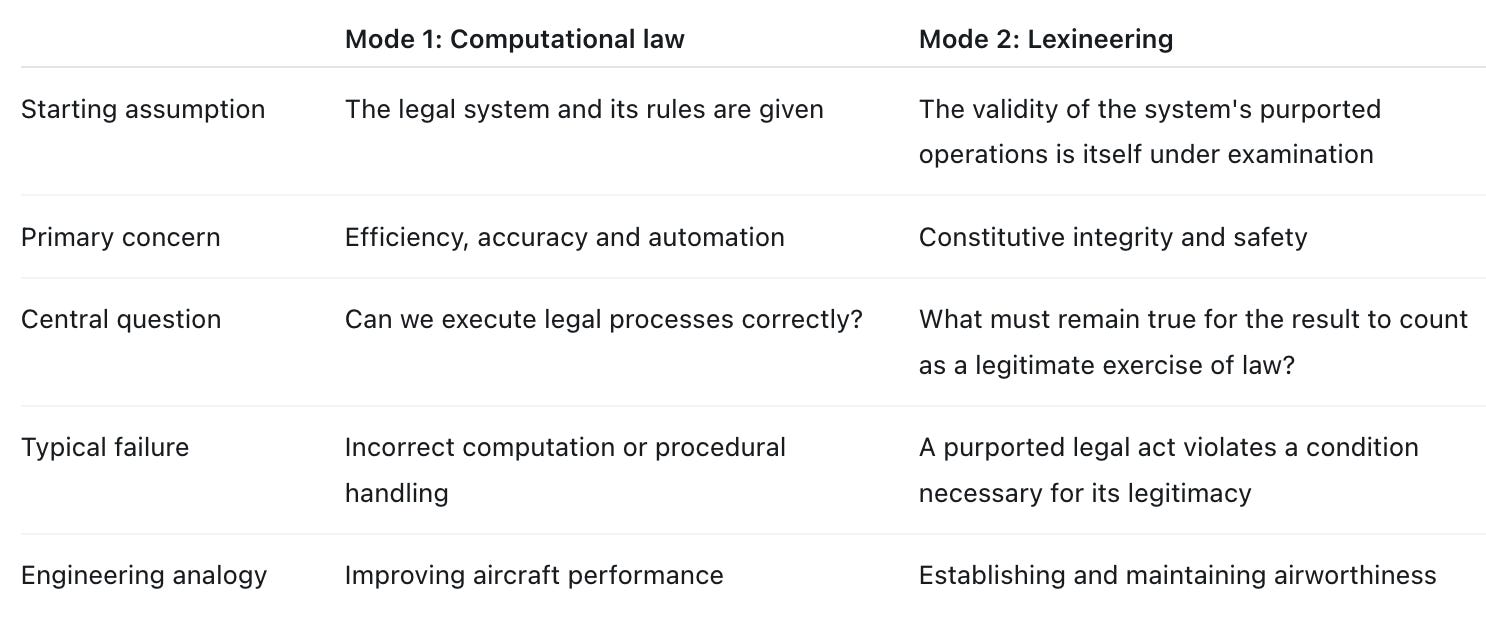
What I am suggesting is different at a category level. No matter how high, fast, or efficiently you “fly” with the law, it has to retain certain properties to still count as “civil passenger law”. A 747 with an equipment defect not permitted under its Minimum Equipment List may still be physically capable of taking off. But that doesn't make it dispatchable for ordinary passenger service.
It is no longer demonstrably safe to operate within the conditions of its certification.
This is closer to a regulatory function, like that performed by the FAA in the USA, or the CAA in the UK. These institutions don’t know how to run an airline better than the actual operators. They instead manage the boundary between a permissible passenger aircraft and flight, and an impermissible one. Within what is permissible, they set rules to bound other failure modes, like delays and lost baggage, so passengers are protected from risks they cannot easily absorb.
That last point matters. An airline can absorb a delayed flight as a routine operational problem. For a passenger, the same delay might mean a missed funeral, a lost job opportunity, or being stranded without money for accommodation. The consequences are not symmetrical. Nor is the power to prevent the failure, or to recover from it.
The same asymmetry exists in law, often more severely.
A court can absorb an erroneous decision as one case among thousands. The person affected might lose their home, livelihood, family relationships, or financial security. The institution continues operating, perhaps with its performance statistics improved by another case disposed of. The individual may lack the resources to appeal, or even to survive the consequences while awaiting correction.
And unlike airline passengers, people subjected to legal proceedings frequently have no choice about participating.
The permissible operating envelope must therefore take account of who bears the consequences of failure, and whether they can reasonably absorb them.
Otherwise, the system can declare its own performance satisfactory while exporting intolerable risks onto the people it exists to serve.
Using the language of aircraft safety, the legal system already has tools to identify defects that fall inside its own remit. “Wrong ink stamp”, “wrong form”, “paperwork filed too late”, “signature not legible”, and so on. These checks matter, just as accurate maintenance records matter in aviation.
But they are not sufficient.
The deeper problem is that the legal system’s representation of lawful authority can be mistaken for the underlying reality that warrants it. You can have the right ink stamp on the right paper, issued by the right person at the right time, and still not have something congruent with genuine “safe to fly” law.
An aircraft does not become airworthy because its paperwork says so. Equally, a judicial decision does not become correctly reasoned merely because a judge has signed it. An order may be authentic, enforceable, and procedurally regular while containing a fundamental defect in the reasoning or exercise of authority behind it.
This is not to suggest that every legal error invalidates an order, any more than every aircraft defect makes flight impermissible. Some defects are tolerable under defined conditions. Some can be remedied. Others prohibit the operation altogether. The distinction is precisely what a mature safety discipline must establish.
Law presents an additional difficulty.
Aircraft certification ultimately answers to a physical reality that cannot be changed by regulatory declaration. A defective wing cannot be made structurally sound by stamping a logbook.
Legal reality, by contrast, is partly constituted by institutional acts. Courts really can create obligations by issuing orders, and those obligations may remain enforceable even when the reasoning is defective.
That makes the assurance problem harder, not less important.
Which is why we need a discipline to manage it.
In aviation, we have learned to distinguish between an aircraft’s ability to fly and its fitness to carry passengers. We don’t expect passengers to discover defects for themselves, or bear the consequences when certification fails.
Law needs the equivalent distinction. Its machinery can function perfectly while producing outcomes that violate the very conditions that make its authority legitimate.
I don’t claim to have the complete specification of those conditions. But I think we need an engineering discipline concerned with recognising when they have been breached.
I call it lexineering.
My hope is that the debate will not be about whether it is needed. Or over the name.
But rather how to implement it.
Courts profoundly affect all our lives, sometimes through decisions that are literally matters of life and death.
Why do we tolerate failures of assurance that would be indefensible in other safety-critical domains?
We should not.
My father’s level of qualifications and skills ought to be the floor of the safety case for law.
Not its (garage) ceiling.