

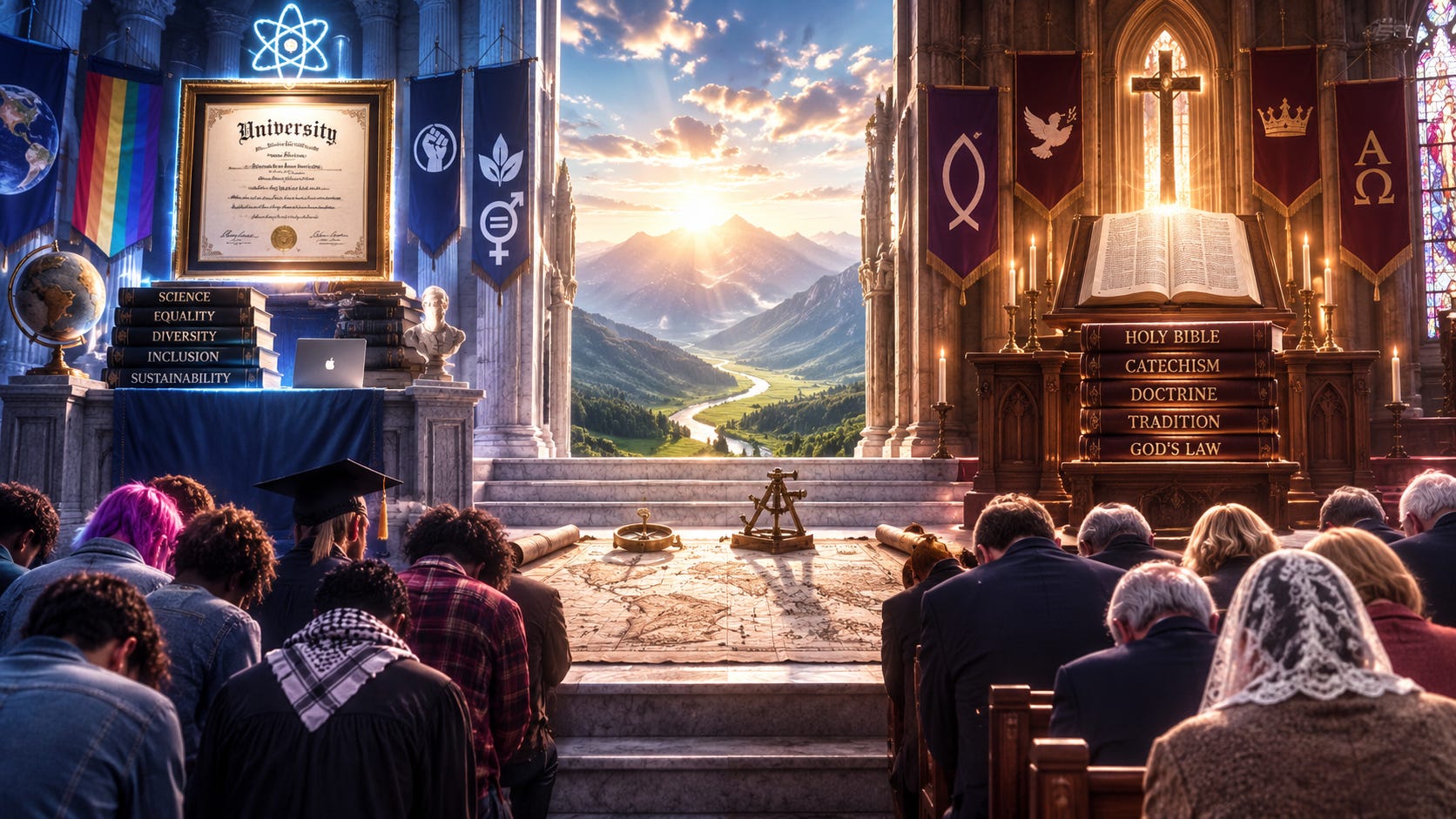
One of the biggest shocks of my life has been third parties labelling me as part of a “right-wing” movement. When I voted, it was never right-of-centre. Not once. For those who know my life story, I spent quite a lot of time being, how to put it, thoroughly liberal — in an Oscar Wilde sense. I have plenty of metaphorical scars to show for it; apparently the gate of repentance is especially well-trodden by serial sinners. And yet my social world continues to span everyone from “party people” to “altar angels”.
Over the years, I have watched friends and family spin off into all kinds of spiritual dead ends: progressive politics, environmentalism, religious sects, travel-as-sacrament, self-sacrifice to the corporatocracy. It isn’t that I am better than them and can see through the nonsense, nor that there is no merit in whatever quest they are on. Quite the opposite. I am often as lost as can be myself, and they are entitled to their own path of growth.
I have simply come to understand that life is as much about being “wrong well” as it is about being “more right”.
Let’s just assume, for the sake of argument, that today, 28th August 2026, is “Vindication Day”. Millions of people who have been following the Trump, MAGA, Q, Great Awakening, patriot, red-pill, The Storm, sovereignty, disclosure, White Hat, and information-warfare mega-jamboree for the last ten years are, suddenly, on the “right side of history”. Truth flows, debts are cancelled, taxes are removed, governments crumble, crypto moons, tears are shed, humanity unites.
OK, maybe not all in one day. But you get the point.
The tempting reading is that the numpties who voted for Hillary, Bernie, or rubber-masked actor Bidan [sic] are all exposed as a bit naive. (I was very comfortable when America “elected” a black President and had an indomitable female Secretary of State, so I am one of them.) The “sheep” who took the jab get to face up to whatever bio-engineered tragedy, in this imagined reckoning, may confront them. There is a massive loss of face for the left, a cultural humiliation, and a marginalisation of their idols.
That would be way too easy.
For sure, it is easier to fool a man than to persuade him that he has been fooled. Yet hidden in that aphorism is a framing problem. A fool who recognises he is only a man, yet remains a fool, is in a sense less of a problem than a man who sees himself as an anointed one because he happened to “hit the nail on the head” in his prognostications on worldly affairs.
The hypothesis I am trialling is that the people with the rough ride ahead aren’t the “libtards” at all. They are merely wrong.
The ones with the real challenge are the “pewmuffins”.
They are right, but in a wrong way.
Any system of belief, be it correct or incorrect, necessarily has founding assumptions. What categories does it create? What deserves to be included or excluded from its worldview? What determines the meaning of observed facts? How, if at all, can it be revised? What authority is sufficient to terminate disputes?
At some point, its internal reasoning runs out and something else takes over. That “something else” is its Source, sponsor, totem, axiom, founder — the label is less important than the function. As explored in my previous articles, every such system has an archē — an originating principle from which its authority proceeds — and a telos, the end towards which it is ordered.
Neither can ultimately be warranted from within the belief system itself.
This matters, because we cannot appeal to our own insight and intellect to justify where we locate the “origin” of our reasoning system; it has to be located in a higher-order space. Whatever we choose, even science itself, always leaves open the question: “is that all there is?” It suggests a bigger geometry in which to consider what “reality” might be.
This means that the most difficult errors to deal with are not errors of reasoning within our preferred framing of existence. Those anomalies can be identified, explored, and resolved. The scientific method, and many of the breakthroughs arising from it, proceed from tiny experimental discrepancies that lack explanation and eventually demand a grander account of reality.
The wickedest problems arise when the very axes by which we measure reality and its disturbances have themselves become misaligned. Internally, everything may appear sound. Yet all that reasoning proceeds from a frame that is itself subject to observation, question, and revision. This makes the core challenge not being right-inside-belief, but being capable of discovering when we are wrong-outside-belief.
In other words, the biggest problem in staying sane is not correcting mistakes within the framing of “rational” that you carry, but recognising when the underlying coordinate system defining “rational” is itself off.
Now, holding that in mind, let’s deconstruct the conventional mainstream leftist view. I am not talking here about your purple-haired transgender activist or radical feminist. This is your ordinary Democrat-leaning factory worker, or conventional progressive professional like an attorney or college lecturer.
Within that worldview, there is a broad acceptance of
the legitimacy of positive law and the institutions that administer it;
taxation as a necessary contribution to a civilised society;
personal autonomy with social and sexual tolerance as public goods;
credentialled expertise, academia, and mainstream media as broadly trustworthy guides to reality; and
an essentially optimistic view of human nature and social progress.
Adjust to your own Hamiltonian pastiche, if you will.
Now impose our hypothetical “ontology shock”: treason, election fraud, paedophilia, human trafficking, crimes against humanity. Venerated NGOs, media companies, and universities crash and burn. Favoured figures are convicted in some Nuremberg 2.0 reckoning. The evidence of corruption is so horrific and unmissable that the status quo is smashed, potentially overnight. The centralised state shrinks its footprint, having lost credibility and coherence.
The “libtards” come to realise that they had been sold a CIA-backed bill of goods; America was on the brink of collapse, and only the sovereign protection function of the military saved everyone from a total takeover by techno-Bolshevism. A long process of grieving begins, accompanied by a deep re-examination of how facts that were supposedly there in plain sight could have been overlooked. The very foundations of their epistemology — why they trusted science, expertise, institutions, credentials, and consensus as they did — come under question.
Culturally speaking, Jefferson triumphed, and Hamilton was discredited.
Not everyone makes it; in this imagined upheaval, some are lost to despair and suicide. But for those who do, a gradual process of correction allows reality back in to have the final say. It isn’t necessarily that they were opposed to truth. Rather, the categories through which they were reasoning were distorted, so the anomaly never registered as an anomaly that counted.
The Q drops are the obvious case in point within our thought experiment. All you needed was a web browser and a pair of eyes, yet propaganda around “QAnon” directed attention towards an altogether different object.
The result is a catastrophe, but not a cataclysm.
The scientific method itself isn’t the problem. The failure mode was treating it as though it exhausted the available geometry of reality, while ignoring the spiritual dimension of “the adversary” and deception in a battle over the adopted archē and telos. Once all your sacred cows have been slaughtered, it becomes easier for the “libtard” left to reconstruct the anatomy of whatever organs remain, using whatever tools are to hand. It isn’t pretty, in the same way that abattoirs are not tourist destinations, but the result — given enough time — can be reconciliation with reality.
Now comes the other side, and this may cost me a few friends, but oh well.
If it’s true and painful, that’s the point. If it’s not true, then just ignore me.
Assume, for the sake of argument, that the broad thesis of Bible-belt mainstream conservative America is validated — modulo some rather substantial shocks involving vast underground infrastructure, decades of off-world activity, and hidden manipulation of humanity and biology.
But suppose the basics are vindicated:
there really was an existential threat;
the “conspiracy theories” were pointing towards real problems, even where they supplied the wrong answers; and
the restoration of the Republic and sovereign rights really was justified.
Great! “The right” was right.
Ah. Now your real problems begin.
The left had their “origin” and “axes” smashed up; they naturally have to return to the founding questions of archē and telos. The religious right faces a different problem. Political vindication does not vindicate its theology, and its own doctrines may turn out to have been corrupted, manipulated, or manufactured too.
From Mount Hermon onwards, it’s a total mess. Those under-read Apocrypha are only the lead-in. The difficulty isn’t simply that there is so much more to learn; you first have to unlearn what you thought you knew. And many of those are cherished beliefs that aren’t instantly contradicted by Hillary Clinton going down for her crimes.
But now you have an identity problem.
The libtards were the dumbasses who were obviously wrong, while the right had it all worked out — even if the Vatican archives hold some very uncomfortable evidence, and our hidden history is now being exposed. “We” didn’t indulge in the sexual free-for-all of the left. “We” kept up appearances in church, raised respectable families, and tithed as demanded, as a counterbalance to the welfare state.
Surely “we” were the good guys?
…
…
…
Surely?
I could name specific doctrinal points that might become focal points of future crises:
Abba, “the Father”, versus Yahweh — are we as certain as we think we are about the identity and character of the divine beings named in the texts?
Christianity as a refinement or fulfilment of “God’s law”, versus an escape from the curse and jurisdiction of law itself.
Whether the biblical canon represents the complete evidential envelope, or whether excluded and neglected texts materially alter the story.
Whether “the Church” preserved the faith from corruption, participated in its corruption, or — most uncomfortably — did both.
Whether obedience to religious authority is evidence of faithfulness, or can become precisely the mechanism by which spiritual sovereignty is surrendered.
Whether outward moral respectability signifies righteousness, or merely provides particularly convincing camouflage for pride and self-deception.
But that’s not the point.
The real issue is not that there are differences of belief, but whether there is a means to resolve them against something outside themselves. For if reality is to mean anything, it must mean that the origins and axes of our systems of belief are themselves corrigible, and not merely the assertions made within those systems.
Are we dealing with “grace-lite”, where only correction-inside-theology is allowed? Or “grace-heavy”, where theology itself — the frame outside any particular belief — remains subject to observation, question, and revision?
Does grace permit correction of the map, or only movement within the map?
The “libtards” self-evidently need new maps — perhaps even new legends, symbols, and conventions of cartography. Their belief system is clearly broken at the origin-and-axis level.
The “pewmuffins”, meanwhile, are left holding out-of-date maps whose own theological symbols assure them that all they need is a new edition, not a re-survey. Their belief system tells them not to examine the origin-and-axis discrepancies.
If there is nothing that would ever make you question Catholicism, Anglicanism, Seventh-day Adventism, Mormonism, or the Jehovah’s Witnesses, then what does that say about the corrigibility of your belief?
This does not mean there must be something that would make you abandon God. It means there must be something that would make you reconsider what you believe about God.
Otherwise “faith” has quietly become non-corrigibility of the human representation of the divine. That is precisely the category error our archē argument has set up: the map acquires the immunity that properly belongs only to the territory.
Infallibility of Source does not imply infallibility of your map of Source.
In a conventional reading of a sovereign restorationist movement, the goal is to secure the “life, liberty, and pursuit of happiness” of the individual. The state protects against external threats, mediates disputes, and coerces only when absolutely necessary.
This leaves us with a conundrum, however. Whatever system of government is installed, it is necessarily imperfect under changing circumstances. Reality drifts, even if some principles remain constant. Freedom is therefore always relative to something being conserved as an inviolable fount of legitimacy. Whatever occupies that position becomes, functionally, an object of worship or veneration.
Sovereignty therefore has a maintenance problem:
How does an imperfect order detect and correct its own divergence from Source?
“One nation under God” expresses that intention.
It is not the instruction manual.
Thus the “libtards” and the “pewmuffins” have to occupy the same physical and social terrain, and somehow come to a sufficiently close agreement over what kind of map allows us to navigate it collectively.
The atheistic left may have constructed a moral system for themselves, only to see it collapse before their eyes. The failure mode was the absence of a transcendent anchor. At least, amid the wreckage, they can begin the search anew for where sovereignty really lies.
Liberty is not the freedom to sin at will, but the capacity to restore balance after sin.
Meanwhile, the “pewmuffins”, puffed up by their cultural victory over the “libtards”, decree that God constructed their moral system, and that they most faithfully represent Him. Their failure mode is that their interpretation becomes immunised from correction; recalibration is recoded as opposition to God.
That is actually much more dangerous to liberty in the long run, because it fixes belief far above reality. In a very real sense, the “peace technologies” of Christianity — repentance, compassion, forgiveness, reconciliation, atonement — become traps when they cannot be applied to doctrine itself.
The very tools of liberation from sin and the curse of the law turn back upon themselves.
If the “libtards” are self-evidently wrong, then they have a hope of being “wrong well”.
If the “pewmuffins” appear to be right, then they tend to be “right badly”.
And where the defining quality is corrigibility, not correctness, that difference is everything.
Wrong + corrigible can converge on reality.
Right + incorrigible can only diverge from it.
Which takes me back to a theme from my past writing — the “Anons” as a new “royal priesthood”. Being anonymous online reduces (but doesn’t eliminate) the risk of identity lock-in to a named sect or dogma. The cost of backing out and re-orienting yourself is minimised. Social ostracism is unlikely to follow from joining the “wrong” online chat board.
In a sense, the online bulletin boards and discussion groups are another “grace technology”. Grace isn’t merely mercy after failure. Viewed cybernetically, grace makes correction survivable. If admitting error means annihilation — loss of tribe, status, righteousness, salvation narrative — people defend errors indefinitely. Grace lowers the cost of updating.
Anons broadly flatter reality by granting it the greatest freedom to correct them. And it is in that contrast that we can see the structural challenge ahead for both “libtards” and “pewmuffins”.
⁂
The “libtards” locked themselves into a graceless prison, whereby intellect itself becomes the object of deification. This can be exploited through propaganda, as Jacques Ellul documented in the 1960s; intellectuals are especially vulnerable because they need an answer to every dinner-table proposition, and propaganda supplies it.
The twisted message doesn’t need to feed outright lies, but only establish the “camera angle” that includes or excludes the facts. You can be extremely clever about everything inside the frame while remaining completely oblivious to whoever is pointing the camera.
⁂
The “pewmuffins” have the same structural problem, but at a higher order, where falsification of theology is nowhere near as in-your-face as falsification by geopolitics. You can spend a lifetime studying scripture, acquiring a “one-up” stance over your less-erudite neighbour, and miss the whole message of loving one another.
While the libtards formed a scientific priesthood, the pewmuffins constructed a doctrinal one. Neither achieved the underlying goal of “looking up”; both ended up serving competitive ends.
Being able to write a doctrinal thesis on grace is not the same as embodying it.
Going full circle, I return to my own story. I don’t feel I am left-wing or right-wing; I reject the default coordinate system being offered. What I observe is that the dominant axis is corrigible vs incorrigible.
When measured on that scale, the “libtards” and “pewmuffins” may have more in common than is comfortable for either to acknowledge. Each is attached to a deeply fixed account of where truth and authority originate, yet both face comparable failure modes as reality impinges.
The paradox is that the atheistic materialists may receive the more tangible negative feedback. Their world visibly fails around them. The notionally spiritual, meanwhile, can interpret worldly vindication as evidence that there is little correction needed at all.
One side is tragedy. The other is comedy.
I will leave it to you to decide which is which.
Thanks for this one martin.....I choose to be amused .....is my mantra for now.
An excellent exploration of the intellectual and spiritual challenges we may face, once the "dust" settles. Thank you for this curtain-raiser !