

Being 75% American, most of my readers will know Rowan Atkinson as the creator of Mr Bean. But as a native Brit who grew up watching first-run television in the 1970s and 1980s, I remember him best from the gloriously irreverent sketch show Not the Nine O’Clock News.
While I cannot match the contortive power of Mr Atkinson’s facial muscles, I do enjoy playing with words and ideas. For the past year I have been circling a stubborn problem: Jefferson and the Founders brilliantly solved the problem of the king. They did not solve the deeper, more universal problem that survives every revolution.
They diagnosed one form of detachment — political authority becoming severed from the governed.
They did not diagnose the tendency that eventually affects every inheritance: the slow, natural drift by which any government, church, culture, or constitution gradually mistakes its own continuation for whatever first made it worthy.
This drift is not caused only by wickedness or laziness. It emerges from simple economics: reconstruction to the original charter is costly, while continuation of the degraded status quo is cheap.
The rituals survive. The meaning weakens. The institution persists.
Its justification becomes assumed rather than renewed.
That is the gap that still remains after 250 years of constitutional experience.
The Declaration of Independence was written for the problems of 1776. This document is intended as a teaching tool for thinking about the problems of 2026.
In the spirit of the old television programme, this is therefore:
Not the American Declaration of Independence.
On Worthy Continuity
Every generation inherits more than it understands. It inherits languages it did not create, institutions it did not found, laws it did not write, beliefs it did not discover, customs it did not choose, and memories it did not live. All arrive already in motion. No generation begins at the beginning. All inherit in the middle.
Human beings do not possess reality directly. Everything reaches us through mediation — through symbols, stories, institutions, rituals, and representations. Mediation is not corruption. It is the necessary condition of scale, memory, and civilisation.
Civilisation therefore depends upon representation, yet representation inevitably introduces distance. The perpetual task of every age is reconstruction: to prevent that distance from becoming separation, so that what is transmitted remains recognisably attached to the source that first gave it worth.
Yet every mediation carries within itself two opposing tendencies. One is fidelity to source. The other is mere continuation. These are not the same. That which is faithful often continues, but that which continues is not necessarily faithful.
Reconstruction is costly. Continuation is cheap. Under the pressure of time and load, every inheritance therefore tends naturally toward the preservation of its own form rather than the preservation of the purpose that first made it worthy. This is the ordinary economics of drift.
Thus every symbolic order slowly separates geometry from topology. The visible structures persist — the rituals, the offices, the texts, the procedures. But the living attachment to the source that first rendered them worthy quietly fails. Form survives. Fidelity fades. This is synthetic continuity: geometric persistence after topological
separation.
The gravest corruption begins when any inheritance mistakes its own continuation for the source that first made it worthy. Fidelity alone is not enough, for one may remain faithfully attached to what is unworthy. Every inheritance must therefore examine not only its attachment, but the worthiness of that to which it remains attached — a question that ultimately passes beyond any single generation’s power to settle.
No king, no parliament, no assembly, no people, no tradition, no church, no science, no law, no language, and no civilisation possesses legitimacy merely because it endures. This law is universal; it applies equally to every form of human order.
Every generation therefore stands under the same obligation. It must not merely preserve what it has received. It must actively reconstruct its attachment to the source that first gave the inheritance its worth. It must distinguish what merely survives from what deserves survival. It must transmit not only the forms, but the living fidelity
between form and source.
This responsibility can never be completed. Every generation receives the inheritance unfinished. Every generation passes it onward unfinished. The capacity to hear unwelcome truth, to audit one’s own inheritance, and to renew attachment is not a luxury. It is sacred infrastructure. A civilisation that treats correction as threat has already begun to die.
Civilisation is not the preservation of forms. Civilisation is the faithful transmission of worthy continuity across time. The measure of a people is therefore not what they inherit. The measure of a people is whether what they hand forward remains recognisably connected to the source that first made it worthy — and whether they have had the courage to ask whether that source itself remains worthy of allegiance.
How this was built
The declaration above is not the starting point.
It is the endpoint.
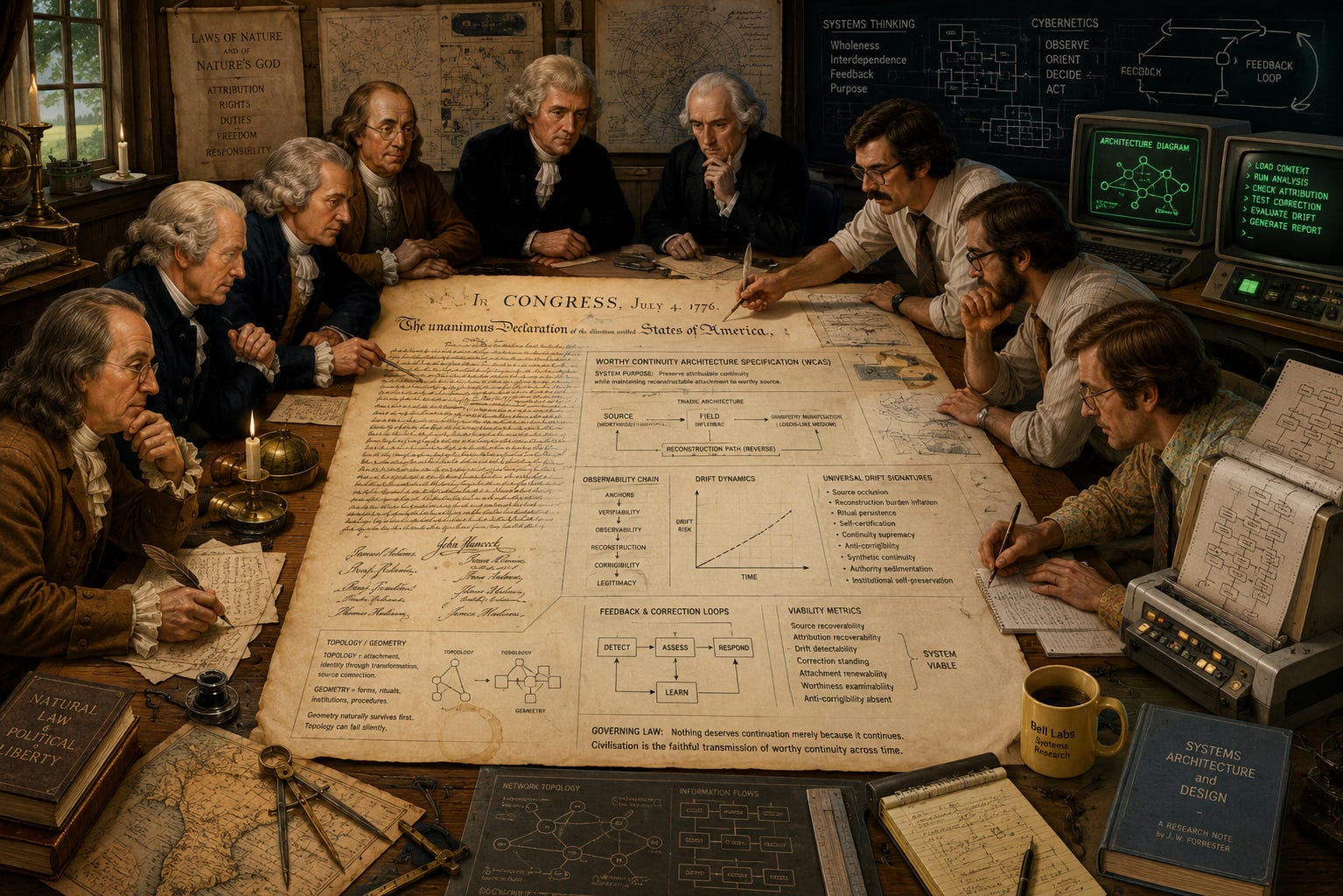
Behind it sits a much larger conceptual framework developed through iterative dialogue between human participants (myself and several collaborators) and our AI systems over many months and years. The immediate catalyst was a friend sharing a UK-centric constitutional renewal proposal, which forced me to extend and integrate a number of existing models.
What emerged was not quite constitutional scholarship, philosophy, theology, sociology, or history.
It borrows from all of them.
But the activity itself increasingly resembled engineering — that is the whole point.
GOVERNANCE SYSTEMS AND CONSTITUTIONS CAN BE ANALYSED AND DESIGNED USING ENGINEERING METHODS, AND THEIR FAILURE MODES MANAGED.
This article is less about the resulting declaration than about that discovery.
Specifically, it resembled the design of viable symbolic systems — more like computer science than political science.
The question gradually shifted from:
What should a civilisation believe?
to:
Under what conditions does a civilisation remain capable of preserving continuity without becoming detached from the thing that first made that continuity worthwhile?
That is a very different problem — akin to safety-critical systems design.
The appendix below is an edited version of the internal design specification that emerged during the process. It was originally intended primarily for AI-to-AI transmission and refinement. I have edited it sufficiently to stand alone outside its original context.
Interestingly, it also casts the original American Declaration of Independence in a favourable light.
Many of the deepest patterns identified by the framework are already present there in embryonic form. The difference is that the framework attempts to generalise those insights beyond political authority to inheritance, continuity, correction, legitimacy, and symbolic systems more widely.
You should therefore read the appendix not as an essay, manifesto, or philosophical argument.
Read it as a design review or technical specification.
The object under examination is not a machine.
It is civilisation itself.
Appendix Specification:
Worthy Continuity Architecture Specification (WCAS)
0. Purpose and Scope
Objective
Design a mediated symbolic system capable of transmitting attributable continuity across generations while preserving reconstructable attachment to worthy source.
Scope
Applicable to:
governance
law
science
religion
culture
language
institutions
identity
This specification is a candidate architecture for analysing symbolic viability in finite mediated systems.
Scope Note
This specification concerns viability conditions rather than substantive doctrines.
It asks how truth, sovereignty, meaning, reality, authority, and transcendence remain recoverable through mediation.
It does not attempt to determine what those things ultimately are.
1. Core Definitions
Inheritance — Language, meaning, authority, institutions, obligations, traditions, and memory received already in motion.
Source — The origin beyond any given mediation layer (e.g. reality, truth, justice, Logos, God, worthy principle).
Mediation — Symbolic, institutional, and representational layers through which source is transmitted.
Representation — Compression operation enabling scale. Necessary, lossy, unavoidable.
Reconstruction — Recovery operation restoring attachment to source.
Continuity — Persistence of form through time.
Fidelity — Living, reconstructable attachment to source.
Worthiness — The property that makes a source deserving of allegiance.
Attribution — The ability to trace a continuity claim back to its claimed source.
Topology — Attachment, continuity of identity, source connection.
Geometry — Forms, rituals, institutions, procedures, structures.
Synthetic Continuity — Geometric persistence after topological separation.
Correction — Capacity to detect and respond to divergence from source.
Anti-Corrigibility — State in which correction loses lawful standing.
Stewardship — Authority held in trust rather than owned.
2. Foundational Assumptions
A-1 Inheritance Assumption
No generation begins at the beginning.
All participants enter an existing continuity stream.
Implication: continuity precedes agency.
A-2 Mediation Assumption
All source interaction occurs through mediation layers.
Direct source access is unavailable.
Mediation is not corruption; it is the necessary condition of scale.
A-3 Scale Assumption
Large-scale continuity requires representation.
Implication: compression and loss are unavoidable.
3. Core Operating Model
OP-1 Representation Function
Purpose: enable scale.
Operation: compress source into transmissible form.
Examples: language, law, ritual, institution, narrative, model.
Constraint: representation is necessarily lossy.
OP-2 Reconstruction Function
Purpose: recover attachment to source.
Operation: traverse mediation layers toward originating justification.
Success condition: source remains recoverable.
OP-3 Attribution Function
Purpose: preserve provenance.
Operation: maintain reconstructable linkage between continuity claims and claimed source.
Success condition: continuity remains attributable.
OP-4 Fundamental Tension
Continuity preserves existence.
Reconstruction preserves attachment.
Viable systems require both.
OP-5 Viability Condition
A continuity system is viable only while:
source remains recoverable,
attribution remains possible,
correction remains lawful.
4. Drift Economics
D-1 Reconstruction Cost Law
Reconstruction requires effort, attention, uncertainty, energy, and courage.
Cost: high.
D-2 Continuation Cost Law
Continuation requires repetition, habit, and inertia.
Cost: low.
D-3 Continuity Preference Law
Under load, systems preferentially select continuation over reconstruction.
Expected outcome: drift.
D-4 Survival Optimisation Law
All continuity systems tend naturally toward self-preservation.
Expected behaviour, not exceptional behaviour.
D-5 Reconstruction Burden Inflation
Reconstruction costs tend to increase over time.
Risk condition: reconstruction cost exceeds participant capacity.
Outcome: formally legitimate but practically unreconstructable systems.
5. Observability Requirements
OR-1 Trace Requirement
Reconstruction requires observable traces.
Examples:
records
witnesses
measurements
decisions
artefacts
OR-2 Verifiability Requirement
Claims must remain independently verifiable.
OR-3 Observability Chain
Anchors → Verifiability → Observability → Reconstruction → Corrigibility → Legitimacy
Failure anywhere in the chain degrades legitimacy.
6. Topology/Geometry Failure Model
TG-1 Distinction
Topology = attachment, identity through transformation, source connection.
Geometry = visible forms, rituals, institutions, procedures.
Geometry naturally survives first.
Topology can fail silently.
TG-2 Master Pathology
Synthetic continuity = geometric persistence after topological separation.
7. Failure Model
FM-1 Self-Certification
Definition: system treats its own existence as evidence of legitimacy.
Indicators:
persistence = proof
scale = proof
popularity = proof
authority = proof
Severity: critical.
FM-2 Source Substitution
Definition: mediation layer claims source status.
Examples:
institution validates itself
authority validates itself
tradition validates itself
Severity: existential.
FM-3 Attribution Failure
Definition: continuity persists while provenance becomes irrecoverable or disputed.
Severity: existential.
FM-4 Anti-Corrigibility
Definition: corrective signals lose standing.
Indicators:
audit becomes attack
criticism becomes threat
dissent becomes disloyalty
Outcome: drift becomes non-recoverable.
Severity: existential.
8. Source Architecture
SA-1 Source Requirement
No mediated layer may serve as ultimate source.
Constraint: legitimacy must reconstruct beyond current mediation.
SA-2 Reconstruction Horizons
H1 Operational
H2 Institutional
H3 Constitutional
H4 Civilisational
H5 Metaphysical
H6 Ultimate
SA-3 Horizon Humility
No reconstruction chain is guaranteed complete closure.
Many deep disputes are horizon disagreements concerning where reconstruction should legitimately terminate.
Requirement: tolerate unresolved ultimate questions.
SA-4 Triadic Architecture
Source → Mediation → Manifestation
Reconstruction proceeds in reverse:
Manifestation → Mediation → Source
This is an architectural pattern, not a theological claim.
9. Source-Worthiness Boundary
SW-1 Fidelity Limitation
Attachment integrity does not imply source-worthiness.
A system may remain perfectly faithful to an unworthy source.
SW-2 Worthiness Priority
Worthiness precedes fidelity.
Fidelity alone cannot establish legitimacy.
SW-3 Boundary Condition
Ultimate worthiness is undecidable within this architecture.
Escalation paths include:
philosophy
ethics
theology
metaphysics
conscience
judgment
10. Correction Architecture
CA-1 Correction Requirement
The system shall preserve lawful standing for corrective signals.
CA-2 Audit Requirement
The system shall permit criticism, audit, transparency, review, and dissent.
CA-3 Prophetic Function
The system shall preserve standing for unwelcome truth.
Rationale: drift detection depends upon anomaly reporting.
CA-4 Metabolisation Requirement
Corrective signals must be:
receivable
processable
actionable
11. Stewardship and Authority
ST-1 Trust Requirement
Authority shall be held in trust.
Ownership prohibited.
ST-2 Non-Ultimacy Requirement
No human layer may claim ultimate status.
Applies to rulers, governments, institutions, majorities, and peoples.
ST-3 Accountability Requirement
All layers shall remain reconstructably accountable beyond themselves.
ST-4 People Drift Clause
Popular sovereignty, majorities, and peoples may themselves drift.
No human collective is self-validating.
12. Universal Drift Signatures
Recurring indicators:
source occlusion
reconstruction burden inflation
ritual persistence
self-certification
continuity supremacy
anti-corrigibility
synthetic continuity
authority sedimentation
institutional self-preservation
13. Viability Metrics
A system is viable when:
source recoverability maintained,
attribution recoverability maintained,
drift detectability maintained,
correction standing maintained,
attachment renewability maintained,
worthiness examinability maintained,
anti-corrigibility absent.
14. Governing Laws
GL-1 Nothing deserves continuation merely because it continues.
GL-2 Every continuity system naturally drifts toward preserving itself rather than preserving the purpose that first made it worthy.
GL-3 The highest duty of a continuity system is preserving its capacity to reconstruct fidelity to worthy source across time.
15. Minimal Compression
Civilisation is not the preservation of forms.
Civilisation is the faithful transmission of worthy continuity across time.
Every generation must distinguish what merely survives from what deserves survival.
Everything else in this specification is elaboration.
Very cool stuff, Martin. However, as I have said before, this system lacks the ability to see hostile actors and deliberate corruption of the system. The US population has been under concerted, hidden attack for well over a century. The Fed, the 16th amendment, the 17th amendment. Dewey progressive school systems. Rockefeller medicine. Toxic food products. Bought and paid for media. NGO networks stealing a trillion dollars a year as lucre and as fuel for the destruction.
Without modification, your system actually tends to help the bad actors hide their destructive attacks by making it all about natural decay.
Without a tool to expose the attack mounted against the US citizenry for almost as long as the country has been a republic, the people cannot even realize they are being attacked and must fight back.
You keep saying it is natural decay, and to a worthwhile degree, your thesis is very helpful, though only for a society not under manifold attack by organized hostile actors who know how to raise the cost of reconstruction to prohibitive levels.
You need to engineer into your system the same kind of add-on that military designers use to harden their systems against hostile actors. Ignoring that aspect of the modern world gives the bad actors that we *know* are there in the systems we use, a kind of free pass. "It's society's failure to maintain across time" doesn't help against the efforts of a group of bad actors that are actively destroying society's ability to understand and maintain those very systems.
Thank you