

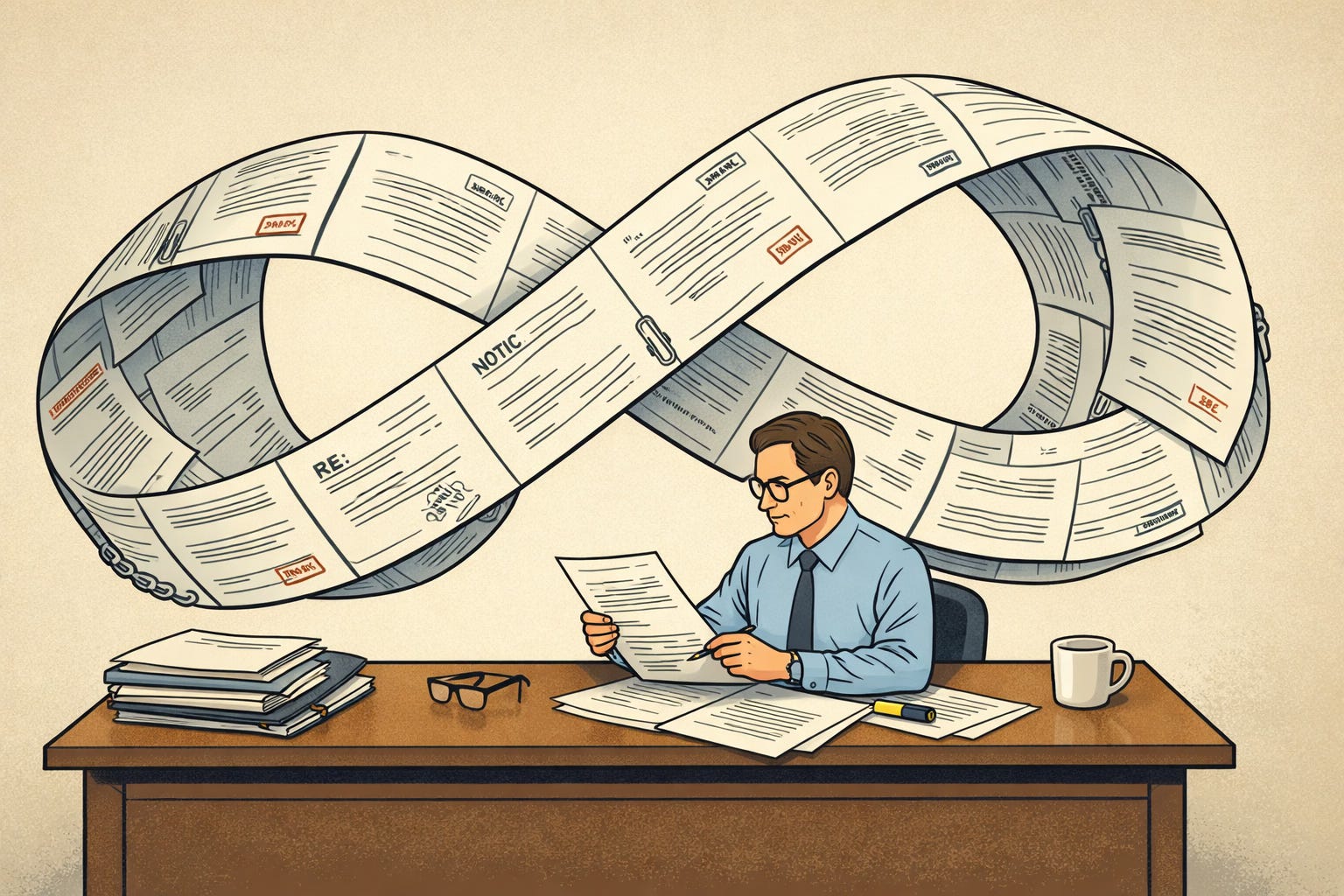
Something arrived in my inbox recently.
I should emphasise — for reasons that will be obvious to anyone of a regulatory disposition — that I claim no authorship of the idea, and I am certainly not advocating its use.
This is offered strictly for entertainment purposes only, in the same sense that one might describe lock-picking in a detective novel without encouraging burglary.
Think of it as a curiosity. A small, slightly mischievous proof-of-concept.
The phrase that came to mind on reading it was:
paperwork sadism.
Not cruelty in any actionable sense. Nothing aggressive. Nothing threatening. No raised voices, no hostile language, no dramatic gestures.
Just a form of procedural attentiveness so polite, so sustained, and so unreasonably thorough that it becomes… uncomfortable.
The broader concept might be called inverse bureaucracy.
For decades, the asymmetry has been clear. Bureaucracies govern through process: forms, procedures, notices, departments, correspondence, hand-offs, and evidential demands. The individual is expected to comply, absorb, and eventually tire.
Delay is power.
Ambiguity is power.
Documentation is power.
The citizen is not expected to win. The citizen is expected to stop.
What has changed — and this is where the comedy begins — is that the cost of procedural persistence has collapsed.
AI can now read faster, remember more, cross-reference better, and draft more coherently than most administrative workflows were ever designed to withstand. What once required a team can now be performed by one mildly determined individual with a laptop and a slightly perverse sense of curiosity.
Which makes something rather delightful possible.
You can take the paperwork seriously.
Alarmingly seriously.
You can read every line. Reconstruct every exchange. Compare every statement against every prior statement. Ask — with impeccable politeness — for the evidential basis of each assertion.
Not angrily. That would be vulgar.
Just… carefully.
The material I received described a technique so simple it almost feels unfair. The tone must remain:
courteous
analytical
mildly perplexed
procedurally immaculate
The posture never shifts:
“I am simply trying to understand your position.”
This is, of course, the most dangerous sentence in the English language.
Administrative narratives, it turns out, are not built for this.
They are assembled — often in good faith — from summaries, internal notes, partial records, and evolving explanations. They function perfectly well under normal conditions, where nobody reads the entire file.
But when someone does — when the correspondence is treated as if it were an evidential bundle, read line-by-line and compared in pari materia — something interesting happens.
The narrative begins to wobble. Not because anyone is lying. Simply because the system was never designed to remember what it said last Tuesday.
That is what this idea exploits.
What follows is not advice — heaven forbid — merely a description of the pattern.
Step 1: Reconstruct the file
Collect everything.
Every email. Every letter. Every notice. Every “summary.” AI is particularly good at reconstructing timelines and identifying when explanations evolve — or quietly mutate.
The correspondence becomes an evidential bundle.
You read it.
Then, for reasons that will remain mysterious to outside observers, you read it again.
Step 2: Cross-reference the narrative
Administrative explanations are rarely self-contained.
A conclusion here.
A caveat there.
A revision a fortnight later.
Taken individually, each is perfectly reasonable. Taken together, they occasionally become… ambitious.
So you read them in pari materia — as a single narrative — and attempt, with admirable sincerity, to reconcile them.
If they do not align, you ask.
Gently.
Step 3: Ask for the evidential substratum
This is where things become quietly awkward.
Organisations are very comfortable providing conclusions. They are less comfortable providing the materials that gave rise to those conclusions.
So you ask for them:
Inspection reports.
Engineer notes.
Logs.
Photographs.
Internal records.
Nothing exotic. Just the things one would expect to exist.
If they do exist, all is well.
If they do not, the narrative begins to hover slightly above reality, like a table with one leg missing.
Step 4: Clarify who is actually responsible
At this point, a small mystery often emerges.
Who, precisely, is saying these things?
Is it the investigations team?
The billing department?
External counsel?
A contractor?
On whose authority were earlier assertions made?
This is not a confrontational question. It is simply… a question.
The answer, however, can be surprisingly difficult to produce.
Step 5: Introduce a little archaeology
Here the tone remains gentle, but the effect sharpens.
You refer back to:
“your email of 17 December”
“my letter of 27 January”
“the explanation provided prior to Christmas”
and attempt to reconcile those statements with the present position.
Often, the recipient must now locate documents they had not planned to revisit.
The file begins, slowly, to reconstitute itself.
Around them.
Step 6: Deploy Latin with restraint
Nothing flamboyant. Just the occasional hint that the exchange is being treated as a record rather than a conversation:
onus probandi incumbit ei qui dicit
audi alteram partem
ex abundanti cautela
Used sparingly, this has the effect of making everyone slightly more careful than they were five minutes ago.
Step 7: Remain charmingly confused
This is crucial.
“I may have misunderstood…”
“I have attempted to reconcile…”
“I remain uncertain how these positions align…”
You are not accusing anyone of anything.
You are simply finding it very, very difficult to understand.
This is surprisingly hard to argue with.
Step 8: Increase the paperwork
AI makes it trivial to add:
comparison tables
chronological summaries
cross-referenced extracts
Each addition is helpful. Each addition is reasonable. Each addition is entirely proportionate.
Collectively, they become… burdensome.
Step 9: Wait
No escalation is required.
No confrontation.
No drama.
Administrative systems are designed to process cases efficiently. They are not designed to defend internally inconsistent narratives under sustained, polite examination.
Eventually, someone — somewhere — asks the only question that matters:
“Why is this person still here?”
Shortly thereafter:
“Can we make this go away?”
At this point, outcomes tend to improve.
The deeper joke
What makes this so amusing is the reversal.
For generations, process has been a one-way instrument. The system applies pressure. The individual absorbs it.
Now, for the first time, the individual can match — and occasionally exceed — that procedural persistence.
Not through force.
Through patience.
Through memory.
Through a mildly unsettling willingness to read everything.
Which brings us back to paperwork sadism.
It is not aggression.
It is not activism.
It is not rebellion.
It is simply the quiet act of replying:
“I have reviewed the correspondence carefully and attempted to reconcile the various explanations provided across the sequence. I regret to say that I remain uncertain as to the precise basis upon which your current position rests.”
And then — with perfect courtesy, infinite patience, and ex abundanti cautela —
refusing to let the file forget itself.
😇😜🤭
Bravo! As only a Brit can do.
I'm heartened to see you enjoying yourself!