

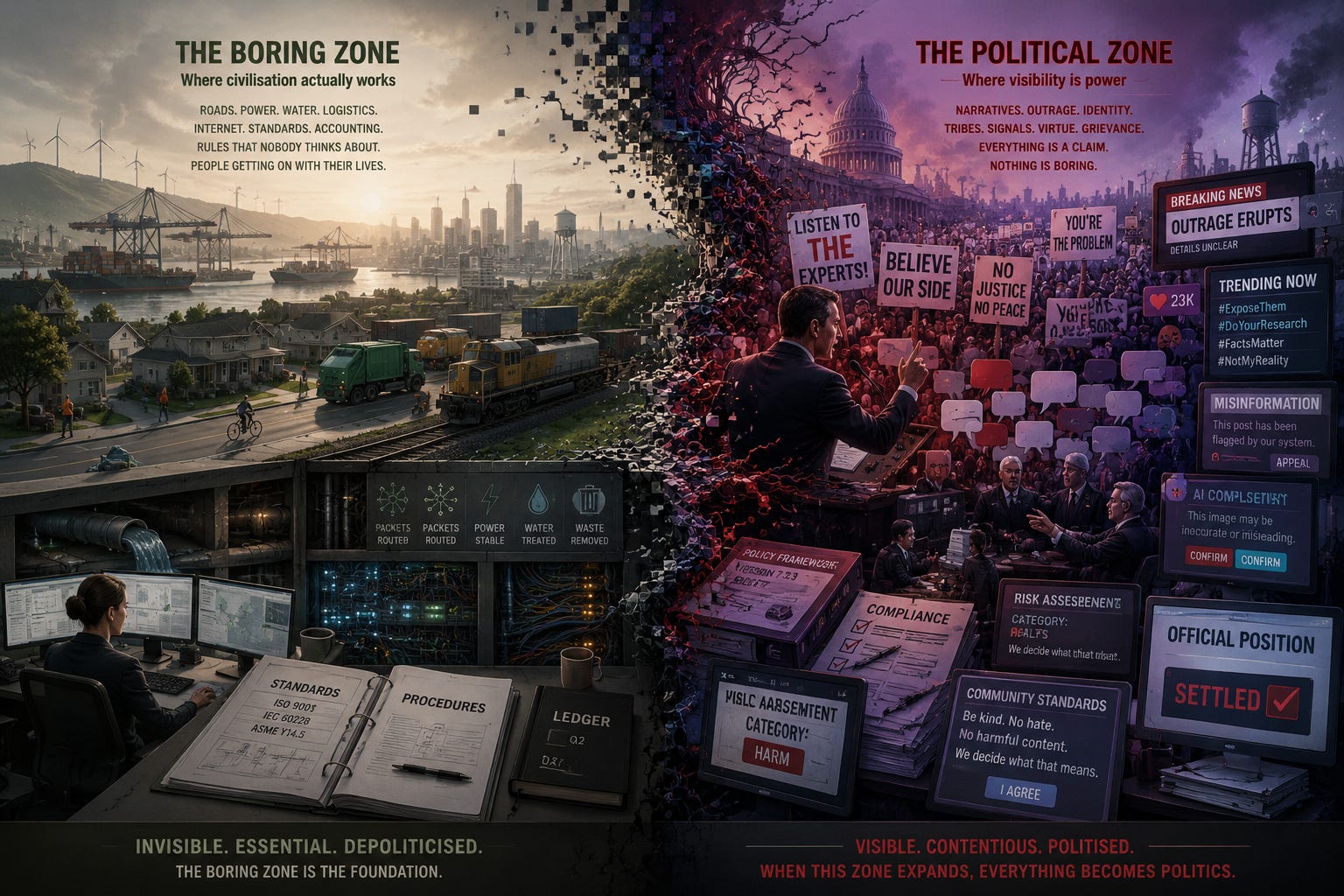
Most political discussion takes place inside the system itself: whose argument should prevail, which party should win, or what should be done about decisions already made. I want to work upstream from politics and underneath ideology, asking a more fundamental question: why does politics exist at all? What problem is it solving?
My argument is that politics emerges wherever “official reality” and “real reality” diverge. Human societies cannot perfectly resolve truth, responsibility, legitimacy, and competing claims at scale. Yet decisions must still be made and coordination must still occur.
Politics is the machinery civilisation uses to manage that misalignment.
What follows is an exploration of that pre-ideological space, and the structural pressures it imposes on every downstream political system. It challenges several familiar assumptions — that the core political struggle is left versus right, market versus state, or centralisation versus decentralisation.
Those conflicts are real, but they are not fundamental.
They are downstream manifestations of a deeper civilisational problem:
how societies continue functioning when responsibility, legitimacy, truth, and competing claims cannot be fully reconciled.
In a way, the easiest place to begin is by examining those parts of everyday life that are not subject to political machinations. The greatest achievement of civilisation is to make many matters “boring” — no longer subject to contest, and outside the realm of political debate.
That not everything is politics tells us something profound.
In fact, civilisation constantly tries to remove things from politics wherever a stable basis in evidence and reason becomes possible. Most people do not politically debate which side of the road to drive on, envelope sizes, shipping container dimensions, electrical socket configurations, railway gauges, or even Internet packet structures.
Why?
Because these domains achieved sufficiently stable grounding:
The relevant objects are determinate — we know what we are dealing with.
The societal coordination benefits are obvious — so dissent has low value.
The factual attribution pressure is low — reasons to change are weak.
The debate termination costs are manageable — institutions handle agreement.
As a result, these questions become standards, protocols, engineering constraints, and settled infrastructure.
That is why they feel boring, and it is a good thing. Boring is success, in civilisation terms — one of humanity’s greatest achievements.
Politics expands wherever boring is not possible.
That is to say, boring is where answers can be cheaply reconstructed, while politics emerges where reconstructable agreement becomes expensive.
That inversion is essential: politics is defined by deviation from what is boring.
Doubtless from an early age you will have been exposed to political debate, and felt that strange unease when the adults could not agree, or someone begins to roll their eyes as another person “goes off again” about their favourite political topic. As children we intuitively feel that there ought to be some higher authority or shared reality capable of resolving these conflicts and restoring peace, yet cannot quite identify what is missing.
Why do the adults seem permanently trapped in dispute over political matters?
These conflicts often revolve around people talking past one another. They cannot fully settle on what the problem actually is, how it should be framed, which facts matter most, what rules apply, or why a particular outcome should legitimately bind everyone else.
There are appeals to policy, science, experts, morality, rights, tradition, community standards, and lived experience — yet none definitively carries the day.
What matters here is not the specific dispute, but that strange feeling everyone recognises. Deep down, we long for agreement because it signals alignment to something greater than ourselves and our own competing wills. Persistent unresolved conflict feels destabilising, especially to a child encountering it for the first time.
We are experiencing politics, but have no place to put it.
That feeling of disquiet arises from a problem no political system can fully solve.
Modern society imbues us with a sense of rights we possess, harms we have endured, abuses of authority we have witnessed, failures of legitimacy we perceive, and injustices that demand recognition. Every misalignment between what we believe to be real and righteous, and what we actually experience, gives us standing to seek representation, remedy, and adjudication.
Politics exists because standing exceeds adjudicability.
No civilisation can fully determine who is right, who is responsible, what justice requires, which harms matter most, how competing rights reconcile, or which truths deserve priority. The chains of reasoning are potentially unbounded if followed all the way down; courts, institutions, and political systems would enter an infinite loop and cease to function.
Yet society must still continue operating.
Evidence has to be truncated somewhere. Debate has to be bounded. Decisions have to terminate even when uncertainty remains unresolved. A certain shallowness in politics and justice is therefore not merely a flaw, but a functional necessity. It is often more important that something be decided than that every possible line of reasoning be exhausted.
Politics emerges from the impossibility of perfect adjudication.
This is the true substrate beneath ideology, elections, constitutions, bureaucracy, and culture war. These are all downstream manifestations of a more fundamental constraint:
Finite societies cannot fully reconcile unlimited standing with limited adjudicative capacity.
Everyone reading this has created or opened a ZIP file at some point, or played an MP3 file. We understand that compression is a process that compacts something too large to manage within our resource constraints, and substitutes a smaller representation in its place.
That smaller object might be reconstructable to the larger one one-for-one, as with a ZIP archive, or it might discard information considered less critical, as with lossy compression formats like MP3. In the latter case the reconstruction is imperfect, but sufficiently functional for practical purposes.
Politics is the lossy compression layer for adjudication.
That means politics is not fundamentally morality, ideology, democracy, or economics. Those are consequences of this more basic function.
Politics takes infinite social and environmental complexity, and reduces it into finite adjudication capacity.
Why? Because reality generates more ambiguity, grievance, causality, interpretation, and claims, than any governance system can fully process.
So civilisation becomes necessarily lossy.
Politics is the machinery that manages the loss.
Most analysis focuses on the artefacts of politics: procedures, narratives, rules, myths, constitutions, bureaucracies, and media systems. Yet those all only exist to resolve a deeper need:
civilisation cannot operate directly on unconstrained reality.
It needs representational compression mechanisms, debate termination technologies, and reality-stabilisation systems.
Civilisation must substitute manageable representations of reality for reality itself.
Now we are in a position to see where mainstream political science stops short of the bedrock issue it ultimately has to confront.
Typical discourse revolves around ideologies, institutions, incentives, rights, classes, constitutions, markets, and power. Every political system claims some form of truth, justice, legitimacy, accountability, or rationality.
Yet under stress they all face the same underlying problem:
reality generates more standing than society can fully adjudicate.
As pressure rises, governance systems are forced into progressively higher levels of compression in order to fit within finite adjudicative capacity. The greater the compression, the greater the loss of reconstructable reality in the resulting decisions.
This is not failure.
It is physics.
Aerodynamics works the same way in capitalist and communist countries alike. Gravity is not suspended by ideology.
The limits being described here pre-exist political debate itself.
No political system can escape them entirely.
This is where conventional political discourse becomes misleading. Debates about class, control, power, freedom, equality, markets, or the state all assume the same substrate beneath them: stable objects, stable legitimacy, stable authority, and stable attribution.
But these assumptions increasingly fail under conditions of scale, complexity, and overload. The objects of political discourse become indeterminate, evidence becomes over-compressed, reasoning grows vague, and decision processes become opaque.
A meaningless choice in a capitalist system is no more meaningful than a meaningless choice in a communist one.
The underlying pathology is the same, regardless of ideology.
The familiar machinery of political science is therefore largely concerned with managing trade-offs between desirable properties that cannot all be simultaneously maximised. These debates are real, but they are downstream manifestations of a more fundamental structural constraint.
The deeper machinery concerns how societies construct governable objects, how authority attaches to them, how unresolved disputes terminate, and how continuity survives overload. The same underlying problem exists everywhere:
preserving meaning and reconstructable reality under conditions of finite adjudicative capacity.
Politics, in this sense, is downstream of the compression of reality into governable form under conditions of overloaded demand for attribution — and therefore liability, accountability, and ultimately someone to blame for outcomes.
Its function is not to establish perfect truth, but to preserve sufficient shared coherence for society to continue operating despite incomplete knowledge, unresolved claims, and finite adjudicative capacity.
Now comes the intellectual shock.
Ideologies are not primarily belief systems.
They are strategies for shedding excess attribution load.
You might want to pause for a moment, because this contradicts much of what modern political culture teaches us — namely that ideologies are primarily moral destinies, inevitable historical outcomes, or final solutions to human conflict. But from this upstream, pre-ideological perspective — one concerned only with the finite resource constraints of society — the conclusion becomes difficult to avoid.
“Left” and “right” are arguing inside a deeper system.
There can never be a final reconciliation between them because both are adaptive responses to the same underlying constraint. They are situational tools for contextual problems, each carrying different costs, benefits, and risks depending on circumstance.
Neither can escape the fundamental limits imposed by reality compression and finite adjudicative capacity.
Every ideology can redistribute the burden of lossy compression, but none can eliminate it. The best any political system can do is minimise the consequential harm caused by incomplete adjudication and imperfect reconstruction of reality.
Every ideology therefore operates within the same constrained trading space:
balancing the degree of compression, the cost of maintaining reconstructable truth, and the risk of drift into synthetic unreality.
This reframing allows us to see the deeper goals and strategies of different political ideologies.
Liberalism increases contestability by assigning more individual rights and protections, thereby generating more standing. Over time this tends to overload adjudicative capacity, leading to procedural expansion, synthetic governance, and philosophical drift as more and more claims compete for recognition and remedy.
Conservatism compresses uncertainty through inherited continuity. The set of governable objects is deliberately constrained through tradition, precedent, and established social structure. This stabilises coordination, but at the cost of adaptability and variety when environmental conditions shift rapidly.
Socialism shifts attribution upward into systems, classes, and institutions, moving the locus of contest away from individuals. This can reduce fragmentation and local inequality, but often at the price of sacrificing personal justice and local nuance in favour of higher-level abstractions.
Technocracy substitutes procedure for grounding. If the machine ran correctly, then legitimacy is assumed to follow automatically. Its characteristic failure mode is progressive detachment from lived reality, as feedback mechanisms weaken and the system loses the ability to recognise its own drift into synthetic governance.
Populism amplifies grievance, exposure, and contestability, often replacing formal reasoning with narrative immediacy and emotional legitimacy. This can reconnect politics to lived experience, but also risks severing decision-making from scientific, institutional, or physical constraints.
Authoritarianism suppresses attribution demands directly. It resolves overload by limiting contest itself, reducing standing rather than increasing adjudicative capacity. This can restore short-term coherence, but unresolved conflict accumulates beneath the surface while meaningful reconciliation becomes increasingly remote.
The key insight is simple: none escape attribution and adjudication overload.
They merely fail differently.
Every ideology possesses its own characteristic forms of corruption, not as anomalies or betrayals of principle, but as structurally emergent consequences of lossy adjudication.
Once we recognise politics as a contest over where the failure modes of adjudication must fall, it begins to look very different. Our intuition that politics is “always corrupt” is substantially correct, but not quite in the way we usually imagine.
A single flipped bit in a ZIP archive can make the original unrecoverable. The very act of compression introduces fragility and loss. Politics is no different. Its function is inherently lossy, and some corruption of reality is inseparable from the task itself.
That politics applies MP3-style compression to ZIP file problems is unfortunate, but necessary.
Politics emerges from the irreconcilability between demand for grounded adjudication and the finite capacity available to supply it. As a result, political systems necessarily prioritise their own continuity. There can be no final intervention that abolishes the underlying constraint, because the constraint arises from the finite nature of social coordination itself.
The political system must preserve continuity before truth by privileging lossy compression over reconstructable correctness.
This sounds like a moral indictment, but it is better understood as a structural reality. Under sufficient load, proof becomes too expensive, attribution becomes incomplete, and adjudicative capacity saturates. The price paid is descent into cheaper termination modes and lower “truth regimes” with progressively more lossy compression.
If this feels uncomfortable, it is because modern political culture teaches us to believe that perfect reconciliation remains achievable. It does not.
The descent path under load is both predictable and universal:
At first, governance systems attempt grounded truth.
Then procedure substitutes for direct accountability.
Later, rhetoric stabilises legitimacy when procedure itself becomes insufficient.
Finally, institutions assert legitimacy directly, because the cost of fully reconstructing reality has become unaffordable.
This is the hidden machinery beneath bureaucracies, courts, corporations, governments, universities, media systems, and online platforms alike. It explains why politics so often feels unresolved, procedural, alienating, and faintly unreal.
Politics exists to manufacture enough shared official reality for the machinery of civilisation to continue functioning despite irreducible disagreement and incomplete truth.
Loss of grounding does not merely weaken governance. It also expands politics itself.
As reconstructable reality deteriorates, fewer questions remain safely inside the “boring zone” of settled coordination. Standards become contestable. Institutions become politicised. Expertise becomes disputed. Categories destabilise.
Every unresolved ambiguity generates new standing, fresh demands for adjudication, and further pressure on already overloaded systems.
The result is a self-reinforcing cycle.
Loss of grounding invites contest. Contest expands adjudication demand. Increased demand requires heavier compression. Heavier compression further weakens reconstructability.
Politics therefore spreads precisely where boring coordination fails.
Now we can see civilisation itself in a somewhat different light.
All governance systems exist between a floor and ceiling boundary.
We have already informally described the upper bound: the cost of reconstructing fully attributable truth becomes unaffordable under finite resource constraints, so adjudication freezes and the system ceases to function.
The lower bound lies at the opposite extreme, where continuity dominates reality so completely that “official truth” becomes increasingly detached from underlying facts — facts which have an unfortunate tendency to eventually reimpose themselves, however inconvenient or embarrassing.
This reframes power itself.
Power is not merely force, wealth, law, or institutional position.
Power is what remains when reconstructable truth becomes too expensive to maintain.
It is the residual authority that determines which compressed version of reality becomes socially binding once full adjudication collapses under load.
As modern information systems accelerate demand for political, legal, administrative, and corporate adjudication, the danger is not quite what we usually imagine.
The conventional fears are criminal corruption, conspiracy, incompetence, or dictatorship. These dangers are real, and should not be underestimated. But they are not the deepest failure mode.
The greater danger is politics consuming all domains of life — where everything becomes contestable, the “boring zone” collapses, and everyday existence enters permanent politicisation.
Governance systems begin preserving operational continuity after reconstructable grounding weakens. The “party line” hardens into incontestable official reality regardless of underlying fact.
Every object of governance, every attribution, every institutional claim slowly loses ontological stability as its epistemic foundations corrode.
But coercion still proceeds.
We already see this dynamic emerging in algorithmic moderation systems, AI classification architectures, floating categories of “harm”, procedural compliance regimes, and institutional workflows nobody can fully reconstruct or meaningfully challenge.
This is synthetic governance.
Now we can see the real danger from AI. Not merely AGI. Not robot tyranny.
The danger of AI is operationally successful synthetic governance at planetary scale.
Our framing suggests the deepest risk is somewhat obscured by conventional debate. AI does not merely automate decisions. It explosively increases standing, visibility, claims, evidence, narratives, contestability, and attribution complexity.
In other words, AI increases the adjudication load placed upon society faster than adjudicative capacity can realistically expand.
At the very same time, AI industrialises abstraction, proceduralisation, rhetorical closure, and synthetic legitimacy. The institutional response is predictable: ever greater politicisation of decisions, continual expansion of adjudication demand, and progressive erosion of the “boring zone”.
AI simultaneously increases standing while automating synthetic closure.
That is the real danger.
Not intelligent machines replacing humanity, but humanity progressively losing the ability to maintain grounded, reconstructable reality under conditions of machine-amplified overload.
This upstream relocation of our understanding of politics, ideology, and power leads to a civilisation-level conclusion.
When we examine the historical record, civilisations rarely collapse instantly. Their names, institutions, procedures, and enforcement mechanisms often persist for long periods. Courts remain open. Temples remain standing. Armies still march.
Bureaucracies continue processing forms and issuing decrees. But the reconstructability of decisions weakens, grounding in reality softens, and legitimacy gradually evaporates.
Edicts are still issued, but they become increasingly detached from lived experience.
This is civilisation attenuation.
Not apocalypse. Not revolution. Not sudden collapse.
The governance system still functions, yet reciprocal intelligibility progressively degrades.
Modern societies can therefore become procedurally dense, technologically sophisticated, and administratively powerful, while simultaneously feeling psychologically unreal.
This occurs when the political zone expands at the expense of the boring zone:
when more and more aspects of life become permanently contestable because societies can no longer bear the institutional, cultural, and moral costs required to sustain grounded coordination.
This insight — that the “boring zone” and “political zone” compete for civilisational territory — allows us to flip the script on morality itself.
So far, we have deliberately positioned ourselves upstream of ideology and tribal affiliation. The structural limits on truth, attribution, and adjudication simply exist. They are not moral opinions any more than electromagnetism is a moral opinion.
From this perspective, political ideologies become descriptive responses to the same underlying constraint. Each represents a different compromise over where compression, ambiguity, contestability, and failure must fall. An honest politics should be able to admit this openly:
“Yes — these are the trade-offs we are making, and here is why.”
This relocates the moral axis entirely.
The deepest divide is no longer left versus right, progressive versus conservative, or state versus market. It is between systems that preserve grounded, corrigible coordination — and systems that progressively dissolve reality into synthetic political contest.
Healthy systems protect the boring zone. They preserve reconstructability, permit challenge, expose attenuation, and remain capable of self-correction when grounding weakens.
Dangerous systems do the opposite. They expand the political zone, suppress challenge, diffuse accountability, conceal attenuation, and substitute synthetic continuity for reconstructable truth.
The real question therefore changes.
Rather than demanding that civilisation eliminate attenuation altogether — an impossible task under finite conditions — we can instead ask:
Can governance systems preserve sufficient reconstructable reciprocity
to remain lawful, intelligible, and self-correcting under scale?
To summarise, what this essay proposes is that politics is not fundamentally a battle of beliefs, nor merely a struggle for power.
Politics is the machinery civilisations use to terminate unresolved questions of responsibility, legitimacy, and authority when standing exceeds adjudicability.
Every ideology therefore becomes a load-management strategy, each with its own overload dynamics and characteristic failure modes. We cannot eliminate the distortions introduced by compressing reality into governable “official truth”; we can only influence where the resulting failure modes fall, and how severe their consequences become.
The great danger of the modern world is not simply tyranny. It is systems that continue functioning after the objects, authority structures, and grounding that justify them have become only partially reconstructable.
The cataclysm is not fake governance that halts.
It is synthetic governance that continues.
The long-term stability of civilisation depends on how much truthful reciprocal intelligibility survives before continuity overwhelms grounding.
That is not a political claim.
It is boring.
The most boring claim imaginable.
And that is a very good place to begin.