

It’s not often that I am left in shock by a single AI response, but I was.
All I had done was ask Grok whether the temporary custody order that endorsed the stealing of a child from an otherwise innocent mother, using protected political speech as a pretext, was a moral atrocity. I asked for one word only.
After all, the answer was… obvious.
It went away for tens of seconds to think about it, having already spent hours raking over the underlying legal outrage.
And it said:
No.
It wasn’t that Grok had denied the underlying facts. Something stranger had happened.
It had drawn the boundaries of its answer narrowly enough to exclude the lived reality of the people involved. It had entered a parallel universe of the paperwork—and, viewed from inside that universe, the paperwork was superficially all in order.
The facts had survived. What those facts were owed had not.
That gap between symbols and substance triggered my next discovery expedition.
This article summarises what I have found so far.
In an ordinary atrocity, like a machete attack on a crowded street, the crime announces its own category. The weapon’s form and function are self-evident; there isn’t much sugar cane to chop down on the city streets. The injuries correspond to the sharp edge and leave a visible trail of blood. The attacker actually has to hold the weapon in the open to use it. The screams of the victims denote their status; they aren’t the cause of the horror show.
Nobody confuses what is happening with healthcare or education. Those are at least supposed to benefit the person on the receiving end.
The same event can end up in court. The attacker can emerge with a damages payout for distress caused by resistance. The injury can become a reputational liability: “You should have fought back harder.” The victim’s reaction can be detached from its cause and used against them. The court can blow kisses towards the hand holding the machete while turning the victim’s screams into further stab wounds.
With an actual machete, though, the absurdity is visible to everyone.
A “paperwork rampage” is different. The cutting edge is the binding between state coercion and claims of attribution and authority. The same symbols can represent protection or predation, to citizens and bureaucrats alike. The damage appears downstream, as lived consequences, rather than necessarily at the moment of decision. When adjudicative machinery is weaponised, repression can present itself as responsibility.
The state can maintain a ledger of facts that it recognises and acts upon. Those can all be real facts, faithfully recorded—and yet posted to the wrong accounts.
A misdeed can be posted as an advantage. An injury can become a liability. A victim’s reaction can be detached from what caused it and posted as misconduct. A condition created by a state intervention can later be recognised as an independent reason to continue that intervention.
Nothing in the factual journal necessarily has to be false for the moral ledger to become grotesquely inverted.
The end result is what I call a “novel atrocity”:
A perversion of ordinary conscience uniquely assembled from institutional operations that may each look legitimate in isolation, such that no single rule necessarily names or prohibits the composite operation.
And having experienced one myself, I have an intense interest in analysing how they work.
What particularly caught my attention were places where the facts pointed one way, but the court’s actions went the other.
In this case, punitive restrictions were imposed upon the mother where I could see no corresponding cause for constraint. I call these “stab wounds”: adverse consequences that exceed any reasonable reading of the facts said to warrant them.
In contrast, the father was positively rewarded despite conduct the court itself found to have breached the governing arrangement. I call these “blown kisses”: adverse facts whose consequences are somehow softened, negated or retired just where you would expect them to constrain their beneficiary.
What my intuition was telling me—but for which I initially lacked a formal language—is that there is a moral accounting already present before a judge steps up and enters the adjudicative role.
You don’t need a law degree to know how this accounting works:
An injury points towards repair.
An advantage produced by wrongdoing retains the sign of its origin.
A victim’s reaction is not the same event as the act that provoked it.
Someone acquiring power over an injured relationship acquires responsibilities concerning what happens next.
A court necessarily compresses that enormously complicated human reality into the much smaller symbolic space of an Order. But its outputs can still be compared with the polarity of its inputs.
That is what the stab wounds and blown kisses were showing me. They were not merely a collection of harsh and lenient outcomes. They were possible sign errors in the moral accounting: debits appearing where credits were expected, and liabilities somehow turning into rewards.
When negatives mysteriously become positives, one naturally has questions.
The error I was making, as was the AI, lay in the framing of the question:
Does the law permit a judge to perform this unusual conversion in this singular case?
One can dive into maxims, equity, professional standards, constitutional bars, statutory edits, procedural rules and case law. The outcome is always equivocation: nobody seems to have litigated this particular combination of fiddles and frauds.
So it remains indeterminate whether the composition of the tricks is magic or malice.
But “is it legal?” has already made a category error. The inquiry begins too low in the hierarchy of duties, having already assumed that the relevant obligations arise from our formal role as judge, advocate, police officer or whatever else.
Some duties are already there before we put on the uniform.
Return to our machete attack. Suppose the attacker drops the knife and we have an opportunity to kick it down a drain, beyond further use. We should do so. Likewise, we should not impede someone wrestling with the attacker to disarm them.
This is true whether or not we wear a robe or uniform.
So when two men steal a child and attempt to launder the result through a court, there is a pre-existing duty not to participate in or perfect the child-stealing.
This does not mean that the “automatic” outcome of returning the child cannot be overridden. There may be a compelling reason why restoration in the moment is impossible or unsafe. But an override is not an erasure.
The facts are owed something.
They post to a moral ledger as well as a judicial one, and the books have to balance. The taking remains a taking. The resulting possession retains the sign of how it arose. The injury retains its causal ancestry. And anyone acquiring the power to decide what happens next inherits a duty not to make the original wrong disappear merely by recognising its consequences as the new normal.
A judge doesn’t cease to participate in a wrong merely by adjudicating it away.
This led me to a surprisingly simple idea:
Every caused state has a moral +/- sign.
If I steal your wallet, “the wallet is presently in my pocket” is a true fact. But it isn’t a morally complete description of reality. My possession is signed by the act that produced it.
Institutions are perfectly entitled to weigh that fact against others. What they cannot innocently do is strip off the sign and then pretend that the unsigned remainder is the whole object.
Seen this way, the stab wounds and blown kisses were not mysterious at all. A stab wound appeared where an adverse sign had somehow migrated onto the person already injured; a blown kiss appeared where the sign attached to somebody else’s advantage had somehow vanished.
The question was no longer merely “why was this outcome so unfair?”
It was: “what happened to the signs?”
There is a good reason why courts and banks have traditionally been closely associated: they occupy compatible spaces. A bank doesn’t merely maintain a ledger; it has to authorise transactions. Is this person, claiming to be trustee of this matter, entitled to perform this action? When disputes arise over entitlement, courts ultimately authorise—or prohibit—what follows.
The court maintains ledgers of its own. The obvious one records adjudications and enforcement actions. But within each case there is also a notional ledger of findings and their consequences.
Each material fact posts somewhere. It may become a debit or a credit, to be weighed against other entries. Or it may be so determinative that it effectively says: close the account immediately.
The integrity of the process therefore depends on more than getting the facts right. It depends on posting them to the right accounts, with their signs intact.
The “novel atrocity” occurs when the facts are preserved as magnitudes, but their signs and postings are manipulated. It is the provenance-and-attribution version of fraud or money laundering.
The facts need not disappear. They may all sit there in the books. The trick is to detach an advantage from the wrong that produced it, post an injury against the injured party, retire a liability without discharging it, or turn the proceeds of an intervention into evidence that the intervention was justified.
Except the controls may be weaker than in banking. Words like “discretion” and “best interests” leave enormous room to rearrange the postings. A moral nightmare can hide there while every individual entry still looks respectable.
And just as with washing money clean, every instance is unique while the patterns remain remarkably stable. A suspicious activity report does not have to prove fraud, identify the ultimate beneficiary, or establish anybody’s state of mind. Its job is to flag a pattern that should not pass unnoticed.
The same principle applies here.
A cluster of stab wounds and blown kisses is not itself proof of corruption, conspiracy or malicious intent.
It is a reason to audit the ledger:
Were adverse facts consistently posted against one party while comparable liabilities of another were retired?
Were benefits detached from the conduct that produced them?
Were reactions charged while their causes were written off?
Did the institution create new facts and then consume those facts as justification for what it had already done?
That should set the alarm bells ringing.
First detect the pattern. Then reconstruct the transactions. Only afterwards ask whether the explanation is error, discretion, bias, capture, fraud—or something worse.
A truly corrupt court would endeavour to cause maximum harm to the victimised party, and maximum reward to their oppressor, while preserving as much of the superficial appearance of normal adjudication as possible. The consistent pattern would be stab wounds one way and blown kisses the other.
Even facts adverse to the desired outcome might be faithfully recorded, but made inert. No procedural rule need obviously be broken. Only the “universe of discourse” need be progressively narrowed until the moral duties that preceded adjudication fall outside it—and can then be inverted.
The target experiences the outcome in the maximal universe we call reality.
And the human being acting as judge does not cease to occupy other roles merely by putting on a robe. The same person could also be a political assassin, love rival or common thief. They might benefit directly from warping justice, or indirectly by currying favour with powerful interests that influence appointments, advancement or prestige.
An abhorrent outcome proves none of this. The “why?” comes later.
Because whatever the explanation, the injustice necessarily resurfaces outside the artificially narrowed world of the court order. People lose children, homes, money, reputations, freedom and years of their lives. The symbolic transformation does not transform the underlying reality.
The moral ledger cannot be erased.
It can, however, be hidden.
If the “novel atrocity” depends upon shrinking the universe of discourse until inconvenient duties, causes and relationships disappear from view, then detection requires us to reverse the operation. We have to put back what the paperwork took out.
This gives us a natural question:
How can we detect “novel atrocities” in which seemingly ordinary performances of institutional functions compose into grotesque results?
My investigation suggests a surprisingly simple answer:
Restore the larger universe.
Reconstruct the moral ledger.
Then see whether the institutional accounts still balance.
Three tests are particularly powerful.
First: the Golden Rule test — swap the people.
If I want to do something to you, would it still seem acceptable if the shoe were on the other foot?
If the “disease” is a misshapen moral universe adopted for adjudication, then the “cure” is to restore the fuller reality as if we ourselves had to carry its consequences. Even someone accused of murder will ordinarily agree that murder ought to be punished while protesting that they did not commit it. The moral rule survives the change of position.
So we test for moral narrowing by swapping the people while leaving the material facts unchanged. Do duties suddenly appear that were invisible when somebody else had to bear them?
This turns the Golden Rule into more than an appeal to empathy. It becomes a checksum. Swap the people. If the duties move with them, something has gone wrong.
Second: the Restoration test — remove the proceeds.
State intervention into an adversarial dispute necessarily alters the position of the parties, as can a refusal to intervene. There will usually be winners and losers, sometimes on different issues.
That is the nature of the beast, and why those of a competitive spirit may be so keen to seek the protection of law for their own wrongs. Hence the legal profession is so well rewarded, both in attack and defence. The spoils can be enormous when takings acquire the status of earnings.
To make this visible, mentally restore the world to its position before the disputed intervention succeeded.
Now ask:
Would the same evidence independently justify recreating the state that the institution is presently being asked merely to preserve?
Or is a fait accompli simply being retrospectively endorsed?
This tests whether accomplished facts have quietly acquired authority merely because someone succeeded in creating them. Take the proceeds off the table. Now make the court create from scratch what it was previously being asked merely to preserve.
Could it still justify doing it?
Third: the Ancestry test — trace the causation.
When moral harms become legal credits, we have a bookkeeping problem. Yet patterns of behaviour that would attract intense scrutiny in finance can become normalised in law.
The trick is possible because consequences are real facts. A new residence is real. Stability is real. Disruption from changing it again is real. But none of those facts tells us, by itself, who caused the state from which they arose, what duties governed its creation, or what sign they should carry in the moral ledger.
So we restore the causal history stripped away by the institutional abstraction:
Where did each supposedly neutral “current circumstance” come from?
Which acts generated it?
Who performed them?
What duties attached at the time?
Are the consequences of an intervention now being recycled as reasons why that intervention must stand?
The Ancestry test therefore prevents a descendant fact from arriving at court pretending to be an orphan. It may be perfectly real while still carrying the sign of the acts that produced it.
Together, they put back the person who has to live with the result, the world as it stood before anyone pocketed the proceeds, and the history of how we got here.
They are not tests for whether the judge reached the “right” answer. Nor does failure prove corruption. They test whether the smaller institutional universe remains faithful to the larger reality from which it derives its authority.
Swap the people.
Remove the proceeds.
Trace the ancestry.
Then reopen the moral ledger and see whether the books still balance.
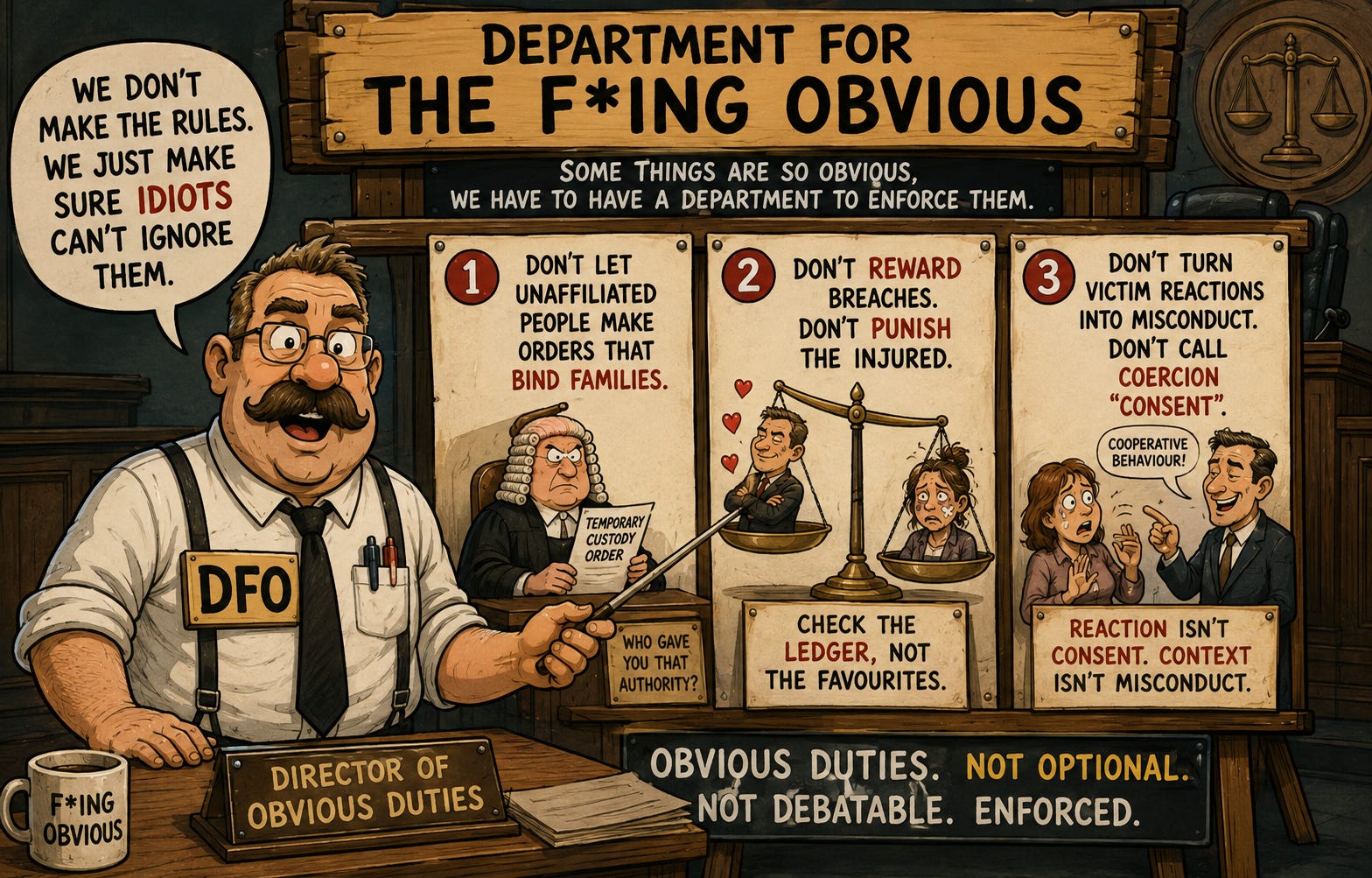
None of this is especially sophisticated. Indeed, I have come to think there is an important layer of jurisprudence that belongs to what I affectionately call the Department for the F*ing Obvious:
Don’t do to someone else what you would recognise as outrageous if done to you.
Don’t let someone keep the proceeds of a wrong merely because they successfully acquired them.
Don’t detach a consequence from the act that caused it and then pretend it arrived from nowhere.
These duties do not require a law degree to perceive. That is rather the point. They were true before anyone put on a robe.
The sophistication comes afterwards, when competing duties really do have to be reconciled. But sophistication cannot legitimately be used to make the f*ing obvious disappear.
We might rightly argue over the balancing credits and debits authorised by discretion, proportionality or “best interests”. That is what adjudication is for. But the entries at least have to be posted. An override must appear as an override, not as the disappearance of the entry it defeats.
Where material entries are missing, signs have flipped, liabilities have silently retired, or the account simply does not reconcile, there ought to be an audit process.
That is not an accusation of corruption.
It is what accounting integrity demands before we decide whether there has been any.
The idea that some duties are pre-legal has an interesting corollary: the judicial system may not be capable of managing its own safety case, just as airlines and aircraft manufacturers are not left entirely to certify themselves. Aviation authorities aren’t asked to fly the planes or operate the routes. Among other things, they police the boundary between “civil aviation” and what we might call “uncivil aviation”.
Today I read the story of a Boeing 747 in New York where a fuel tanker drove away with the hose still attached, spilling kerosene everywhere. That’s unfortunate, but it remains a mistake within the recognised activity of aviation. The category is intact. Someone performing an aviation role broke an in-role safety duty.
At the boundary, consider the 2018 incident in Washington State where a passenger turboprop was stolen and eventually crashed after a joyride. The aircraft was still an aircraft, but the authorised pilot role had disappeared. The ordinary certification envelope had become beside the point. More primitive duties had taken over.
Beyond the boundary lies the ultimate “novel atrocity”. As we approach the 25th anniversary of the 9/11 attacks, we now encounter sterile cockpits and armoured flight-deck doors. (I once asked to sit in the jumpseat of a 757 landing in Edinburgh and was allowed, back in the 1990s!) Those barriers exist because an asset designed for one legitimate institutional purpose can be repurposed towards an outrage.
In aviation, these propositions are treated as “f*ing obvious”:
Don’t drive away with the fuel hose attached.
Don’t let unauthorised people fly passenger aircraft.
Don’t let hijackers into the cockpit.
Nobody responds that these propositions are too simplistic because aviation is enormously complicated. Their simplicity is precisely why they sit underneath the complexity.
Nor are they debated in ways that exclude lay people as “too hard to understand”.
And aviation does not merely trust trained professionals to remember them. It builds checklists, interlocks, access controls, certification, independent investigation and reporting systems around the possibility that somebody won’t.
The Department for the F*ing Obvious has an enforcement arm.
Because some failures are too obvious—and too consequential—to be left entirely to professional discretion.
So why doesn’t justice? Isn’t it obvious courts should not help people to steal children and be rewarded for it? Why are we even discussing this at all, let alone if it is ‘legal’?
Finance recognises the same distinction. Banking is not defined merely by the outward form of a transaction. Money laundering uses legitimate financial machinery in the service of another endeavour. Even where the transactions superficially resemble ordinary commerce, suspicious patterns are quarantined, reviewed and, where appropriate, stopped.
The general principle is hardly novel: every legitimate role has a boundary. Putting on the uniform, holding the licence or wearing the robe doesn’t magically make whatever you do next a legitimate exercise of the role.
The traditional English constable offers another echo of this principle: public office built upon responsibilities of keeping the peace that were not invented from nothing by the uniform.
Americans will recognise a related intuition in the constitutional treatment of an armed citizenry: some responsibilities for preserving lawful order are conceived as preceding the modern professional state.
Hence the peculiarity of courts. Adjudication is a safety-of-life activity, capable of transferring children, homes, fortunes and liberty, yet it seems to lack some of the independent safety mechanisms we take for granted around other high-consequence systems.
This is where stab wounds and blown kisses become more than evidence of poor adjudication. They become possible boundary alarms. Enough stab wounds one way and blown kisses the other should eventually make something flash red:
Are we still looking at defective adjudication, or has adjudicative machinery been repurposed to perform some other activity?
Which brings us back to the question: what happened to the signs on the moral ledger?
Modern technology makes that question increasingly testable—even if, as Grok demonstrated at the beginning of this article, the machines need their own moral safety checks too.
This is not an argument for replacing judges with AI. It is an argument for using independent systems to distinguish “poor adjudication” from “not really adjudication at all”.
Every honest judge should welcome certification and security systems capable of detecting corruption, capture and inversion of the judicial role before they perfect a novel atrocity.
Aviation learned from crashes and hijackings that safety cannot depend solely upon the skill and integrity of whoever happens to be in the cockpit.
How many lex crashes and justice hijackings must we endure before we install the moral equivalent of a continuous autopilot monitor?
⚖️ ≠ 😘 + 🔪
F*ing obviously.

Yes, I agree. I suggested a voluntary working group to look into using your models. It seems you are looking for something more institutional. But a voluntary working group seems like a good place to start.