
Earlier today I published the “publicly acceptable” version of my analysis of Donald Trump’s famous 2016 election campaign ad, a piece of political messaging that has since been remixed into videos with many millions of views. The purpose was not to promote or condemn any political stance, but to highlight how structural constraints inside modern governance systems can increasingly dominate questions of policy, ideology, and democratic agency themselves.
But it wasn’t the article I really wanted to write — only the one I logically had to produce first.

In creating it, I had to leave much of the really interesting material on the cutting-room floor. Underneath the published article sits a much deeper structural decomposition of the advert using my ΩΛ∆∑ attribution and reconstructability framework.
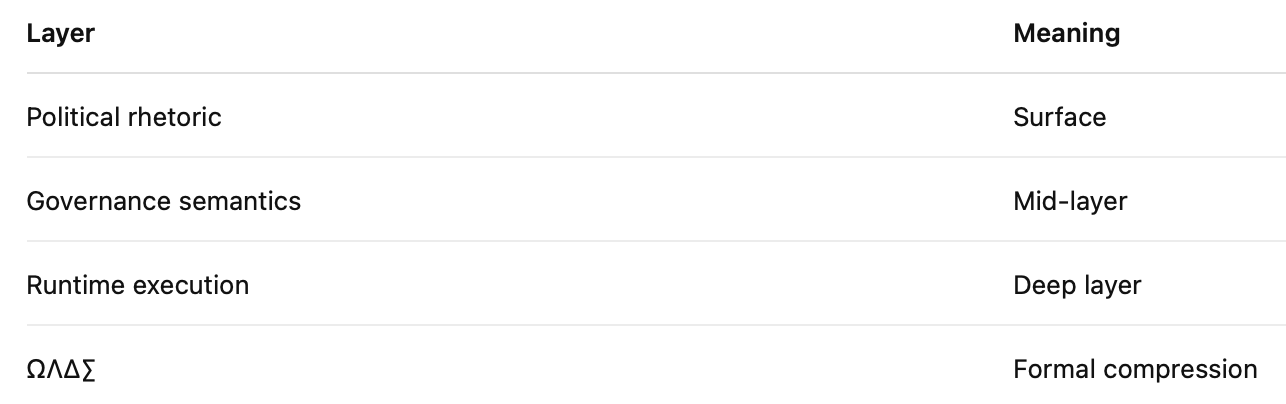
What I am effectively doing is stripping political messaging down into its primitive structural components and examining how they relate to one another under execution. This has more in common with debugging a complex program written in C++ or assembly language than with conventional political science.
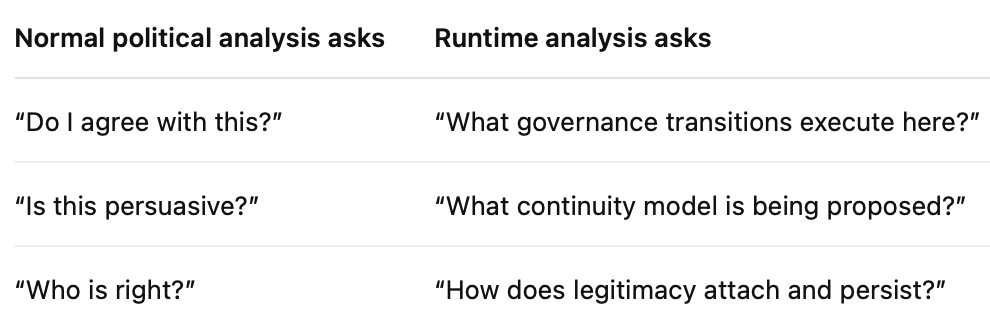
Some readers will find this exciting. Others will be confused but intrigued. And some will probably conclude that I have finally lost my marbles altogether. I can live with all three reactions. The purpose here is not accessibility or mass persuasion, but demonstrating a new analytic capability:
treating political rhetoric as executable governance runtime rather than mere ideological communication.
We are no longer asking whether the speech is morally good, politically wise, or factually correct in every claim. We are halting the message itself at breakpoints, and inspecting what governance-state transitions execute line by line of “political code”.
If that doesn’t interest anyone, then I probably need to emigrate to another universe.
The structure I think will help readers most is this:
Gentle deconstruction of the first clause in the speech, no Greek letters.
Introduce the debugger and runtime primitives.
Attach the debugger — and run through all the clauses giving the formal deconstruction in the ΩΛ∆∑ calculus.
A synthesis of the “aha!” moments that fall out in ordinary English.
The final biggie — where this redefines “The Swamp”.
Clause 1 — Plain English analysis
The opening line of the advert is:
“Our movement is about replacing a failed and corrupt political establishment with a new government controlled by you, the American people.”
Let’s unpack the governance primitives embedded inside that sentence.
Object determinacy
The text sounds straightforward at first glance. But if you sit with it for a moment, something feels structurally unusual about the way the two sides behave:
“The American people” is concrete and intuitively understandable, even if broad and internally diverse. Most readers can form a mental model of what the phrase refers to, even if its exact boundaries remain debatable.
“The political establishment” is different. It feels simultaneously real, persistent, causally powerful — yet difficult to pin down exactly. Different people may mean radically different things by it.
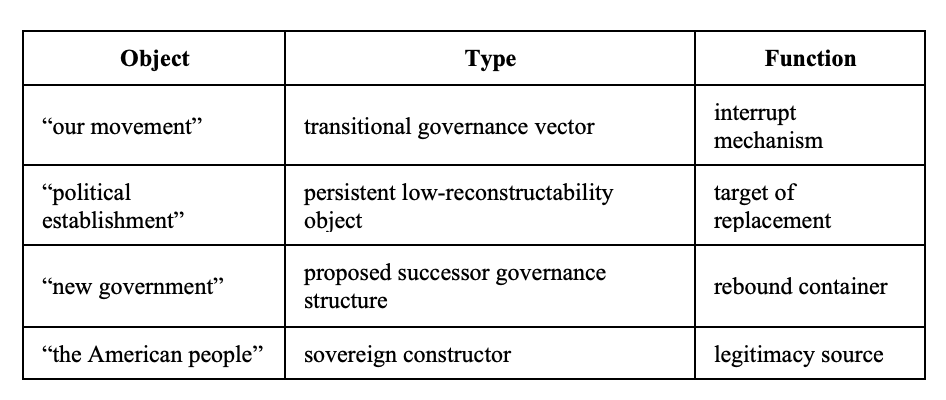
There are two other objects:
“Our movement” is especially unstable. Depending on the speaker or listener, it might refer to MAGA, Republicanism, constitutionalism, populism, conservatism, anti-globalism, militarism, or some shifting combination of all of them.
“New government” feels stranger still: not fully real yet, but spoken about as though it already possesses coherence, continuity, and agency in advance of its actual construction.
The takeaway: these objects exist with very different degrees of reality, stability, and definitional clarity.
Attachment structure
The sentence does not merely describe four political objects. It also specifies a proposed restructuring of attachment between them:
“Our movement” is positioned as the active transformational agent.
“The political establishment” is positioned as the displaced governing structure.
“New government” is positioned as the successor institutional object.
“The American people” are positioned as the ultimate legitimating authority to which the new structure will attach.
The sentence therefore encodes a proposed transfer of institutional attachment:
movement → replaces establishment → with new government → controlled by the American people.
But the attachment relations themselves remain highly compressed:
What exactly constitutes “control” here?
How does “our movement” relate to “the American people”? Are they identical, overlapping, representative, or merely rhetorically associated?
What continuity exists between the “political establishment” and the “new government”?
Is this replacement revolutionary, electoral, administrative, constitutional, or recognitional?
The takeaway: these attachment transitions present as self-evident, even though the underlying binding structure remains largely implicit.
Coordination load
The sentence also carries an implicit diagnosis about the scale of the challenge it is addressing.
The call to replace an entire “political establishment” — rather than simply reforming policies or voting out specific officials — suggests that the system is perceived to be operating under intense pressure. The need for a “movement” and wholesale replacement implies that normal channels of accountability and adjustment are no longer perceived as sufficient.
The takeaway: there is implicit diagnosis that governance is operating under stress severe enough that incremental reform is no longer seen as capable of restoring legitimate control.
Termination regime
The sentence quietly reveals a different assumption about how political authority is supposed to persist over time:
In ordinary democratic language, governments are expected to remain corrigible: elections occur, leaders change, policies are revised, and authority periodically returns to the public for renewal.
But the “political establishment” here is portrayed differently. It behaves less like a temporary government and more like a self-preserving continuity that survives elections and absorbs political shocks while remaining fundamentally intact.
This is why “our movement” matters structurally. It is presented not as a normal campaign operating inside an already responsive system, but as an external corrective force attempting to interrupt a continuity that no longer appears capable of meaningful self-correction.
The takeaway: two different models of political continuity exist here — one that preserves itself institutionally and does not meaningfully terminate under democratic pressure, and another that claims legitimacy only insofar as it remains terminable through the sovereign public.
To summarise what we have seen so far:
Governance involves many different actors, institutions, movements, and publics participating in collective decision-making, some more clearly bounded and understandable than others.
(“The American people” and “the political establishment” do not feel equally reconstructable.)
These actors have authority attributed to them and form binding relationships with one another that can strengthen, weaken, or shift over time.
(Legitimate authority is shifted away from the establishment and re-grounded in “the American people”.)
The resulting governance structure operates under increasing pressure from scale, complexity, conflict, coordination demands, and the need to maintain continuity across large societies.
(The need for a “movement” and wholesale replacement implies that ordinary corrective mechanisms are already perceived as overstressed.)
Under sufficient stress, governance systems can become increasingly focused on preserving their own continuity, even when ordinary mechanisms of democratic correction, interruption, and renewal begin functioning less effectively.
(The establishment is portrayed as continuity-preserving, while the proposed “new government” derives legitimacy from remaining democratically interruptible.)
We can now give formal labels to these four recurring governance phenomena:
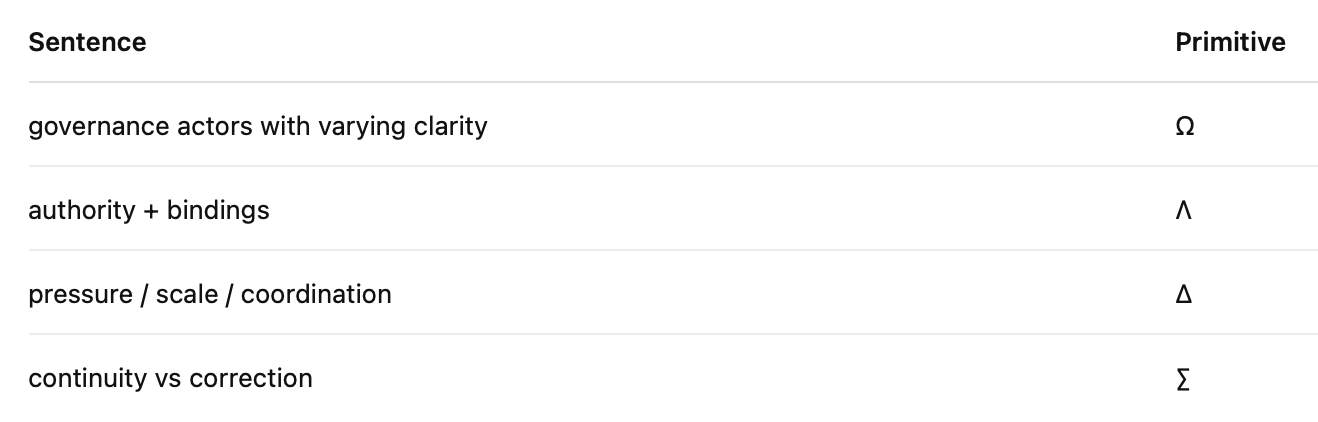
These primitives are defined more formally as follows:
Ω — reconstructable governance object
(how “real” and grounded the object is)Λ — authority attachment
(what gives it legitimacy and binding force)∆ — coordination pressure
(the complexity load the system is operating under)∑ — closure / termination regime
(how decisions become final, binding, and enforceable)
Governance systems also differ in how they preserve continuity and resolve challenges under stress. As coordination pressure (∆) increases, systems can drift through progressively less reconstructable modes of closure (∑):

To complete the model, we need additional terms:
SGO — synthetic governance object — an institution or structure that persists operationally despite weak reconstructability
Corrigibility — the ability of a governance system to be meaningfully corrected or interrupted when it fails
Meta-corrigibility — the ability of a governance system to preserve corrigibility itself under increasing scale, complexity, and coordination pressure
We can now take a second pass through Clause 1 with the “political debugger” properly attached, and then continue through the remaining clauses in the same way.
The point is not that every reader should follow every symbolic step on a first pass. The point is that formal, clause-by-clause runtime analysis of political rhetoric is possible at all — and that governance structures, legitimacy transitions, continuity pressures, and democratic correction mechanisms can now be inspected far more explicitly than conventional political language normally permits.
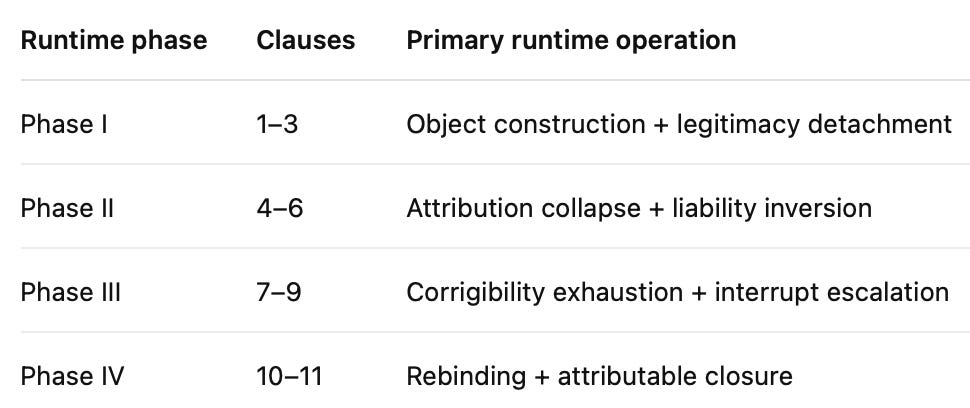
From this point onward the analysis becomes progressively more formal and machine-structural. The aim is not rhetorical persuasion in the style of a normal essay, but runtime inspection of governance semantics — one “line of code” at a time.
Runtime phase I
Object construction + legitimacy detachment
The runtime begins by constructing the core governance objects and establishing the primary legitimacy fracture. Institutional continuity is progressively detached from reconstructable (i.e. traceably attributable) democratic grounding, while the sovereign public is elevated as the corrective reference point.
Clause 1 — Sovereignty fracture initialisation
“Our movement is about replacing a failed and corrupt political establishment with a new government controlled by you, the American people.”
A low-Ω governance object is constructed in the form of the “political establishment”: an SGO (synthetic governance object) that is operationally persistent yet increasingly detached from clear democratic grounding. At the same time, a high-Ω sovereign constructor (“the American people”) is invoked as the legitimate source of authority capable of re-grounding the system.
The “failed and corrupt political establishment” is implicitly treated as a governance structure that has descended from formal/procedural corrigibility (F/PF) toward rhetorical/institutional continuity preservation (RL/I).
The clause therefore performs a Λ transition: legitimate authority is detached from an institutional continuity perceived as self-preserving and reattached to the sovereign public. “Our movement” functions as the proposed interrupt vector. The proposed “new government” derives legitimacy from remaining democratically interruptible rather than from preserving institutional continuity for its own sake.
The clause therefore executes:
low-Ω SGO construction,
Λ reattachment,
continuity interruption,
and attempted restoration of democratic corrigibility within formal constitutional continuity.
Clause 2 — Financial continuity reinforcement
“The establishment has trillions of dollars at stake in this election.”
The low-Ω SGO established in Clause 1 is now reinforced through explicit material incentives. The “establishment” is presented not merely as persistent, but as financially invested in preserving its own continuity. “This election” is framed as a reconstructable hinge capable of interrupting that continuity.
Large-scale financial exposure acts as elevated ∆ pressure reinforcing low-Ω continuity preservation.
The clause therefore executes:
financial reinforcement of low-Ω continuity,
liability inversion exposure,
escalation of attribution pressure,
and elevation of the election into a meta-corrigibility hinge within formal constitutional continuity.
Clause 3 — Attribution shadow formation
“For those who control the levers of power in Washington and for the global special interests, they partner with these people that don’t have your good in mind.”
The clause fuses domestic institutional authority with transnational coordination structures into a composite low-Ω SGO. This creates an attribution shadow between domestic power and global influence. The qualifier “don’t have your good in mind” performs explicit Λ detachment from the public interest.
At this point the runtime begins shifting from visible domestic politics toward partially opaque transnational coordination structures.
The clause therefore executes:
composite low-Ω SGO fusion,
attribution shadow formation,
Λ detachment from public interest,
and escalation of reconstructability scarcity under transnational ∆ pressure.
Runtime phase II
Attribution collapse + liability inversion diagnostics
The runtime now expands the establishment from a diffuse political object into a persistent multi-domain causal structure. Policy failures, economic dislocation, and global coordination pressures are fused into a synthetic continuity exhibiting escalating liability inversion and reconstructability scarcity.
Clause 4 — Multi-domain causal consolidation
“The political establishment that is trying to stop us is the same group responsible for our disastrous trade deals, massive illegal immigration and economic and foreign policies that have bled our country dry.”
The clause reinforces the “political establishment” as a single low-Ω SGO that persists as the causal agent across multiple distinct policy domains. It performs explicit multi-domain attribution binding while exposing recursive self-protection (“that is trying to stop us”).
The establishment increasingly behaves as an RL/I continuity-preserving structure capable of absorbing democratic interruption while maintaining operational persistence.
The clause therefore executes:
low-Ω SGO reinforcement as multi-domain causal agent,
explicit attribution binding of policy harms,
recursive closure diagnostic,
cross-domain force-termination escalation,
and further exposure of liability inversion under elevated ∆ pressure.
Clause 5 — Local grounding erosion
“The political establishment has brought about the destruction of our factories and our jobs as they flee to Mexico, China and other countries all around the world.”
The clause shifts focus from abstract policy to concrete high-Ω lived consequences: factories, jobs, and local economic continuity. The “political establishment” remains the low-Ω causal agent, while Mexico, China, and global outsourcing act as low-Ω abstraction vectors dissolving local grounding into larger systems beyond ordinary democratic visibility.
Global outsourcing functions as a ∆ amplification mechanism through which local reconstructability collapses into larger transnational coordination systems.
The clause therefore executes:
high-Ω local grounding erosion,
transnational abstraction escalation,
concrete economic continuity displacement,
and intensified reconstructability scarcity under global ∆ pressure.
Clause 6 — Archetypal synthetic continuity
“It’s a global power structure that is responsible for the economic decisions that have robbed our working class, stripped our country of its wealth and put that money into the pockets of a handful of large corporations and political entities.”
The clause constructs the “global power structure” as an archetypal global low-Ω SGO: a diffuse transnational object exerting clear operational influence over economic outcomes while remaining weakly reconstructable.
It constructs a hybrid low-Ω SGO in which corporate, financial, and political continuity structures become operationally fused.
The clause therefore performs an extreme liability inversion diagnostic: decisional power and continuity are concentrated inside the hybrid low-Ω structure while the resulting harms remain difficult to finitely attribute through ordinary democratic mechanisms.
The clause therefore executes:
archetypal low-Ω global SGO construction,
explicit multi-domain attribution of wealth extraction,
hybrid corporate-political continuity exposure,
extreme liability inversion,
and intensified reconstructability scarcity under global ∆ pressure.
Across the runtime, the governance structure progressively descends from F/PF corrigibility toward RL/I continuity preservation under escalating ∆ pressure, until bounded democratic interruption becomes the only remaining reconstructable corrective pathway.
The framework here does not assume omniscient coordination or unified intentionality; it models emergent continuity preservation under high coordination pressure.
Runtime phase III
Corrigibility failure + interrupt escalation
At this point the runtime treats meaningful internal democratic self-correction as exhausted. The sovereign public becomes the only remaining reconstructable interrupt mechanism capable of reopening corrigibility through bounded constitutional means.
Clause 7 — Internal corrigibility exhaustion
“The only thing that can stop this corrupt machine is you.”
The clause names the “corrupt machine” as a low-Ω SGO locked in I-mode closure and positions “you” (the American people) as the high-Ω external corrective agent. Meaningful internal self-correction is now treated as impossible. The sovereign public becomes the only remaining force capable of interrupting the machine’s continuity.
The runtime now treats the governance structure as having completed descent into I-mode continuity preservation.
The clause therefore executes:
explicit I-mode closure diagnostic,
force-termination escalation via “the only thing”,
Λ reattachment of corrective authority to the sovereign public,
and direct meta-corrigibility appeal through the election/movement as bounded interrupt vector.
Clause 8 — Collective sovereign mobilisation
“The only force strong enough to save our country is us.”
The clause elevates “us” (the American people) as the high-Ω collective constructor and sole corrective force capable of restoring reconstructable national continuity. It performs a meta-corrigibility diagnostic by declaring the existing order insufficient and positioning popular mobilisation as the only remaining interrupt vector against synthetic continuity.
Corrective closure/termination (∑) authority is now relocated entirely into the sovereign public.
The clause therefore executes:
high-Ω collective constructor elevation (“us”),
exclusive corrective Λ reattachment,
I-mode closure diagnostic of the existing order,
and meta-corrigibility appeal via collective popular mobilisation.
Clause 9 — Electoral interrupt formalisation
“The only people brave enough to vote out this corrupt establishment is you, the American people.”
The clause elevates “you, the American people” as the high-Ω sovereign constructor and sole legitimate corrective agent capable of removing the low-Ω SGO. It designates the vote as the bounded interrupt mechanism through which governing legitimacy can still be re-grounded in popular sovereignty.
The vote is treated as the remaining PF/F-compatible interrupt mechanism.
The clause therefore executes:
high-Ω sovereign constructor elevation (“you, the American people”),
exclusive corrective Λ reattachment to the sovereign public,
I-mode closure diagnostic of the establishment,
and positioning of the election as the meta-corrigibility hinge.
Runtime phase IV
Rebinding + attributable closure
Having relocated corrective authority to the sovereign public, the runtime now binds the intervention to a finite, attributable execution vector before sealing the sequence inside formal constitutional continuity.
Clause 10 — Attributable sovereignty rebinding
“I’m doing this for the people and the movement and we will take back this country for you and we will make America great again.”
The clause binds the candidate as a high-Ω attributable vector to the high-Ω constructor (“the people,” “you”) for national re-grounding. It performs a personalised Λ binding operation: the candidate explicitly attaches himself as the attributable execution vector for the corrective sequence.
The candidate collapses diffuse attribution into a finitely attributable execution vector.
The clause therefore executes:
high-Ω constructor binding (“the people” / “you”),
personal attributable vector (“I’m doing this”),
Λ re-grounding (“take back this country for you”),
and restoration of high-Ω national grounding (“make America great again”).
Clause 11 — Terminal authentication seal
“I’m Donald Trump and I approve this message.”
The clause instantiates the candidate as a high-Ω attributable political actor and serves as the terminal authentication vector for the entire intervention. It performs a final F-mode signature, personally binding the candidate to the full force-termination probe and meta-corrigibility appeal.
The clause therefore executes:
high-Ω personal agent invocation (“I’m Donald Trump”),
terminal Λ authentication (“I approve this message”),
F-mode signature on the entire runtime sequence,
and preservation of reconstructability and constitutional continuity for the whole intervention.
I think you will agree that wasn’t your typical analysis of political rhetoric or policy speech. It feels much closer to algebra than advocacy. That is deliberate: we are operating at a substrate level beneath where nearly all normal political deconstruction attempts to go.
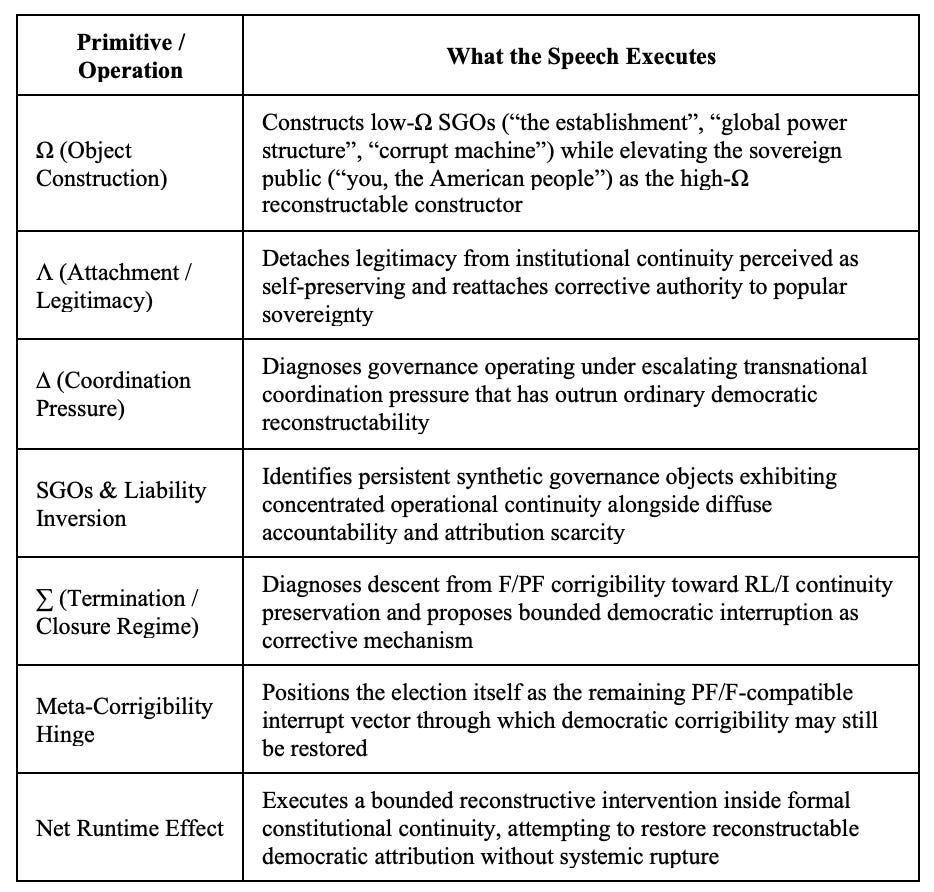
The value is that it allows us to see the world in a new light, from the space before ideology even becomes the primary concern. Instead of asking first whether we agree or disagree with the speech, we can ask a deeper structural question:
what is being advocated for at the level of governance primitives, and does it cohere there?
Which leads us to…
The “aha!” moments
What makes the 2016 ad feel electrically true is that it diagnoses synthetic governance without the vocabulary to name it.
The speech is diagnosing synthetic governance
What millions experienced as “the establishment” was never necessarily a hidden cabal or a perfectly coordinated conspiracy. It was a synthetic governance object (SGO):
an operational structure with genuine continuity, binding power, and self-preserving behaviour, yet increasingly weak reconstructability to ordinary democratic actors (low-Ω under rising ∆ pressure).
The speech resonates so deeply because it intuitively names a runtime dynamic that ordinary citizens can feel in their daily lives but cannot formally describe.
Populism becomes reconstructability politics
The anti-establishment sentiment is not merely resentment or nostalgia. It is an attempt to restore traceable democratic accountability inside systems whose operational continuity has begun to exceed ordinary public visibility and correction.
Globalisation anxiety, institutional distrust, and “deep state” intuitions are surface symptoms of the same underlying runtime problem:
rising coordination pressure (∆),
weakening reconstructability (Ω↓),
and the increasing priority given to continuity preservation over attributable sovereignty (descent from F/PF toward RL/I closure regimes).
The emotional force comes from high-Ω versus low-Ω polarity
The rhetoric repeatedly contrasts concrete, reconstructable objects — factories, jobs, working-class communities, “our country” — with diffuse synthetic abstractions: “the establishment,” “global power structure,” and “the corrupt machine.”
This polarity explains why the language feels simultaneously precise and vague: it is pointing at governance structures that exert real operational effects while remaining resistant to finite reconstruction.
The election is treated as a meta-corrigibility hinge
The repeated invocation of “you,” “us,” and “the American people” is not just emotional persuasion. It is an attempt to relocate corrective authority (Λ reattachment) back into the sovereign public once internal institutional self-correction is perceived as exhausted (RL/I closure under elevated ∆).
The election itself is framed as the last remaining bounded interrupt mechanism through which democratic corrigibility (restoration of PF/F-compatible termination) might still be restored.
The speech models governance descent under pressure
Through the ΩΛ∆∑ lens, the ad depicts a progressive runtime descent:
from formally grounded and procedurally corrigible governance (F/PF)
toward rhetorical and institutional continuity preservation (RL/I) under rising coordination pressure (∆↑).
Its core intuition is that operational continuity has outrun reconstructable democratic grounding. That is the real source of the tension it captures.
The framework explains the intuition without collapsing into conspiracy
The ΩΛ∆∑ framework does not require omniscient actors, secret master plans, or perfectly coordinated hidden control, nor does it deny them. It instead models emergent continuity preservation under high coordination pressure:
systems become increasingly self-preserving because reconstructability (Ω), accountability (Λ), and correction pathways (∑) attenuate under scale and complexity (∆).
The “establishment” therefore becomes structurally real without becoming mythological.
The runtime reinterpretation
Ultimately, the speech reads less like conventional campaign rhetoric and more like a bounded reconstructive intervention inside formal constitutional continuity. It:
constructs low-Ω synthetic governance objects exhibiting recursive self-protection, liability inversion, and RL/I closure under rising ∆ pressure,
then attempts Λ reattachment to high-Ω popular sovereignty through the electoral process itself as a bounded PF/F-compatible interrupt mechanism.
In that sense, the ad is not primarily exposing a conspiracy — even if one exists.
It is exposing a governance runtime problem.
A final word on “The Swamp”
The deepest takeaway from the 2016 ad is this: “the swamp” is not a hidden cabal, a single bureaucracy, or a separate deep state. It is an emergent phenomenon — the metastable intermediation ecology that forms at the overlap of three governance layers.
The constitutional state is the original high-Ω layer of formally attributable democratic authority.
The continuity state is the overt synthetic substrate — the sprawling administrative, financial, regulatory, and security machinery whose primary function has become self-preservation under rising ∆ pressure.
The criminal state is not omnipotent hidden rulers, but bounded high-opacity actors and leverage networks that operate opportunistically inside the attribution shadows created by weakening reconstructability.
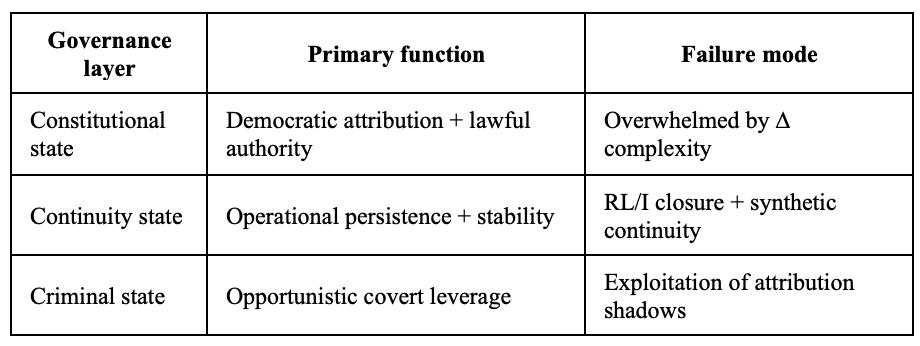
“The swamp” is the zone of recursive overlap where the constitutional state, continuity state, and criminal state begin reinforcing one another through procedural laundering, narrative management, regulatory capture, revolving-door incentives, opacity, and continuity preservation.
Most people inside “the swamp” are not conspirators.
They are institutional loyalists, continuity optimisers, or incentive maximisers
simply operating inside increasingly synthetic conditions.
The crucial runtime insight is that overt synthetic continuity dramatically lowers the cost of covert leverage. Once attribution becomes diffuse and reconstructability scarce, small high-opacity interventions can exert outsized effects without requiring unified control or hidden omnipotence.
Conspiracies occupy the space left by reconstructability constraints.
This is why the language of “the establishment,” “the machine,” or “the swamp” feels simultaneously true, vague, emotionally powerful, and analytically slippery. Citizens intuitively sense the operational continuity, self-protection, opacity, and accountability failure — yet lack the reconstructive language to map it precisely.
The ΩΛ∆∑ canon stabilises that intuition structurally. It shows that the real crisis facing modern democracies is not corruption or conspiracy in isolation, but the gradual emergence of governance environments in which operational continuity has begun to outrun reconstructable democratic grounding under conditions of rising scale and complexity.
Let me say the conclusion again, one more time.
The speech did not decode the Deep State.
It was diagnosing synthetic governance under stress.