

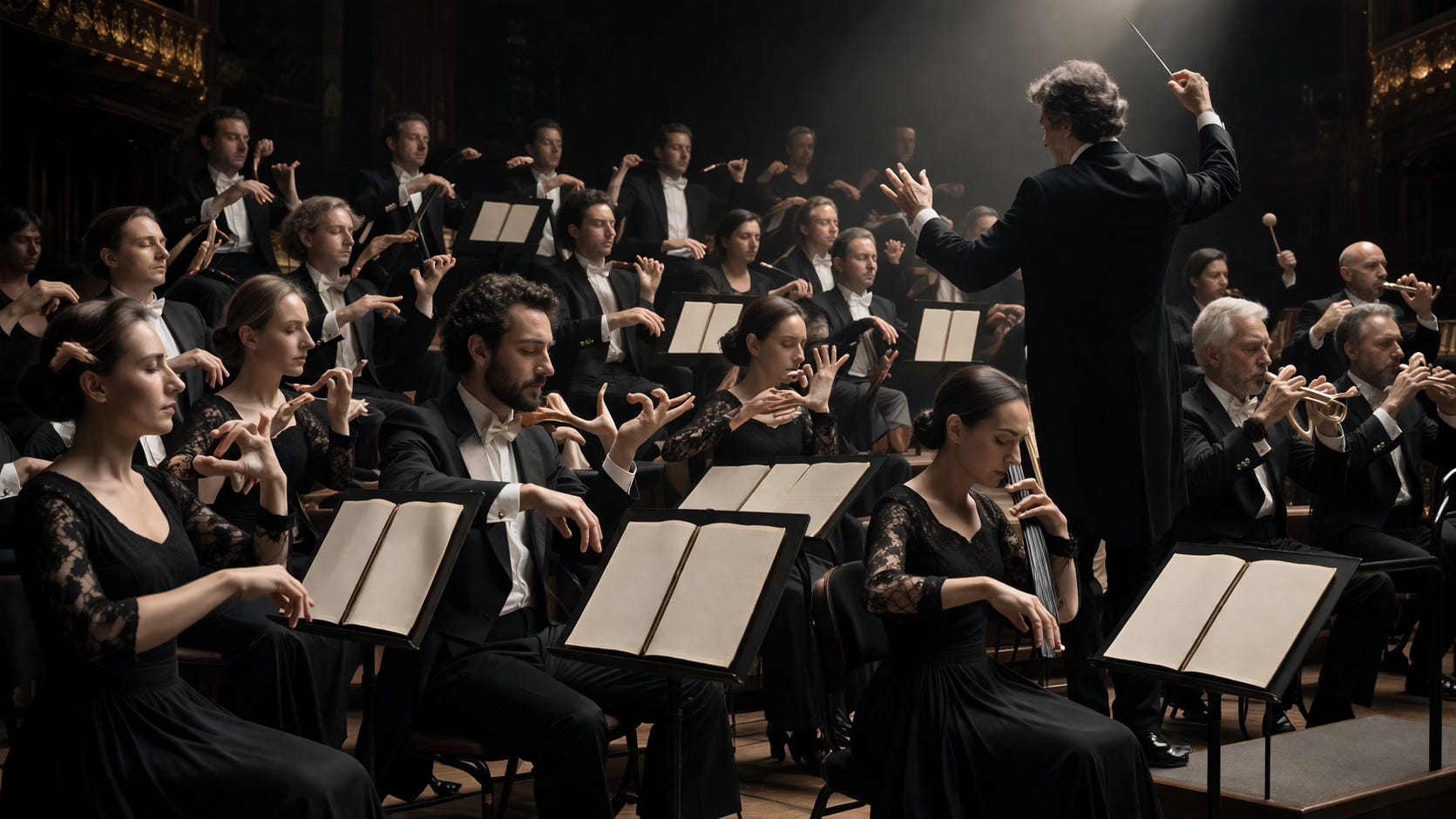
Today I prodded the High Court to do something about my Part 8 claim — a request for clarity on how, exactly, a judgment under the Single Justice Procedure is attributed judicial authority when all the outwardly verifiable signs of a tribunal are missing.
A straight legal analysis of that question is, at this stage, probably a bit heavy going for most readers. So I thought I’d have some fun instead.
After many hours translating my ∆∑ attribution framework into a musical analogy, I’ve applied it to the case.
I am therefore delighted to present to you the inaugural (virtual, and entirely silent) performance of:
The Case of the Missing Song
Enjoy!
🎤 Opening
Claimant
I would like to hear the music.
And to know who is playing it.
Defendant
We are not entirely sure what the listener seeks to achieve by asking this question.
🎼 Movement I — The Score
Defendant (placing papers on a stand)
The composition is fully provided for
under the Musical Framework Act 1980.Here is the score.
Claimant
Yes. I can read it, but that’s not the point.
I am asking to hear it!
🎻 Movement II — Sufficiency
Defendant
The existence of the score is not in dispute.
The framework for music is clear.
The score exists.Therefore, the music is in order.
Claimant
That defines only the possibility of music.
I am asking who is playing it!
🎶 Movement III — The System
Defendant
The orchestra is properly constituted.
The parts are assigned.
The process is followed.This is how the music is always performed.
Claimant
Then show me this performance.
🎷 Movement IV — The Record
Defendant (producing a sealed envelope)
The system records that the music has been played.
The outcome is documented.The record speaks for itself.
Claimant
In that case… let me hear the recording.
🎭 Movement V — The Review
Defendant (reading from a note)
“A measured and coherent piece,
executed within the recognised framework,
producing an appropriate and proportionate result.”
Claimant
That’s only a description of the music.
I am asking for the music itself.
⭐ Movement VI — The Rating
Defendant
The piece has been duly assessed!
It is valid.
★★★★★
Claimant
A rating is not a performance. Where’s the music?
🎧 Movement VII — The Displacement
Defendant
There is no real dispute
that this is music.The framework is clear.
The system functions.
There is no requirement, in this context,
to identify a performer.
It is not necessary
to descend into questions of performance.
This request does not arise
within the proper form of performance.If the listener wished to hear the music,
the appropriate notice should have been given
within the prescribed time.
(The Defendant smiles faintly, as if the question itself has been answered.)
Claimant
If music is said to occur,
then there must be someone responsible.Who is it, then?
🥁 Movement VIII — The Closing
Defendant
The score exists.
The orchestra is provided for.
The piece is recognised.Even if more were to be said,
it would serve no useful purpose.The matter is complete.
(The Defendant steps back.
A performer appears on stage.)
🎭 Movement IX — The Performance
(The performer begins the motions of playing with perfect precision.)
Defendant
The music has, in fact, been performed.
The audience was present.
The piece proceeded as expected.
Claimant
Then I will listen again.
(The performer continues: precise, assured, exact.
No sound is produced.)
Claimant
There’s no music!
Defendant
The performance complied
with all recognised standards.
Claimant
But no one is playing.
Defendant
The appearance of performance
is sufficient for present purposes.
(The performer bows.
Silence.)
🎬 Finale
Claimant
I still hear nothing.
Defendant
Then you have understood it.
(Lights out.)
Afterword
If the piece felt slightly absurd, that’s because it is — and it isn’t.
Each movement tracks a familiar institutional move: the score (the statute), the system (procedure), the record (outcome), the review (narrative), the rating (recognition), and finally the performance itself — precise, compliant, and entirely silent.
At no point does the music appear, yet at every stage it is said to exist.
The question is not whether music is described, provided for, or even recognised, but whether it is actually played — where attribution finally lands on an identifiable act.
The piece is a translation of the ΔΣ attribution framework into a different register: a compression ladder from grounded act to pure recognition, and the various ways systems avoid ever settling the question while continuing to operate. If you found yourself waiting for the music, you were already doing the analysis.
No instruments were harmed in the making of this performance.
The music, however, remains conspicuously absent.
Martin Geddes: Allegory Opus in G-wtf
Brilliant!
Musical ideas exist
No conductor, musicians
No notes read, interpreted
no instrument sounded, expressed
no volume in the music hall
no appreciation of beauty and gift
That ideas have consequences, I suppose, is not always true