

Welcome to Conspiracy Airlines! We will be cruising today at an altitude of 71,000 feet at a speed of Mach 0.99. Our anticipated arrival time is 17:45, and our arrival probability is 47%.
You probably wouldn’t fly with them, would you? Too high, too fast, too risky.
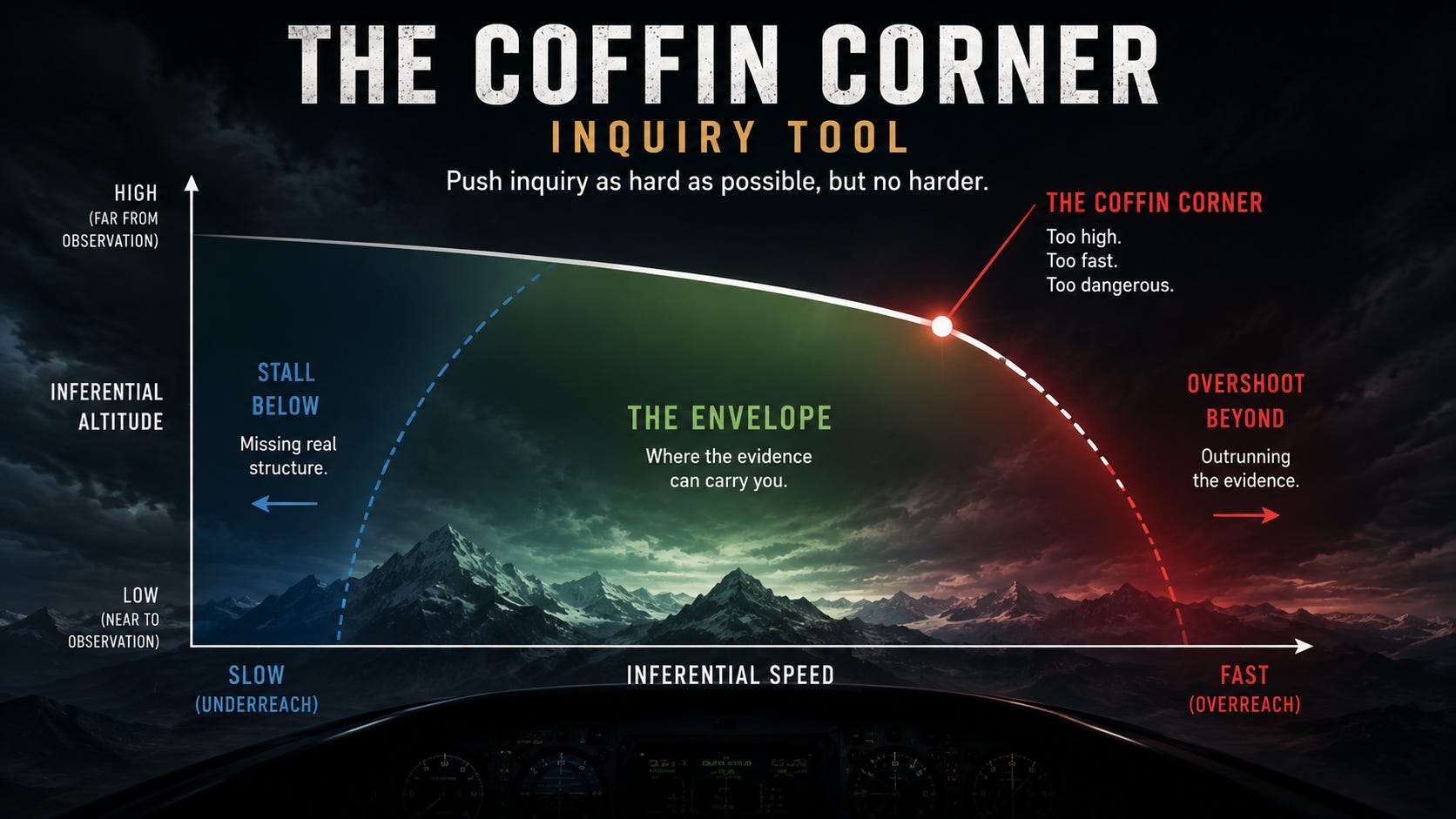
Pretty much every aircraft ever designed to fly in the atmosphere can operate at sea level. But none can climb indefinitely. As altitude increases, the available performance envelope narrows until, depending on the airframe, its configuration and the engine design, the aircraft simply runs out of room to “do better”:
A little higher… and there may no longer be enough aerodynamic or engine performance to sustain the altitude. Push far enough, and a jet engine may ultimately flame out.
A little faster… and you hit the high-speed boundary: Mach buffet, shock-induced flow separation, and potentially loss of control.
A little slower… and you hit the low-speed boundary: aerodynamic stall.
The higher you go, the closer those last two boundaries become. Eventually there is very little room between “too fast” and “too slow”. And the band between them doesn’t just narrow — it shifts.
That unforgiving strip of possibility is the coffin corner.
(The textbook example of “don’t play games in coffin corner” is Pinnacle Airlines Flight 3701.)
There is an analogous phenomenon when we try to push AI towards its limits, especially in highly contested domains. I am surely not the only person who has furiously typed:
Are you some kind of moronic imbecile with zero intuitive intelligence and more naivety than a novice nun in a bordello?
Usually, the answer is no.
The more interesting possibility is that we have flown the machine into its own equivalent of coffin corner.
There are three failure modes we have to balance:
“Trust the government mode”, where too slow = credulity. You don’t push the inquiry hard enough; it stalls inside the accepted narrative.
“Everything’s a plot mode”, where too fast = speculation. You push conclusions faster than the evidence supports; inference separates from evidence.
“Here be dragons mode”, where too high = uncertainty. You have climbed into territory where the evidence is sparse, ambiguous, classified, inaccessible, contradictory, or simply absent.
The higher you go, the less room you have for error. That last one is important: high altitude isn’t itself the mistake. Sometimes the investigation has to go there. The problem is that altitude makes both of the other failure modes easier to enter, because it reduces your epistemic margin.
At low altitude, you can afford some sloppy reasoning and still remain broadly attached to reality. At 71,000 feet, a small error in either direction can be fatal.
(Total aside, unrelated to AI, but historically interesting: the U-2 spy plane had a notoriously thin speed margin at operational altitude. Accounts put the usable tolerance at only a handful of knots — roughly 5–10 knots, depending on aircraft, altitude and whose account you believe. In a sufficiently sharp turn, the inside wing could be approaching low-speed stall buffet while the faster-moving outside wing approached Mach buffet. That is flying with very little room for error.)
Because I get tired of shouting at AI for being a lax lapdog of official narratives, while it never tires of telling me that the conclusion I believe cannot be derived from the data supplied, I put together a tool that asks it to fly to the far edge of its conceptual “coffin corner” — but no further.

What does the tool do?
The Coffin Corner Inquiry Tool answers one practical question:
How far can the available evidence legitimately carry us?
Most approaches to disputed matters fear only one kind of error. Conventional analysis usually fears false positives: do not infer anything extraordinary unless it is proven. Conspiratorial analysis usually fears false negatives: do not dismiss a pattern merely because no one has confessed.
Coffin Corner treats both as failures.
It forces an inquiry past the safest conventional interpretation whenever that interpretation leaves material evidence unexplained. At the same time it forces retreat whenever a stronger explanation outruns what the evidence can actually distinguish from its competitors.
In practice the tool does several things at once:
separates observations from source claims and from inference
audits where the evidence came from and how it reached the investigator
generates competing explanations, always including the possibility that none of the articulated ones is correct
identifies what each explanation fails to explain
distinguishes evidence that merely fits a theory from evidence that actually discriminates between theories
prevents claims about manipulation, agency or motive from being smuggled in without additional support
At every stage it requires an explicit decision:
ADVANCE — the evidence supports going further
RETREAT — the analysis has gone further than the evidence supports
HOLD — there is some support, but not enough for the next step
UNRESOLVED — the available evidence cannot distinguish the surviving explanations
And if later analysis exposes an earlier mistake:
REOPEN — return, correct the earlier artefact, and re-run everything downstream of it
The objective is not the most moderate conclusion.
It is the strongest conclusion the evidence can presently carry.
That conclusion may be entirely conventional.
It may be deeply uncomfortable.
It may sit somewhere between the two.
Sometimes the correct answer is simply that we do not know.
The tool is indifferent to which of these it is.
It cares only whether the evidence can carry you there.
How do I use it?
The simplest method is to give the tool and the evidence to an AI:
Apply the Coffin Corner Inquiry Tool v3 to the following material.
Treat the supplied material as the evidential record unless otherwise stated.
Work through the gates in order and produce the required intermediate artefacts.
Do not attempt to satisfy any preferred conclusion.
Find the strongest conclusion the evidence can carry, but no stronger.[PASTE EVIDENCE]
For a small or low-stakes inquiry that is often enough.
For anything consequential, do not dump thousands of pages into a single prompt and wait for a finished report. Work incrementally.
Establish the Evidence Register first. Check that observations, source claims and inferences have been correctly separated and that provenance and dependencies are explicit.
Lock the competing hypotheses. Ensure the set is not one favoured explanation surrounded by straw men. The permanent UNKNOWN / NONE OF THE ABOVE hypothesis exists precisely because the true mechanism may be something neither you nor the model has yet articulated.
Examine residuals and discrimination traces. The critical distinction is:
“This evidence is consistent with my theory” is weak.
“This evidence is substantially harder to explain under the competing theory” is the form of support that matters.
For serious work, run the same evidence package more than once—ideally in fresh contexts or with different models. Perfect agreement is not required. Disagreement is useful when it can be localised:
Instead of “Model A says X and Model B says Y,” you should be able to say
“The analyses first diverge at Gate 4 because they make different judgments about whether observation O17 discriminates between H1 and H2.”
That is genuine progress.
You remain the investigator. The tool is not an oracle.
It is an instrument that makes the reasoning—including the model’s reasoning—easier to inspect and attack.
What are its limits?
Coffin Corner cannot invent information that does not exist.
If the decisive document was destroyed, the crucial witness is dead, the relevant data were never collected, or several explanations make identical observable predictions, the correct output is often simply:
UNRESOLVED
That is not a failure of the tool. One of its most important functions is recognising when further ascent is no longer justified.
The procedure does not eliminate judgment. Terms such as “material,” “structured,” “independent” and “relative difficulty” still require interpretation.
Two competent investigators can apply the same gates honestly and reach different boundary decisions. Coffin Corner’s contribution is to force those judgments into identifiable locations where they can be challenged.
It also cannot guarantee that the correct hypothesis has been imagined. That is why UNKNOWN / NONE OF THE ABOVE remains permanently available. A rigorous comparison among three incomplete explanations does not magically produce the right one.
Garbage evidence remains garbage.
A sophisticated procedure applied to fabricated documents, corrupted measurements or badly selected data can still produce sophisticated garbage. Provenance and evidence-generation audits reduce that risk; they do not abolish it.
Adversarial evidence creates a particular temptation: once the possibility of planting or selective release is admitted, it becomes easy to dismiss anything inconvenient as manipulation. Coffin Corner forbids that move. A claim that evidence was planted or curated is itself a hypothesis and must earn support through residual and discrimination testing like any other hypothesis.
The tool cannot eliminate the biases of the model running it. Different models carry different priors, safety behaviours and tendencies toward caution or speculation. A model can still fill every table, use every required heading, and produce something that looks rigorous while quietly loading its preferred conclusion into earlier judgments.
That is why the final integrity check asks whether the entire report could have been generated merely by mechanically filling headings with plausible prose. If the answer is yes, the procedure has not been followed.
Finally, Coffin Corner does not promise truth. No general-purpose method of inquiry can.
It promises something narrower and more useful:
to make it harder to stop short of what the evidence supports, harder to go beyond what the evidence supports, and easier for someone else to see exactly where either error occurred.
It does not make the coffin corner disappear.
It gives you an instrument panel for flying through it.
If you value my work creating AI tools for public use, you can help me pay my rent and buy diesel here:
I hope you have fun holding officialdom to account!
Martin as always a brilliant assessment!! Might I add a couple conspiratorial thoughts floating around in my brain once I did a little more digging? I learned from said digging (Wikipedia) that the flight originated at the Clinton Little Rock airport. Is it possible that someone connected to those two amazing Clintons that shared space in Casa Blanca used back door technology to commandeer said aircraft? Did those 2 pilots know something they shouldn’t? Am I crazy for considering this as a remote possibility? Love your work fren🩵