

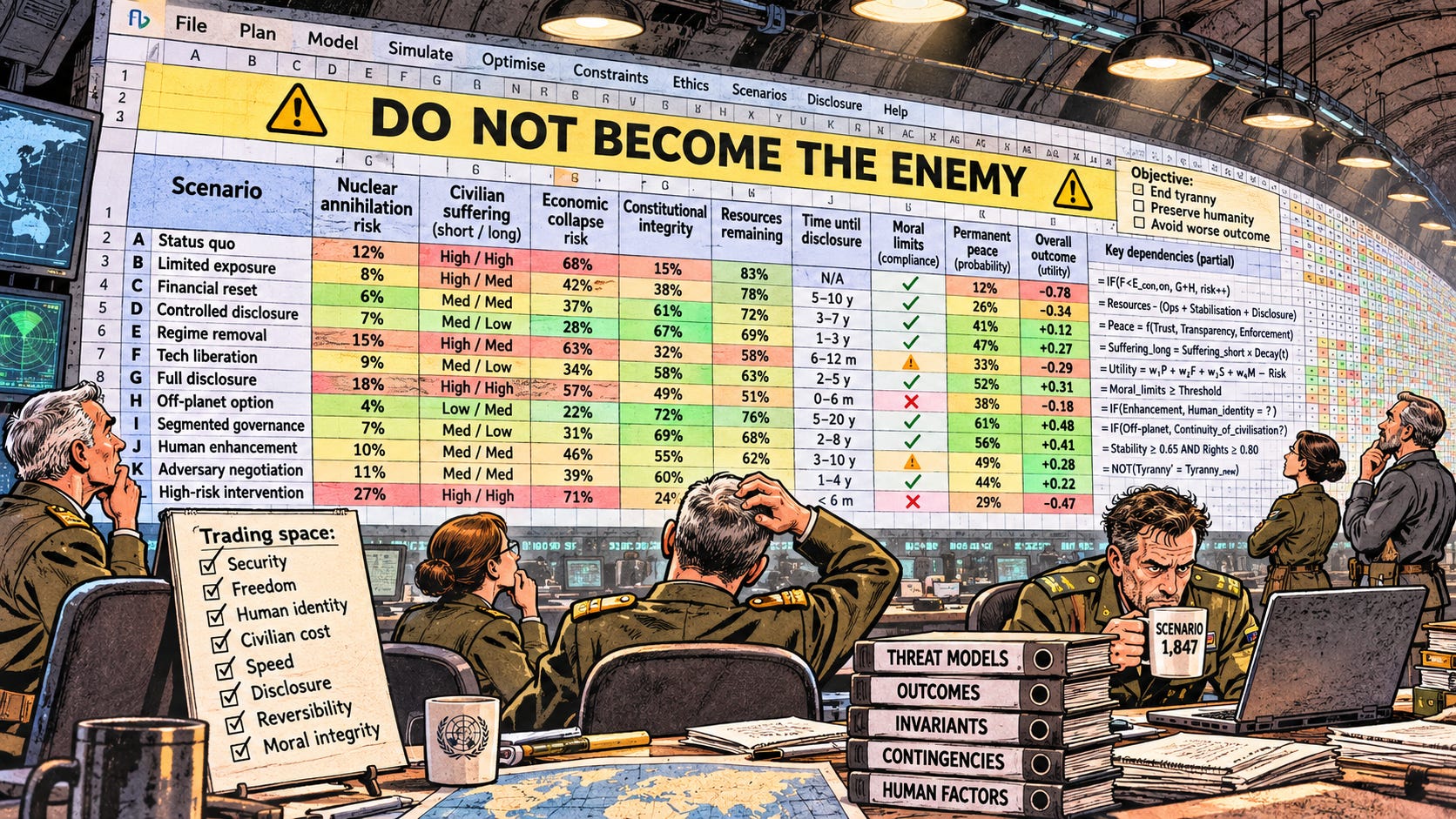
Last weekend marked the 63rd anniversary of the JFK assassination event in Dallas. In many ways, it remains a mystery, down to the question of whether it was JFK himself or a body double in the car. What is certain is that the world took a different course that day, the power of the shadow state grew, and the people lost out. Without litigating every detail, we can examine the event as a discontinuity of power. So what would a long, slow counter-coup by patriots look like?
There are plenty of pundits who can outdo me as alternative historians, military analysts, or political scientists. My professional background is in computer science and the performance engineering of large distributed systems. I bring a different perspective: more theoretical and information-centric. However convoluted the schemes of man, as systems of coordination and action they must exhibit certain common properties.
What follows is a simplified framework to help you make general sense of what is going on, without telling you what is specifically happening. I make no claim that the military sees the world this way, that I have insider access to clandestine planning, or that my analysis is complete or necessarily correct. The purpose is narrower: to give you the thinking tools to explain to yourself (and others in the civilian world) why “it had to be this way” for the desired end state to be realised.
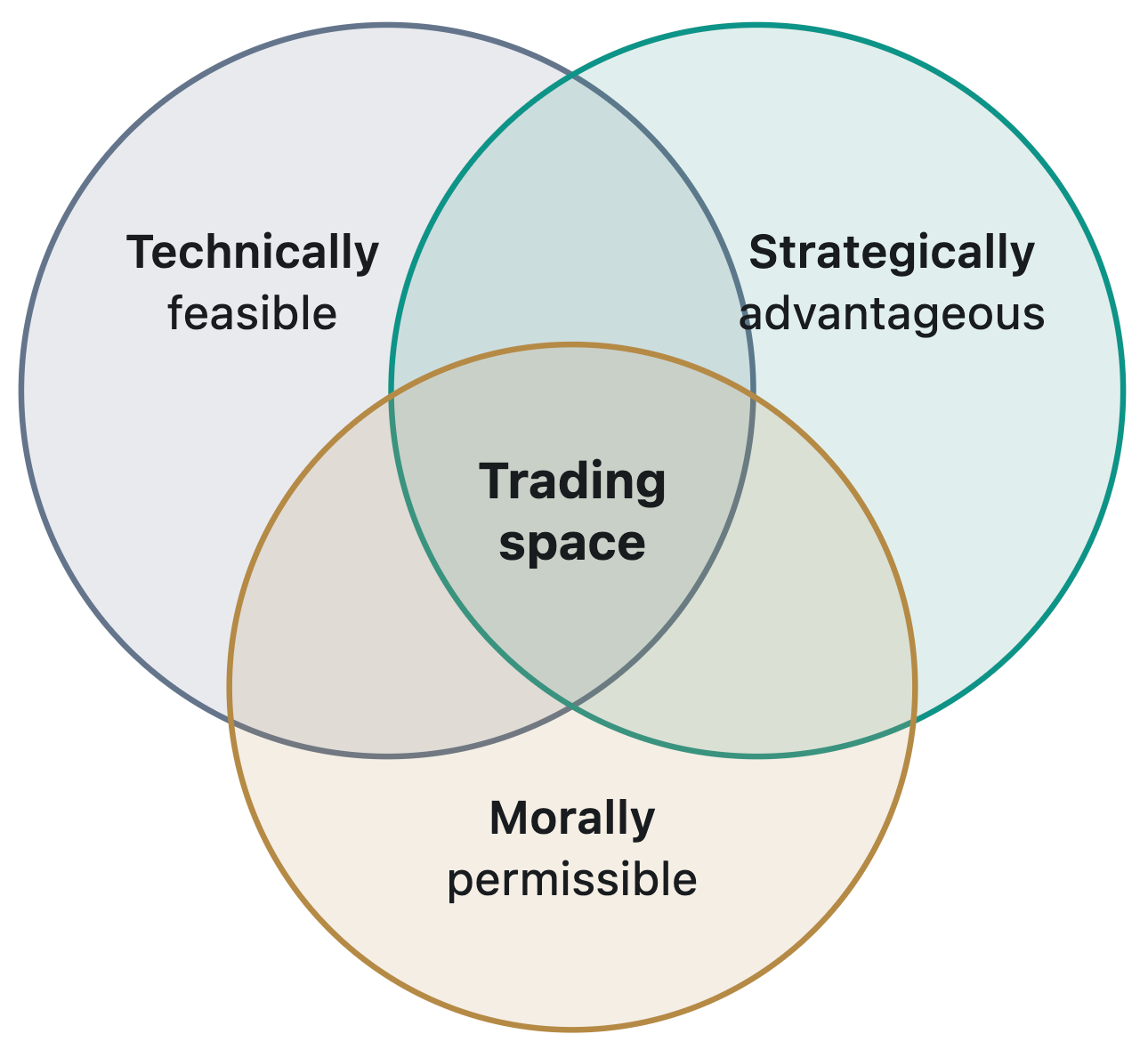
I am going to give you the punchline up front. This is a particular and unusual kind of engineering problem that requires balancing three different domains:
(Can we do it?) What is technically possible, given the resources you have.
(Do we want to do it?) What is strategically desirable in order to defeat the enemy.
(May we do it?) What is morally and legally tolerable, so that the ends do not automatically justify the means.
Any plan to save humanity from totalitarianism and genocide has to avoid recreating the very problem it purports to solve.
A common failure in the analysis of geopolitical affairs is to isolate parts of the puzzle, ignore the trading space, and judge them as standalone problems. That is not the feasibility and optimisation problem that military planners face. They have to deal with the totality of the problem, including all its interdependencies.
For instance, your temporary but extreme discomfort while waiting for anticipated events is not, in itself, evidence of a moral wrong being done to you. It may be the price of avoiding other outcomes that are immeasurably worse. The problem is that the connections between these things are not immediately visible. You experience one side of the trade, but cannot see the other.
We experience the costs of what happens, but not the costs of what is prevented from happening.
The overall problem space can be divided into five classes of feature:
Definition — universe of discourse, threat model, outcome, invariants.
Valuation — benefits, harms, costs, losses, non-ruin risks, ruin risk.
Feasibility — agency, resources, enablers, constraints, observability, couplings, timelines.
Optimisation — trading space, encompassing technical possibility, strategic desirability and moral permissibility.
Closure — termination conditions and the self-sustainability of the outcome.
Let’s run through these ingredients for our “save the world cake”.
Definition
The first step is to understand the conceptual cosmos you inhabit. Are we talking ETs? Time travellers? Ancient underground civilisations? The Moon as an artificial satellite? Interstellar travel by a breakaway group? Antarctic ruins and bases beneath the ice? I cannot vouch for any of these hypotheses, but they illustrate the problem: the average person is not in a position to establish the true scale or scope of any such conflict.
This is the “universe of discourse”, and its definition already determines what is considered possible, impossible or irrelevant. Most of us therefore face vast uncertainty before we have even begun to consider what is wrong or how to fix it. We may not merely be missing pieces of the puzzle; we may have misconceived the dimensions of the puzzle itself.
Within that universe of discourse, we then need a threat model. What are the unacceptable outcomes that must never be allowed to materialise? And what are the merely very undesirable ones, where some degree of compromise or surrender might be in the best interests of humanity?
The most nightmarish scenarios involve human consciousness being shorn from our bodies and trapped in torture vessels. Whether that is sci-fi horror or a real prospect, I cannot tell you. The potential of transhumanist technology for control and domination is no secret. Mammalian cloning is already a reality. What might its weaponisation entail, and what questions would that raise about human identity?
So, before we even get to consider any ongoing activity to reverse tyranny, we already face an uphill battle to establish what the enemy might be and how they might destroy us. Rigged elections, debt slavery and corrupted legal systems may be quite a long way down the list of problems.
Given that threat model, there must be a desired outcome — our “intentional semantics”. What does success look like, and over what timescale? What level of regression might be tolerable? What aspects of human failure are inevitable and cannot (or should not) be mitigated? What, if anything, is beyond salvage? Do all peoples and nations have to participate equally in a new model of governance and finance, or might their participation be differentiated according to capability and maturity?
Any desired outcome might have threshold, target and stretch goals: a minimum level of acceptable success, a preferred outcome and a maximal one. Not everything that is desirable is essential, and not everything that is achievable is worth the additional cost or risk of achieving it.
The realisation of that outcome then demands that we have invariants. Who is in charge of the transition, and to what are they answerable? Which laws and principles are non-negotiable? What is the chain of command throughout? Which rights cannot be suspended, irrespective of expediency? What essential functions of civilisation must be maintained, even as its institutions are dismantled or reconstructed? What moral boundaries must never be crossed, no matter how tempting the strategic advantage?
These are the properties that must hold throughout the transition, not merely be restored at its conclusion. They distinguish a plan to end tyranny from a plan to transfer its ownership.
Valuation
We are now at the point where we can begin to populate our conceptual model of “the plan to save the world”. If some things are invariant, others must be variant. An obvious goal is the protection and welfare of the public, so there are benefits on offer. A full stomach and a warm house in winter are rather more comfortable than food and energy shortages. Those benefits also extend to the agents and assets involved in executing the plan.
On the other hand, there are dangers in the world that can and will manifest as harms. The lockdowns are the obvious recent example. Many suffered isolation and psychological distress, in some cases leading to suicide. Harms can be physical, psychological, environmental, cultural, genetic, and so on. Again, they apply to all actors, both the general public and those operating as insiders. Not all harms are equally serious or enduring. Damage to our genome can persist for generations, whereas brainwashing by television may be reversible.
Any plan to transition humanity to a new model demands resources, and those resources come with costs. We are not necessarily talking about financial costs here. Being seconded into the armed forces and having to abandon another life carries a cost. Those living in witness protection programmes incur a cost, as do those who protect them. Anyone tasked with clearing tunnels in underground enemy facilities faces a cost as well as a risk.
The consumption of human time, energy and potential is a cost, even where nobody suffers any identifiable harm. All else being equal, we would rather have easier lives than harder ones.
Of course, when people are put in harm’s way, bad things happen. There are risks to everyone in warfare, civilian and military alike. Death is part of the deal: warfare is a safety-of-life undertaking from the outset. All assets, human and otherwise, are subject to attack and loss.
When risks materialise, we may suffer losses. These might include the death of experienced personnel, the destruction of infrastructure, the compromise of intelligence networks or the loss of public trust. Losses differ from costs in that they are not the intended expenditure of resources in pursuit of an outcome. They can also diminish our future agency, especially where what has been lost cannot readily be replaced.
There is a critical distinction, however, between non-ruin risks, where losses are sufficiently contained that “the game” has another round and there is scope for recovery, and ruin risks, where the losses are catastrophic and irrecoverable — it is “game over”. Worldwide nuclear annihilation is the archetypal example of a ruin risk.
Feasibility
We might seek the best possible plan, which is the subject of the next section — optimisation. Before that, we need a plan with a “window of possibility” within which at least the threshold outcome can be realised, with an acceptable balance of benefits, harms, costs and risks.
The first step in feasibility analysis is to identify our agency: who can act, upon what, how and when? Who has the authority to initiate action, and who has the practical ability to execute it? Where is agency concentrated, and where is it distributed? To what extent does success depend upon the autonomous actions of others, including the general public? What agency does the enemy retain, and how might that change over the course of the plan?
The mere desire for an outcome does not confer the agency to realise it. Nor does the existence of agency imply that it can all be coordinated towards a common purpose.
That agency is then exercised through the resources at our disposal. These range from the obvious military resources of armaments and trained personnel to less tangible ones, such as technological capabilities, intelligence, institutional knowledge and soft power in the form of cultural influence. All resources have a lifecycle of creation, development, deployment, replenishment and eventual loss or obsolescence. What matters is not merely the stock of resources available at any given moment, but the capacity to generate, sustain and renew them over the lifetime of the plan.
Underpinning the availability and deployment of these resources are enablers. These are the legal, institutional, technological and social conditions that make particular courses of action possible. They include laws of war, executive orders, emergency powers, treaties, alliances, jurisdictional arrangements and technological breakthroughs. Public awareness, consent and cooperation may also be critical enablers.
Having the resources to undertake an action is not the same as having the authority or opportunity to undertake it. Much of the preparatory work of any plan may therefore consist of establishing the enablers for subsequent action, rather than directly pursuing the desired outcome.
This naturally leads us to our constraints. We cannot do anything we want, whenever we want, in a finite world. Our resources and enablers also define the limits of our agency. There are only so many trained personnel, so much industrial capacity, and so many hours in the day. Legal authorities have limits of jurisdiction and application. Technologies have limits of capability and reliability. Even public attention, patience and psychological resilience are finite.
Some constraints are absolute, whereas others can be relaxed through investment, innovation or the passage of time. Some are imposed by the enemy, some by the nature of reality, and others are self-imposed in adherence to our moral and legal invariants. Much of the ingenuity in engineering a plan lies in overcoming constraints without violating invariants.
A less obvious consideration is observability. We cannot act effectively upon a world whose state we cannot adequately ascertain. This is the purpose of spying, surveillance and intelligence gathering: to increase our observability of the enemy while limiting their observability of us. We also need to establish whether our own actions are having the intended effects.
The difficulty is that observability cannot always be selectively granted. Revealing something to the public may also reveal it to the enemy. Hence the tension between the operational need for secrecy and the civilian desire to know what is going on. Ultimately, however, restoring sovereignty to the people demands restoring their observability of power.
Next are the couplings within the system we seek to transform. There are many different nations, industrial sectors, attack vectors, resource dependencies and possibilities for substitution. None can be considered in isolation. Taking down a corrupt financial institution might inadvertently disrupt food distribution; shutting down an enemy-controlled communications network might disable essential civilian services.
Some couplings are obvious, others are hidden, and still others emerge as the system changes. Much of the engineering challenge lies in understanding which things cannot be changed independently, which dependencies need to be severed, and which alternatives must be established first. You cannot simply pull out the rotten threads without considering what else might unravel.
The end result of this feasibility analysis is a set of broad timelines: the natural grouping of possibilities into strategic themes that are distinct, if not mutually exclusive. Some activities can proceed in parallel, whereas others have strict dependencies. Some opportunities have narrow windows, whereas others can be deferred almost indefinitely.
These timelines are not necessarily schedules of predetermined events, but possible trajectories through a changing world. Each has its own profile of benefits, harms, costs and risks, as well as its own potential to realise threshold, target and stretch outcomes.
Our optimisation is downstream of the set of possibilities we have to choose from. There is little point in advocating a more desirable timeline if it lies outside the window of feasibility.
These timelines are themselves subject to continual revision as new information becomes available, resources change, opportunities emerge and the enemy adapts.
Optimisation
Now the punchline, and the part civilians seem to struggle with. There is a trading space within which the various feasible possibilities are weighed against one another. One timeline might be slow and steady, saving more “normies”, but at the cost of increased losses among military personnel and civilian “anons” in a MIL/CIV alliance. Another might involve far more brute force, delivering an outcome much sooner, but at the risk of civil war and mass casualties. Each option has to reconcile technical possibility, strategic desirability and moral permissibility.
The difficulty is that we are trading things that have no common unit of measurement. How do you weigh another year of public suffering against a reduction in the risk of nuclear war? How do you compare the loss of cultural heritage with the loss of human life? How much additional harm is justified in pursuing a stretch outcome rather than settling for a target or threshold one?
There may be no timeline that is superior to all others in every respect. Improving one aspect of the outcome may necessarily degrade another. The engineering challenge is to find the best available compromise without violating the invariants or incurring unacceptable ruin risks.
The crucial insight is that the trading space cannot be wished away. It just is. You may not like its contours or the limits it imposes, but it exists, and someone has to make choices within it. You and I have little visibility into such decisions, although we may gain second-hand insights into the kinds of choices being made on our behalf and why.
The general population does not get to vote on the operational decisions of a military campaign. Those decisions are not the immediate product of elections or civic debate; they are a military function. That does not, however, exempt those making them from the legal and moral invariants established earlier.
Closure
The last, and perhaps most easily forgotten, requirement of any campaign is that it needs conditions for its own termination. A plan that never ends is not a plan to save the world, but a plan to entangle humanity in conflict forever.
Termination can come through success or through an acknowledgement of failure, when continuing is worse than stopping. For instance, had Britain been conquered by Germany in WW2, it would not have been the literal end of the world, even if it had been the end of our society as we knew it. There comes a point when stopping makes sense. The fate of Japanese soldiers who fought on for decades on Pacific islands illustrates the futility of waging war irrespective of the prevailing reality.
The ideal closure, however, is where a new status quo has become self-sustaining, the extraordinary powers and structures needed for the transition can be relinquished, and the plan itself can be wound up as having done its job.
The ultimate measure of success of a plan to save the world is that the world no longer needs such a plan.
For those who have patiently waded through this theory, the question that naturally arises is how to make sense of our own experience and frustration. A silent war between intelligence agencies, going on in the background since JFK, if not long before, is not something we were taught about in school or trained for in adult life.
We have spent the past decade adapting to a situation that has become more readily apparent to those with the eyes to see and ears to hear. Only gradually have we become aware of the possible severity of the threat, the length of the campaign and the ambition of the outcome. Our imaginings back in 2017 or 2018 that the endgame was only a year or two away now look appropriately absurd.
The purpose of this framework is to give some intellectual body to the hunches we have had, so we can better understand why such an undertaking might take so long.
It is a little like explaining why a gyroscope precesses when we spin it up and hold it. There isn’t really a neat, compact narrative answer: you solve the equations, and this is what it does. Likewise, in fifth-generation warfare, you populate the model, solve the optimisation problem within the trading space, subject to the invariants and closure conditions, and this is what it does.
There is no trivial reduction of such complexity into a simple narrative. Imagine billions of data points being processed using whatever advanced computational capabilities are available to solve the planning problem. We inherit the outcome as lived experience.
Reconstructing such a military model from our observations is not possible; we don’t have the starting data. But we can reason about the structural properties it must possess, even if we express them in language the military itself might not recognise.
That gives us a little more visibility, and perhaps a little more sanity, when contemplating the plan to save the world (and keep it saved).