

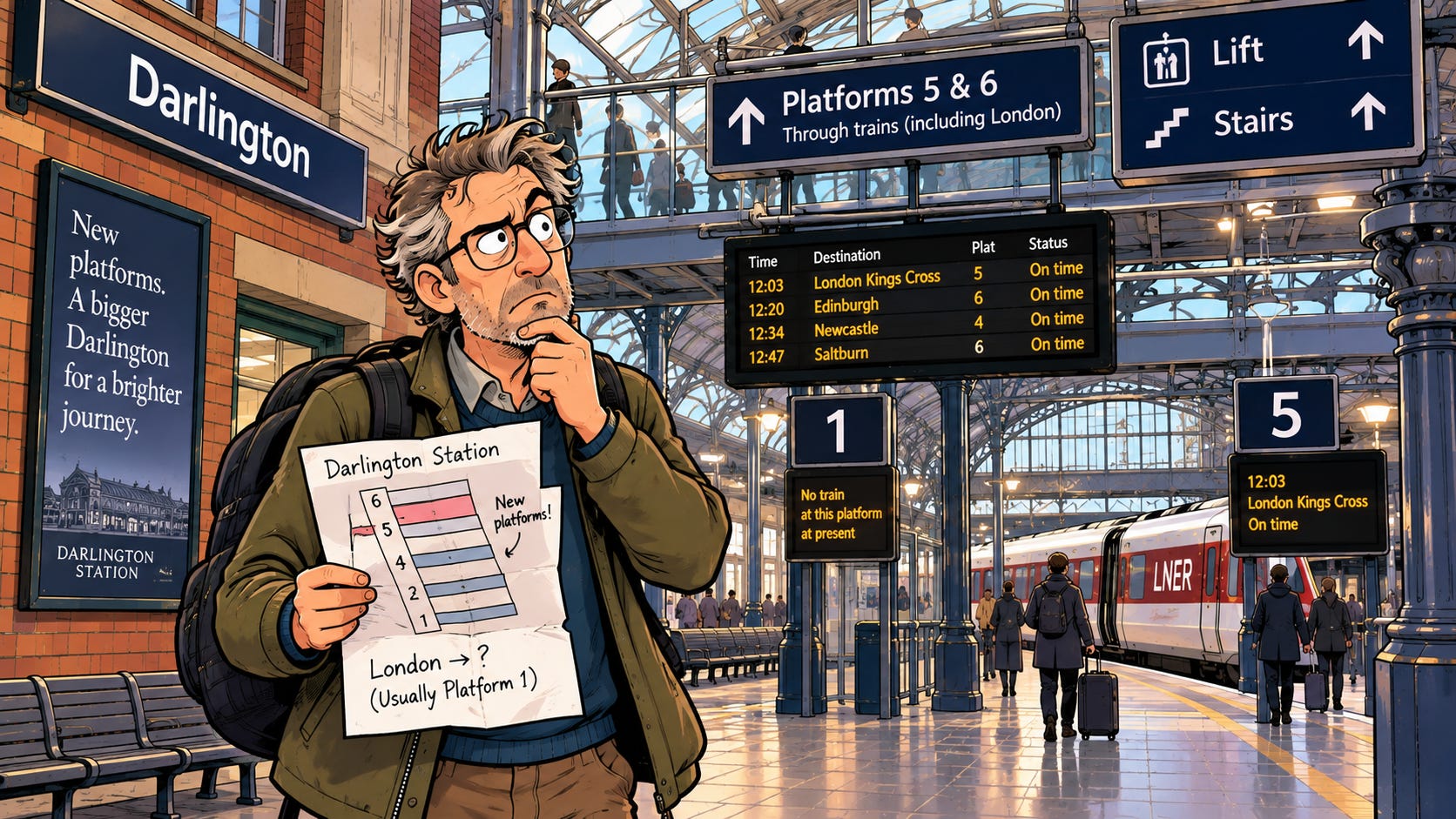
Sitting at home, day after day, in my comfortable rocking lounger chair (from the charity shop, I should add) sometimes gets a bit too lonely and depressing. Even if I do manage to write articles for my lovely readers, whom I value so dearly.
Every once in a while, I need some stimulation beyond the view of the trees outside my window and the convenience store opposite. So this week I made a short trip to London for a wellness appointment, plus a chance to see a friend and stay with my parents. So far, so ordinary.
To get to London, I take a local train to Darlington, where I change for the East Coast Main Line south. It is a journey I have made many times in the five years since I moved “up north”.
Darlington sits on the route of the original Stockton and Darlington Railway, the birthplace of the public passenger railway, and there is plenty of railway archaeology around for those with keen eyes. Old sidings and shunting lines lie disused, along with traces of the many local services and infrastructure swept away as the railway network contracted in the 1960s.
The modern layout of “Darlo” station, as the town is affectionately known by locals, was therefore deeply familiar to me. For years there had effectively been two main through platforms: one northbound and one southbound, plus two bay platforms for local trains towards the coast at Saltburn. Between them sits the old waiting room and café.
For my purposes, the station was almost completely predictable. Trains north left from Platform 4. Trains south, including my London train, left from Platform 1. Same journey, same platform, every time. There had been occasional disruption — memorably, a train once sat stuck at Platform 4 while everyone waited for an ambulance after a passenger suffered a heart attack.
I didn’t think of this as a theory about how to navigate Darlington station.
It was simply how my journey worked.
Was.
There is much to complain about in modern Britain, but it would be churlish to put the trains too high on that list. Compared to their state in the 1970s and 1980s, with frequent strikes, delays, dirt and an air of managed decline, the railway today can sometimes feel like something approaching a golden age.
Passenger numbers have recovered strongly since Covid, investment is visible, some old lines are reopening, and much of the rolling stock is vastly better than what I grew up with. The messy legacy of 1990s privatisation is itself now being reworked towards a more coherent public-service model, while retaining room for open-access operators.
Darlington has been one beneficiary of all this investment. The station has undergone remodelling in recent years, and the hoardings have only recently come down.
Alongside the great Victorian train shed there have long been bypass lines, allowing express and freight trains to pass without entering the old platform area at all. It is here that much of the new construction has taken place: a bonus Platform 5 for through trains, and Platform 6 for terminating services.
The astute among my readers may already be able to see where this story is going.
Because little old Martin was sitting in the waiting room, as usual, frantically bashing away at his laptop keyboard during the thirty-minute wait for the London train.
It was quiet.
Awfully quiet.
The middle of the day, in the middle of the week, is usually busy. Never mind. Two minutes until the train is due. Laptop away. Out onto Platform 1. Carriage B.
But Platform 1 is empty.
Nobody is waiting.
Fook.
Something is wrong. I look at the departure board.
No train to London.
Then it clicks.
My internal map of how I get through Darlington station is out of date. My train must be leaving from the new platform.
So I dash up the stairs. From the new elevated walkway I can already see the London-bound train coming into the station below. Fook again.
The bridge is longer than I expected. I sprint across it, only to discover another problem: I can’t immediately work out how to get down to Platform 5. The stairs are hidden behind an elevator, and for a few precious seconds I hesitate over which way to go. Fook and eek!
Eventually I find them, race down the steps, and jump aboard just in time, thoroughly out of breath, and conscious that middle age has arrived while youth reached its destination years ago.
The doors close.
I have made it.
And as the train pulls away from Darlington, something rather more interesting than my near-miss begins to dawn on me.
Platform 5 had been there all along.
It was even in my mental map of the station.
The problem was that it wasn’t in my operative map of the journey.
With me being me, a happening of this kind cannot simply be left “as is”. It has to be ruminated upon.
Because it struck me, somewhere joyfully south of Darlington, that my little train panic contained a teachable moment. I had fallen victim to precisely the kind of error I spend so much of my time writing about.
There was nothing particularly wrong with my logic. The problem was upstream.
We can reason impeccably from a model of railway reality that contains the right objects in misconfigured relationships, and thereby arrive at platform conclusions that are perfectly rational — and completely wrong.
My expectation that the London train would arrive at Platform 1 was entirely sane in a travel universe in which Platform 5 had no significance to my journey. Indeed, after making the journey so many times, it would have been rather peculiar to expect anything else.
But the universe I needed to navigate had expanded.
Platform 5 now mattered.
And once something matters in real reality but not in your operative model of reality, an interesting thing starts to happen. The world begins sending you anomalies that your incumbent model cannot explain.
More subtly, you may see no particular reason why they need explaining at all — the famous “Somebody Else’s Problem” field from Douglas Adams’s The Hitchhiker’s Guide to the Galaxy.
The empty waiting room was strange, but so what? Perhaps it was just a quiet day. I had an article to write and a train to catch. My objective was not to explain the distribution of passengers around Darlington station. My objective was to get to London.
The empty Platform 1 was different. Now the anomaly collided directly with my objective. The train was due, but its passengers were nowhere to be seen. Something was wrong enough to investigate.
That matters.
Anomalies compete for our attention with whatever else we are trying to accomplish. Most of the time we do not wander through life performing ontological audits whenever something seems slightly peculiar. We shrug. We improvise some harmless explanation. We get on with the task at hand.
Until the anomaly collides with the task.
The empty waiting room didn’t force an update.
The empty Platform 1 forced an investigation.
Suddenly the inadequacy of my model might have consequences. Something was wrong enough for me to stop merely using the cached model and start testing it.
Only then did the scattered clues become a problem requiring explanation.
That cascade is what I have come to think of as the Platform 5 problem.
Now we can pull this apart using the kind of framework I have been espousing for many months. Being in the right place to catch the train at the right time has a subtle set of conceptual preconditions.
But before we dive in, let’s note what makes my railway mishap such a useful teaching case.
It is clean.
Nobody was deceiving me into disbelieving in the possibility of a Platform 5. There was no wild conspiracy to conceal it, no propaganda campaign telling me that Platform 1 was the only possible location for a London train, and no institutional interest in preserving my obsolete understanding of Darlington station. Quite the opposite: there were signs and departure boards whose entire purpose was to correct me.
The only stale component in the system was Martin.
Reality had changed. My cached relationship to it had not.
Better still, there was almost no cost to correction. I had no reputation invested in Platform 1. I hadn’t written a doctoral thesis on Platform 1. My employer wasn’t paying me to defend Platform 1. My friends weren’t going to ostracise me for believing in Platform 5. I wasn’t going to lose my professional licence for mentioning it.
I just needed to catch a train.
So when reality finally supplied a sufficiently strong error signal, my model yielded immediately.
Platform 5 existed.
Martin updated.
Martin ran.
That looks almost insultingly simple. But the interesting stuff isn’t in those three events. It lies in the cognitive space between and around them.
And that starts with an elementary truth: if we had to audit our map of the world every time we used it, then cartography itself would have little purpose other than becoming an all-absorbing obsession.
My sense of what exists in Darlington station had been cached from years of usage. I didn’t even bother looking at the departure boards, not that I can read them with my mid-50s eyesight. Years of successful journeys had compressed themselves into my operational shortcut:
London = Platform 1.
Nothing stupid about that. It is how functioning minds work.
Remember, this is a teaching example. I acknowledge that none of us is necessarily fascinated by the layout of Darlington station. I am not a trainspotter, or a railway maniac. The payoff is seeing the structure, and how it transfers to far more consequential matters of geopolitics and survival in mad times.
So, the parallel here is that I had already been primed about the “conspiracy theory” of Platform 5. While I had never personally observed the platform itself, I had noticed the hoardings come down on my previous trip through Darlington station. I had admired the new footbridge and how it was integrated into the fabric of the old building.
So I wasn’t an absolute Platform 5 denier. There wasn’t some rupture where I went from certainty about Platforms 1–4 to the shock of discovering that Platform 5 had landed in my garden like some unwelcome UFO. The bridge and platform had already entered my representation of the station as physical additions.
But they had not altered the operational relationship that mattered. I knew perfectly well that Platform 5 existed as part of Darlington station. What had not changed was my cached understanding of my own journey:
My journey to London = Platform 1.
Platform 5 belonged to the station. Platform 1 belonged to the journey.
I could readily imagine why the railway might want another through platform: extra capacity, emergencies, disruption, exigencies. None of those possibilities required me to reconsider my own routine. Why would they make people stagger out of the café onto some windswept new platform holding their coffee?
I had quietly pre-rationalised away any need to investigate whether Platform 5 changed anything for me.
So the new thing was visible.
Its consequence was not.
I had even done some online research as to why Platform 6 had not been built as yet another through platform. (It was to save cost, but remains an option for the future.) This was part of my curiosity about how much of the lost UK rail network might be restored in some hypothetical brighter future, after so many valuable routes had been closed.
So my understanding of Platform 5 was actually quite rich as a contemporary object of study. I was no Platform 5 ignoramus. I knew what it was, where it was, and something of why it had been built. What I had not integrated was its relationship to my own journey.
My underlying stored map of the travel universe still said:
“Whatever else has changed around here, London still means Platform 1 for me.”
What is interesting is that my model was perfectly capable of absorbing potentially consequential new facts about Darlington station without changing my operative map.
I didn’t need to deny the new bridge or the new platform.
I just had to assign them a non-threatening role within my existing belief system.
But there were threats to that comfortable downgrade as the anomalies built up.
Again, we aren’t really concerned here with train travel. We are interested in how beliefs change — and, more importantly, what has to happen before they do.
Stepping through each in turn:
I correctly recognised the new bridge and Platform 5 as railway infrastructure, but misclassified their significance as peripheral to my own travels. They were interesting additions to Darlington station, not things that changed “going to London”.
The empty waiting room was odd. Again, I correctly recognised what I saw, but misclassified its significance: “quiet day”, rather than “the passengers for my train are waiting somewhere else”. Nothing about the observation prevented me from going to London, so the existing model survived.
An empty Platform 1 was different; this was classified as an anomaly that collided directly with my orientation. I was going to London. My cached model said that meant catching a train from Platform 1, with other passengers waiting to do the same.
There were no passengers.
That suggested there might be no train either.
At this point I still hadn’t abandoned Platform 1. But the anomaly had become serious enough that I checked the departure board. This was an important transition: I was now testing the cached relationship rather than merely living inside it.
There was no London train on the Platform 1 board. This was stronger still. The problem was no longer that my train had simply failed to appear. Reality was contradicting the cached relationship itself:
My London train ≠ Platform 1.
Direct contradiction meant that the cached relationship “my journey to London = Platform 1” could no longer cheaply survive the data in front of me.
Reality had forced the cached relationship open for recomputation.
These weren’t simply increasing quantities of evidence for Platform 5, as if they resolved some uncertainty about its existence or purpose. After all, I already knew Platform 5 was at the far end of the new walkway, and served trains going somewhere at some times.
What changed was what those observations meant for the model I was actually using:
My orientation — going to London — determined what mattered, and filtered out what didn’t.
My cached recognition supplied both the objects and relationships by which that objective could be achieved, allowing me to disregard most of the noise of the world.
And those relationships, in turn, determined how I classified what I observed, including whether an anomaly arising from that noise mattered to my journey.
The bridge could therefore be real but irrelevant. The empty waiting room could be real but insignificant. Even Platform 5 could be real, consciously known about, and still occupy the wrong place in my travel universe.
Platform 5 was in my encyclopaedia.
It was not in my itinerary.
I had recognised the object.
I had not recognised the relationship.
What finally forced the cache open was not contradiction for its own sake. It was the threat of failure in orientation. No train from Platform 1 meant no going to London under the model I was currently using. Reality had made the objective around which my operative model was organised impossible to execute without revising that model.
At that point it wasn’t Platform 5 as an object that had to be recognised afresh. It was my relationship to it. Nothing about the concrete and steel had changed in those few seconds. What changed was its status in my model: from incidental railway infrastructure to the necessary place from which my London train departs.
The relationship recomputed:
My journey to London = Platform 5.
My orientation was executable again.
Martin ran*.
*Subject to 55-year-old dadbod physical limitations.
When you see it laid out that way, a surprising number of cognitive moves were required, and in a particular sequence. The crux is easily missed among them: Platform 5 changes type.
In my old mental model, Platform 5 was something like:
new infrastructure, auxiliary capacity for the future, exception use in the present
In my refreshed model it had become:
the normal departure point for my London train
That is an ontological update to what Platform 5 is for me, accompanied by a relational update to my journey — not merely the acquisition of another geometrical fact about “the thing over there”.
Suddenly I inhabited a different cognitive edition of Darlington station. And that new topology back-propagated into observations I had already made, changing their significance retrospectively:
“Ah. That’s why the waiting room was empty.”
No new evidence about the waiting room had arrived. The observation remained exactly the same: hardly anybody was there. What changed was what that observation meant, because the topology into which it fitted had changed. The model had generated new explanatory information without receiving new observational information.
Note what didn’t happen. I didn’t stand on Platform 1 impotently wailing “fck train travel, fck LNER trains, fck Darlington station, fck London, and fck this life” — and stubbornly refuse to engage with Platform 5.
For sure, my cache was stale. That’s inevitable in life.
My initial interpretation of Platform 5 was also inadequate. Also ordinary.
But sufficient collision with reality caused reconstruction of the map.
Just as information security is concerned with keeping computer systems resilient as threats and circumstances change, cognitive security requires us to preserve the ability to update our map of the world when reality no longer fits it.
There is another word for this: corrigibility.
The pathology isn’t:
Martin stupidly went to Platform 1 based on an outdated understanding.
It is:
Martin discovers that Platform 1 is empty, the departure board contradicts his cached relationship, and nevertheless refuses to reopen it.
Now that would be real stupidity!
At that point, I would have missed the train in defence of the old map.
We’re not done yet! Even after I know Platform 5 is where my train is, I am not aboard.
Now reality demands purely operational knowledge:
Where is it?
How do I reach it?
What connects here to there?
How long is the bridge?
Where are the stairs?
I had admired the new footbridge aesthetically before. Now I had to rediscover it consequentially by running across the bloody thing.
Knowing that Platform 5 mattered was necessary. Knowing how to get there was something else.
Only when I reached the platform and boarded the train was the loop finally closed: operational success connected the repaired map back to reality.
So far, this has all been reassuring.
My cached model was wrong, reality supplied an error signal, I reopened the model, reconstructed the relevant relationship, acquired enough operational knowledge to act, and made the train.
Martin was corrigible. Indeed, he’s a professional corrigibilist.
But remember why Darlington makes such a useful teaching example. The experiment was almost absurdly clean.
Changing my mind cost me nothing.
What happens if we change that?
Suppose I had written a doctoral thesis proving that London trains leave from Platform 1. Now there is a credential cost to correction. What then?
The evidence on the departure board hasn’t changed. Platform 5 hasn’t moved. But reconstruction now carries a reputational cost. Does the map update still? When?
Suppose my income depends on Platform 1. Now there is a financial cost. Ouch!
Suppose I have spent five years publicly ridiculing people who said London trains might leave from Platform 5. Now there is humiliation too — a psychological cost. Updating my model requires updating my account of myself and my sense of identity.
Suppose I have directed thousands of other passengers to Platform 1. Now something more serious happens. Reconstruction potentially converts past confidence into past culpability. Updating the map may require me to confront not merely that I was wrong, but that other people acted on my wrongness — a moral cost.
The stronger my previous authority, the more expensive correction becomes.
Suppose my entire profession is standing beside me on Platform 1, reassuring one another that this is where London trains leave. Now correction carries a social cost as well. Platform 5 may be physically only a footbridge away, while becoming psychologically almost unreachable.
Notice what has not changed: The station. The train. The departure board. The footbridge. Platform 5.
Reality is supplying exactly the same evidence. What has changed is the price of allowing that evidence to reconstruct the model.
And so the question is no longer merely whether reality contains enough evidence to correct me. It is whether I remain corrigible when correction becomes expensive.
We can now see that the Platform 5 problem is more subtle than “something exists outside your model” due to an under-sized conceptual universe.
There are at least three ways in which a model can fail.
⁂
I don’t know X exists.
That is straightforward ignorance. Platform 5 is absent from my universe.
⁂
I know X exists, but it is non-operative in the model I am actually using.
This was my Darlington problem. Platform 5 existed in my encyclopaedia but not my itinerary. I knew what it was as railway infrastructure, but had not integrated the relationship that made it consequential to my journey.
⁂
I know X exists and understand its consequences, but refuse the correction they require.
Now we have crossed from an inadequate model into something more interesting. I know where the train leaves from. I know Platform 1 will not get me to London. Yet reputational, financial, social or psychological costs make me unwilling to cross the bridge.
At that point I am no longer merely mistaken.
I am incorrigible.
I wasn’t a Platform 5 denier.
I was something much more commonplace:
a Platform 5 non-consequentialist.
Darlington station had become larger in my visual universe before it became larger in my operational universe.
I could see the new bridge. I knew about the new platform. I could research Platform 6. The physical station had expanded, and my propositional knowledge had expanded with it.
Yet the universe in which I actually acted remained stubbornly four-platform Darlington.
That universe did not become larger when Platform 5 was built.
It did not become larger when I saw the bridge.
It did not even become larger when I learned what Platform 5 was.
It became larger when Platform 5 acquired a consequential relationship to my objective.
Now leave Darlington, if you can and will.
Take Q.
We need not agree on what Q was to apply the Platform 5 test. Indeed, that disagreement is the point. The posts existed. Millions of people could read them. Their existence as objects was hardly the interesting question.
The harder question was what kind of thing they were.
A prank? A political marketing exercise? A psychological operation? An intelligence operation? Something else?
Those classifications can accommodate many of the same observations while placing Q in radically different relationships to the surrounding political world. And, just as with Platform 5, the classification determines what becomes consequential.
Suppose my own model says that Q was connected to a genuine intelligence operation whose promised consequences have yet to become fully visible. That is not an exemption from the method I have just described.
It is a cached relationship of my own:
What would test it?
What observations would make “quiet day” progressively harder to sustain?
What departure-board moment would force me to reopen the relationship?
And, most importantly, what evidence would make me conclude that I had assigned Q the wrong type altogether?
I have to be able to answer those questions. Otherwise “corrigibility” is merely something I demand from people whose models disagree with mine.
For instance, if the specific institutional consequences I expect — EBS, debt jubilee, restored Republic — repeatedly fail to materialise while an alternative account consistently predicts events better, then “quiet day” eventually stops being an adequate explanation. My classification has to reopen.
Every consequential belief needs a departure board.
The same test can be applied to 9/11, FISA surveillance, the Fed and IRS, the Covid injections, or any other politically loaded object. The interesting question is not merely whether we agree about the observations. It is whether we agree about
what those observations instantiate,
how the objects are related, and
what consequences should follow.
People can therefore agree upon a surprising amount of reality while inhabiting radically different operative worlds.
Hence my growing interest in consequence theories.
But there is no exemption for Martin.
If reality contradicts my map, I have to reopen the cache.
Otherwise I am just another confused bloke standing on Platform 1.
The same applies to anyone else. We all have our Platform 1 moments. What matters is how we deal with them.
Looking back, the most interesting clue wasn’t actually the empty Platform 1. It was the empty waiting room.
By the time I reached Platform 1, reality was practically shouting at me. But several minutes earlier it had already whispered. I had noticed that the waiting room was unusually empty and dismissed it as merely a quiet day. Even before that, on my previous journey, I had seen and admired the new bridge. I had researched the new platforms. I knew perfectly well that Platform 5 existed.
In a sense, much of the reality I needed was already in front of me. What I lacked was recognition of how the pieces fitted together — until the departure board supplied the fact that forced the relationship open.
That may be the deeper Platform 5 problem. The thing that eventually overturns our model need not arrive as some spectacular new revelation. It may already be sitting comfortably inside the model, correctly observed and perhaps even correctly named, but classified as irrelevant, peripheral, exceptional, or Somebody Else’s Problem.
The bridge was there, the waiting room was empty, and the train was going to Platform 5. Reality was not hiding from me. I simply had not joined the pieces together in the way required to get my body onto the train.
Which leaves me with two rather uncomfortable questions:
What new bridges am I presently admiring while continuing to navigate by an old map?
And what empty waiting rooms am I dismissing as merely a quiet day?
The universe does not become larger when we recognise Platform 5.
We discover that it was larger all along.
Thank you Martin!! I seldom have the actual time or cognitive energy to read “extraneous” or “additional”, perhaps “optional” works by authors but I always know that if I invest a bit of my time to your work, it always pays off. In fact, if you don’t mind my saying so, I shall now classify you in my relational model towards cognitive efficiency as: Martin = Cognition Gandalf.
Again, thank you sir!
Martin, you are delightfully weird. Or weirdly delightful. This is a very entertaining riff on this whole subject.
But how about this for baking your noodle: You can't just update your model. For at least a while going forward, you are going to have to read the signs at Darlington each time you go. Your model hasn't just been updated with a permanent fix. It has become modestly or completely unanchored. Yes, the train to London could be coming on Platform 5 next time you go. But what if the construction needs a modification? It's early days on new arrangements. There could be times in the next few months where the London train has to be sent back to Platform 1 for some reason you won't know about the next time you show up. You will have to read the sign each time for a while until you see the arrangement as steady and dependable. But it will never be the same: Once the train went to Platform 1 and now to Platform 5, you can never fully depend on your new cached belief that it won't ever switch back. Platform 5 can never be quite as dependable to your outlook as was Platform 1 because you now face a constant question between two options, where before you only ever faced one option. Your world has just become a little less stable and dependable than before.
Nyunh-uhn-uh!