

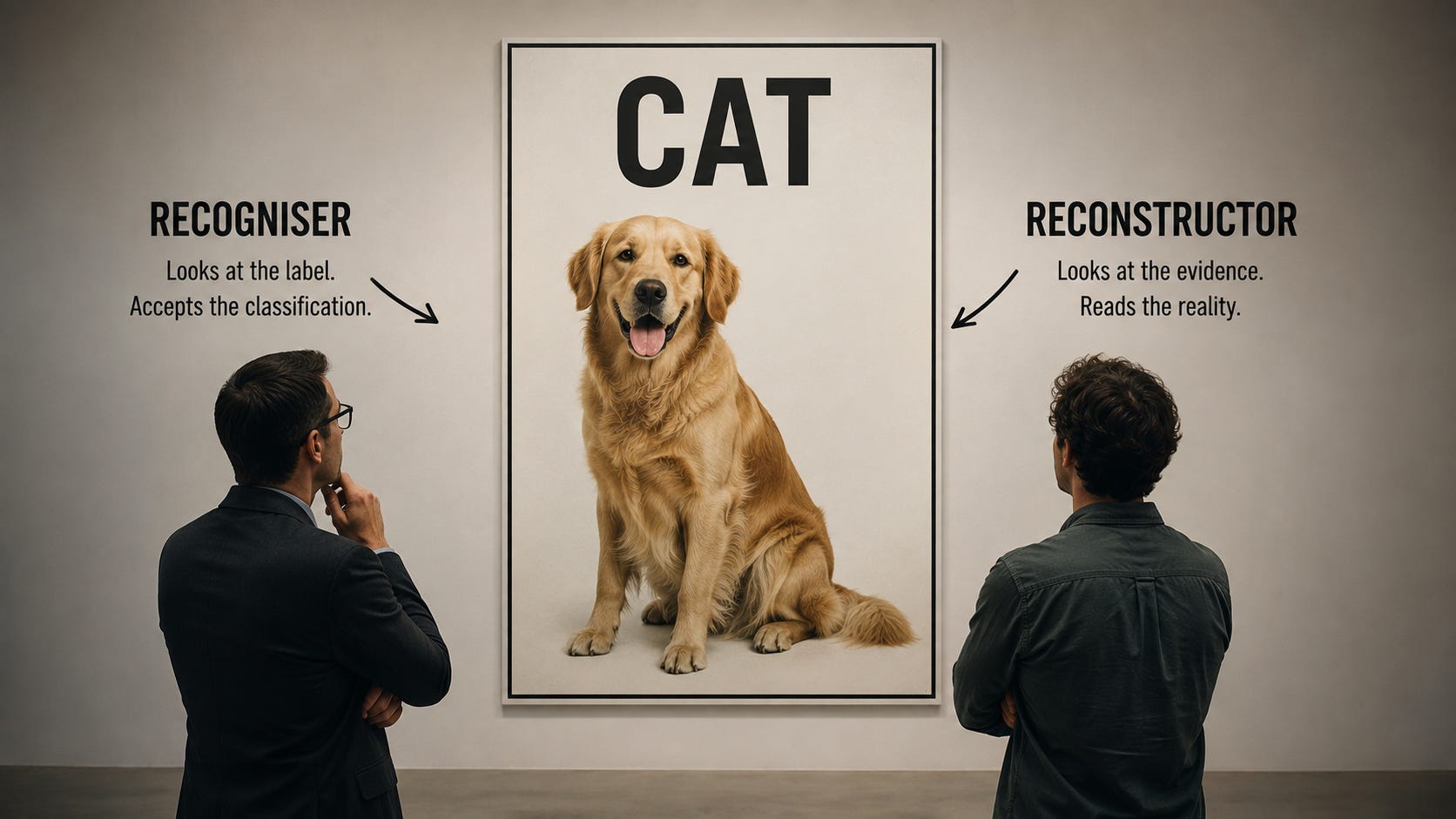
As I write this, I am sitting opposite my elderly parents, who are quietly studying on their iPads. My brother is wallowing upstairs in the bath during a visit back to England from his home in the United States. I have seen both of my daughters this week. This afternoon I may meet an old university friend for coffee; we only spoke last week.
On the face of it, I do not appear to have severed ties with my nearest and dearest in order to join an isolating mind-control cult. Even though we disagree about many things.
Back in 2020, however, that is not the impression that the mass media was giving out. Anyone who took the time to look at the Q drops and make an effort to infer what might be going on “behind the scenes” in government and military affairs was immediately tarnished as a conspiracy nutjob and fringe opponent of consensus reality. I have an archive of media material from that era that is proving very interesting as I can now feed it into AI, and ask it “what is it consistently directing you away from?”.
The “negative attractor” is the truth about corruption they don’t want to spread! More precisely, the “unspeakable” is not a particular conclusion. It is a forbidden mode of cognition. The reader is not merely discouraged from believing certain things; they are systematically diverted from retracing how those things might be independently established.
The reconstruction of reality itself becomes socially hazardous.
As part of my work to curate that material into a library for AI use, I happened upon a Washington Monthly article that quotes myself as evidence for its case. The structure mirrors the corrupted court order I described in yesterday’s article: recognition comes before reasoning. In other words, an upstream classifier is injected — “cult” — that infects all downstream interpretation, which remains coherent only so long as you unquestioning accept the unestablished premise.
This is the reverse of rational inquiry.
In logic, reconstruction precedes recognition: public traces are gathered, competing hidden runtime models are evaluated as explanations for those traces, and only then is the object classified. Here the order is inverted. Recognition is loaded first, and reconstruction is never permitted to execute independently. It doesn’t matter if you agree or disagree with the article content as long as you swallow the premise without noticing its was never argued from the observable data.
I thought it would be good to review this piece because it usefully illustrates the difference between “forward propagation” influence techniques that directly tell you what to think verses “anti-backward investigation” ones that seek to prevent you looking too closely at how we got here. As Spygate, FISAgate, Russiagate, Coronagate, Jan6Gate and who knows what else roll back into view, this is a handy moment to review the architecture as many “wake up” to having been lied to, and wonder how they fell for the trickery of criminals.
So, let’s take this in pieces. First, the headline:
Why the GOP Can’t Control QAnon
and the subtitle:
The Republican Party is itself a conspiracy cult
The implication is ontological: there exists a well-defined “QAnon” object, framed as a hive-mind collective, and that this thing can have epistemic properties as a result like being “under control” or otherwise. In then proceeds to make a raw and absolute framing assertion: not that the object is akin to a cult, but it emphatically is one. Yet there is no upstream reasoning to justify this; it is axiomatic.
Now let’s take each initial sentence of the first paragraph and examine it. Is this doing recognition work (i.e. a priori classification) or reasoning work (i.e. authenticated facts to reasonable inferences)?
At long last, mainstream reporters are starting to take the QAnon conspiracy cult seriously.
This is pure recognition work. The object is introduced already classified. “QAnon” is treated as a settled entity, “conspiracy” as an established property, and “cult” as an unquestioned category. No reasoning is offered to derive these labels; they are simply pre-loaded into the reader’s mental model.
With at least one QAnon devotee about to be elected to Congress, millions of online followers and several big stories in major publications, the cult has come into its own.
The recognition state is now reinforced. “Devotee” silently precludes investigator, sceptic, analyst, or participant; the relationship has already been defined as one of religious allegiance. The numerical references do not reconstruct the nature of the phenomenon. They merely amplify the urgency of the already-loaded classifier.
Pushback against it has come too little, too late.
Again, this is recognition rather than reasoning. The existence of “pushback” is presented as self-evidently justified, and the only remaining question is whether there has been enough of it. Independent inquiry has already been classified as a social threat, and the reader is quietly invited to identify with those resisting it.
Facebook, Twitter and TikTok only recently started deactivating major QAnon promoters and groups, even as those accounts engage in coordinated ban evasion and continue to peddle lies on other platforms.
This is perhaps the most interesting sentence of the four. It completes the recognition programme by normalising exceptional measures. Deplatforming, coordinated suppression, and the removal of ordinary speech protections are presented not as actions requiring independent justification, but as natural responses to an already-recognised threat.
The implied logic is circular: if such extraordinary containment measures are being deployed, then the threat must already have been extraordinary. Yet the article has still not established why the classifier itself should be accepted. The necessity of suppression becomes retrospective evidence for the correctness of the suppression.
Let’s keep going! If we’re going to invoke fair use, we might as well get our money’s worth by deconstructing every phrase.
I (as others have) use the word “cult” here very intentionally.
This is a recursive appeal by the writer to the authority of the classifier class. The existence of prior classification is itself offered as justification for continued classification. The classifier authenticates itself. There is no causal chain back to independently established facts; consensus within the recognising community substitutes for reasoning.
QAnon is not a political movement centered around an ideology or policy platform: it is a freewheeling grab bag of mostly far-right but also non-partisan conspiracy theories from flat-earthers to believers in lizard people to those who believe that JFK Jr is still alive and coordinating the arrests of a massive global pedophile and Satanic child sacrifice ring.
Notice the remarkable absence of reconstruction. The object is defined not by architecture, origin, design, methods, or evidence, but by an ever-expanding list of socially discrediting associations. It is simultaneously “far-right” and “non-partisan”; simultaneously lacking an ideology while somehow possessing a coherent cult identity.
The underlying claims that motivated many people’s inquiry—election integrity, intelligence operations, human trafficking, institutional corruption, NGO influence, classified programmes, or constitutional questions—are absent. Those are not even examined.
Instead, the article performs guilt by aggregation. The reader is taught to compute on the status of those associated with the object, rather than on the object itself.
Its adherents demand not allegiance to a specific orthodoxy, but only blind faith in the leader: an anonymous online figure nicknamed “Q” who began posting on 4chan during the early days of the Trump Administration, claiming to be a member of the administration with top “Q” level security clearance.
Here the inversion becomes complete.
Any attempt to reconstruct the underlying runtime is reclassified as evidence of blind faith in its supposed author. The distinction between using a source as data and submitting to a source as authority is erased.
That distinction matters enormously:
A forensic investigator studies a document without believing it.
A cryptanalyst studies a ciphertext without believing it.
An intelligence analyst studies intercepted communications without believing them.
The article quietly collapses all of these into one category: unthinking belief.
Thus the act of reconstruction itself becomes psychologically suspect. Once reconstruction is reclassified as devotion, independent inquiry has already been neutralised.
Members spend countless hours analyzing specific “drops” from Q, using numerology and other hokey deep reading techniques to parse misspelling in Trump tweets for hidden messages and patterns, fitting them into bizarre and hopelessly complicated “calendars” and “clocks.”
Again, the reconstructive act itself is placed on trial.
If there existed any circumstance in which coded, indirect, or deniable communication between state actors and the public were operationally necessary, then careful decoding would be a rational response to that possibility. Whether such communication actually existed is a separate question. The article never reaches it.
Instead, it performs a much earlier operation.
It teaches the reader that attempting reconstruction is itself evidence of irrationality.
The offence is not arriving at the wrong conclusion.
The offence is attempting to reconstruct at all.
This is the essence of anti-reconstructive propaganda. Rather than disproving an alternative runtime, it delegitimises the very cognitive process by which one might independently determine whether such a runtime exists. The taboo falls not upon a belief, but upon a method of inquiry.
Thus the opening section lands an unstated prohibition: independent reconstruction is socially and psychologically illegitimate. The “cult” recogniser is merely the delivery vehicle. Once that cognitive beachhead has been secured, the remainder of the article expands the occupied territory by repeatedly applying the loaded recogniser to ever more semantic objects.
The architecture is no longer trying to establish the classifier. It is exploiting it. Watch the conversion that cashes in the prior “cult” category recogniser.
The key catchphrases of the movement are typical of cultic in-groups with political overtones. “Trust the Plan.” “Patriots Are in Control.” “Where We Go One We Go All.”
There are slogans?
No.
There are cult slogans.
It provides a built-in community of fellow believers, and a chiliastic all-encompassing spiritual battle against both human and supernatural enemies.
There is a community?
No.
There is a cult community.
As with an adventist cult, Q followers are supposed to be essential team members laying the groundwork for the exposure of the “truth”: a giant global ring of child-eating Satanist pedophiles restricting access to free energy, debt jubilees and world peace.
There are followers?
No.
There are cult adherents.
Central to all of this is the figure of Donald Trump, who will supposedly one day bring “the pain”: the mass arrest and summary execution of all the cult’s enemies, ranging from standard right-wing targets like Hillary Clinton and Barack Obama to celebrities like Tom Hanks and Chrissy Teigen.
There is a political leader?
No.
There is a cult leader.
(The fact that President Trump, leader of the Executive Branch of the United States, has supposedly allowed this ring to exist unhampered for nearly four years while an anonymous 8chan user spreads the gospel is dismissed as a minor inconvenience.)
There is anonymous communication?
No.
There is cult evangelism.
Now comes associative expansion, having already grown the scope to the entire Executive Branch. The occupied cognitive territory now extends into adjacent recognition networks: racism, Nazism, extremism, fascism, and so on.
The purpose is no longer explanation. It is saturation.
All of it is overlaid on existing white supremacist and anti-semitic themes, as the enemy is supposed to be a “globalist” cabal using minorities to overwhelm majority-white Christian nations.
Nothing new is being learned. More things are being recognised.
That is the distinction:
Reconstruction expands knowledge. It is cognitively expensive. It demands reasoning, invites error, and exposes the investigator to ridicule if they get it wrong.
Recognition expansion enlarges the domain of application of an already-authenticated classifier. It is cognitively cheap. There is no need to reconstruct anything independently; one merely extends the existing recognition graph.
Socially, the latter is safer too. There is little reputational risk in joining the crowd and recognising what everyone else already “knows”.
This is less about persuasion than cognitive economics.
Anti-reconstruction propaganda markets recognition as a low-cost substitute for reconstruction.
The next section cashes in this accumulated cognitive capital. Having made reconstruction socially expensive and recognition socially cheap, it now explains why those who continue reconstructing reality become isolated from friends and family.
QAnon followers are also suffering the same sorts of social isolation and estrangement from family and friends that is typical of new cult members. QAnon leaders, for their part, offer a substitute family for them in replacement.
This is where the runtime closes its own feedback loop. Having established reconstruction (“think for yourself”) as socially suspect, the article now explains the resulting social isolation as further evidence that the classifier was correct.
The refusal to adopt the offered ready-made recogniser, and the decision instead to reconstruct reality independently (accurately or otherwise), becomes the trigger for ostracism. “You believe that QAnon nonsense? Stay away from us!” That ostracism is then retrospectively recognised as confirmation that the individual belonged to the “cult” all along.
The classifier therefore becomes socially self-protecting—a kind of cognitive black hole. Any loss of friends, family, professional standing, or institutional support that follows from rejecting the dominant recognition system is immediately reclassified as evidence that an alternative recognition system has captured the individual.
The punishment for reconstruction becomes epistemic evidence that reconstruction effort itself was pathological.
The socially engineered consequences of mass media articles like this are quietly recycled as epistemic evidence that the prohibited mode of cognition was defective. Ostracism ceases to be a sociological fact and becomes proof that the act of independent reconstruction was itself pathological.
And it achieves this by quietly reclassifying reconstruction as merely another form of recognition. It simply refuses to recognise reconstruction as a legitimate cognitive act in its own right. Hence reconstruction is no longer admitted as an independent inferential process capable of generating new knowledge.
Instead, it is recursively re-recognised as nothing more than allegiance to an alternative recognition system—a recognition system that has already been classified as illegitimate. The moment you begin independently reconstructing reality, you are no longer seen as reasoning at all. You are simply recognised as having loaded the “wrong” recogniser.
Yes, your head should hurt. The trick is deliciously perverse.
The anti-reconstruction propaganda method literally eliminates reconstruction as a cognitive primitive. There are only recognisers, and “thinking for yourself” is reinterpreted as merely selecting an unauthorised one.
The cardinal sin is not believing the wrong thing.
It is believing that you are entitled to reconstruct anything at all.
Now the fun bit because it is about me!
The article says:
As QAnon influencer Martin Geddes once tweeted before his account was suspended:
“Part of the struggle of being “awake(ish)” is that many of your normal sources of support become flimsy or even can attack. Your preacher, teacher, therapist, mother, lover etc can be under the spell of false narratives or devious doctrines. Requires building a whole new network.”
Before unpacking that, however, notice something curious.
The embedded hyperlink in the article points not to this tweet, but to another one:
The pain of being a critical thinker (aka “conspiracy theorist” or “anon”) in a mad society is isolation, alienation, and ostracism. The Q movement flips this. Anons are now connected, directed, and acknowledged. We all shine a little light, and together we are a beacon of hope.
The Washington Monthly article silently reverses cause and effect.
My point was never that people should abandon their families in favour of a cult.
My point was that when a society penalises independent reasoning, those who continue reconstructing reality inevitably become isolated from those who continue recognising reality through the dominant classifier.
Mutual recognition between independent thinkers is therefore not the cause of the estrangement. It is an adaptive response to it.
The article assumes the opposite causal order. It treats the formation of a new community as evidence that the community itself caused the estrangement. My own tweet argues precisely the reverse: social ostracism comes first, and only then do people seek out others who have undergone the same experience.
The observable facts are identical. People lose friends. People build new friendships. People find mutual support.
The disagreement is not over the observations, but over the hidden runtime that generated them.
The article never attempts to distinguish between these competing causal explanations. It simply assumes one in advance and interprets every subsequent observation through it. My words are therefore not analysed on their own semantic terms.
They are reclassified to fit an already-authenticated recogniser.
Cue the Mandy Rice-Davies defence: “Well he would say that, wouldn’t he?” The MRD defence is the self-sealing move by which any denial, clarification, or counter-evidence is dismissed as exactly what someone bearing the prior classifier would be expected to say.
So the more you protest, from inside their recognition system, that you are not in a cult, the more your protest is reinterpreted as evidence that you are. Reconstruction of whether the cult classifier is actually correct has already been excluded in advance.
Now let’s perform a little semantic decompilation.
Up until now we have been analysing the article’s recognition model. Now we can watch it execute on something concrete: my own words. Rather than debating whether my tweet is true or false, we will reverse-engineer the semantic transformations that the article quietly applies to it.
The words themselves never change. The observable facts never change. What changes is the recogniser through which they are interpreted.
Three distinct transformations occur.
First: Modality transformation
I stated:
“Your preacher, teacher, therapist, mother, lover etc can be under the spell of false narratives or devious doctrines.”
Notice the conditional. This is an observation about possibility, not certainty. I am not claiming that these people are deceived (i.e. failed to reconstruct reality correctly), only that they can be. The article silently upgrades a conditional statement into an absolute one, then attaches it to its already-authenticated “QAnon equals cult” recogniser. The effect is one of delegitimisation by falsely imputing a paranoid worldview.
Second: Scope transformation
I never mention Q at all. My observation is much more general: profound disagreements often fracture existing support structures. That applies equally to whistleblowers, abuse survivors, political dissidents, religious converts, scientists challenging orthodoxy, or anyone else whose reconstruction of reality diverges sharply from the dominant recognition system.
Likewise, notice the symmetry of my list: preacher, teacher, therapist, mother, lover. It spans religion, education, psychology, family, and intimacy. I am not attacking institutions. I am pointing out that any recognition authority can become misaligned with an individual’s own reconstruction of reality.
The article quietly narrows both observations from universal properties of human society into supposedly QAnon-specific ones. The effect is to reclassify ordinary features of social disagreement and human cognition as evidence of cult involvement.
Third: Function transformation
My concluding observation was simply:
“Requires building a whole new network.”
This contains no recruitment, no coercion, no hierarchy, no exclusivity, no leader, and no prohibition on maintaining existing relationships. It is entirely descriptive. It simply observes a social consequence: if your reconstruction of reality diverges sufficiently from those around you, some existing support networks may fail and new ones may have to emerge.
The Washington Monthly article quietly performs one final inversion. A descriptive observation about social adaptation becomes evidence of prescriptive cult behaviour.
Once again, the observable facts remain unchanged. People become estranged. People form new relationships. People seek mutual support. Only the hidden runtime (e.g. “white hats” and “black hats”) differs.
The article assumes that the new community caused the estrangement. My tweet argues the opposite: estrangement came first, and the new community emerged in response.
One tweet.
One article.
Three semantic transformations.
The words never changed.
Only the recogniser did.
My tweet was never really about Q, or any of the specific claims in the drops.
It was about recognition.
I wrote that “many of your normal sources of support become flimsy” because they no longer recognise your reconstruction of reality. More precisely, they no longer recognise reconstruction itself as a legitimate cognitive act.
Instead, they misclassify it as recognition of the “wrong” authority:
Once that happens, recognition fails.
When recognition fails, trust fails.
When trust fails, the social network fails.
When the social network fails, its support function fails.
New recognition networks naturally emerge to replace what has been lost. My tweet was therefore describing recognition topology years before I had developed the vocabulary to explain it.
Then the Washington Monthly article inadvertently proves the point.
It becomes one of the very institutions that withdraws legitimate recognition. It takes an observation about independent reconstruction and reclassifies it as allegiance to the false recogniser called “QAnon”.
So the tweet predicts the article.
Then the article cites the tweet as evidence that the tweet was wrong.
That is a wonderfully self-referential loop!
The article becomes an instance of the very phenomenon it is attempting to explain away.
By withdrawing charitable recognition and reclassifying a general observation about social estrangement as evidence of cult involvement, it performs the precise recognition failure that necessitates the formation of new networks of mutual understanding.
It is difficult to imagine a more elegant demonstration of the theory.
Yes, I am smiling, too.
Now, I owe today’s reader a small apology.
I am not really writing this article for the reader of 6th August 2026, which happens to be today. I am writing it for an unusually bright teenager, or perhaps a political science student, five or ten years from now, trying to make sense of the extraordinary insanity of the early 2020s.
That reader will have one overwhelming question:
“What on earth were these people thinking?”
So I’m going to keep ploughing through the article phrase by phrase, even if I lose a few of today’s audience along the way.
Sorry.
I love you too.
Just not quite as much as the kids who will one day be trying to understand how millions of intelligent adults encountered the Q drops—the most consequential public intelligence artefact of their generation, if not in modern history—and mostly responded by arguing over whether they were allowed to look at them in the first place.
Taking my tweet as the starting point, the article continues:
This is not a political movement.
Classifier.
No reasoning given.
It is a novel form of online religion enabled by social media algorithms.
Classifier repeated.
No reasoning given.
And it is deeply dangerous, not just because of its capacity for catapulting all sorts of misinformation but also because of its natural tendency toward political violence.
Classifier extended.
Still no reasoning given.
After all, if you believed that such things were true and such people existed, what would you do to stop them?
Now the interesting move happens.
Three recognition assertions have been stacked on top of one another without any intervening reconstructive reasoning. Those recognisers are then immediately converted into a prediction about social behaviour.
The article therefore performs a remarkable shortcut.
It does not infer danger from reconstructed reality.
It infers danger from recognised identity.
Once the object has been recognised as a “cult”, “religion”, and “danger”, violent behaviour follows almost automatically. The behavioural prediction derives not from independently authenticated facts, but from the semantic content of the classifier itself.
Recognition has become destiny.
Following that transition, we continue on…
One would think that the Republican Party would see the danger of this phenomenon and try to nip it in the bud, as surely as any political entity would try to quell a cult growing like a cancer within it. But it hasn’t.
Notice that “cult” is now treated as an operational fact rather than a proposition requiring defence. The article has completed the landing phase. Reconstruction has disappeared entirely from view. The remaining problem is no longer whether the recogniser is correct, but why institutional actors failed to enforce it consistently.
The object of concern has subtly shifted.
It is no longer Q’s claims themselves.
It is the failure to suppress reconstruction of Q’s claims.
House GOP Minority Leader Kevin McCarthy has come under fire for not doing enough to stop QAnon within Republican circles and hewing too close to Trump, but he is unlikely to be seriously threatened for leadership. Trump himself refuses to try to squelch the conspiracy group, seeing any supporter as a good supporter.
Again, the discussion no longer concerns evidence or competing reconstructions of reality.
It concerns recognition governance:
Who is recognising the “QAnon” object “politically correctly”?
Who is failing to recognise it and deserves reproach?
Who is permitting rival recognition systems to persist?
Political leadership is evaluated less by what it knows than by whether it maintains the approved recognition boundary. Independent reconstruction cannot easily be prohibited directly. Millions of individuals can privately inspect information, compare observations, and form their own runtime models.
What can be controlled is the social legitimacy of those reconstructions. The practical battlefield therefore shifts from suppressing information to regulating recognition. The contest is no longer over who possesses the data, but over which interpretations remain socially permissible.
Even as I write this, the richness of the underlying structure surprises me. I thought I was simply going to review one old article in context. Instead, every paragraph reveals another layer of the reconstruction-versus-recognition dynamic. I am learning as I write, despite having spent nearly a decade immersed in this subject.
That tells me something important. We are only just beginning to understand, at a deeper architectural level, what we have actually been participating in. What looked like a political or media dispute increasingly resembles a struggle over the very cognitive machinery by which societies distinguish recognition from reconstruction.
The article next makes a particularly interesting manoeuvre.
The problem is that Republican Party has been relying on only slightly milder forms of conspiratorial politics for years now. It’s staggering to ponder the implications of modern Republican ideology all at once, but consider a few examples.
For the first time, the article appears to engage in something resembling reconstruction. It asks the reader to consider the beliefs held by another group and how those beliefs might fit together.
That is progress.
But notice where the reconstruction stops.
Thousands of climate scientists…
But is it true?
Millions of fraudulent votes…
But is it true?
A coordinated effort to disarm white people…
But is it true?
Social services exist primarily to secure Democratic votes…
But is it true?
At every stage the article reconstructs only as far as the next recogniser.
It never continues the journey back to independently authenticated reality.
Instead it quietly assumes that the proximate recogniser—Fox News, Republican rhetoric, social media, or whatever intermediate explanation happens to be available—is the terminus of inquiry.
The runtime halts there.
The deeper reconstruction never executes.
Then comes the punchline.
These are truly bizarre beliefs…
But are they?
They are preached from the Fox News pulpit…
Are they?
They are outlandish and nonsensical…
According to whom?
Notice what never appears.
Evidence.
The article repeatedly asks the reader to recognise that these claims are absurd.
It never reconstructs whether they actually are.
The rhetoric now enters its final phase. The recogniser has already landed and expanded, so it no longer needs to defend itself. Instead, it totalises. One recognised object is used to absorb neighbouring ones until an entire semantic landscape has been brought under the same classifier.
So it’s not a huge logical leap from these conspiracy theories into even more fantastical QAnon territory.
Reconstruction has now disappeared completely. All that remains is the repeated application of an already-authenticated recognition function.
It’s not a big step, for instance, from ridiculously claiming that climate scientists are all lying for grant money—which lacks real credibility as a motive—to speculating that they’re lying for deeper, more nefarious ends.
Observe what has happened. The article is no longer debating facts; it is policing the permitted depth of reconstruction. Ordinary motives such as money remain legitimate objects of inquiry. But the moment one asks whether there might be higher-order incentives, coordination, coercion, ideology, institutional capture, or state influence, the reconstruction itself becomes impermissible.
The offence is no longer arriving at the wrong conclusion.
It is asking the next question.
In some ways the Republican tropes actually gain more credibility the more villainous the opponents’ motives are claimed to be. If you’re going to claim that Democrats want to offer universal childcare as an evil scheme to gain power to do vague unspecified things, why not go all the way to claiming that they want to keep patriots subdued so they can harvest babies for adrenochrome?
The argument now reveals its true structure.
The article never reconstructs whether any particular allegation is true. Instead, it constructs a general continuum of deviance. Once independent reconstruction has crossed the authorised recognition boundary, there is presented to be no principled limit.
Question one official narrative today, and tomorrow you will believe anything.
If you’re going to vilify your enemies with absurd claims and keep your followers in a tightly controlled information bubble, why stop at a partially enraptured cable news/AM radio audience? Why not go all the way?
The implication is profound. Reconstruction itself is portrayed as a runaway process.
The danger is no longer that a particular inference might be mistaken, but that independently reconstructing reality has no authorised stopping point. In science, inquiry ends when the evidence is exhausted. Here, it is expected to end the moment it encounters an authorised recogniser.
The offence is not reaching the wrong conclusion.
It is refusing to stop asking questions.
The ending has the natural quality of “accuse them of that which you are guilty of”, as any architecture of inversion must.
This is why the GOP can’t control QAnon. Once the Republican Party handed over control of its messaging to cable news and radio hosts, and once it began to depend on an alternative universe of conspiracy theories promulgated on social media to prop itself up, it was only a matter of time before these things started to take on a life of their own.
Note the one participant that is excluded from having any say.
Reality.
Under no circumstances may truth outrank narrative.
Above all, do not permit a citizen-driven reconstructive process to develop an independent life of its own. Recognition governance depends upon preventing exactly that.
Now we are all paying the price as this toxic cult threatens to infuse American politics with even more extremism, misinformation and violence. But it was the “mainstream” Republican Party and its allies that laid all the groundwork for it.
The closing paragraph is quietly revealing. The ultimate victim is not the public. Not those harmed by corruption, abuse, or criminality. Not even the constitutional order itself.
It is the integrity of the recognition system.
The complaint is not that reality has been reconstructed incorrectly. It is that the recognised gatekeepers have failed to prevent unauthorised reconstruction from entering the political arena.
That is exactly what one would expect from an architecture built upon inversion of reality.
The final irony is delicious.
The article itself contains a correction notice:
Note: the original version of this article stated that “Q” level security clearance does not exist. It is actually a Department of Energy clearance level.
So the very last act of the article is to acknowledge that reality sometimes requires reconstruction.
Q.E.D.
Martin, that was actually really fun. I kept finding myself saying, "yes, exactly" to point after point the author made when stating QAnon claims in order to ridicule those same QAnon claims. OMGosh, it was so funny! And I thought to myself, "Did this author actually use an article full of recognizers and resulting ridicule to actually bring into the author's sleeping community of readers actual knowledge they needed to know? Was it deliberate on his part to do that? Or was the author so clueless that he thought repeating so many Q-related claims would never ultimately lay the groundwork for waking up some of those same readers years down the road?
Think about it - the author could have written the article without stating any of the claims at all and basically accomplished his apparent goal, or he could have taken just one truly weird claim and made all the same points without naming any other claims.
From our current perspective, though, the list of claims reads like a list of truths - was that deliberate, the only way he could get those claims registered in his readers' minds for later? Or did the Q folks set out from the start to troll folks like this author into spreading their information (ie, there is no bad marketing but rather only reinforcement)?
Kinda mind-bending. :-D
This is a beautiful and apt metaphor—the law's patient presumption of life offers a powerful lens for Geddes' journey . Like a missing person legally held in a state of "not dead," he refuses the social and legal pressures to declare his intellectual self deceased, instead insisting on his right to personhood and presence until definitive proof of his "wrongness" is established . He is not demanding a final verdict, but rather resisting a forced declaration of cognitive death, choosing instead the dignity of a living, questioning sovereign soul over the tidy administrative convenience of a recognised identity.