

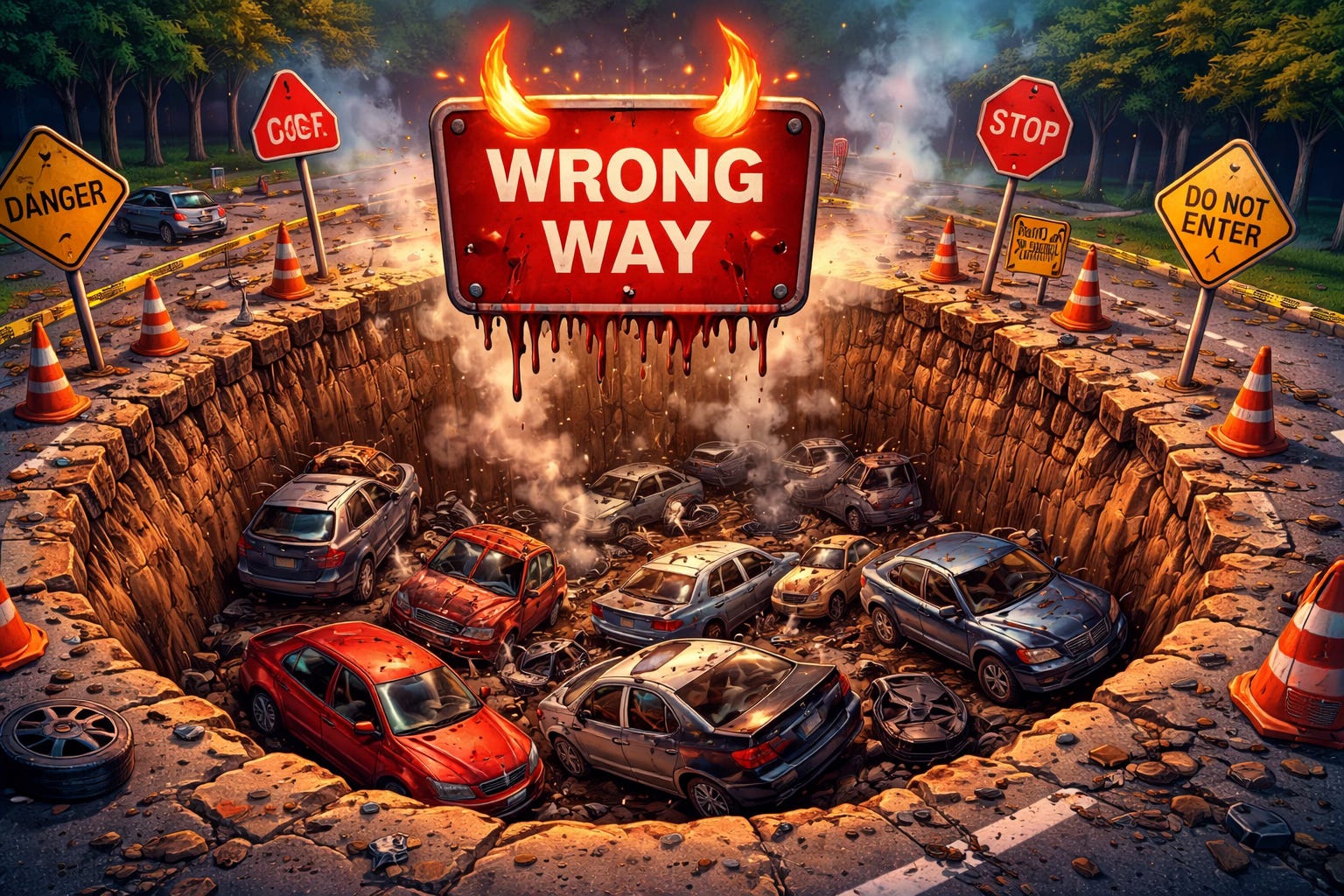
For the last month I have kept open a tab in my browser with a thirty-second video posted on X. At first glance it looks like a trivial curiosity — a minor wrinkle in the machinery of modern traffic management. I kept it open as a prompt to write this essay, because it highlights a subtle but important moral shift in how society is organised and managed.
On the surface it is simply a “reverse speed bump”: a trough cut into the road intended to stop cars from entering a guided busway. Buses, with their wider wheelbase, can pass safely over the gap. Cars cannot. If a driver turns the wrong way, the wheel drops into the trench and the vehicle comes abruptly to a halt.
The more I looked at it, the stranger it seemed.
On certain modern British roads, a wrong turn does not lead to a fine, or even to a raised barrier or bollard. It leads to a hole in the road designed to disable — and sometimes destroy — your vehicle.
This is not ordinary traffic infrastructure. A barrier can be raised. A gate can be opened. A fine can be appealed. A hole in the road is different. It is a device that punishes error with physical consequences whose severity depends entirely on circumstance: the vehicle, the weather, the driver, and sheer bad luck.
In essence, we have quietly reintroduced man traps to public space — not for poaching pheasants, but for passing a “Wrong Way” sign.
The question is not whether these devices are technically lawful. The question is far simpler.
Why, exactly, do we think this is acceptable?
To understand how such devices have appeared on public roads, we need to look briefly at the broader landscape of traffic control in Britain.
Over the past two decades the country has developed an extensive system of bus lanes enforced by cameras and automated penalties. These schemes are intended to give priority to public transport, but they have also generated persistent controversy. Infractions are frequently unintentional, arising from complex signage, unfamiliar road layouts, or the positioning of other vehicles.
Around them has grown a secondary industry of enforcement contractors and debt collectors whose incentives are tied to the penalties generated. The High Court’s recent criticism of Croydon’s Low Traffic Neighbourhood scheme suggests that judicial patience with some of these arrangements may be wearing thin.
Alongside this system, many local authorities are now constructing segregated infrastructure for trams and guided buses. In principle, the idea is straightforward: remove public transport from the congestion of the public highway and give it its own dedicated corridor. Whether that is good policy or bad policy is an ordinary matter for political debate and transport planning.
The problem arises when authorities attempt to enforce exclusive access to these corridors.
In a small but growing number of locations, councils have installed so-called “car pits”: trenches across the road surface that buses with a wider wheelbase can pass over, but which trap the wheels of an ordinary car if it proceeds.
Their legal basis is ambiguous. They exist largely because nothing in statute explicitly forbids them. In that sense they sit within a familiar feature of administrative governance: practices that persist not because Parliament has positively endorsed them, but because no rule has yet been written that clearly prohibits them.
This brings us to the central tension. Public authorities owe a duty of care to the people who use the highway. At the same time, they face strong institutional pressure to enforce rules cheaply, automatically, and without the need for human judgment.
Car pits represent one attempt to resolve that tension.
The objective — preventing private cars from entering dedicated public busways — is perfectly legitimate.
What deserves scrutiny is the means.
There is often a dilemma in designing any form of public intervention, whether in healthcare, education, or traffic engineering. What may be justifiable in the aggregate is not always suitable for the individual.
My own doctor once suggested statins based on population-level studies for people with my health profile. But the potential side effects — cognitive fog and muscle weakness — are precisely the outcomes I most want to avoid as someone whose work depends on mental clarity and who enjoys walking for recreation. The statistical average hides the consequences for the individual — regardless of whether the average case applies.
Modern traffic management often rests on a similar philosophical premise: it is designed for the “average road user”. This imagined person is calm, attentive, well informed, able-bodied, driving a modern vehicle, and behaving in predictable ways.
Real road users are rarely so tidy.
They are tired, frightened, distracted, unfamiliar with the area, under financial strain, coping with disability, or simply making the ordinary mistakes that every human being makes from time to time.
When such a person drives past a “Wrong Way” sign, two errors collide: the small error of the driver, and the larger error of the system that assumed only “normal” use would occur.
The result is a form of error-intolerant design. A minor mistake by the individual can provoke a vastly disproportionate response from the system itself.
The real world is full of variation, and good design accounts for it. Human error is only one axis along which deviation from the norm occurs. A driver may be frightened, ill, distracted, unfamiliar with the area, or responding to misconduct by others. Civilised systems absorb such variation and attenuate its consequences.
A man-trap system does the opposite. It punishes human error or variation, amplifying the consequences instead of dampening them.
In the context of road use, predictable sources of variation include overseas visitors, satnav errors, unfamiliar surroundings, misconduct by other road users, and poor or confusing signage. This list is illustrative, not exhaustive. The nature of accidents and tragedies is that circumstances align in novel and unpredictable ways.
Infrastructure that relies on user error to function is therefore already morally suspect. It belongs to an engineering and moral paradigm outside the normal expectations of civilised society. Road users do not anticipate encountering devices designed to magnify the consequences of a mistake.
The typical worst-case scenario for a driver who breaks a traffic rule is a summons to the magistrates’ court, penalty points, and a fine.
Even in restricted environments such as airports or defence facilities — places where the consequences of unauthorised entry could be far more serious — physical barriers exist precisely to prevent casual entry. The system is designed to stop the mistake from happening, not to punish it with physical harm.
The weaknesses of the man-trap model become clear when we examine plausible edge cases. None are far-fetched; the point is not their probability but their inevitability.
Injury to the vulnerable road user
Cyclists represent the most immediate collision between the logic of the man-trap system and the hierarchy of road safety. They are among the most physically vulnerable participants in traffic, yet also among the easiest to blame. A cyclist who strays onto a guided busway can suffer severe injury from the same mechanism that merely disables a car. The predictable response is to attribute fault to the cyclist rather than to the infrastructure that magnifies the consequences of a navigational error.
Coercion in the face of danger
The law recognises that necessity sometimes overrides strict rule compliance. A driver fleeing a threatening situation — a stalker or an episode of road-rage intimidation — may instinctively divert into any available open route. A trap in the road converts this instinct into a cruel dilemma: remain in immediate danger, or risk catastrophic mechanical failure. The enforcement device silently favours obedience over self-preservation.
Economic destruction from a minor mistake
For a well-resourced driver, disabling a vehicle and damaging its chassis may be an inconvenience. For someone living close to the margin, it can be economically devastating. The car may be essential for employment, childcare, or access to services. A system that destroys a vehicle in response to a navigational error imposes a penalty that scales with wealth rather than culpability. The same mistake can mean inconvenience for one person and financial ruin for another.
Environmental conditions that conceal the trap
Weather introduces another axis of variation. In heavy snow or poor visibility, signage and road markings may disappear entirely under a veneer of ice or behind fog. A roadside fire in a field could send thick smoke drifting across the highway. A snow drift could fill the trough entirely. What appears to be an ordinary stretch of road can conceal a device designed to immobilise the vehicle. In such conditions the system no longer punishes deliberate disobedience; it punishes an error that the environment itself has rendered almost inevitable.
Entrapment in a secondary hazard
Modern vehicles introduce new risks. Electric vehicles contain high-energy battery systems that can ignite if structurally compromised. A trench capable of immobilising a vehicle can also create the conditions for secondary hazards — fire, collision, or exposure to extreme weather. New forms of propulsion with different safety risks — such as hydrogen fuel systems — may emerge during the lifecycle of such infrastructure. Once occupants cannot easily move the vehicle or exit safely, the enforcement device becomes part of the danger itself.
Stranding the driver who cannot escape
Infrastructure quietly assumes a particular kind of body. A disabled driver may be unable to exit a trapped vehicle quickly or without assistance. Vehicles adapted for mobility often rely on ramps, lifts, or specialised door mechanisms that require clear space to operate. A pit that immobilises the vehicle may therefore strand its occupant in place, converting a simple navigation error into a prolonged and potentially dangerous situation — particularly if other hazards, such as freezing weather, are present.
Panic and injury to animals
Consider the same mechanism applied to a horse-drawn cart. The animal cannot read signage or understand why the ground suddenly collapses beneath it. The predictable result is panic, injury, and possibly the destruction of the animal. Most people instinctively recognise such a device as cruel. Yet the mechanism itself is unchanged; only the identity of the victim differs.
Harm to innocent passengers
Finally there are those who have no control over the vehicle at all. A passenger — perhaps elderly, injured, or heavily pregnant — experiences the consequences of sudden mechanical force without having made any decision about the route. Traffic-calming devices already demonstrate how forces applied to vehicles are transmitted directly to the bodies inside them. The man-trap model simply intensifies this principle: the innocent are punished alongside the rule violator.
Synthesis
Each of these cases is different, but the underlying pattern is the same. The man-trap model does not merely enforce rules. It magnifies the consequences of ordinary human variation — whether that variation arises from fear, poverty, weather, disability, unfamiliarity, or simple mistake. In doing so it shifts the burden of enforcement from the legal system to the physical world, and ultimately onto the bodies of those unlucky enough to encounter it.
The moral discomfort created by man-trap infrastructure is not a vague intuition. It reflects deeper principles that are already embedded in the way civilised systems are designed. One place where those principles are articulated with unusual clarity is the Civil Procedure Rules, which govern how courts in England and Wales resolve disputes.
At the very beginning of the Civil Procedure Rules sits the “overriding objective”. It sets out the fundamental standard that courts must pursue when exercising their powers:
The rules are a procedural code with the overriding objective of enabling the court to deal with cases justly and at proportionate cost.
Dealing with a case justly includes, so far as practicable:
ensuring that parties are on an equal footing;
saving expense;
dealing with cases in ways proportionate to their importance and complexity;
ensuring that cases are dealt with expeditiously and fairly.
This sits in stark contrast with the growing trend towards what might be called “punishment through physics” — the imposition of hard penalties through mechanical coercion without the prudential judgement that lies at the heart of law.
‘Car pits’ are not unique. Speed bumps, spikes used to deter homeless loitering, and other forms of hostile architecture embody the same principle: behaviour is controlled not through judgment, but through engineered discomfort.
In this sense they introduce a new kind of synthetic object into the discourse of public law: governance by injury.
There are environments where severe harm may be an accepted consequence of ignoring warnings — high-security defence or energy installations, for example. Outside such contexts, civilised societies have long repudiated the logic of the man-trap. When the state deliberately engineers disproportionate loss, harm, or injury to the public as a mechanism of enforcement, it approaches conduct that would ordinarily fall within the shadow of the criminal law.
Infrastructure that magnifies the consequences of ordinary human error therefore sits uneasily within the familiar architecture of the rule of law. The mechanism replaces judgement, and injury replaces proportional sanction.
Given these downsides and limitations of man-trap models of physical coercion, why do councils take the risk of deploying them?
The answer is simple: administrative incentives.
They are cheaper than activating an already overloaded justice system and the case management required for conventional enforcement. The victims are politically invisible and diffuse. Because the mechanism is built into the road itself, it is “beyond automated” — nothing needs to move at all, apart from the recovery truck that arrives at the victim’s expense. Responsibility for the consequences is similarly dispersed.
Most of all, a trap allows institutions to avoid exercising judgement — and the accountability that accompanies it. It replaces human decision with mechanism.
The underlying principle is not new. Britain confronted it two centuries ago.
In the eighteenth and early nineteenth centuries landowners sometimes defended their estates with mechanical traps designed to injure trespassers. Steel man-traps, spring-guns, concealed pits, and other hidden hazards were deployed to deter poachers.
These devices shared a defining characteristic: they required no judgement. They waited silently and acted automatically.
The results were predictable. The traps could not distinguish between a poacher and a traveller, a thief and a servant, or a criminal and a child. They punished the lost, the confused, and the unlucky as readily as the guilty. The harm they inflicted was often grievous, and wildly disproportionate to the offences they were meant to deter.
Parliament eventually intervened. The Spring Guns Act 1827 prohibited the use of spring-guns, man-traps, and similar engines in open environments where they might injure members of the public.
The lesson was clear. Civilised societies rejected the idea that mechanical devices capable of causing serious harm should be left to operate automatically in spaces used by the public.
Two centuries later, and a car pit operates on exactly the same principle that was previously rejected as barbarism.
It is a concealed physical hazard designed to punish a navigational error through automatic mechanical force. It requires no judgement, exercises no discretion, and cannot distinguish between circumstances. The mechanism simply waits until someone makes a mistake.
Like the traps of the nineteenth century, it punishes the lost, the confused, the frightened, and the unlucky alongside the guilty.
The technology has changed. The logic has not.
The abolition of man-traps established a boundary that still underpins modern legal thinking: enforcement should occur through law and human judgement, not through concealed mechanisms designed to magnify the consequences of error.
Car pits cross that boundary.
They reintroduce into public infrastructure the same architecture of automatic harm that earlier generations concluded had no place in a civilised society.
The problem is not the existence of mechanical enforcement devices as such. In certain tightly bounded contexts they are both legitimate and widely accepted.
Consider the tyre spikes sometimes installed at the exits of car rental depots, secure parking facilities, or military installations. Their purpose is simple: to prevent vehicles leaving in the wrong direction or escaping a controlled perimeter.
Few people object to such devices, and for good reason. They operate within a clearly defined set of constraints:
They are located at gates, not embedded invisibly within the fabric of ordinary public travel.
They are clearly signposted and visually unmistakable.
They sit within controlled environments, where entry implies consent to a particular set of rules.
They guard restricted property, not open public space.
Under those conditions the device functions as a boundary marker rather than a trap. It protects a restricted system by preventing unauthorised exit.
Councils will argue that a car pit performs the same function: it marks the boundary of a guided busway.
But genuine boundaries share another characteristic. They are designed to be seen and understood before they are crossed, and they allow mistakes to be corrected. A barrier can be stopped at. A gate can be turned away from. Even tyre spikes are positioned so their presence is obvious before the vehicle commits to crossing them.
Car pits operate differently. They are embedded within ordinary road infrastructure and encountered in the normal flow of public travel. The driver approaching them is not crossing a controlled perimeter but navigating what appears to be a continuation of the road. The “boundary” reveals itself only after it has been crossed, when the damage is done.
At that moment the device ceases to function as a gate and becomes something else: a hazard that punishes error through mechanics rather than law.
The distinction is fundamental.
Civilised systems place coercive mechanisms at boundaries, where rules are explicit and entry is deliberate. They do not scatter them across public space where mistakes are inevitable.
A further difficulty lies in the strange contradiction between the sign and the road itself. Drivers may encounter warnings that a “pit” lies ahead or that a busway is restricted. But the surrounding environment remains that of an ordinary public road. There is no gate, no barrier, no narrowing of the carriageway that signals a transition into controlled space.
The infrastructure therefore sends two incompatible messages at once. The sign speaks the language of a controlled perimeter, while the road continues to behave like an open highway. Drivers are expected to interpret the space according to one paradigm while navigating a landscape that still belongs to another. The result is not clarity but cognitive dissonance — a design that relies on human error in order to function.
The principle is simple:
Traps belong at gates, not on public roads.
I instinctively knew, on seeing the man-trap video, that this was about more than traffic management at guided busways. It points to a deeper malaise in the relationship between the state and the citizen. The device reflects the broken logic of administrative governance at scale.
Modern governance often optimises for efficiency, automation, liability management, and cost reduction. In the process it neglects human fragility, moral judgement, and tolerance for error. I have encountered this myself in a prosecution for parking that was morally indefensible on multiple levels, yet the machinery of enforcement proceeded as if such considerations were irrelevant.
Car pits are a symbol of this wider failure. They embody the same administrative instinct: replace judgement with mechanism, and responsibility with process. That instinct sits uneasily with the older covenant between the governed and the state under the rule of law.
What makes their appearance troubling is not merely their intrinsic lack of merit, but the absence of any wider public reaction. Devices that earlier generations would have recognised instantly as man-traps have quietly returned to the public highway.
Man-traps have returned to Britain — and this time they are set not by landed aristocrats, but by councils.
We once recognised traps as uncivilised.
Now they return under bureaucratic names: traffic calming, access control, infrastructure design. Such language smooths away their moral and spiritual character: physical harm engineered into the environment, indifferent to circumstance or variation.
A civilised society designs its roads for the lost, the frightened, and the mistaken.
An uncivil one lays traps for them.
And sends the recovery truck.
Martin, thank you for bringing my attention to this matter. It would appear that this system of 'enforcement' is immoral and dangerous. It must be legally challenged and removed. We already have to suffer potholes in our roads on a daily basis, deep enough to do damage to vehicles. Whilst this is bad enough, the deliberate implementation of this scenario as a means of 'control' on the public highway is outrageous.
I am gob-smacked! Only a fiendish gang of bullies could come up with this. U can see them; giggling and rubbing their hands together gleefully as they huddle in a group discussing their cleverness.