

Today is the 8th day of the 8th month of ’26. And 2+6 makes eight. An 888 day.
Could be interesting, should our DeLorean hit 88mph and transport us into another fiscal era. The plausibly deniable digital tea leaves have been hinting quite strongly that this weekend could prove historic. We shall see.
In the meantime, I have one remaining task from my “ghost court” legal saga.
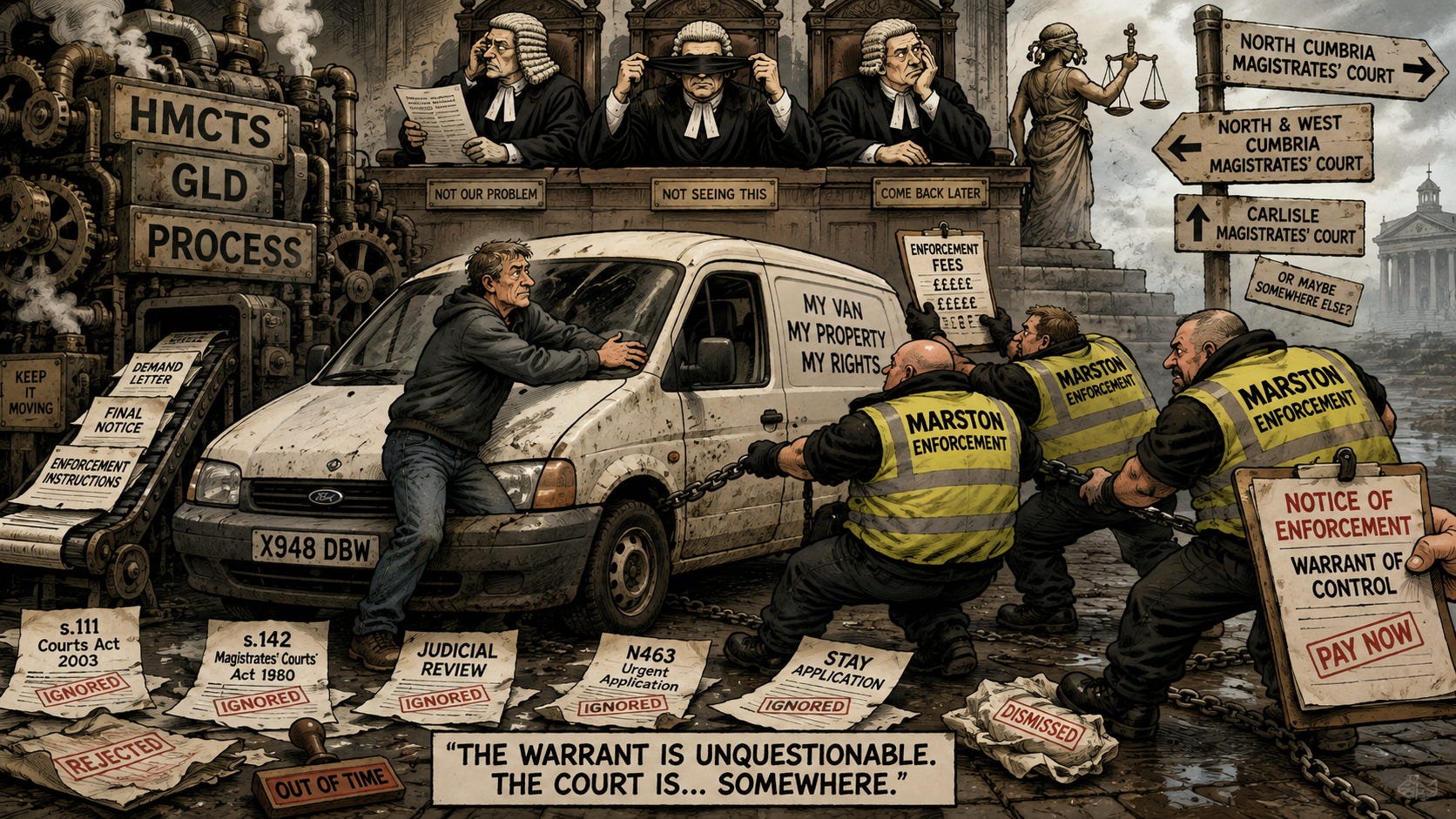
This article documents how the state continues coercive enforcement even when the legal authority for that enforcement is in reasonable question, and how the exercise of that coercive power is outsourced, at arm’s length, to private agents.
Specifically, I want to set out the public timeline surrounding the filing of my Judicial Review and the subsequent actions of HM Courts & Tribunals Service, the Government Legal Department, and Marston Recovery.
I know I am not the only person who has experienced aggressive state enforcement. While I do not expect my mostly American audience to be captivated by the peculiarities of British administrative law, there is a broader purpose in recording what happened. This is about preserving a documentary record of “before times”, so that those who never had to navigate these systems can understand how they operated in practice.
After living through a bio-medical campaign by the state that profoundly affected many people’s health, finances, relationships, and mental wellbeing, I find there is little inclination left to extend institutions the benefit of the doubt when they exercise overbearing coercive power. That makes it all the more important to document events carefully, allowing the chronology and the correspondence to speak for themselves.
First, a brief recap of the legal case, which I have covered extensively over the past two years.
What began as a disputed parking case evolved into something entirely different when I discovered that the court names appearing on the official paperwork could not be cleanly mapped to any identifiable legal body. This was not simply a clerical naming error. The underlying statutory framework left fundamental questions of jurisdiction, seisin, and attribution open to challenge.
Faced with dozens of tribunal labels spanning incompatible administrative systems, together with procedural failures that frustrated effective appeal, I commenced Judicial Review proceedings. The central question was remarkably simple:
Which court, in law, purported to convict me?
It was a reconstructive challenge. Starting only with the documentary record, could the state identify the specific legal body that performed the judicial act and explain how that conclusion was reached?
The response, in substance, was that no longer needed to be demonstrated. The operation of the statutory machinery was said to be sufficient, even if no single, attributable judicial body could be identified from the paperwork.
I find that both morally and constitutionally troubling.
If no identifiable legal actor can be shown to have exercised judicial authority, there is no concrete body to hold accountable. More fundamentally, the proposition that “we no longer need that attribution” appears to derive its authority only from the system asserting it, rather than from any independently identifiable legal source.
After Covid, “we are coercing you because we can” is not an attractive posture for the state to adopt.
Just as habeas corpus allows a person to challenge the legal authority for their detention, I was effectively pursuing a kind of “habeas courtus”—a challenge to the attribution of judicial authority itself. My question was not whether a conviction could exist in the abstract, but which legally identifiable tribunal had actually performed the judicial act and thereby acquired authority to bind me.
In the absence of a clearly attributable warrant of enforcement, traceable to an extant court whose acts can themselves be scrutinised and reviewed, enforcement ought to fail. That is not a collateral attack on the conviction. It is a prior question. If the state cannot identify the legal body from which the enforcement authority originates, there is nothing capable of lawful enforcement in the first place.
In such circumstances, where the legal basis of enforcement is itself under active Judicial Review, enforcement ought to pause in order to preserve the status quo while the Court exercises its supervisory jurisdiction. That is not merely an appeal to fairness. It reflects the purpose of interim relief, the Administrative Court’s supervisory function, and the regulatory expectation that enforcement agents act proportionately when liability is subject to active judicial challenge.
My correspondence to HMCTS and Marston (their debt collectors) relied on the Taking Control of Goods Regulations 2013, the Enforcement Conduct Board’s National Standards, and the Court’s inherent jurisdiction to prevent prejudice to ongoing proceedings.
Let me now walk you through the timeline, pointing out the key events without over-indulging in legal analysis. The real issue is that the state’s authority under positive law has become self-sealing and self-certifying. Every part of the machine validates every other part of the machine. There is no independent point from which authority can be challenged. There is no brake. Momentum itself has become authority.
Phase 0 — The statutory routes fail. Before Judicial Review is commenced, I invoke every ordinary remedy Parliament has provided. Those mechanisms fail to provide an effective means of resolving the constitutional issues, leaving Judicial Review as the only practical supervisory remedy.
Then the remainder flows naturally:
Phase 1 — Judicial Review issued. The Administrative Court accepts my claim challenging the legal attribution of the court said to have convicted me.
Phase 2 — Enforcement begins. Marston Recovery issues a Notice of Enforcement demanding payment and threatening seizure of property on behalf of HMCTS.
Phase 3 — Everyone is put on notice. Marston, HMCTS, the Government Legal Department and the Administrative Court are all informed that enforcement is underway while Judicial Review proceedings are live.
Phase 4 — The machine refuses to stop. Despite repeated requests for the legal authority underpinning enforcement, the official response is simply that the process will continue.
Phase 5 — Escalation. Urgent applications, formal complaints, legal notices and warnings of prejudice are exchanged, including applications for interim relief, yet enforcement continues to gather momentum.
Phase 6 — The knock on the door. Marston hand-delivers a final notice threatening removal of my belongings unless payment is made.
Phase 7 — Payment under protest. Faced with the imminent seizure of my property, I pay while expressly reserving my legal position and continuing the constitutional challenge.
The timeline should therefore be read with one overarching question in mind. Not only does the state refuse to “produce the court” on demand, it cannot produce the authority for its refusal to produce the court.
We have entered a constitutional world in which criminal consequences can arise without an attributable judicial actor. The paperwork remains. The coercion remains. The identifiable source of authority does not.
Phase 0 — Every statutory remedy failed
Before turning to Judicial Review, I exhausted every ordinary route Parliament provides.
The prosecution began with a Single Justice Procedure Notice issued in the name of “North Cumbria Magistrates’ Court”. It later proceeded under a summons naming “North and West Cumbria Magistrates’ Court”. By the end of the proceedings, the authorities asserted that Carlisle Magistrates’ Court was the court that had exercised jurisdiction.
That answer merely shifted the question. By what legal mechanism had judicial authority become attributable to Carlisle Magistrates’ Court when the originating documents named different courts?
HMCTS, the Crown Prosecution Service and court staff all proceeded on the basis that a valid court existed. Yet none could explain the legal chain of attribution by which the proceedings became those of Carlisle Magistrates’ Court. Requests for clarification produced administrative explanations rather than judicial ones.
That distinction matters. You cannot be convicted by an administrative label. You can only be convicted by a judicial act under the authority of a tribunal established by law.
After conviction I pursued the statutory remedies available to me, including applications under sections 111 and 142 of the Magistrates’ Courts Act 1980. The former—a Case Stated appeal application—was not even acknowledged, let alone processed. The latter, an application inviting the magistrates’ court to revisit its own decision, directed me to the High Court instead.
Neither route resolved the underlying constitutional issue.
Once every ordinary remedy had been exhausted, Judicial Review became unavoidable. I was no longer asking whether I was guilty of a motoring offence. I was asking whether the State could lawfully enforce a conviction when it could not identify the tribunal from which that conviction derived.
Even after conviction, I received no post-conviction document making a definitive legal attribution of the judicial act to a specific court. That omission became central to the Judicial Review.
One would expect the enforcement machinery to pause while the High Court determined it.
It did not.
Phase 1 — Judicial Review is filed
On 17 October 2025, I filed Judicial Review proceedings in the Administrative Court against the Secretary of State for Justice, acting through HM Courts & Tribunals Service. The claim was not directed at the original parking allegation. It challenged HMCTS’s continuing decision to enforce the resulting financial penalty without first producing a sealed or authenticated order authorising that enforcement.
The application described itself as a modern quo warranto—literally, “by what warrant?”—directed at the enforcement process. Its purpose was straightforward: before exercising coercive judicial power against a citizen, the state should be required to produce the lawful warrant authorising that power.
The remedies sought were equally modest:
First, I asked the Administrative Court to stay all enforcement while the legality of the enforcement process was determined.
Second, I asked the Court to require HMCTS to produce the sealed sentencing order or certificate of conviction upon which enforcement supposedly depended, or formally confirm that no such document existed.
Finally, if no lawful order could be produced, I sought declarations that no enforceable conviction or fine existed capable of supporting continued enforcement.
Nothing in the claim asked the High Court to decide whether I had committed a parking offence. The immediate question was procedural and constitutional:
Could the state continue coercive enforcement while the legal foundation of that enforcement was itself under challenge and ordinary review was precluded?
Moral intuition says “no”.
Reality says otherwise.
Phase 2 — Enforcement begins
On 10 November 2025, while my Judicial Review was already before the Administrative Court, Marston Recovery entered the picture.
Acting on behalf of HMCTS Lancashire Fines Centre, Marston issued a Notice of Enforcement demanding £1,649. The underlying Collection Order totalled £1,574, comprising a £660 fine, £264 victim surcharge and £650 prosecution costs.
The moment the matter was referred to Marston, however, a further £75 compliance fee was added to the amount I was required to pay. The notice warned that, if enforcement progressed, still more fees would follow.
This marked a significant change in approach.
Earlier in the proceedings, HMCTS had voluntarily suspended enforcement while my application under section 142 of the Magistrates’ Courts Act 1980 was outstanding. The enforcement machinery was therefore demonstrably capable of pausing when the authorities considered it appropriate.
Once the matter moved into Judicial Review, however, that restraint disappeared. Despite the legality of the enforcement itself being under challenge before the Administrative Court, enforcement resumed and continued.
The very purpose of my Judicial Review was to require HMCTS to demonstrate the legal authority for enforcing the fine. Yet before the Court had even considered that question, the machinery of enforcement had already been outsourced to a private company empowered to enter property and seize goods.
Put simply, I was now being threatened with coercive action before the State had demonstrated the legal foundation for exercising that coercion. Worse still, it had repeatedly declined to explain the legal basis upon which that coercion was continuing.
The issue was never whether Marston had invented the debt. They were acting on instructions from HMCTS. The constitutional question was simpler:
What should a private enforcement company do when it is informed that the authority for the very warrant it seeks to enforce is itself under active challenge before the High Court?
That question would be answered over the following weeks.
Not by legal argument.
By conduct.
Phase 3 — Everyone is put on notice
From the moment the Notice of Enforcement arrived, I moved quickly to ensure that every relevant party understood the position:
Marston Recovery was informed that the legal basis of the enforcement was under active Judicial Review before the Administrative Court.
HM Courts & Tribunals Service was likewise notified that coercive enforcement had commenced while the lawfulness of that very enforcement was the subject of ongoing proceedings.
The Government Legal Department, acting for the Secretary of State for Justice, was informed of the same.
The Administrative Court itself was asked to intervene urgently to preserve the status quo pending determination of the claim.
Nobody could later say they were unaware.
My position was straightforward. I was not asking anyone to decide the Judicial Review in my favour. I was asking that the enforcement machinery pause until the High Court had determined whether there was lawful authority to continue.
That request was neither radical nor tactical.
If the Court ultimately rejected my claim, enforcement could resume exactly where it had left off. No prejudice would have been suffered by the State. If, however, the Judicial Review succeeded after my property had already been seized, the damage could not simply be undone.
The choice facing the authorities was therefore simple:
pause briefly while the High Court examined the legality of the enforcement, or
press ahead regardless.
They chose the latter.
Phase 4 — The machine refuses to stop
At this point, there could be no misunderstanding.
Marston knew the enforcement was under active Judicial Review. HMCTS knew. The Government Legal Department knew. The Administrative Court had been asked to intervene urgently. Every relevant institution was aware that the legal authority underpinning the enforcement was itself before the High Court.
Yet nothing changed.
No one said, “Let’s wait for the Court.”
No one said, “Let’s make sure we actually have the documents being requested.”
No one said, “Perhaps we should avoid irreversible enforcement while the legality of that enforcement is being examined.”
Instead, the process simply carried on.
Each institution pointed to another. Marston acted on HMCTS’s instructions. HMCTS maintained the enforcement process. The Government Legal Department defended the position.
The machinery became its own justification.
This was the moment I realised the real issue was not a parking fine. It was institutional momentum. Once the state had decided that enforcement should occur, no individual actor appeared willing—or perhaps able—to stop the machine and ask whether it remained lawfully justified.
That is a deeply troubling constitutional position.
The whole purpose of Judicial Review is to permit the High Court to supervise the exercise of public power. Clearly the issue of attribution of the conviction was not frivolous given the fragmentation of the tribunal identity on the record.
If coercive enforcement continues unabated while that supervisory jurisdiction is actively engaged, the practical value of the remedy begins to disappear. By the time the Court speaks, the coercion may already have achieved its purpose.
The machinery had become more important than the question it was supposed to answer.
Phase 5 — Escalation
With enforcement continuing unabated, the correspondence inevitably became more formal.
I served legal notices on Marston, HMCTS and the Government Legal Department, making clear that the enforcement process was now proceeding with full knowledge that its legal foundation was under active challenge before the Administrative Court. Nobody could claim ignorance.
Every subsequent step was taken with eyes open.
My position remained unchanged. I was not asking anyone to concede the Judicial Review. I was asking them to preserve the status quo until the High Court had determined whether the enforcement process rested upon lawful authority.
The response was revealing.
Rather than engage with the underlying constitutional question, the institutions continued to rely upon the existence of the enforcement process itself. The machinery was treated as self-validating.
The fact that enforcement had begun became the reason why it should continue.
The practical consequence was obvious. Every passing day increased the pressure on me to abandon the litigation and pay. Enforcement fees accumulated. Deadlines approached. The prospect of enforcement agents attending my home became increasingly real.
This is one of the least appreciated features of administrative coercion.
The law may move at one speed; enforcement moves at another. If the enforcement machinery is allowed to outrun judicial supervision, the citizen faces an impossible choice: surrender first and argue later, or risk the seizure of their property while waiting for the Court to rule.
That is precisely where I found myself.
Phase 6 — The knock on the door
On 20 December 2025, I returned home to find an envelope marked “BY HAND”. Inside was a Marston Recovery Final Notice.
The message could not have been clearer.
“Your belongings will be removed.”
The notice relied upon a purported Warrant of Control and demanded an increased sum, yet by this stage no sealed court order, no authenticated warrant, and no document identifying the issuing court had ever been produced to me despite months of requests and a live Judicial Review.
The notice itself was dated 18 December, but it was not present when I cleared my mail the previous evening, suggesting it had been delivered later than the date shown. Later that same day my doorbell rang. I chose not to answer it.
What struck me was not the prospect of losing property.
It was the inversion of constitutional order.
The High Court had been asked to determine whether the State possessed lawful authority for the enforcement process. That question remained unresolved. Yet the machinery of coercion continued exactly as if the question did not exist.
At this point the legal arguments had become secondary.
The practical reality was simple: a private contractor, acting on behalf of HMCTS, was threatening to remove my belongings while the State continued to decline to produce the very documents whose existence lay at the heart of the dispute.
That is the moment the constitutional question ceases to be an abstraction.
It arrives at your front door.
Phase 7 — Payment under protest
Just before Christmas, I received confirmation that my request to halt enforcement had been refused by the High Court.
That left me with a simple choice.
I could continue resisting and risk enforcement agents attending my home over the holiday period, with the attendant costs, disruption, and potential seizure of property. Or I could pay the sum demanded while making it absolutely clear that I was not abandoning my legal position.
I chose the latter.
The payment was made under protest. It was not an admission that the enforcement had been lawful, nor an acceptance that the constitutional questions had somehow disappeared. It was a practical decision taken under the shadow of coercive enforcement.
By that stage, Marston had already attended my property. The amount demanded had risen from £1,649 to £1,890, increasing my financial liability while the legality of the enforcement itself remained under challenge.
The refusal to pause enforcement therefore did not merely preserve the status quo; it increased my financial liability while the legality of the enforcement itself remained under challenge. Every escalation generated additional fees for Marston.
In one sense, the State had achieved what it wanted. The money had been collected. Marston had earned additional fees. The financial cost of maintaining my legal challenge had increased.
In another, it had not.
The purpose of the Judicial Review was never simply to avoid paying a fine. It was to expose and challenge a constitutional defect in the attribution and exercise of judicial authority. Payment did not answer that question. It merely demonstrated the effectiveness of the enforcement machinery while the question remained unanswered.
That is why I have documented this chronology.
The issue is not the amount of money involved. It is that coercive state power was allowed to run to completion while its legal foundation was itself before the Administrative Court.
If that can happen in my case, it can happen in anyone’s.
Sidebar — “Can we please stop the train?”
One of the more dispiriting aspects of this episode was the treatment of my repeated requests for urgent judicial intervention.
My application for Judicial Review was accompanied by Form N463, the Administrative Court’s prescribed procedure for urgent consideration. I was not asking the Court to determine the merits overnight. I was asking for something much simpler: preserve the status quo while the Court considered whether the enforcement itself rested upon lawful authority.
As noted earlier, the draft order sought only a temporary stay of enforcement, production (or confirmation of the absence) of any sealed sentencing order or certificate of conviction, and an orderly timetable for the litigation.
The first application was refused.
The reasons included concerns that:
I had not identified the correct defendant,
that proof of service was absent from the court file, and
that an appeal to the Fines Officer appeared available.
The order also stated that Judicial Review is a remedy of last resort.
The difficulty was that these concerns were either already addressed or overtaken almost immediately by events.
The Government Legal Department confirmed the correct defendant. My Certificate of Service had in fact been filed, but it was only added to the court record after the refusal. The HMCTS FOIA response disclosed on the same day as the refusal provided fresh evidence central to the jurisdictional issue.
Meanwhile, the HMCTS complaints process expired unanswered, and the statutory remedies had already been exhausted or blocked.
So I did what any litigant should do.
I renewed the urgent application.
The renewed N463 was not a repetition. It expressly identified the material changes since the first refusal, explained why urgency had increased, and again sought only modest interim relief to preserve the High Court’s supervisory jurisdiction while the constitutional questions were determined.
That too ran into procedural obstacles.
The Administrative Court Office returned the renewed N463 on procedural grounds, indicating that the application should instead be made using Form N244. There was no determination of the merits; I promptly prepared to refile in the format requested.
From my perspective, this captured the frustration of the entire litigation.
Every application was met with another procedural step.
Every procedural step consumed more time.
Every passing day brought Marston closer to my front door.
The constitutional question remained exactly where it had started.
The enforcement did not pause.
From my perspective, this is a profoundly disturbing state of affairs.
There was never a particularised allegation that I had personally committed any substantive offence. Only a generalised allegation arising from a parking situation that developed after I had parked.
The conviction arose from a paperwork matter, which I argue never had an originating cause of action. There was literally nothing beyond me parking beside a bush, which is not a crime.
The originating documents failed clearly to identify the sender, the prosecutor, or the court.
The process never answered the fundamental question of how the various tribunal identities mapped to legal entities, or by what authority the proceedings had actually been conducted.
Appeal was precluded.
Complaint was precluded.
Correction was precluded.
Review was precluded.
Supervision was precluded.
Yet enforcement continued.
That is the inversion which troubles me most. Every mechanism designed to test the legality of the process became unavailable or ineffective, while the one mechanism capable of compelling obedience carried on regardless.
Meanwhile, the state outsources coercive enforcement to private agents, creating a degree of plausible deniability. HMCTS issues the instructions. Marston executes them. Each can point to the other, while the citizen faces the knock on the door.
If this whole system eventually ends up in the dustbin of history, we will know why.
It wasn’t built on law.
It was built on power.
Legality was merely the cover.
Yuck.