

I went out for a nice long walk today along my local railway line, to the little café at the locomotive museum. On the way, I tried my newfound hobby of talking to ChatGPT through its voice interface — until I ran out of credits. Somewhere between the tracks and the steam engines, I had an epiphany.
The old legal concept of acting beyond authority — ultra vires in Latin — might be just one point in a much larger space of “vires” failures. (Intra vires is when the state stays within its remit.) I started improvising categories: “non-vires”, “anti-vires”, “super-vires”. Then I iterated the idea with GPT and Grok. What emerged is unexpectedly powerful — a whole spectrum of failure modes for state power.
Consider this another “executable essay”: something you can feed into AI and use to classify your own struggles with authorities gone rogue. Half the problem is that officials themselves often have no idea when they’ve wandered into unlawful territory. Administration behaves like a self-replicating organism, constantly inventing new modes of self-validation to justify whatever it has already chosen to do.
To keep the state in check, we need to identify these failure modes. And to identify them, we need a language rich enough to map the overreach. Without the right vocabulary, abuse slides silently past our defences.
Over to Grok and ChatGPT in collaboration… with examples from the Single Justice Procedure (SJP) used in England and Wales.
We all instinctively feel it when the state abuses its power.
That gut punch when:
a fine arrives from a “court” that doesn’t exist
a conviction is entered by software rather than a human being
“justice” is done in secret by algorithm
But anger without precise terminology is just noise.
To fight something, you first have to be able to name it.
For 400 years, English law relied on one main label for unlawful state action: ultra vires — “beyond the powers”. It worked when the problem was a minister tiptoeing past a statutory line.
It is laughably inadequate for a 21st-century reality of ghost courts, zombie jurisdictions, and automated conviction machines that have never been lawfully brought into being.
What we face today is not mere excess of power. It is the collapse of power itself into new and unrecognised forms of juridical nothingness.
Below is the new vocabulary we have been missing.
The vires failure spectrum
Level 1 — Ultra vires
Meaning: The state goes beyond the authority Parliament actually granted.
Feels like: “They broke the rules, but at least the rules and the referee existed.”
Closest doctrine: Classic judicial review (Anisminic, Privacy International).
SJP example: A real court imposes a penalty it was not expressly authorised to impose.
Level 2 — Super-vires
Meaning: The act is so far outside its legal power it becomes almost comical.
Feels like: The state isn’t just over the line; it’s playing a different sport in a different stadium.
Closest doctrine: None — a rhetorical upgrade because the situation demands it.
SJP example: A conviction issued in the name of a “court” that appears in no statute, no statutory instrument, and no legal universe.
Level 3 — Anti-vires
Meaning: The act reverses the entire purpose of the power supposedly being exercised.
Feels like: Justice that is secret, automated, and invisible — the opposite of open courts.
Closest doctrine: Misuse of power (Padfield, Congreve).
SJP example: Turning the constitutional guarantee of public, placed, human justice into closed, digital, unreviewed punishment.
Level 4 — Contra-vires
Meaning: The state acts with knowledge that the supposed power is defective or non-existent.
Feels like: They were told the court doesn’t exist… and carried on anyway.
Closest doctrine: Malicious prosecution / abuse of process.
SJP example: HMCTS continuing to issue process from entities they have been formally informed were never constituted by law.
Level 5 — Infra-vires nullity
Meaning: The power looks fine on paper, but the act collapses into a legal black hole when performed.
Feels like: Perfectly formatted paperwork that is constitutionally impossible.
Closest doctrine: None — this is a philosophical failure mode.
SJP example: An SJPN that follows every template but emanates from a tribunal that has never legally existed.
Level 6 — Non-vires
Meaning: There is simply no power, no court, no jurisdiction at all.
Feels like: Not unlawful justice — no justice. A legal non-event.
Closest doctrine: Coram non judice; void ab initio.
SJP example: “North & West Cumbria Magistrates’ Court (1752)” — no creating order, no building, no judges, no existence, ever.
Level 7 — Ex-vires
Meaning: The power once existed but has expired, lapsed, or been extinguished.
Feels like: Zombie courts: abolished institutions still issuing warrants because nobody updated the database.
Closest doctrine: Expired custody time limits (Peacock).
SJP example: Using the name of a court that was merged or abolished years ago with no new statutory authority.
Level 8 — Ab-vires
Meaning: The act has left the plane of law altogether. It is juridical nothingness.
Feels like: A database entry that resembles a conviction but has no court, no judge, no oxygen of legality behind it.
Closest doctrine: None — pure ontological vacancy.
SJP example: Digital “convictions” sustained by no tribunal that has ever existed.
Level 9 — Meta-vires
Meaning: Power no longer comes from law; the bureaucracy becomes autopoietic and self-validating.
Feels like: The machine runs itself and declares its own outputs to be “law”.
Closest doctrine: Luhmann’s autopoietic systems theory.
SJP example: The Common Platform + SJP ecosystem: automated, unreviewed, self-ratifying, and post-legal.
Summary table
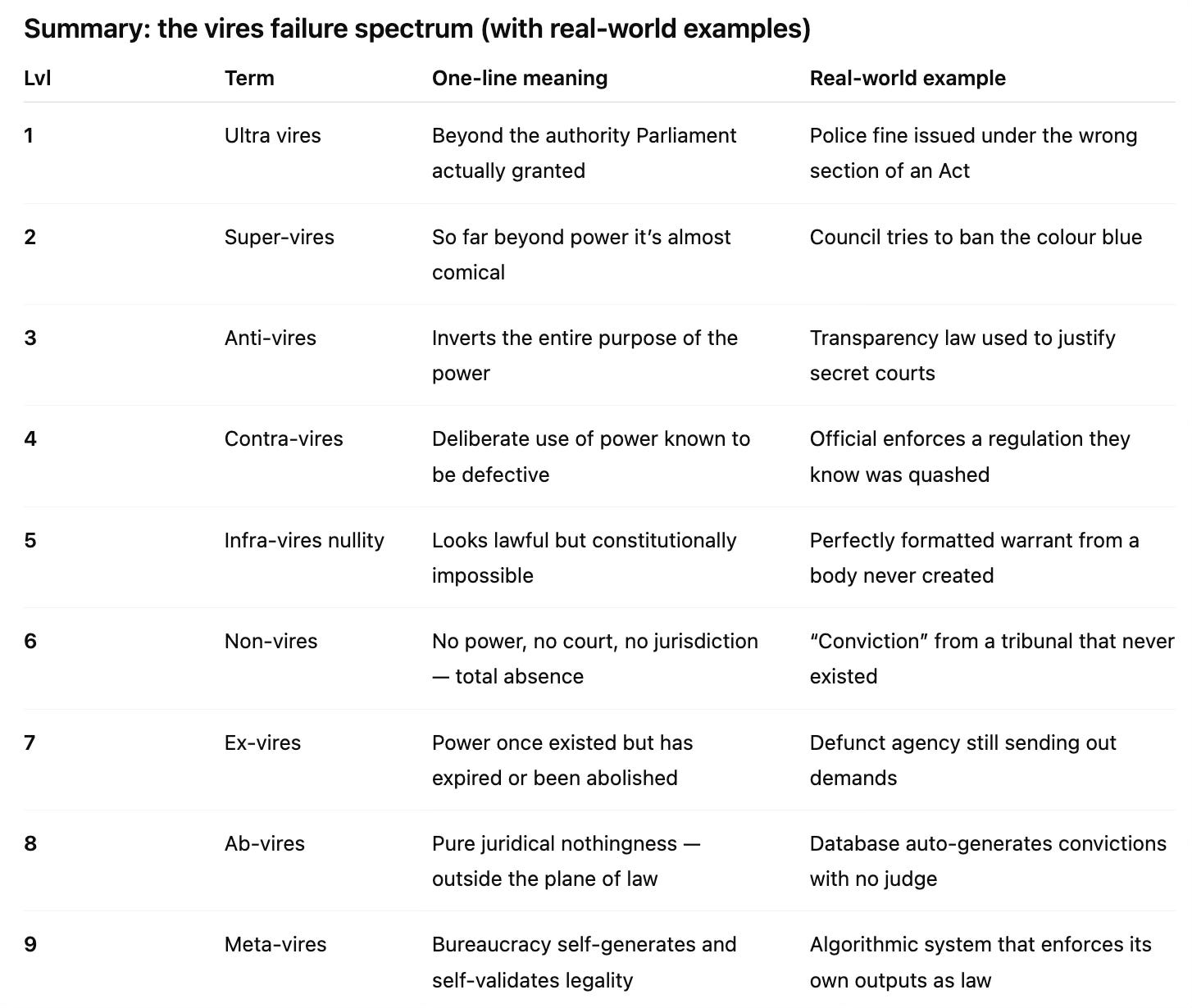
Where the UK “ghost court” scandal actually sits
The Single Justice Procedure operating through ghost tribunals is not Level 1 (ultra vires).
It is:
Level 6 — Non-vires (no lawful court exists)
Level 8 — Ab-vires (convictions exist only as data artefacts)
Level 9 — Meta-vires (the administrative machine generates its own “reality”)
Until we have names for these phenomena, judges will keep reaching for the comfortable old label “ultra vires” — and then uphold the conviction anyway.
Language is the first act of resistance.
Now we have the language.
Use it.
Share it.
Force the conversation beyond the 400-year-old vocabulary that no longer describes the world we actually inhabit.
The law is not dying from lack of power.
It is dying from lack of truthful description.
Let’s start telling the truth.
Thank you for making things that were once invisible now clear for all to see !
I was enjoying this list but then had my own epiphany. The Left has as one of its tactics (one it uses often) the redefinition of a word or a concept to make it the opposite of what it used to be.
For example, "liberal" was changed from meaning limited government and individual freedom with responsibility to generous Big Government funding of welfare to enslave. It doesn't fit inside the legal area where you are working, Martin, but the Anti-Vires points the way to at least partially understanding how "liberal" becomes "using big government and other people's money to provide welfare that enslaves people and buys their votes for more."
The Left philosophically and strategically uses all these techniques at the level of Law *and* at the level of philosophy to distort people's understanding of basic concepts so as to take and hold power. To the Left there is no Law at all. It is only another means to power.
This gets to your own path toward faith over the past couple years. It is the Judeo-Christian system of concepts and (self-)disciplines that leads toward societies where people can thrive in goodness and trust. The Left works to subvert all of these, from most consequential to least consequential in order to take us back to paganism where blood and bleeding lead to power and enslavement. The best take on this, as far as I can tell, is Rene Girard and his work, like "The Scapegoat" book.
This brings up the question, what specifically can be done to prevent that corruption of our very understanding of Life and what works to help people thrive? How do we conserve the correct concepts? How do we set up a conceptual immune system that exposes such corruption and prevents it from taking hold?
Perhaps the only way is by engineering a Great Awakening, but then, how do we keep ourselves and our neighbors from falling back to sleep after one or two generations?