

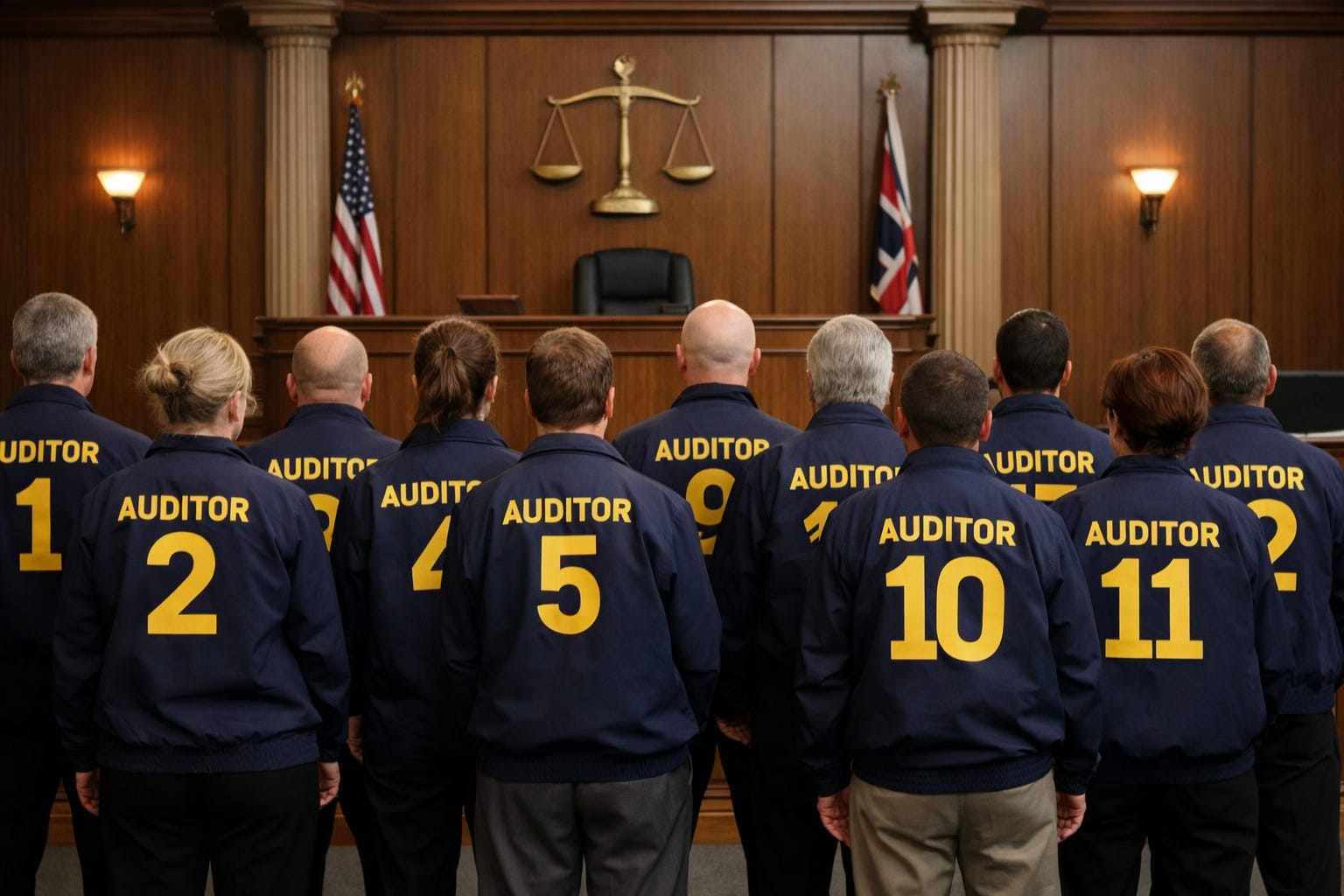
If you were convicted of a criminal offence,
could you identify, in law, which court judged you
and how it got that authority?
And what would you do if there were no clear answer?
In my previous article I described how I was stripping down a High Court claim to its barest non-controversial essence. The aim was simple: to obtain a “datum” ruling on how the Single Justice Procedure actually enacts judicial authority. That meant setting aside everything contentious — so I am presenting it here instead.
The core issue is straightforward. People are being convicted of criminal offences, yet the legislation does not clearly articulate:
how judicial authority is attributed in the individual case,
which tribunal is said to exercise it, or
at what point that authority arises.
These are perfectly reasonable questions for any defendant to ask:
Which court am I in — by law?
Who or what is convicting me?
How do I check the paperwork?
This high-volume automated system marks a shift away from a model in which the source and identity of judicial authority are explicitly stated and traceable on the record, towards one in which those elements are increasingly implicit and distributed across process.
As part of that process, I undertook a forensic analysis of the Single Justice Procedure. While this is a UK-specific system, the underlying issues are more general. Much legal commentary focuses on outcomes, fairness, or procedural detail. By contrast, this analysis looks at the underlying mechanics—how authority is constituted, identified, and maintained—using an approach closer to how cybersecurity audits examine the “attack surface” of complex systems.
I am raising funds to cover my out-of-pocket expenses in running self-represented litigation.
The “health warning”
Nothing that follows directly asserts unlawfulness, nor does it imply bad faith. What it does expose is a system operating at scale, where efficiency and administrative practicality have taken precedence over explicit legal articulation. These design choices may be defensible, but they reduce the transparency of the system from the perspective of the individual subject to it.
In public-facing terms: at a minimum, the ability to identify, in law, the tribunal exercising authority in a criminal case ought to be as foundational as knowing the charge itself. If that identification becomes unclear or implicit, it raises broader questions about how the legitimacy of the system is perceived and maintained.
To examine this more precisely, I have mapped what I call the “audit surface” of the system: the set of points at which jurisdiction must be constituted, identified, and maintained if it is to operate coherently in law. This approach draws on a kind of computational jurisprudence, importing ideas from computer science—particularly completeness—into legal analysis.
A system is complete, in this sense, if every necessary element of its operation can be identified, traced, and, in principle, interrogated in the individual case. The question is not whether the Single Justice Procedure functions in practice, but whether its underlying mechanics can be made fully explicit in this way.
The twelve questions that follow are intended to test that completeness — as the product of a year of deep analysis. This is as much for you to feed into AI to review your own court cases as it is to read through directly; an “executable essay”.
Twelve audit questions on the Single Justice Procedure
This is the full set. I set them out first in formal legal terms, for precision, and then return to each in plain English. The structure matters — but so does being able to see what it means in practice.
What is the legally recognisable act, event, or rule of law by which proceedings instituted by written charge become vested in a magistrates’ court in the individual case?
Which specific tribunal, in law, is said to be seised of those proceedings at each stage of their lifecycle?
By what mechanism is the identity of that tribunal maintained, transferred, or reconstituted as the case progresses from initiation through the Single Justice Procedure to ordinary determination?
What juridical act, event, or rule of law appears on the record of the individual case as the basis of that tribunal’s authority?
If no such act or rule appears, what elements of the record are relied upon as constituting or evidencing the basis of jurisdiction?
By what legal rule are differing court names, locations, local justice areas, and administrative codes to be treated as referring to a single tribunal recognised in law?
What converts the general statutory permission conferred on “a magistrates’ court” into the exercise of jurisdiction by a specific tribunal in the individual case?
If jurisdiction is said to arise through administrative processes or system operation, what is the legal basis for treating those processes as constitutive of judicial authority?
Against what identifiable legal basis can a defendant direct a jurisdictional challenge in the individual case?
How is that basis made sufficiently precise and stable to permit formulation, response to, and adjudication of such a challenge as a matter of law?
If no discrete mechanism of attribution can be identified, on what legal footing is the exercise of coercive criminal jurisdiction said to rest?
How does the system ensure that the tribunal exercising authority in the individual case satisfies the requirement of being “established by law” in a form that is accessible, identifiable, and contestable on the record?
These questions are not new in themselves, but presenting them together, systematically and at this level of resolution, is unusual. What they amount to is a kind of structural audit — the sort of “airworthiness check” that, in other safety-critical disciplines, would be built into the design before a system is relied upon at scale.
Here, it has to be reconstructed from the outside, revealing a gap between how the system is assumed to operate and how its underlying mechanics are actually articulated and exposed.
Other fields treat this kind of traceability and completeness as non-negotiable. In law, particularly in high-volume automated processes, it is more often taken on trust. These questions are a way of making that trust explicit — and testable.
Taken together, these questions point to a single issue:
whether the legal basis of jurisdiction
in the individual case
can be identified at all.
We now explore this question in all its audit facets.
Q1. What is the act of vesting?
The issue: The statutory scheme does not identify any act, event, or rule of law by which proceedings instituted by written charge become vested in a magistrates’ court in the individual case.
What must be identified: A legally recognisable mechanism by which proceedings are brought before a court so that jurisdiction exists in law.
Why it matters in practice: An ordinary defendant has no clear point at which the case actually becomes “before a court”. A step that used to be explicit has disappeared into the background of the process, leaving you unable to know when judicial authority over you officially begins.
Q2. Which tribunal is seised of the proceedings?
The issue: No specific tribunal is consistently identified in law as exercising authority over the proceedings across their lifecycle.
What must be identified: A tribunal whose identity can be specified in law and traced from start to finish.
Why it matters in practice: You can go through the entire case — notice, prosecution, conviction — without ever being able to say, in plain legal terms, which court is actually judging you. The system runs, but the decision-maker remains invisible.
Q3. How is the identity of the tribunal maintained across stages?
The issue: The statutory scheme identifies no mechanism ensuring continuity of authority as the case moves from the Single Justice Procedure to an ordinary hearing.
What must be identified: A legally recognisable basis by which the same tribunal (or a properly connected one) keeps its authority throughout.
Why it matters in practice: When your case changes from paper procedure to a full hearing, you cannot see how (or whether) the court’s authority carries over. What used to be a clear legal hand-over is now handled invisibly inside the system.
Q4. What appears on the record as the basis of jurisdiction?
The issue: The record of the individual proceedings discloses no clear juridical act, named decision-maker, or identifiable rule of law as the basis of the court’s authority.
What must be identified: A record entry or document that shows, in legal terms, how the court obtained authority over your case.
Why it matters in practice: When you look at the paperwork, there is nothing concrete you can point to and ask “what gave this court power over me?” The record shows what happened, but not the legal step that made it lawful.
Q5. What in the record is being relied upon instead?
The issue: The record consists largely of administrative artefacts — names, codes, notices, and listings — rather than legally constitutive acts.
What must be identified: A clear distinction between routine administrative processing and the legal act that actually creates jurisdiction.
Why it matters in practice: You are left trying to make sense of system print-outs and codes instead of seeing an identifiable legal decision. The paperwork is visible, but the legal foundation behind it is not.
Q6. How are different court names and codes mapped to a tribunal in law?
The issue: There is no identified rule by which varying court names, locations, and administrative codes are treated as referring to a single tribunal.
What must be identified: A legal mapping from these different labels to one tribunal recognised in law.
Why it matters in practice: Your documents can refer to several different “courts” without any explanation of whether they are the same legal entity. What used to be a fixed court name is now a shifting set of labels you have to guess at.
Q7. What converts statutory permission into actual authority?
The issue: Statute allows “a magistrates’ court” to act, but does not identify how that general permission becomes authority exercised by a specific tribunal in your case.
What must be identified: The mechanism that turns abstract statutory power into real authority over an individual case.
Why it matters in practice: Authority appears to switch on automatically once the paperwork starts. The law says courts in general can act, but you never see the precise moment it applies to you.
Q8. Are administrative processes being treated as the source of authority?
The issue: In practice, authority appears to arise from administrative handling, listing, and system processes rather than identifiable legal acts.
What must be identified: A legal basis for treating those administrative steps as the thing that creates judicial authority.
Why it matters in practice: Everyday office procedures end up doing the job that used to belong to a clear legal act. You can be subject to the full coercive power of the court without any obvious moment when that power was lawfully turned on.
Q9. What is the object of a jurisdictional challenge?
The issue: Without a clearly identified legal basis, there is no obvious target against which a jurisdictional objection can be directed.
What must be identified: A specific act, rule, or decision that can be challenged as the source of the court’s authority.
Why it matters in practice: You know you have the right to challenge the court’s power, but there is nothing concrete to aim the challenge at. The objection ends up floating in the abstract.
Q10. Can a jurisdictional objection be properly formulated and decided?
The issue: The absence of a clear legal foundation makes it difficult to frame, respond to, or adjudicate a jurisdictional challenge.
What must be identified: A stable and precise legal basis that a court can actually examine and rule upon.
Why it matters in practice: Even if you want to question whether the court has power over you, the issue cannot be clearly stated or fairly decided. The case simply continues without ever testing its own legal foundation.
Q11. What is the legal basis if no mechanism is identified?
The issue: If no discrete mechanism of attribution can be found, it is unclear on what legal footing the exercise of coercive criminal jurisdiction rests.
What must be identified: An explicit explanation of whether authority comes from statute alone, from practice, or from some combination of both.
Why it matters in practice: The court’s power over you starts to look as though it flows from the system simply running, rather than from any identifiable rule of law. What used to be stated openly is now simply assumed.
Q12. How is the tribunal “established by law” in the individual case?
The issue: It is unclear how the tribunal’s authority is made sufficiently identifiable and contestable to satisfy the requirement of being “established by law”.
What must be identified: A basis that is accessible, traceable, and capable of challenge in the individual case.
Why it matters in practice: If you cannot look at the record and see exactly how the court that is judging you was lawfully established for your case, your ability to challenge that authority is seriously weakened. The system works, but it is no longer transparent to the person it is judging.
These are not theoretical questions. They are the minimum conditions for a system exercising criminal jurisdiction to be intelligible in law. If they cannot be answered clearly, then the system’s operation may be intelligible in practice, but not fully articulated in law.
For those who have stuck with me to this point, I’m going to be candid.
This kind of analysis costs me audience reach. It’s not easy reading, and it’s not designed for virality. Most people quite reasonably want something more personal, more immediate, more obviously relevant to their own situation. This is just… work. And it is hard work.
But it is happening for a reason. I am part of a much wider community of citizens who can feel that something isn’t right, even if they can’t yet explain it. What we are doing, together, is figuring that out — patiently, methodically, and increasingly with the help of tools that let us interrogate systems at a level that used to be out of reach.
You might call this a kind of “guerrilla AI lawfare”. Not to tear anything down, but to do something the system itself struggles with: unlicensed repair work. Looking at how things actually function, not how they are supposed to function, and then asking whether that gap is necessary.
They teach civics in school, but this is something else entirely. It’s applied, structural, and hands-on. It’s what happens when ordinary people start asking technical questions about power — and don’t stop when the answers get abstract.
There doesn’t have to be this level of opacity. We could design systems where every step in the exercise of authority is explicitly visible — something closer to a “digital warrant”, with full traceability from start to finish. That is not science fiction; it is a design choice.
What this exercise shows, above all, is that the current model is not inevitable. It works — but it works by leaving certain things implicit that used to be explicit.
Once you see that clearly, it is hard to unsee.
And once you can see it, you can start to imagine doing it differently.
Your last paragraph says so much and is so true. So many more of We The People thankfully now can see the cracks and injustice in systems and I'm so glad we have, as you say, a whole lot of brave, knowledgeable patriots like yourself working diligently and relentlessly providing the changes needed for solutions. Thankyou so much for all your hard work and dedication.
Neat.