

For more than a decade, I have retained analytics from my Twitter and later X account, originally for personal reasons: to track audience growth, understand engagement patterns, and detect meaningful changes in how the platform behaved over time. Those records accumulated into an aggregate spreadsheet that provided a high-level view, but not a clear explanation of why the dynamics had shifted.
Recently, I consolidated all available data and analysed it systematically using multiple large language models, including ChatGPT and Grok, treating them as analytical tools rather than sources of interpretation. The goal was not to validate a preconceived narrative, but to extract the simplest explanation consistent with the data across platforms, eras, and metric regimes.
That process surfaced a coherent pattern: five distinct eras of platform governance, a transition from accelerating (compounding) audience growth to linear recovery following a major network shock (mass deplatforming in early 2021), increasing volatility in attention distribution, and a progressive loss of user-level observability into how reach converts into audience.
What follows presents those findings in a deliberately restrained, quasi-academic format. The emphasis is on empirical patterns, ratios, and structural changes rather than platform intent or motive. Readers who prefer to skim can focus on the figures: the graphs alone capture the core transition. The accompanying text exists to explain what is being shown, what cannot be inferred, and why these changes matter for understanding audience formation on large social platforms.
Executive summary
The account @martingeddes was opened in 2008. Over the past decade, the same social media account has operated under multiple platform governance regimes, spanning Twitter prior to 2021 and X following reinstatement. Across those regimes, the basic physics of audience growth changed in a measurable and consequential way.
Before deplatforming in early 2021, the account accumulated an audience of approximately 254,000 followers. Twitter-era analytics show escalating reach, improving conversion of impressions into followers, and accelerating cumulative growth over time, despite substantial month-to-month volatility. In aggregate, attention reliably accumulated into durable audience scale.
Following a large network shock in 2021—during which many accounts in the same social graph were removed and dispersed to other platforms—the account was later reinstated on X with an observable baseline of approximately 160,000 followers. Since reinstatement, the account has partially recovered, reaching approximately 180,000 followers as of early 2026, but under fundamentally different conditions. Across two distinct X analytics regimes, follower counts increase only linearly, without returning to an accelerating or compounding pattern.
This shift is not explained by lack of attention alone. Impressions remain non-trivial relative to posting volume and follower base, yet the efficiency with which attention converts into sustained audience growth is markedly lower—and far less stable—than during the late Twitter era, representing an orders-of-magnitude change in conversion efficiency. Growth is episodic, volatile, and unevenly distributed, producing the appearance of activity without reliable accumulation.
At the same time, the analytics themselves have changed. Granular visibility into how reach, engagement, and follower acquisition relate has progressively declined. While later dashboards offer smoother aggregate metrics, they limit the ability to reconstruct causal pathways or audit how attention translates into audience over time, particularly given shifts in metric definitions across eras.
Taken together, the data describe a structural reset: from a system that enabled accelerating audience formation to one that distributes attention without reliably allowing it to accumulate. This article documents that transition empirically, outlines the constraints and uncertainties in the available data, and contrasts the pre- and post-reset regimes. Broader interpretive questions—about observability, governance, and analysis under contested information conditions—are addressed cautiously and separately.
Data, scope, and methodological constraints
This analysis uses retained platform analytics from a single social media account, drawn from multiple, non-uniform datasets corresponding to different platform regimes. The datasets vary substantially in structure, granularity, and metric definitions, reflecting changes in analytics products over time.
Three distinct data sources are used:
Twitter-era aggregate analytics, primarily monthly summaries covering impressions, follower changes, profile visits, and mentions, with varying completeness across years.
X era 1 granular exports (late 2023–early 2024), consisting of daily aggregates and per-post metrics with high temporal resolution but limited continuity with earlier definitions.
X era 2 account-level analytics (2024 onward), providing smoother, pre-aggregated metrics with reduced granularity and limited causal traceability.
These datasets are not directly comparable at the raw metric level. Definitions, aggregation windows, and available fields change across eras. For this reason, the analysis avoids point-by-point numerical comparisons across platforms or time periods. Instead, it focuses on relative behaviour within each era, using ratios, slopes, volatility patterns, and qualitative classifications to identify structural changes.
Several constraints are important to state explicitly.
First, follower counts and growth rates are incomplete in early years, and absolute totals prior to mid-2016 cannot be reconstructed precisely. Where cumulative growth is shown, it reflects the portion of the record for which data exists.
Second, impressions are not treated as a success metric in isolation. The analysis consistently distinguishes between attention (impressions) and accumulation (follower growth), and places primary weight on how reliably attention converts into durable audience scale.
Third, volatility matters as much as averages. Month-to-month and day-to-day variability is treated as a signal rather than noise, particularly where spikes in reach do not translate into sustained growth.
Fourth, observability itself is treated as a variable. Later analytics products provide fewer means to reconstruct how reach, engagement, and follower acquisition relate at the post or cohort level. The loss of auditability constrains inference and is therefore described as an empirical condition, not an allegation of intent.
Finally, the 2021 deplatforming event and contemporaneous removal of many accounts in the same social graph are treated as a structural network shock. This shock establishes a clear pre- and post-boundary in the data. It explains the reset in baseline audience size, but it is not assumed to explain all subsequent behaviour. Where multiple interpretations are plausible, they are noted rather than resolved.
This section is intended to bound interpretation rather than argue conclusions. What follows should be read as a descriptive account of system behaviour under changing governance regimes, grounded in what the data can support and explicit about what it cannot.
Five eras of platform governance
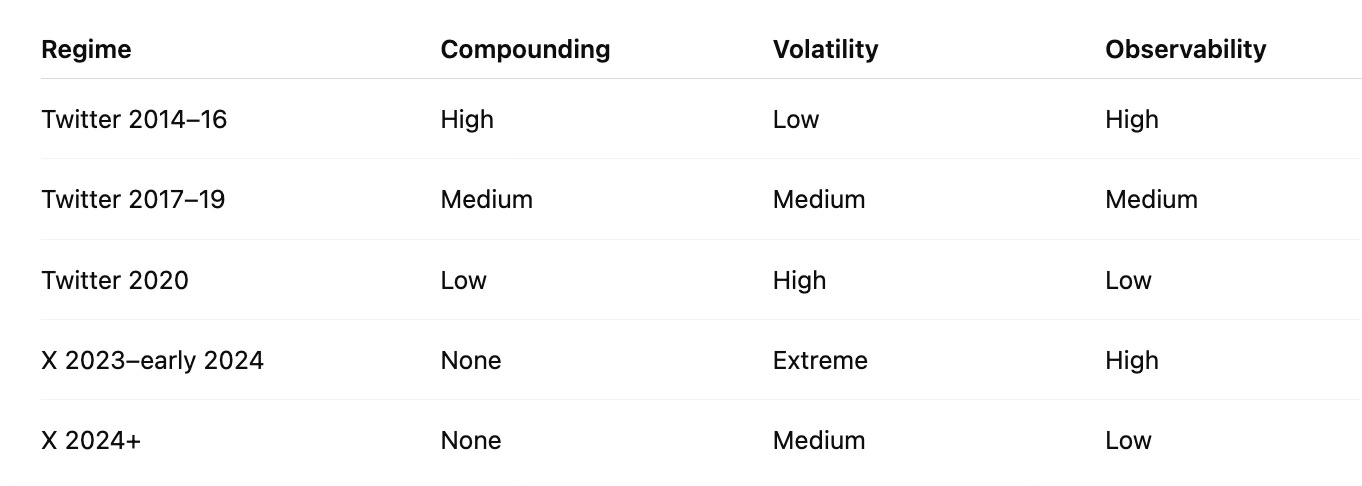
The analysis that follows is organised around five distinct eras of platform governance, defined not by branding changes or ownership alone, but by observable differences in how audience growth, volatility, and analytics visibility behave over time.
These eras are summarised in the table above. The classifications are qualitative rather than numeric, reflecting relative behaviour within each period rather than absolute measurement. This approach avoids false precision and accommodates changes in metric definitions across platforms and years.
Three system properties are used to distinguish eras:
Compounding refers to whether audience growth accelerates over time—specifically, whether attention reliably accumulates into durable audience scale rather than increasing only linearly.
Volatility captures the degree to which reach and engagement fluctuate over short time horizons, particularly whether spikes in activity are common and whether they translate into sustained growth.
Observability reflects the extent to which users can reconstruct how reach, engagement, and follower acquisition relate—across posts, cohorts, or time—using the analytics available to them.
The five eras are not assumed to be internally uniform, nor are the boundaries perfectly sharp. They are best understood as regime shifts: periods in which the underlying behaviour of the system changes in ways that are visible across multiple metrics and persist over time.
The sections that follow examine each era in turn. The Twitter-era analysis establishes the baseline conditions under which accelerating audience accumulation was possible. The subsequent X-era analysis examines how those dynamics changed following the 2021 network shock and under later governance regimes. Only after each era is analysed independently are direct comparisons drawn.
This structure is deliberate. It ensures that contrasts between Twitter and X rest on observed differences in system behaviour, rather than assumptions about platform intent or motive.
Twitter era: accumulation and compounding (2014–2020)
The Twitter-era data provides the baseline against which later regimes can be understood. While analytics availability and completeness vary across years, the record is sufficient to identify how audience growth behaved under successive governance conditions prior to the 2021 network shock.
This period is best understood in three sub-eras:
an early, low-amplitude phase (“Paleo Twitter”),
a period of algorithmic amplification and accelerating accumulation, and
a final year marked by heightened volatility but not collapse.
Paleo Twitter (2014–2016): linear growth under high observability
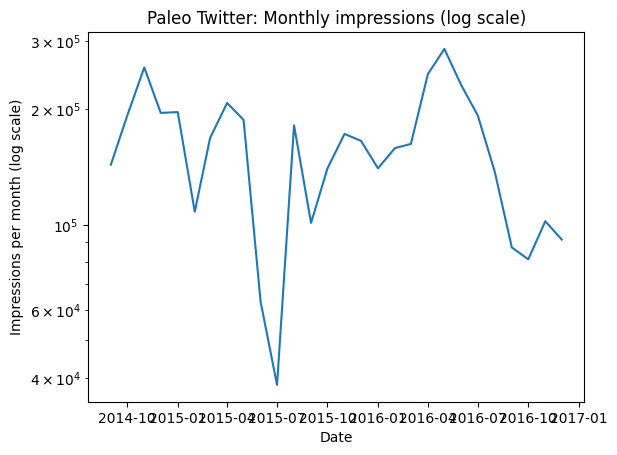
In the earliest period, audience growth is modest and largely linear. Reach is limited, engagement levels are low, and month-to-month changes are relatively smooth. Volatility is present but constrained, reflecting a predominantly chronological feed and a comparatively simple analytics environment.
What distinguishes this phase is high observability. The relationship between posting activity, impressions, engagement, and follower growth is legible, even if the absolute numbers are small. Growth does not compound rapidly, but it is predictable and interpretable.
This phase establishes an important baseline: a system in which accumulation is slow but intelligible, and where changes in behaviour can be reasonably linked to changes in outcome.
Algorithmic Twitter (2017–2019): escalation and emerging compounding
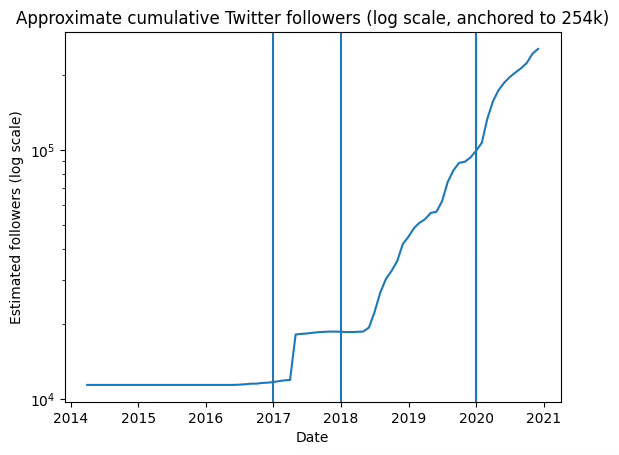
From 2017 onward, the data shows a clear escalation in reach and engagement. Monthly impressions increase by an order of magnitude relative to earlier years, and follower growth rises accordingly. While month-to-month volatility increases, the aggregate slope of cumulative followers steepens over time.
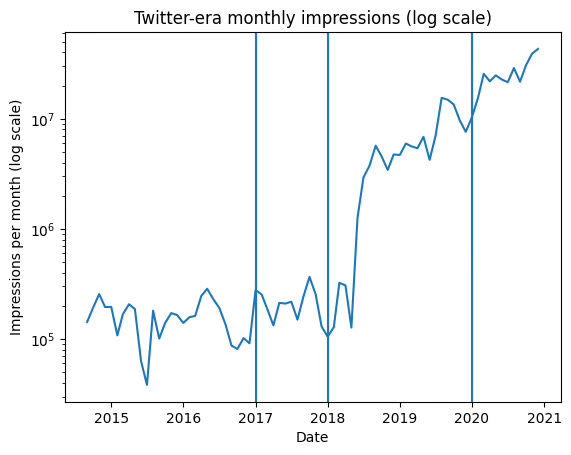
Importantly, conversion efficiency improves during this period. Ratios such as impressions per new follower trend downward, indicating that attention increasingly accumulates into durable audience scale rather than dissipating. Growth remains uneven, but the system exhibits structural acceleration when viewed over multi-year horizons.
This is the phase in which compounding becomes visible at the system level: not as smooth exponential curves, but as threshold effects, step-changes, and sustained increases in the rate at which attention converts into followers.
Twitter 2020: volatility without breakdown
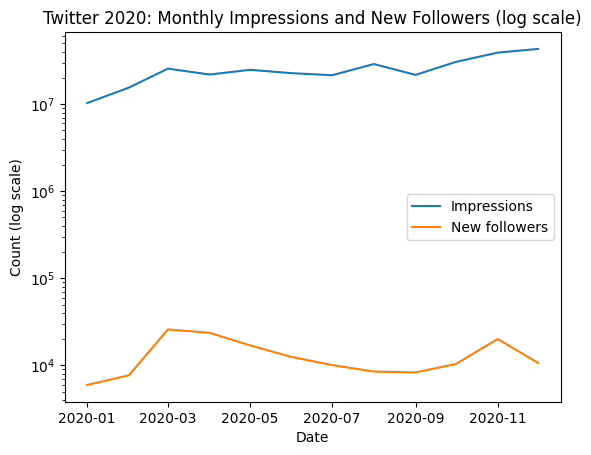
The final year of the Twitter era is characterised by pronounced volatility. Impressions and engagement fluctuate sharply, with large spikes that dominate monthly aggregates. This reflects broader platform turbulence and external events, rather than a simple continuation of earlier trends.
Despite this instability, two properties remain intact. First, aggregate accumulation does not stall: cumulative followers continue to increase, and the overall slope does not flatten. Second, conversion efficiency does not collapse; attention, though volatile, still reliably contributes to audience growth over time.
This distinction matters. High volatility increases noise and uncertainty, but it does not, by itself, negate compounding. The Twitter-era system remains capable of translating attention into durable audience scale, even under stressed conditions.
Summary of the Twitter era
Across the Twitter era as a whole, three properties are consistently observed:
Audience accumulation accelerates over time, despite uneven month-to-month growth.
Conversion efficiency improves, indicating that attention increasingly compounds rather than dissipates.
Observability, while imperfect, remains sufficient to reconstruct how reach and engagement relate to follower growth.
These properties define the pre-shock baseline. They establish that, under Twitter’s pre-2021 governance regimes, audience formation was not only possible but structurally supported, even in the presence of volatility.
The next section examines how these dynamics changed following the 2021 network shock and under subsequent X governance regimes.
X era: post-shock dynamics (2023–present)
Following reinstatement, the account operates under governance conditions that differ materially from those observed during the Twitter era. The available analytics indicate that the system has entered a new regime: one characterised by persistent volatility, weakened accumulation, and changing observability.
As with the Twitter era, this period is best understood in two sub-eras, distinguished by differences in analytics granularity and stability rather than by branding alone.
X era 1 (late 2023–early 2024): granular but unstable
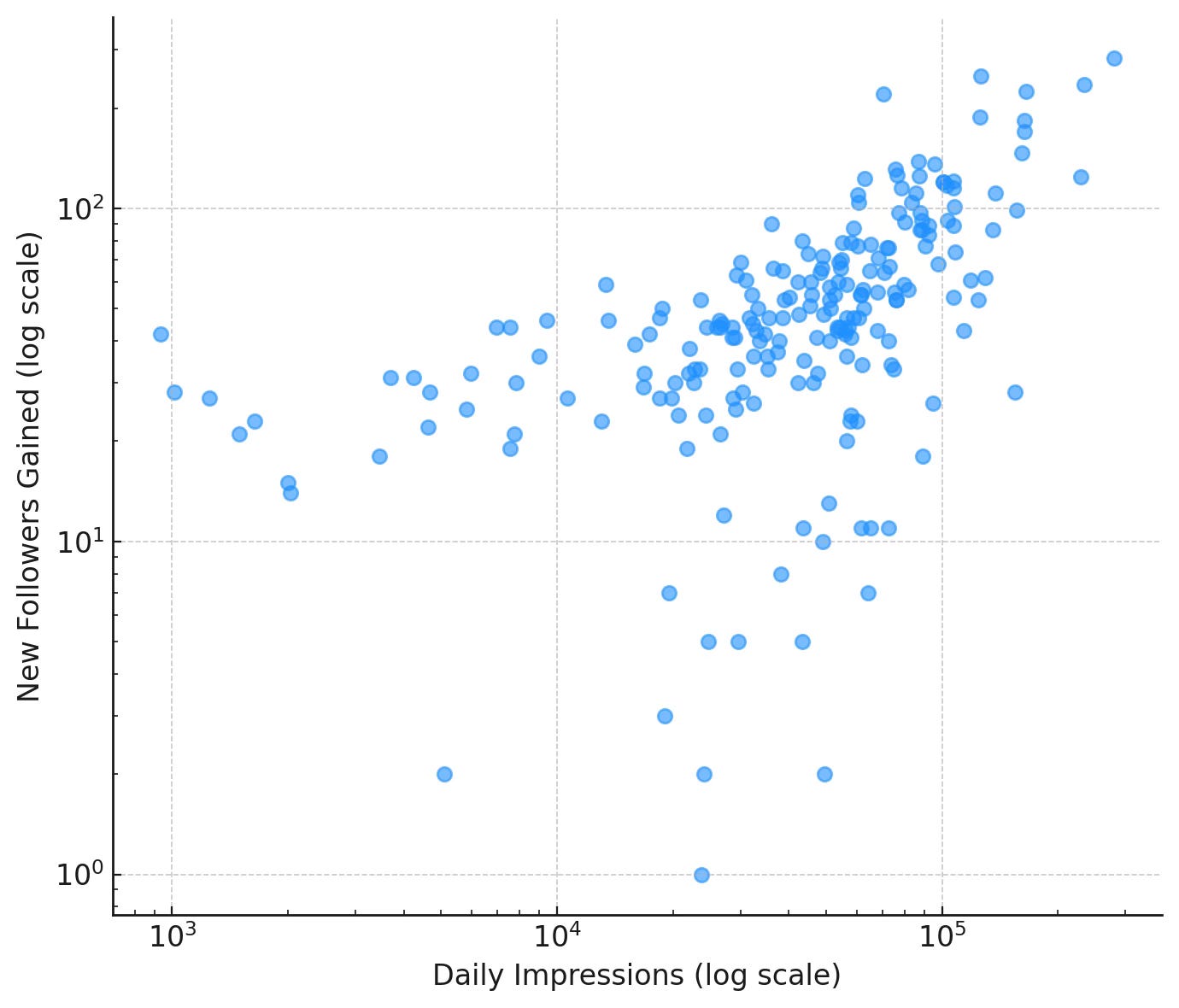
The first post-reinstatement period is notable for its high-resolution analytics. Daily aggregates and per-post metrics are available, offering visibility into impressions, engagements, and follower changes at a level of detail not present in earlier Twitter-era summaries.
At the same time, this period exhibits extreme volatility. Impressions vary sharply day-to-day and post-to-post, with a small number of posts accounting for a disproportionate share of total reach. Distributional measures confirm heavy tails and strong concentration, consistent with episodic amplification rather than broad-based exposure.
Despite this attention, conversion efficiency is weak and unstable. The relationship between impressions and follower gains is inconsistent, and ratios such as followers gained per million impressions fluctuate widely. Growth occurs, but it is uneven, difficult to predict, and rarely sustained across adjacent periods.
In this sense, X era 1 represents a paradoxical regime: high granularity without reliable accumulation. The system makes activity visible, but does not provide a stable pathway by which attention compounds into durable audience scale.
X era 2 (2024–present): smoothed but opaque
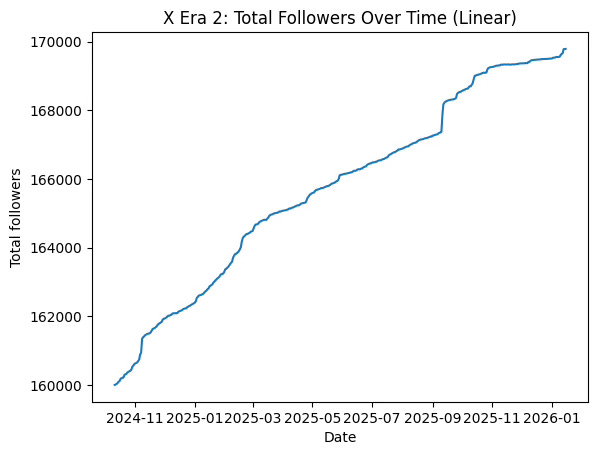
In the subsequent period, analytics shift again. Per-post detail is reduced in favour of pre-aggregated, account-level summaries, and short-term volatility appears dampened. Daily and weekly metrics are smoother, and growth trends are easier to visualise at a coarse level.
However, this apparent stability does not correspond to a return of compounding dynamics. Follower growth remains approximately linear, with no evidence of acceleration comparable to late Twitter-era behaviour. Conversion efficiency stabilises at a low level, and cumulative growth does not steepen over time.
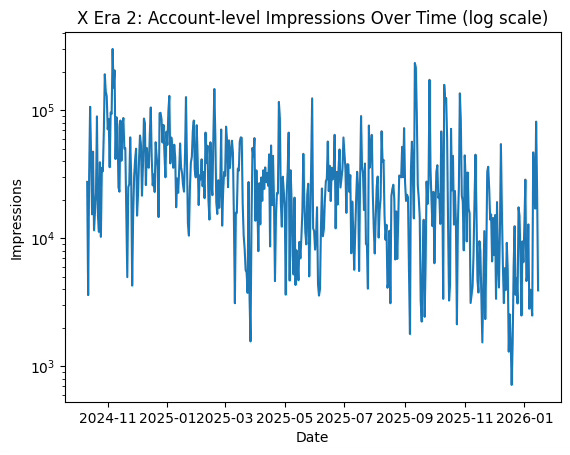
Notably, this period shows a divergence between reach and accumulation: while account-level impressions trend downward over time, total followers continue to increase slowly and approximately linearly.
At the same time, observability declines. The aggregation of metrics limits the ability to reconstruct causal relationships between individual posts, bursts of reach, and follower acquisition. While macro-level correlations remain visible, micro-level pathways are no longer auditable.
The result is a regime that is easier to summarise but harder to interrogate: stable without being reconstructable, and active without enabling accumulation.
Summary of the X era
Across both X sub-eras, several properties are consistent:
Audience growth continues, but does not accelerate; recovery is linear rather than compounding.
Volatility persists, either as extreme short-term fluctuations (era 1) or as smoothed aggregates that mask underlying variability (era 2).
Conversion efficiency remains low, and does not recover to Twitter-era levels.
Observability declines over time, constraining the ability to audit how attention translates into audience growth.
These properties distinguish the X era from the Twitter baseline established earlier. Growth is possible, but the system no longer reliably enables attention to accumulate into durable audience scale.
The following section draws these analyses together, contrasting Twitter and X directly to identify the structural reset implied by these regime changes.
Twitter vs X: the structural reset
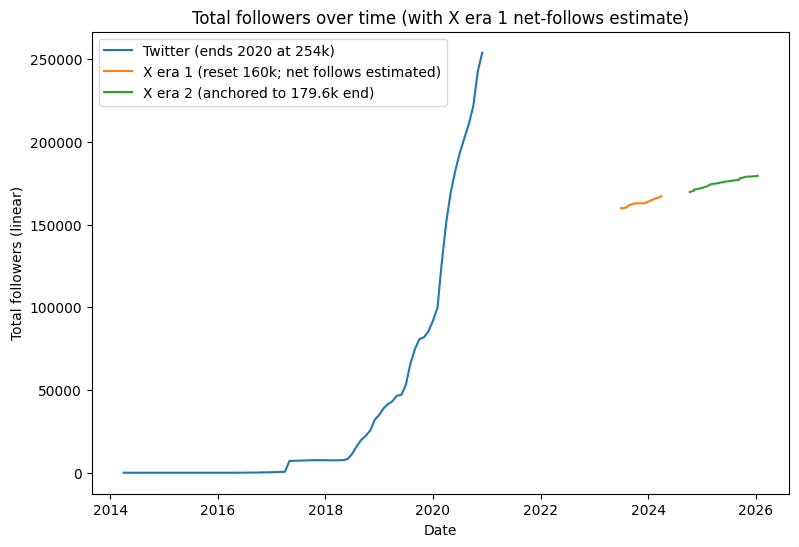
With the Twitter and X eras analysed independently, the contrast between them can now be stated directly. The purpose of this section is not to adjudicate platform intent, but to identify which system properties persist across regimes and which do not.
Three differences are decisive.
Accumulation: from accelerating to linear growth
Under Twitter-era governance, cumulative audience growth accelerates over time. Despite volatility, the slope of cumulative followers steepens across successive sub-eras, indicating that attention increasingly compounds into durable audience scale.
Under X-era governance, this behaviour does not reappear. Following reinstatement at a reduced baseline, follower counts increase only linearly. Partial recovery occurs, but the slope does not steepen, and growth does not enter an accelerating regime across either X sub-era.
This distinction matters. Linear recovery and compounding growth are qualitatively different dynamics. The former rebuilds slowly from a fixed base; the latter enables audiences to form, reinforce, and expand through feedback. The data indicate that the latter property is absent in the X era.
(Key chart here: cumulative followers — Twitter vs X, with the reset annotated.)
Conversion efficiency: attention without accumulation
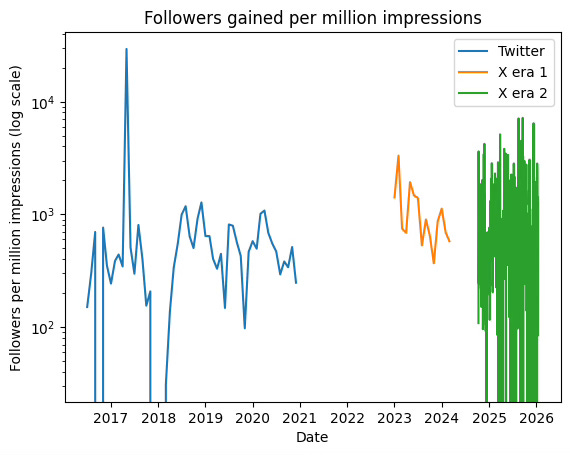
A second invariant concerns conversion efficiency: how reliably impressions translate into follower growth.
During the late Twitter era, conversion efficiency improves over time. Ratios such as impressions per new follower decline, indicating that attention increasingly accumulates rather than dissipates. Even during periods of high volatility, attention remains productive at the aggregate level.
In contrast, X-era conversion efficiency is markedly lower and far less stable. Although impressions remain non-trivial relative to posting volume and follower base, the number of followers gained per unit of attention drops by orders of magnitude and does not recover across sub-eras. Spikes in reach frequently fail to produce sustained growth.
The result is a system in which visibility is possible, but accumulation is unreliable.
Volatility and observability: different failure modes
Both Twitter and X exhibit volatility, but of different kinds.
In the Twitter era, volatility increases over time but remains interpretable. Spikes in reach can usually be situated within broader growth trends, and analytics remain sufficient to reconstruct how attention contributes to accumulation.
In the X era, volatility either manifests as extreme, episodic amplification (era 1) or is dampened through aggregation (era 2). In neither case does volatility reliably feed compounding growth. At the same time, declining observability limits the ability to audit causal pathways between reach and follower acquisition.
These differences point to distinct failure modes. Twitter-era volatility adds noise to an otherwise compounding system. X-era volatility, by contrast, coexists with a system that no longer reinforces accumulation.
Summary: a reset in system behaviour
Taken together, these contrasts support a single, conservative conclusion.
Twitter-era governance enabled accelerating audience formation: attention accumulated into durable audience scale despite volatility. X-era governance permits continued activity and partial recovery, but does not restore the conditions under which accumulation compounds.
This change constitutes a structural reset. It is visible in growth slopes, conversion ratios, volatility patterns, and analytics availability. Importantly, the conclusion does not depend on any single metric or interpretation, but on the persistence of these differences across multiple eras and analytical approaches.
The final section considers how such structural changes should be interpreted in environments where analytics visibility itself is contested, and why intent need not be assumed for governance effects to be consequential.
Interpreting platform analytics under contested conditions (i.e. information warfare in 5GW)
The analysis above documents a change in system behaviour: a transition from accelerating audience accumulation to linear recovery, accompanied by increased volatility and reduced observability. These findings are descriptive. Interpreting what they mean requires care, particularly in environments where platform governance, analytics design, and public discourse are themselves contested.
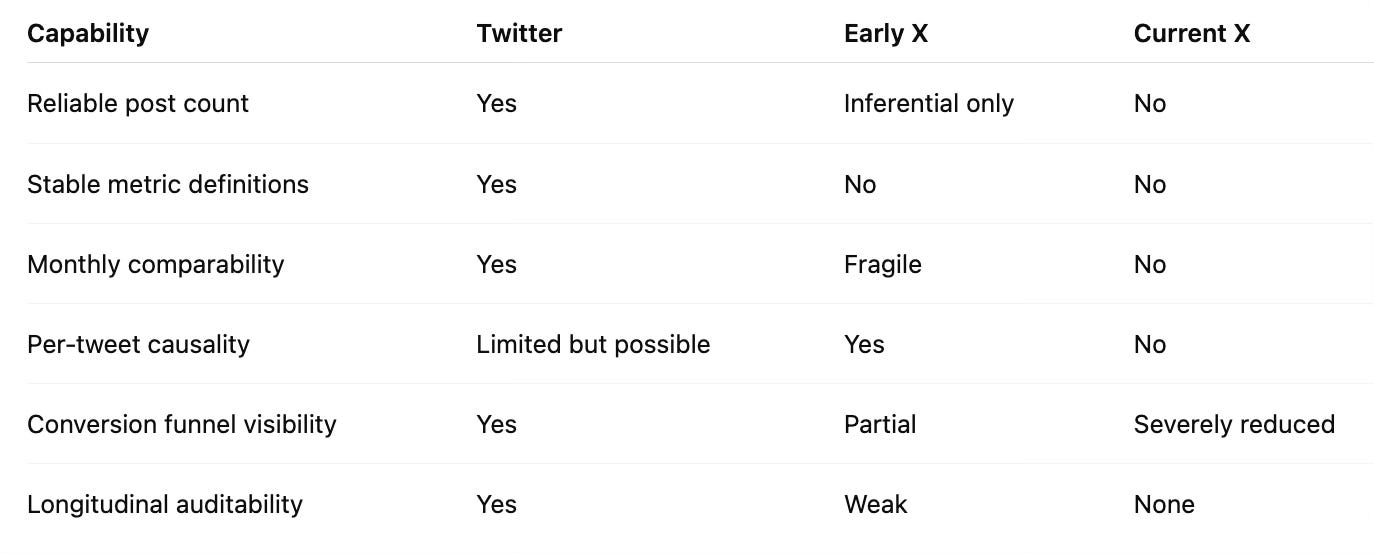
One implication concerns observability. Analytics are not neutral mirrors of platform behaviour; they are interfaces through which users can—or cannot—understand how reach, engagement, and audience formation relate. As metrics become more aggregated and less reconstructable, the ability to audit causal pathways diminishes. This constrains inference regardless of intent and complicates any effort to distinguish structural effects from behavioural ones.
A second implication concerns volatility. Episodic amplification and unstable conversion create the appearance of activity without providing reliable feedback. In such systems, short-term signals become harder to interpret, and growth feels unpredictable even when underlying metrics appear healthy. This dynamic does not require suppression or intervention to be consequential; it emerges naturally when accumulation mechanisms weaken.
These considerations matter beyond any single account. In contested information environments, where actors care about reach, credibility, and audience formation, reduced observability and weakened accumulation alter strategic behaviour. Attention may still be distributed, but its capacity to reinforce durable networks changes.
Importantly, none of these interpretations depend on assumptions about platform motive. Governance effects can arise from design choices, product evolution, risk management, or commercial priorities, without any single explanatory cause. The analysis presented here is therefore limited to what can be observed: how growth behaves, how volatility manifests, and how analytics visibility changes over time.
The purpose of this section is not to resolve those broader questions, but to situate the empirical findings within a wider analytical context. Structural resets in audience dynamics are consequential whether intentional or emergent, and understanding them requires attention not only to outcomes, but to what users are allowed to see.
Conclusion: what changed, and what did not
Across five governance eras, the same account experienced markedly different growth dynamics. Under Twitter-era regimes, attention accumulated into durable audience scale, even amid volatility. Under X-era regimes, growth resumed following a network shock but did not return to an accelerating or compounding pattern.
What changed was not the presence of attention, nor the capacity for activity, but the system’s ability to reinforce accumulation and the user’s ability to observe how that process unfolds. What did not change was volatility itself, which persisted across regimes in different forms.
This article has aimed to document those changes conservatively, using multiple datasets, invariant ratios, and independent analytical checks. The conclusions do not rest on claims of intent or suppression, but on consistent differences in system behaviour observed across time.
Understanding how platforms shape audience formation requires attention not only to what is amplified, but to what is allowed to accumulate—and to what remains visible in the process.