

I am currently reviewing some of my older writing with a view to curating future collections of essays. Some of these pieces were tied to specific events and timelines during the extraordinary uncertainty of the COVID era. Others are more personal reflections or confessional in nature. And some contain practical frameworks and insights that still feel useful today.
This essay was originally written in the autumn of 2020 for a small private newsletter and has never previously been published publicly. While the immediate backdrop was the upheaval of that period, the underlying subject is how we respond psychologically and practically to overwhelming change.
I am republishing it because the core ideas still seem relevant: how to regain agency, orient yourself under pressure, and make decisions when certainty is impossible. I hope you find something of value in it.
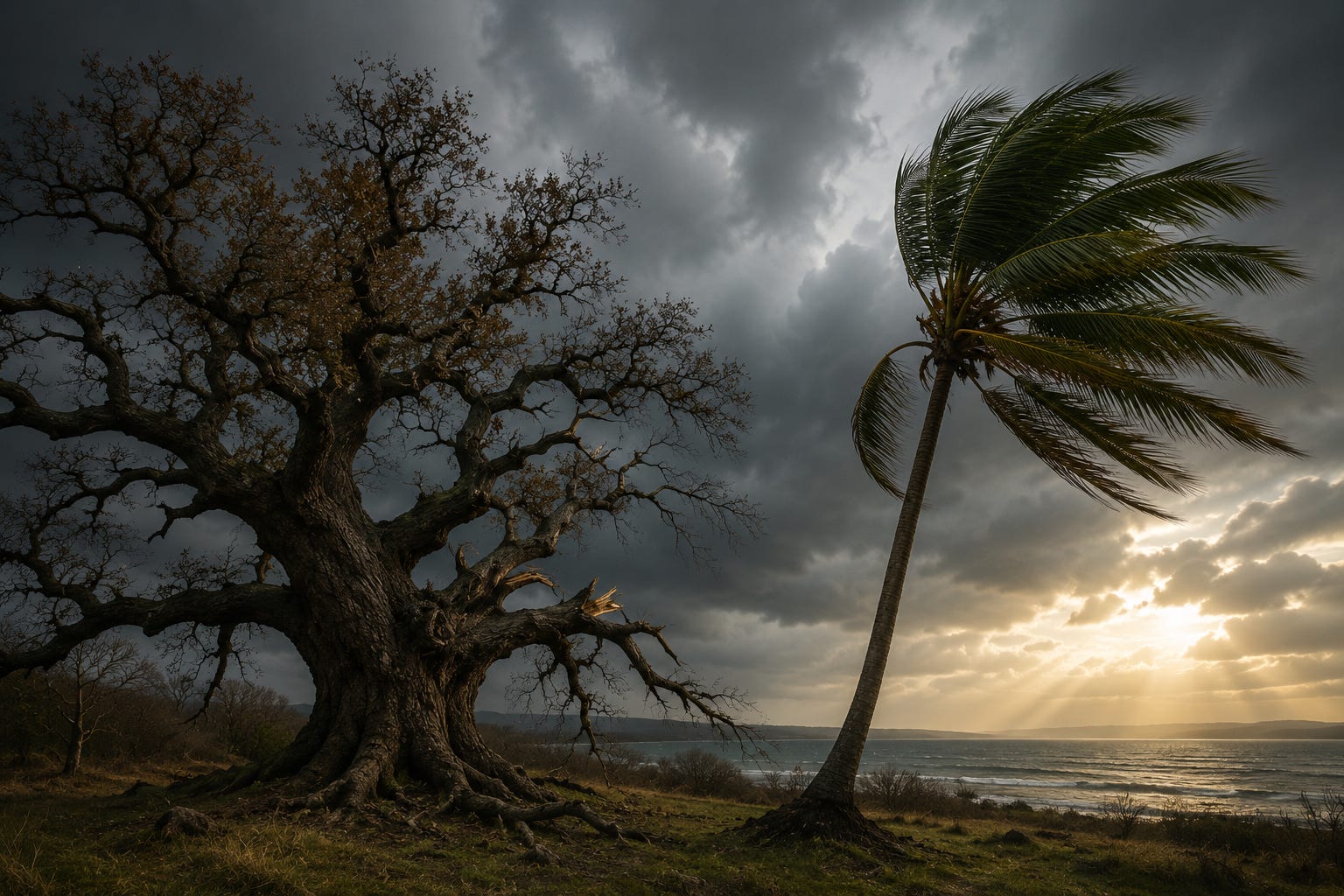
In October of 1987 a storm swept across southern England, with winds over 120mph. An estimated 15 million trees were lost, and billions of pounds of damage caused. Deciduous trees don’t fare well in hurricane force winds. This contrasts with palm trees, where several species are nearly hurricane-proof. The different root system, structure, and flexibility gives palms the ability to weather any tempest.
We are collectively entering a worldwide geopolitical “hurricane”. The United States is experiencing a full-blown (attempted) Bolshevik style uprising. The criminals who have been in power are not going to go quietly. The upcoming election promises drama like no election before it. Coronavirus has also inflicted havoc on economic and social life, and brought the credibility and legitimacy of many important institutions into question.
Given all this turbulence, the question you might be asking yourself is how can you weather “The Storm” — a global corruption purge — and be more like a palm tree, and less like an English oak. More than a decade ago I faced a personal crisis and major life change. I picked up some simple and useful tools to deal with the sense of overwhelm when everything appears to be in chaotic motion.
Tool #1 — A stakeholder map
When we face dramatic upheaval in life, the first action is generally to look for advice or help. We don’t have to make immediate decisions about major projects to launch or processes to redesign. Since the primary action is in the social, a stakeholder map can help us to order our thinking. This is especially true of change that is systemic and impacting many areas of personal or professional life.
A stakeholder map puts in a circle in the middle of a piece of paper the nature of the change for you — like “getting divorced”. This first step alone is helpful, despite seeming trivial, as it names and locates the change “in the world”. It isn’t just a nagging worry that keeps you up at night; it can be separated from your feelings and hence managed.
For a corporate entity, “Managing my role in my company’s response to a global corruption purge and financial reset” might be a good label for the change to be engaged with.
Then we can around that draw the classes of stakeholders, say “lawyers, children, childcare, ex-spouse, relatives, schools”. After that we can draw the individual stakeholders off of these classes. Just remember this map is about you, so can have stakeholders from well beyond your institution. There may be relevant stakeholders in your church, sports club, or alma mater, for instance.
My experience is that this exercise often flushes out more people than we might expect. There may be persons with relevant understanding of resources in areas of our life totally disjoint from the presenting problem itself.
Each stakeholder can be understood in terms of their role (and that role clarified if needed), and the contribution they might make. In our present circumstances, those in commercial or public sector organisations may wish to add some additional colour to the stakeholder map. Staff may range from Marxists supporting extremist movements, through ordinary diverse political viewpoints, to those who are experts in open source intelligence about the current geopolitical changes.
The other thing about a stakeholder map is that it is always possible to produce one. It gives us back a sense of agency, and puts us back into a mindset of reasoned management, rather than fear-induced panic reactions.
Tool #2 — A list of what isn’t changing
The world is full of paradoxes, and change is one of them. In organisation theory, Arnold Beisser noted in his “paradox of change” that lasting shifts in behaviour only happen when we identify with what truly is, not what could or should be. For example, someone might give up smoking by keeping a log of spending, and compassionately noting when we have poor heath or experience other negative impacts. This identifies with reality. Focusing on being a non-smoker alone doesn’t work; we paradoxically have first to understand what kind of smoker we are (and will become) in order to change.
In a similar way, when change arrives that seems beyond our ability to cope with, we can begin by defining one aspect of the change landscape: what isn’t changing. So in our example of a divorce, we might say that our friends won’t change, our professional skills won’t change, and our hobbies won’t change. It is quite possible that these assumptions prove delusional in time, but we cannot know that.
Producing such a list might seem a pointless activity, but it has a purpose: to give us psychological safety. “Everything is shifting” isn’t true; there are always aspects of life that do not. Which leads us to the last tool.
Tool #3 — A framework for safety vs certainty
I have been a consultant for many years, and corporate executives often buy advisory services when they feel both unsafe and uncertain. What an unwise buyer of consulting hopes to get is safety and certainty. But this is usually not on offer in our world; it is too unpredictable and surprising.
What is possible, and what a good consultant offers, is safe uncertainty. We begin to define the doubt and even confusion. All strategic management decisions are made under conditions of imperfect information. So in the example of a global corruption purge and financial reset, we might acknowledge conflicting understandings, and outlier opinions.
The enemy of management decision making is paralysis from fear. By separating attainable safety from unattainable certainty, we can turn profound change into an ordinary scenario planning activity, just with wilder “wildcards”. Therefore the question to be asking yourself over and over is “what is making me feel unsafe, and stopping me making decisions?”. The containment of the objective risk or subjective anxiety can be dealt with, even if the uncertainty about the world cannot.
In a covert war involving intelligence agencies and secret societies you are guaranteed for the unexpected to surface. By building a map of our “helpers”, bounding the scale and scope of change, and focusing on feeling safe enough (in an uncertain world) we can weather the coming storms.
Just like a palm tree.
Epilogue (2026)
Re-reading this essay years later, what strikes me is not the specific predictions or historical context, but the underlying assumption that upheaval is tractable. Human beings can orient themselves amidst uncertainty. Fear, complexity, and sudden change can be decomposed into manageable relationships, decisions, and actions.
That still feels true to me now.
The specific mechanisms of disruption may differ from what any of us imagined in 2020, but the deeper challenge remains the same: how to preserve agency, clarity, and humanity during periods of rapid change. The tools in this essay were my attempt to make upheaval psychologically and socially manageable rather than overwhelming.
I think that project remains worthwhile.
Thank you.....I needed that....hugs x
Thank you, as always. for sharing wisdom which leads to comfort in shared responses, and clarity in choices moving forward. God bless you Martin