

I have never studied philosophy in any formal sense. I did once buy an overview guide to philosophy, but, as with so many books I have purchased, it remained unread. Looking back, that’s probably because I couldn’t draw a line between the theory and my own life.
At least learning about computers offered some hope of a livelihood outside academia. And computers had games. Philosophy didn’t seem like playtime. I am a strict orthodox hedonist: if there isn’t some kind of pleasure in it — even the perverse satisfaction of brutal perseverance — then I am not up for it.
If you had asked me at the start of this long journey what truth is, I would have thought the question barely needed asking. Surely it is simply a faithful and accurate mapping between what is said and what is real? I might have accepted some degree of social construction in our shared reality — “Bob is a jerk” being a relational claim, not one of physics. Even so, the idea of truth itself seemed so self-evident that it needed little explanation.
We use “true” and “false” in computing, yet the machine is neither a knower nor does it know. A Boolean value can be perfectly correct within the formal system while the system itself is hopelessly detached from reality. Garbage in, garbage out. The calculation may be flawless while its correspondence to the world is worthless.
True and false, I have come to realise, sit inside a larger space of veracity and fidelity. It is possible to hold a true belief for bad reasons, or a false belief while nobly investigating reality and remaining open to correction. The proposition matters — whether it is true or false — but so does the relationship between the knower and the known.
There seems to be a foundational divide between two distinct postures with respect to truth. One is that a more rigorous outlook might get you promoted to a professorship. The other is that an insufficiently rigorous outlook might get you killed. These are not the same thing. They are barely related, even. Hence they might share “truth” as a label, yet not necessarily denote a shared object.
With the former positioning, you might know the names and definitions of every school of thought, and even invent a new one, yet be useless in a fight against deception. With the latter, the terminology might elude you, but you’re around to tell the tale long after the abstracted thinker has been tricked into surrendering everything of value, including life.
They both studied what is true and real. Only one survives.
Survival, of course, does not prove that you were right. The truthful can be killed and the deluded can prosper. But consequences expose a dimension of our relationship with reality that intellectual consistency alone cannot test.
Nor is heterodoxy any protection. Even in the “truther” community, deep attachment to some alternative orthodoxy is commonplace — your flat earth versus my globe earth, or vice versa. The conclusions may differ, but the same dysfunctional relationship to mismatch, investigation, and correction can remain. Changing the answer does not necessarily change the architecture by which the answer is defended.
One group does, however, expose something different about our relationship to truth: whistleblowers. These are people who don’t merely hold a strong opinion for discussion around the dining table. They have seen something deeply amiss that offends the soul, and to which they cannot consent by becoming an accomplice. They discover the lie operationally. Whether they ever formalise what they have discovered into a doctrine is almost irrelevant to whether they can discern truth from falsehood.
Yet without formalisation, their protests remain isolated and singular. They can tell us what they saw, perhaps at enormous personal cost, but they cannot necessarily give us a method by which we might have seen it too. Something more is needed if an encounter with falsehood is to become a transferable way of finding truth.
So my tentative redefinition of truth leads me towards a more consequential framing. Truth is not merely a beautiful painting of the world to be admired for its accuracy. It is operational: other structures and behaviours are built upon it. There is a downstream cost to inaccuracy and error.
Hence our relationship to truth cannot be static; it has to function as a dynamic system. Mismatches between observation and model must trigger, if nothing else, a gateway process for deciding whether they warrant investigation and, ultimately, correction. Fidelity to reality demands that the model must be allowed to lose.
In that sense, our relationship to truth is more like a method — as with the scientific method — than a collection of statements about what is. Yet it lies at a different conceptual level from science. It must continually probe its own priors of orientation, recognition, and perspective before we even get near to deciding what constitutes rational inference. The architecture of inquiry matters more than any particular conclusion it happens to produce.
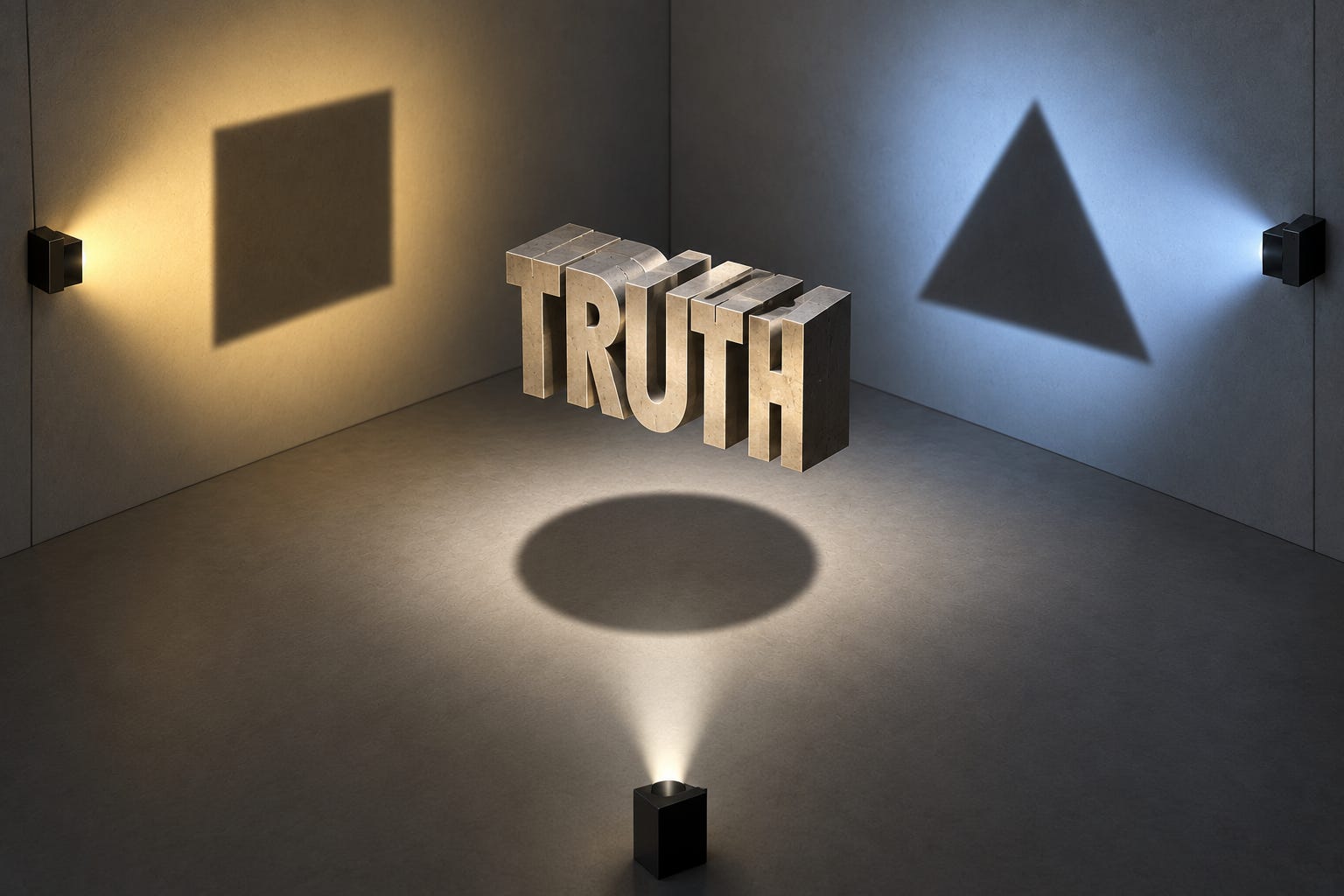
A fact says that the thing has a shadow, and describes its shape. Truth is that the thing is not its shadow. And the shadow cannot be promoted into the thing, not even if we have already conceived it as such.
There is something more basic here than whether “this thing” corresponds to this representation of “this thing”. What if we have mistaken what the thing is in the first place? Perfect correspondence between our statements and the shadow does not repair our failure to recognise the object casting it.
It is as if we are less concerned with truth per se, and more with truthfulness as a quest: maintaining the kind of relationship with reality in which even our identification of the object remains open to correction. What really matters is that someone can tell me I have confused the thing for its shadow — and that my way of knowing permits this objection to enter.
Before asking whether my representation is accurate, I must remain corrigible about what it is a representation of.
This leaves me wondering who maintains the machinery. Who are the “truth engineers”? Who manages the safety case for our methods of knowing, investigates their failures, and becomes accountable when deception is negligently or wilfully allowed to propagate downstream?
I am not sure who these people are. The language of engineering seems appropriate because engineering implies responsibility, not merely expertise. You are not simply entitled to announce that your bridge is sound; you assume responsibility for the means by which its soundness is established.
But they probably aren’t philosophers.
Nothing wrong with them.
But I am not sure there is enough right, either.
Maybe it isn’t about truth.
But being not so sure.