

I tend to avoid generic social and political commentary, as that’s a very saturated market. But there is something I am the #1 expert on, and that’s being me. So reporting on what I see in the world going on around me, and in the places that matter to me, is perfectly justifiable. This is a short observation of what I see that I hope is meaningful to you.
I was recently back in the town of my birth and upbringing, Staines, at the western fringe of London. It has been renamed to the more genteel Staines-upon-Thames, and it does have a history as a pleasure spot for day-trippers from London on the Victorian steam railway. It has also been a manufacturing hotspot in the past, notably linoleum flooring. The house I grew up in is where the factory used to be.
When I grew up in the 1970s and 1980s, Staines was an easily-legible working and middle class town.
As a child, I went to the local primary school (now closed), and then the local middle school (demolished and replaced with an ugly new police station). I wasn’t one of the three kids selected to see the Queen open the new shopping centre in 1980, but I do recall the archaeological excavations near Barclays Bank, maybe around the late 1970s.
The industrial estate on the other side of the High Street was later replaced with a larger car parking and retail area. The old wall I walked atop, with my father holding my hand to steady me, is gone. As is the magical toy store — once Retlaws, then Gamleys. Waitrose, Tesco, International Stores, and Marks & Spencer have occupied roles as town centre food shops over time; new Asian stores provide fresh variety.
These are ordinary changes, with losses and gains. Everywhere has its comparable tale.
The town itself has a history going back to the Roman era, as it was the end of the tidal reach of the Thames before the weirs and locks were added. It is the natural upstream crossing point above London, and its proximity to Heathrow makes it a crossing point of the world, not just inside England. Therefore expecting it to retain a purely English culture is aspirational at best, delusional at worst.
That said, something really shocked me recently.
Between the housing estate where I grew up and the High Street there was a small light industrial and warehouse area. Back in 2014 there was a big fire and one of the units burnt down. The result was that the whole area was redeveloped. It has taken quite a few years for the works to be completed, and during that time foot access was redirected around the site.
The building finished recently, and I got to walk the old path into where the trading estate used to be.
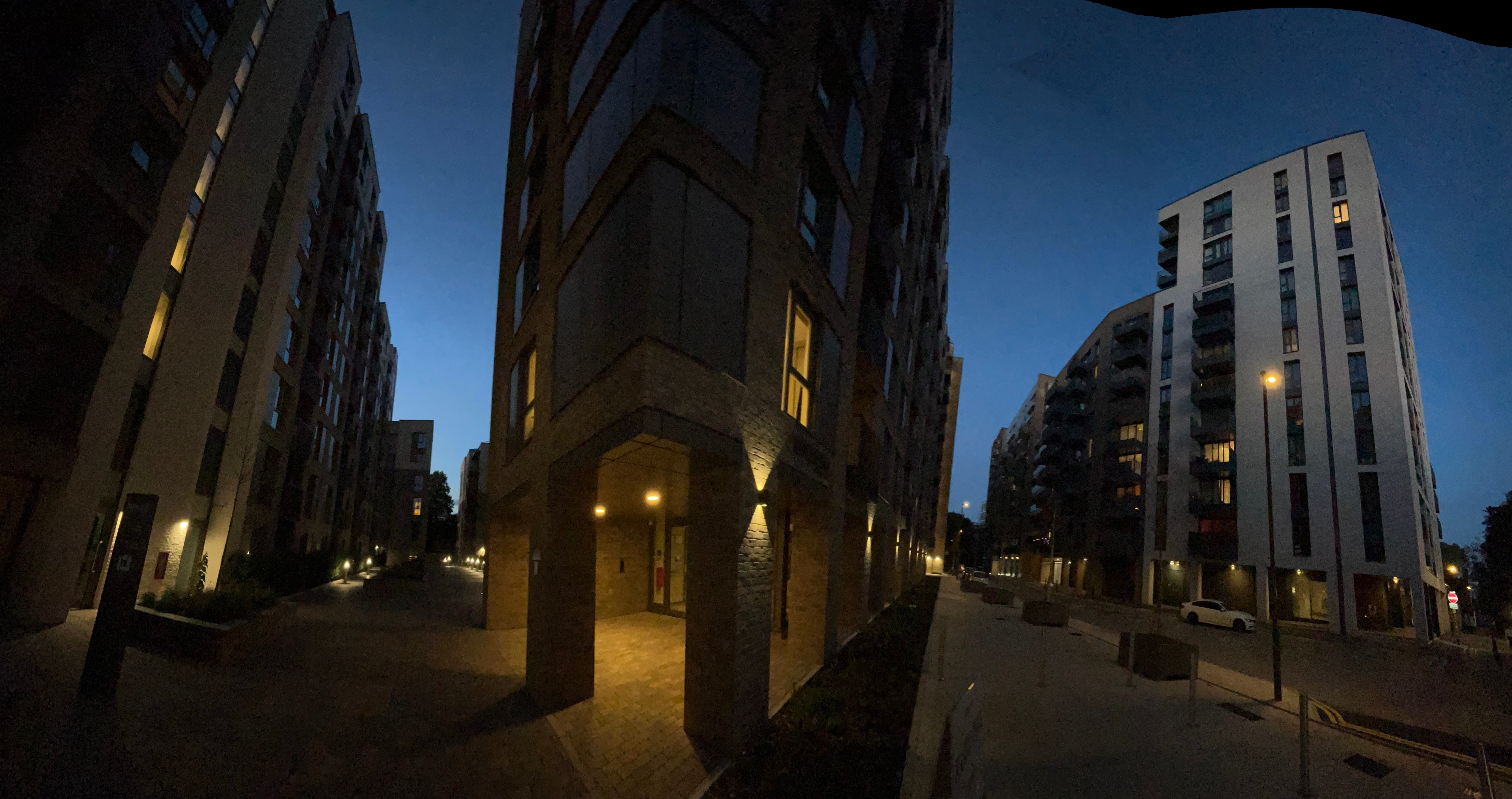
The result is essentially a modern “comfortable vertical slum”. Several hundred units are piled up — I didn’t count how many storeys — in a tight urban canyon layout. There is poor light, only token greenery, and minimal decoration. Just boxes. It doesn’t vibe right.
This is not what the future of local living in this area was meant to be. Apartments and even tower blocks are OK. But there’s a density and configuration that is oppressive, not enlivening.
That’s not the real problem, though. Bad architecture is everywhere. The real issue is that nobody has a long-term stake in Staines any more if they cannot own property there. Every single unit in Renshaw’s Yard, all 391 of them, is for rent, not for sale.
These aren’t buildings you would design if you grew up there and cared about the place.
They aren’t buildings you would want to hand on to future generations if it was home.
They look to me like buildings you would construct if you were socially engineering the natives out of society.
It doesn’t mean that there is a sinister plan; I am not asserting that. But it is the first thought that comes to mind. And that is not a healthy state of affairs.
Expanding the Council Tax base is not, by itself, evidence that the town is heading in a healthy direction.
My neighbours growing up in the 1970s were French, Irish, Syrian, and Pakistani, as well as British. I don’t have some bucolic fantasy of England untouched by outside influences. (Although I might have a lingering resentment of the Normans.) But these people were deeply integrated, and a natural part of the wider airport economy. What I am feeling is a discontinuity: I no longer feel like a native of my own place of birth. It isn’t a natural evolution of what came before.
Staines is becoming unrecognisable culturally; it is becoming a Croydon.
For my mostly overseas readers, Croydon is not a particularly nice place, having become a byword for aggressive urbanism gone wrong. It is geographically a “Staines of south London” but way more “far gone” and doesn’t have the redeeming river feature through it; more “Croydon-under-Concrete” than “upon-Thames”. It’s the less endearing bits of multicultural London (think: knife crime) mixed with the worst of post-war planning.
At the bus stop outside the new development, I and my partner were the only two white people there; and I was the only identifiable “local”. I have taken buses from this spot for decades. It was not always so. I don’t recognise these people. They aren’t even the “airport diaspora” I once knew of airline personnel. They are something else. We don’t queue the same!
(But one guy on the bus in Stanwell later made me smile by talking about someone being a “div”; pure local slang I won’t translate. Perhaps knowing the idiom is the real test of cultural belonging, and is independent of ethnicity, nationality, or birthplace?)
Americans will know of a “white flight” phenomenon, but that’s not what is really happening here. London as a whole is in reasonable health, even if it is more global megacity than English capital city. There isn’t a Detroit-style collapse going on anywhere. There are no abandoned neighbourhoods, even if there are poverty spots. London has always had its share of violence, destitution, and social conflict with incomers.
The issue I have here is more local and personal.
The wider site of these new apartments used to house a dark 1970s office block monolith of North Thames Gas, where I briefly worked in the basement shredding documents as a student job. It was more open and airy than the new development, but won’t be missed. Change in itself is not the problem.
The same site also once had a nice 1930s (I think) building for the old Post Office, also lost in my lifetime. Old photos show pretty railway worker cottages down Mill Mead. The ones on the other side of the railway were demolished for the access road to the expanded shopping centre.
Those who occupy these new apartments are unlikely to know any of the history of the area. I have nothing against them being there. Maybe some will come to love and appreciate what it has to offer. A few might help to refashion the area into something new that the indigenous would never have thought of doing.
At least the volume of bodies brings in commerce and keeps facilities open. But a society with little in common beyond transient cohabitation is a loss. Who would want to raise a family in these apartments? What happens when no child has any experience of a garden? What kind of people do we produce in homes that are aesthetically far behind the little brick cottages they replaced?
Even the areas around Hounslow which are often Hindu, Sikh, or Muslim in character are still structurally British underneath in terms of layout, style, and architecture. This new style of habitation is not; it is Globalism. It is alien. It is not welcome.
Many write about demographic displacement, but this is a whole different level. If you grew up in a 1930s semi over in Hayes while your father was a baggage handler for Air India, I can understand you. We’re mutually intelligible. Mine was a maintenance engineer at Hatton Cross. You know who I am. We mumble in the same West London dialect. I can recognise your concept of “home” as valid in my ontology, and vice versa.
I was only born in Staines because my father worked at Heathrow. The airport imported Empire. Its people and problems could be absorbed. There were centuries of trading and military history. This isn’t that process. It is something else. It doesn’t feel right. I am just trying to figure out why. Perhaps it is just the invisible boundary between London and Staines collapsing. I take this arrangement for granted when I see it elsewhere. Seeing the same evolution in my home patch is the jolt.
I just don’t see the same process happening where I live in the North; my local town is likely 99% white British. There are no rental mega-blocks being built here. The local town centre is mostly closed shops. Out-of-town and online retail has ended the model the place was built upon. It isn’t coming back. But it is adapting. The warmer months have food trucks, entertainment, and cultural events. You can still aspire to buy a home in the place you were born.
What I fear is Staines becoming so unmoored that it loses any sense of what it is and why it exists. These high-density rentals assume one model of social and physical mobility. It may not last. The world changes. Even Heathrow may not be forever. Technologies advance. Jet aircraft are not the last word in travel.
People would still come to Staines to dine riverside at The Swan inn, see the old church, walk in the windswept moor, cross the old stone bridge, and enjoy the Lammas park.
I don’t see these new residential blocks ever being a cherished part of a future Staines and its history.
That upsets me.
Zero new property being built worth preserving, from what I see.
Cultural estrangement between the old and new.
These incomers aren’t like the people I went to school with, or played with in the park.
It isn’t that long ago; only four or five decades.
Yet we’re all on the same island.
And we’re in the same country.
But are we the same people?
I don’t think so; I don’t see a jury of my peers living here.
Yards from where I grew up.
And it disturbs me.