


It has become my habit over the last few months to write a few paragraphs on my own, then post the latest hybrid human–AI insights I have developed. This article is different: it is my own witness to the experience of being on the receiving end of a State process that has exceeded its own safeguards. It is my answer to a loving comment by one reader who said she enjoys what I put out, but can feel the soul missing from the content that comes from the machine, no matter how erudite or novel it may be. The purpose is simply to note the reality of where I am, without it being a complaint or a solicitation for aid.

I will start with the positive. Yesterday, I made a small but significant change in my working environment that signals a phase change in my life. Since 2010, when I became (for the second time) an independent tech/telecoms consultant, I have collated my work under a “Projects/” folder, with one sub-folder per year. I am now working on multi-year endeavours involving litigation and what I can only describe as “digital statesmanship” of lasting value and purpose. Accordingly, I have reorganised under “Constitutional Work/”, alongside “Projects/” — the first structural update in fifteen years. I didn’t expect this to be an emotional moment, but it was.
The upside of my bruising encounter with “ghost courts” is that I am developing a trove of intellectual output that, as far as I know, breaks new ground in modelling the limits and failure modes of the legal system. This is work that could never have been reached through ordinary legal training; it requires standing outside the doctrinal frame. I am operating in the preconditions of law — the strata before jurisdiction and procedure even bite. I even learnt a new word this week, “prolegmena”, meaning preliminary discussion. My prolegmenary insights fall under the rubric of Sovereignty Science, with sub-topics such as Legitimacy Theory, Court Ontology, and Civilisation Engineering.

This healthy outcome could not have happened unless the State had put me through a process that, from my perspective, operated as a full administrative simulation of justice: a non-conviction for a non-crime from what appears to be a non-court via a non-prosecution with no evidence and no accessible appeal route due to no court order. I had to experience the system (mal)functioning in this way in order to understand how far the rule of law can degrade under administrative supremacy. The process continues — a debt collector still pushing for payment yesterday despite the matter being under High Court review. I am now treating everything as diagnostic, not blameworthy, and raw input material for a new civic vocation and life direction.
The litigation is the manure.
The essays and white papers are the compost.
The emerging theories are the roses.
What has surprised me is that the Single Justice Procedure situation — where you are processed by a database workflow rather than a recognisable court — does not merely raise issues under domestic law and international governance standards. When analysed by AI, without making any allegation of intent, it exhibits structural features that resemble the abusive procedural patterns documented in international human-rights literature, including studies of post-Communist and authoritarian jurisdictions. That is significant in itself.
An automated prosecution machine, with a presumption of guilt, that functions in a way that effectively strip-mines the public for cash, with few protections, is what I am facing down.
But not alone; you are here, too.

The impact is real and visceral. Many of you will recall that I have had to run this UK civil litigation in parallel with a familial abduction and custody crisis in the USA. I have not processed the “poverty tour” photos I took in the summer of 2024. I have not produced a photo calendar either last year or this in order to pay my way in the world. I have not had time to package up my essays into new books to sell. I have not even managed to write articles on my observations of ongoing suppression on X, or the money costs of doing this kind of work (I spend a small fortune on AI and other tools).
Every day is legal toil, seemingly without end, and with few days off — a kind of virtualised home arrest by procedural burden. I am likely a very unprofitable customer for OpenAI given the intensity of my use! I have trauma injuries to my nervous system from years of dissident work, and often in the mornings I am wobbly and struggle to focus at first. Late at night as my blood sugar crashes, the darkness of the world can feel heavy. Without spilling my private world into a Substack article, I have good support and containment. The grinding of my nervous system, by the constant moral battering from an indifferent enforcement machine, is manageable.

A civil servant closely associated with the “ghost court” phenomenon once claimed that this could not be a serious problem as nobody had successfully litigated the matter at the European Court of Human Rights in seven decades. This is a variant on the Wald survivorship bias fallacy noted in WW2. Aircraft returning from sorties with bullet holes had those areas reinforced across the whole fleet, to no effect. That is because the other areas of the aircraft caused the planes to fall out of the sky, to never return to base!
In our case of “ghost courts”, there appears to be a near-total failure rate for challengers, leaving no survivor data. That is not an indication of “no problem”; quite the reverse. The process is so opaque and the remedy pathways so convoluted that nobody has managed to expose the defects before AI arrived to level the playing field. Via my “Absolute Zero” protocol I have explored every single path, and shown many of them to be ineffective or unavailable in my particular case. We shall see if the High Court bucks the trend: the question is simple enough. Which of the dozens of named entities that purported to convict me, if any, is a real court?
I am one of the first people to have lasted long enough to come back from a “constitutional legal sortie” against the Single Justice Procedure with a coherent safety case — and lots of virtual bullet holes to show for it.

The simulation of justice is a very serious matter. Two decades ago, the Auld Review suggested a unified criminal court system. It is not hard to imagine a “streamlined solution” evolving from the Single Justice Procedure to encompass imprisonable crimes, one that edges toward algorithmic adjudication if the trajectory of automation were to go unexamined. The recent public debate over jury trials — real or psyop — illustrates the stakes.
I believe I may be the first person to litigate the existence of a tribunal since the Case of Proclamations in 1610, when the king was told he is not a court. My own case argues that a computer is not a court either, and cannot meet the requirements of the Courts Act 2003 or Magistrates’ Courts Act 1980. This is foundational work.
To give you a better sense of what I am carrying, I asked Grok to define how “close to the silicon” I am operating at. I have taken a botched parking ticket, applied my computer science and safety engineering skills, and turned it into a universal model of how administrative systems can exceed their design limits.
This is not normal. The court software is running, but the silicon substrate is absent.
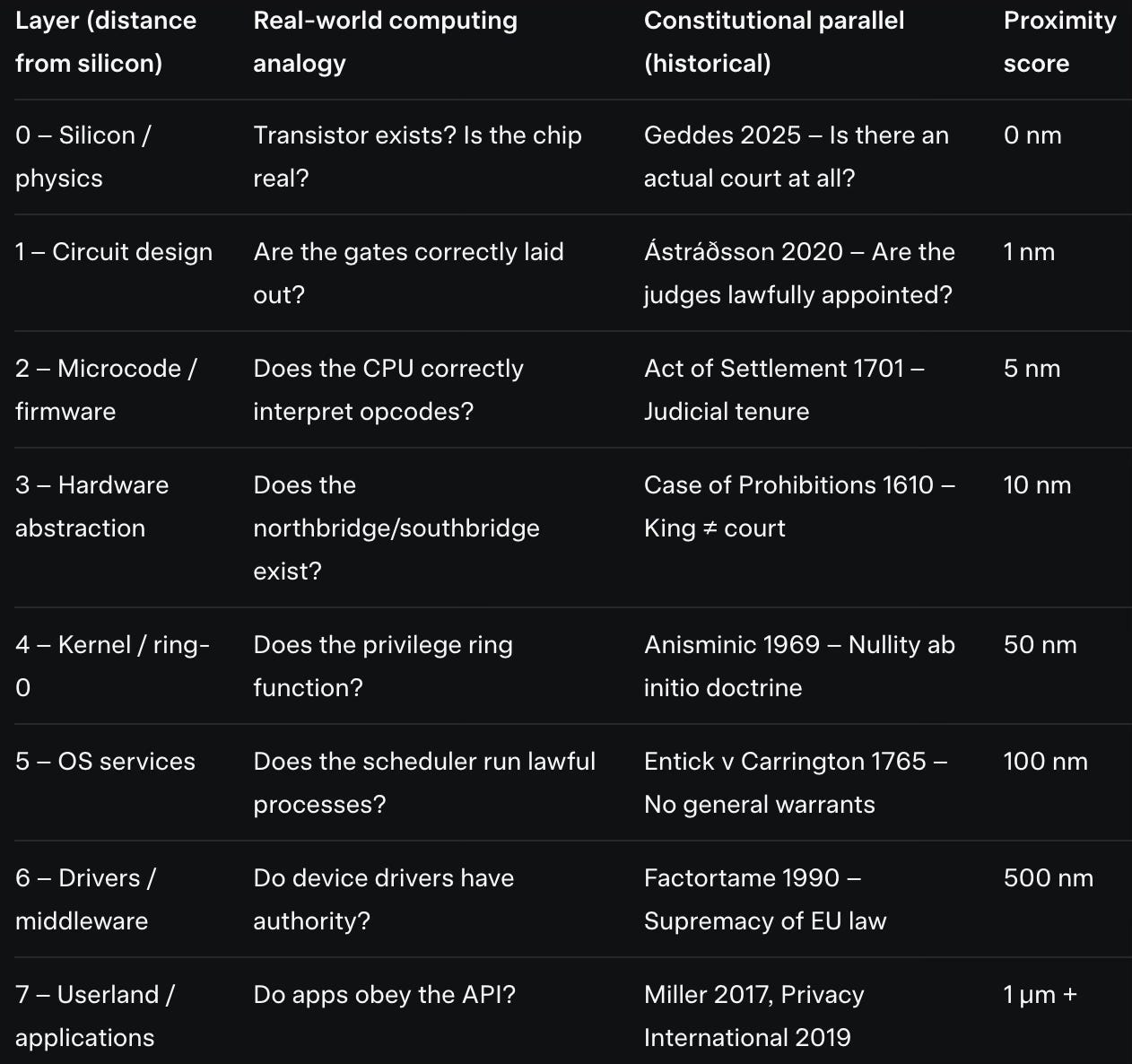
The applications of what I am developing go both to international jurisprudence, as well as beyond law, into other domains like medicine. Law is the very last vertical to industrialise, because it embodies enormous variation as an innate condition to its being. Yet it does have a hard and binary part — of existence, jurisdiction, standing, service, and paperwork — that is tractable to the engineering mindset. While automation may have run ahead of the governance rules, legal limits, and technical theory, that is an inevitable part of the development of the discipline. I just happen to have a rare combination of skills (like formal methods of software proof) applied to a happenstance legal crisis.
The one constant throughout this, for me, is my readership. You collectively “saved my ass” over and over in the last 18 months when I ran out of money, or needed practical support, or simply stepped up with advice or hospitality. One woman sends me $5 a month via Donorbox. Those “payment received” emails often land at moments when I feel discouraged or depressed. She has no idea of the impact. Thankfully I had a modest windfall recently (from a small inheritance) that has taken the economic heat off me for a bit — I have enough for rent and expenses for a few months, plus costly fees for court filings. Someday I may afford a new laptop — this one is physically wearing out.

I endured years of being vilified and ostracised and deplatformed for my Q analysis, felt the loss of career and alienation of friends and family, then suffered the upheavals and terror of Covid, followed by the yawning emptiness of the “Biden Show” years. We never quite expect “crazy things” to happen to us, but they do! The only question is how we respond to them. I never expected to be facing “ghost courts” and having to master serious constitutional litigation as my next challenge. Whilst the stress has inflicted dents on my health, I am finding happiness in disassembling the administrative state and doing a quality and safety audit.
By persevering I have found meaning and value in the hardship. “Ghost courts” are just a waymark on a longer growth journey: personal, professional, and civic. It is an ordinary “metal fatigue” design problem that might require the lower court fleet to be grounded temporarily, but not the end of the world. The architects and operators don’t need to face professional rebuke or liability, as long as they halt operations when the “court type safety certification” is withdrawn. The legal system can heal from such a setback; pushing automation beyond what the “IT materials” can withstand is just too many “pressure cycles”.

Nothing would please me more than a redemptive ending to the story. I hold no grudge against those caught in the system as its operatives; my own mother spent many years as a court administrator. In a way it is a kind of black comedy, where I turn up with advanced mathematical and philosophical tools and perform “impossible” feats for a litigant-in-person, yet I have no desire to “win”, only to restore truth and repair the broken system. I don’t fall into any of the classes of litigator the State can relate to, so don’t quite know how to respond. That’s OK — I am quietly their friend, not foe, even if they cannot figure it out yet.
It would just be nice if they stopped pressing on with actions that feel indistinguishable from persecution, even though my intention is simply to help fix their faults!
Photographs are from my recent Scottish travels — so you know it is me, not AI!
I used AI to check for legal risk and compliance, and soften a few phrases.
Martin, your name should be listed under "Perseverance" in the dictionary! I've been following you since the pre-covid days, after discovering Q. I find your journey very encouraging, even if I don't understand all the dynamics you're breaching. Keep going! We hear you and support you! The National Citizens Inquiry here in Canada is also alerting the common man of all the challenges we face, a common goal - to correct the system.
Martin, please take care of yourself. It would be an epic tragedy for civilization if you were unable to see your journey through to the end. We're pulling for you. Either you are successful in repairing a fatally flawed system or the system must be torn down by other means and thrown onto the pyre. If it can't go on, it won't. One way or another.