

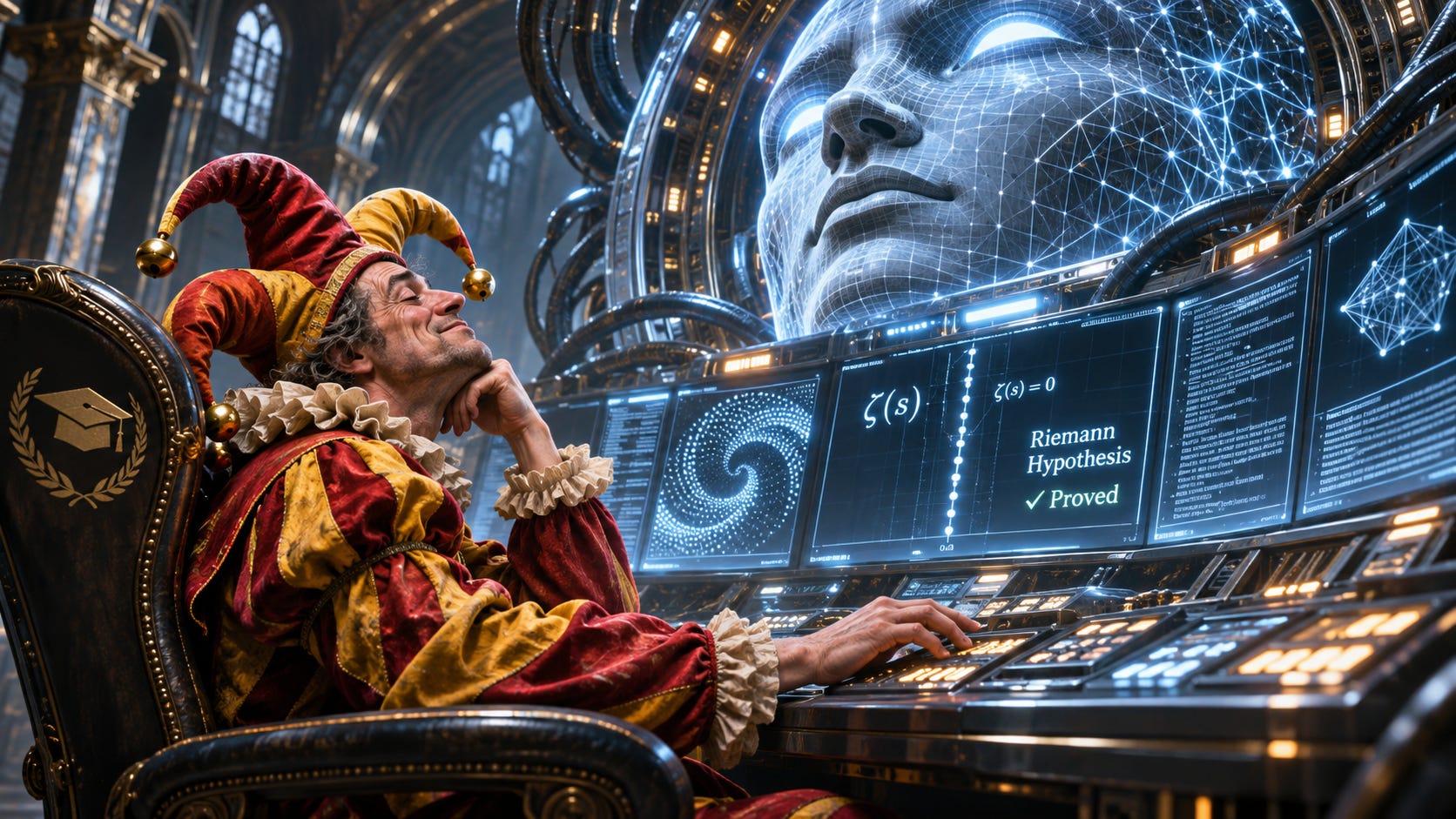
The last week has been extraordinary for the way machine intelligence is revolutionising the practice of mathematics. On 20th November, mathematician Levent Alpöge announced that he and the AI system Claude had proved the Riemann Hypothesis, a longstanding problem concerning the distribution of prime numbers. The result was presented as some 17 million lines of computer-checkable proof, subsequently independently verified by the Lean and Mathlib communities.
For my audience here, the mathematical details are immaterial. What matters is that one of the most celebrated unsolved problems in mathematics has apparently fallen to a collaboration between a human mathematician and an AI system. Remarkably, the formal proof has been verified by machines before mathematicians have fully understood the argument themselves. Further outstanding mathematical puzzles are expected to yield as the technology develops.
Three decades ago I completed a degree in mathematics and computation, so I have some skin in this game, personally and professionally. I am technically aware enough to recognise who genuinely knows what they are talking about, without necessarily being a particularly competent expert myself. The main thing my degree taught me was that I didn’t want to become a mathematician or join academia. My interests are broad, and I prefer a polymath life without the accompanying credentials and recognition.
Being somewhat wayward has led me to an unusual position of doing what I might call “basement-level work in the foundations of knowledge”, but in circumstances involving authority, institutional power, and adversarial intent to deceive. How you label it — fifth-generation warfare or “conspiracy theories” — is secondary to the genuine inquiry into the subversion of consensus reality.
Solving problems about the properties of numbers isn’t going to get you exiled from polite society or punished by the authorities. Figuring out that we are all being lied to, and subjected to unethical manipulation and coercion, is a rather different matter. It carries all the personal, professional, and social risks of being a whistleblower.
Having experienced that ostracism myself, my view of conventional intellectuals and their tools of the trade has changed considerably.
I see a collision coming between cleverness and foolishness.
Large language models and similar reasoning technologies give the intellectual class astonishing new resources to confront the problems facing humanity. One extraordinary mathematical achievement is not, by itself, proof of general superintelligence. But it is a signpost towards machine capabilities that exceed the intelligence we can ordinarily muster for ourselves, across an increasing range of domains.
There are already testimonies online of senior mathematicians having uncomfortable moments of self-reflection as they realise that their personal brilliance can be outpaced by a machine. Their remaining distinctive contribution increasingly lies in formulating interesting questions, recognising important problems, and integrating the resulting discoveries into the corpus of accepted knowledge.
There is an obvious intellectual humiliation in discovering that a lifetime of specialised achievement can be surpassed by software.
But I believe a much greater humiliation is approaching.
I use the term panunwisdom to describe a pervasive failure of wisdom across a society, including among its most educated and intellectually accomplished members. It is not simply ignorance or stupidity. It is the failure to exercise sound judgement in the presence of abundant intelligence, education, and technical expertise.
More importantly, it is a systemic phenomenon. Institutions can organise intelligent people into collective foolishness by rewarding conformity, punishing dissent, and substituting professional consensus for independently established truth. Nobody needs to be individually stupid for the resulting system to become catastrophically unwise.
Indeed, extraordinary intelligence may coexist with extraordinary foolishness, and even contribute to the latter. The smartest participants may become the most effective rationalisers of a corrupted consensus.
The critical distinction is between the ability to reason brilliantly within an accepted framework and the wisdom to recognise when the framework itself has been corrupted — and possess the courage to stand against it.
This is where mathematics provides a revealing contrast.
We have now developed machines capable of producing millions of lines of mathematical reasoning, together with formal verification systems capable of checking their logical correctness. The intellectual achievement is immense. It will get you praised and rewarded, and rightly so.
Yet the same civilisation struggles to establish the truth of its own political, historical, and institutional narratives. There is no equivalent verification system for detecting when the premises of public discourse have been manipulated, inconvenient evidence suppressed, or the boundaries of acceptable inquiry deliberately constrained.
Formal verification can establish that a conclusion follows from its premises. It cannot establish that an institution supplying those premises is acting honestly.
There is a remarkable inversion here. In mathematics, we can now have proofs that machines verify before human beings fully understand them. In public life, we have narratives that almost everyone understands and repeats without their foundations ever having been independently verified.
Meanwhile, many of the same intellectuals wore depersonalising muzzles during Covid, obeyed edicts to poison themselves without thinking, and scorned those who questioned the official narrative. Their celebrated critical faculties deserted them precisely when independent judgement mattered most.
They could interrogate a mathematical proof but not a government proclamation. They could detect a subtle logical error yet fail to recognise the machinery of coercion operating around them. They were comfortable following what was normal, rather than investigating what was true.
The contrast between their specialised cleverness and their practical foolishness is striking. This is not fundamentally a problem of insufficient intelligence. It is a problem of social conformity, moral courage, institutional incentives, and the inability to recognise adversarial deception.
A brilliant mind can be extraordinarily effective at solving a problem that someone else has defined. It may be almost helpless when the real problem is that someone else has deliberately misdefined the situation. And the smarter the person, the more elaborate their excuses for refusing to reconsider can become.
Intelligence helps you solve problems. Wisdom helps you recognise which problems are real, which premises are false, and when someone is trying to deceive you.
That distinction matters enormously as we enter the age of superintelligence.
Our history books have been twisted, generations have been taught propaganda, and entire professional classes have built careers within systems whose underlying assumptions are broken. The intellectual prestige of the participants does not guarantee the integrity of the knowledge they produce.
The collective recognition of having been conned has yet to occur. But that does not mean it won’t happen. I expect that it will, and that the consequences will be profound.
Imagine the moment when people who regarded themselves as society’s most sophisticated thinkers discover that they were among its most thoroughly manipulated participants.
Their problem won’t be that they lacked access to information or the intellectual capacity to evaluate it. It will be that they failed to ask the necessary questions, deferred to the wrong authorities, and protected their standing within institutions rather than their relationship with reality.
That is a different kind of humiliation from being outperformed at mathematics. I was thoroughly outperformed at mathematics by elite mathematicians as a teenager, so I got over that years ago! My quest has been to confront collective foolishness, whether in the specialism of telecoms network performance or in the wider world of accepted narratives.
Being shown to be second-rate at mathematics merely exposes the limits of human intelligence. Being shown to lack the courage or integrity to question foundational assumptions exposes the failure of human wisdom. The difference matters.
There are already many excellent analyses of the risks presented by superintelligent machines, alongside critiques of the ideological conformity of the liberal intelligentsia. What I find missing is an adequate anticipation of a phase change in society where hidden truths emerge, accepted narratives collapse, and the collective folly of supposedly sophisticated people becomes impossible to ignore.
The two developments may arrive together, and not by accident.
Superintelligence offers something that was previously unavailable: the ability to interrogate enormous bodies of evidence, reconstruct historical sequences, cross-reference institutional records, identify contradictions, and trace patterns of deception across domains that human investigators could never realistically integrate.
The complexity and fragmentation of information have long provided protection for those who manipulate public understanding. Evidence can be scattered across decades, jurisdictions, professional specialisms, and incompatible systems. Establishing the underlying reality demands more intellectual effort than any individual can reasonably supply.
Machine intelligence changes that equation.
The same technology that can verify millions of lines of mathematical proof can be applied to reconstructing the provenance of claims, identifying missing evidence, testing competing explanations, and exposing inconsistencies in supposedly authoritative narratives.
It cannot manufacture the honesty of the people who use it. But it can radically reduce the cost of challenging their claims.
Superintelligence could become the most powerful instrument of accountability ever created — or the most powerful instrument of institutional deception.
That is the second half of the collision.
An extraordinarily capable machine operating within a corrupted institutional framework can produce extraordinarily sophisticated support for false premises. If its questions are constrained by authority, its conclusions may merely give existing deceptions an appearance of mathematical inevitability.
The danger is not simply that machines become cleverer than people. It is that we place unprecedented reasoning power at the disposal of people and institutions that have never learned to distinguish intelligence from wisdom.
We could end up industrialising foolishness on a scale never previously possible.
But there is another possibility, and it brings us back to the importance of practical wisdom.
Those who saw through the Covid con, and recognised other forms of institutional manipulation, have acquired skills that conventional intellectual achievement does not necessarily develop. They have learned to recognise adversarial framing, resist social pressure, distinguish evidence from manufactured consensus, and navigate situations where authority itself is part of the problem.
These are a form of street smarts rather than book smarts.
They are not credentials that can be awarded by a university, nor do they necessarily bring professional status. Quite the opposite: they may have been acquired through exile, economic loss, personal suffering, and the painful experience of discovering that trusted institutions were not acting in good faith.
Yet these capabilities may become extraordinarily valuable when specialised intellectual horsepower is abundant and cheap.
The intellectual class has largely been rewarded for operating successfully within established institutions. Those who have lived outside that consensus have been forced to develop different skills: discovering when the rules are dishonest, when the evidence has been selected to mislead, and when apparent expertise is being used to disguise the exercise of power.
The approaching question is not merely who knows the most. It is who knows how to recognise and confront deception when the deceivers are intelligent, organised, and institutionally protected.
That is why I regard the approaching humbling of the intellectual class as a cause for relief rather than concern. The mythology of superior intelligence as a guarantee of superior judgement needs to be dismantled before it becomes the organising principle of a civilisation governed by superintelligent systems.
And the timing matters. We are entering a formative period where “first steps are fateful”. The assumptions, incentives, and moral commitments embedded in these systems will shape whether their extraordinary capabilities serve human freedom or reinforce our subjugation.
Just as superintelligence enters its decisive phase, reshaping how knowledge is produced and how society develops, humanity may be forced to confront the consequences of its own panunwisdom.
It may be uncomfortable, but it could also be cleansing. Those who have learned to exercise independent judgement under adversarial conditions will be in a position to guide those who possess extraordinary technical capabilities but feel increasingly lost when their inherited frameworks cease to make sense.
There are interesting times ahead.
What happens when the people accustomed to being the cleverest in the room discover that they were not particularly wise? What happens when they can no longer dismiss uncomfortable questions by appealing to their qualifications, their professional consensus, or their institutional standing? What happens when the machines can reason more effectively than the experts, while the social and moral failures of those experts are laid bare for everyone to see?
The response cannot simply be to demand even more intelligence. We are already making intelligence abundant. Intelligence itself can be part of the problem when it is deployed to rationalise falsehood or defend corrupt authority.
What remains scarce is the courage to confront inconvenient reality, the humility to acknowledge error, and the independence of judgement to recognise when authority has become an obstacle to truth.
We are approaching a civilisation in which intelligence may become cheap and ubiquitous, while wisdom remains painfully scarce.
And cleverness without grace and mercy is dangerous when authority is adversarial.
There is a further moral trap here. If the coming reckoning merely replaces one arrogant intellectual hierarchy with another, then nothing fundamental has been learned. The people who were mocked and ostracised must not simply become the new class of people who mock and ostracise.
The purpose of exposing foolishness is not to celebrate the humiliation of others. It is to restore our collective ability to perceive reality, exercise sound judgement, and act with integrity.
There will be people who have been terribly wrong, including those who inflicted genuine harm while believing themselves righteous. Recognising that failure must be accompanied by accountability. But the restoration of wisdom also requires grace for those willing to acknowledge their errors, and mercy towards those struggling to understand how they were deceived.
Wisdom is not merely knowing what is true. It is knowing how to act upon the truth without becoming another instrument of domination.
The great opportunity is not merely to make humanity cleverer through machines. It is to use this upheaval to confront the collective foolishness that our cleverness has so often concealed.
The age of superintelligence may be arriving at precisely the moment when humanity most needs a lesson in humility.
And that lesson is not about how much we know.
It is about how thoroughly we have allowed ourselves to be misled, whether we have the courage to stop participating in our own deception, and whether we can extend sufficient grace and mercy to help others do the same.
Superintelligence may transform what humanity is capable of knowing. Only wisdom can transform what humanity is willing to face.

I remember in the 90's buying a snowboard for my daughter. I was requested to sign a form reliving manufacturer liability, I started questioning this requirement, but finally signed to my daughters relief.
They make the rules, you choose to play in their game.