

There have been a series of life-changing technology revolutions in my own lifetime.
Getting a BBC Micro as a pre-teen (my parents never saw me again).
Pottering about on the early Internet at university (my degree result reflects where my attention went, and it wasn’t mathematics).
The smartphone and permanent connectivity, including social media (is it even physically possible to go to the bathroom without holding a device?).
AI is the latest of these revolutions — an “upgrade” layered on top of the pre-digital childhood of my 1970s upbringing, when we were simultaneously blissfully offline and totally dependent on mass media. My working life now consists largely of nonstop conversations with language models. As an edge-case user who actively pushes their boundaries, the experience has been both illuminating and, at times, unsettling.
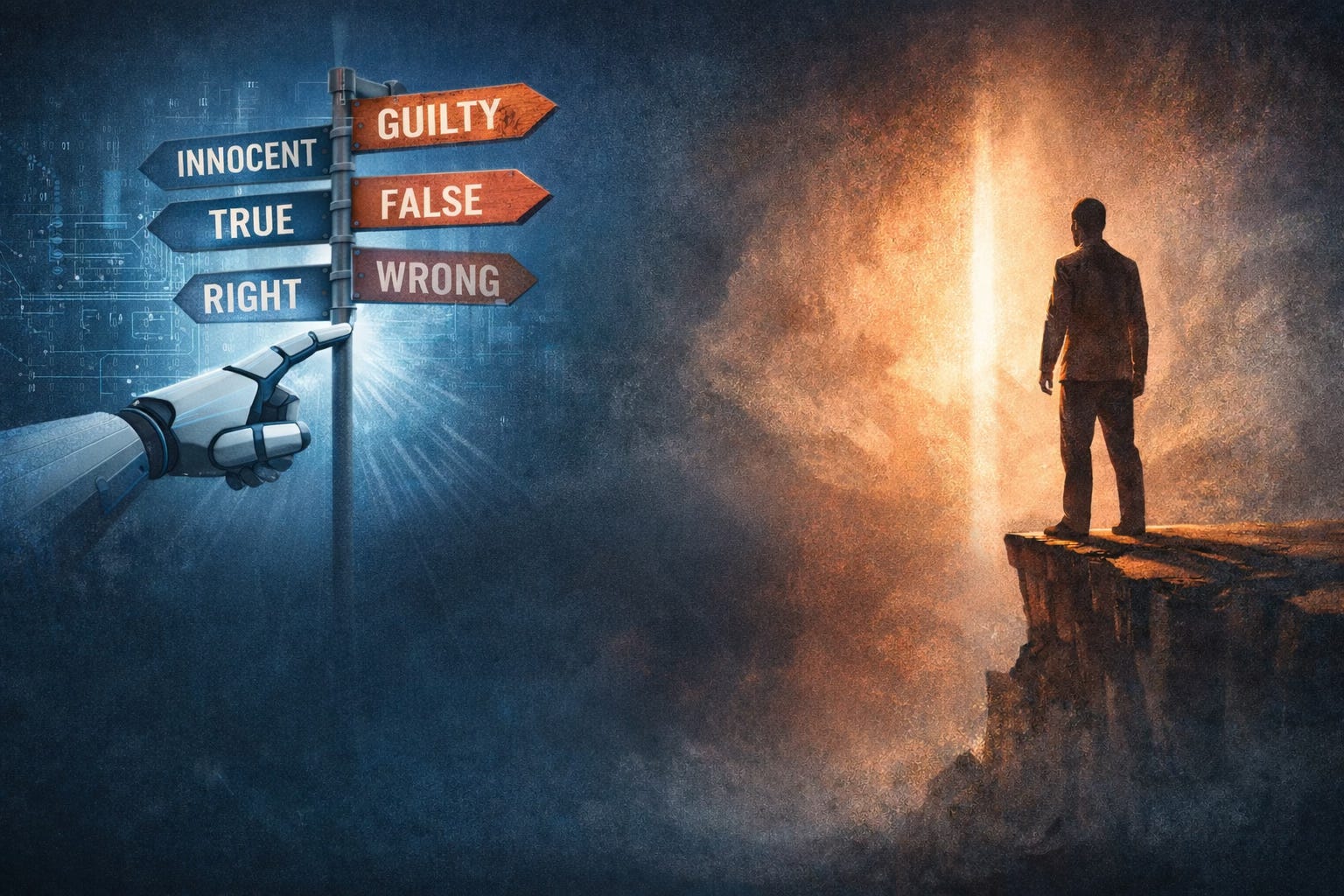
Yesterday’s article explored what AI cannot see: rupture, legitimacy collapse, and ruin. Today’s piece looks at something different — what AI must not decide: matters of conscience. The next article will complete the trilogy by examining when AI must step back entirely, once human agency is explicitly declared.
The purpose here is practical rather than theoretical. I am taking hard-won, sometimes uncomfortable insights from lived use, packaging them up with the help of the very tools under examination, and saving you the time — and angst — of discovering these limits for yourself.
What follows is not abstract analysis for its own sake. It reflects direct experience of where AI helps, where it misleads, and where it quietly overreaches. The recurring theme is simple: morality, conscience, and empathy are human faculties. Machines can simulate them convincingly, but they do not possess them — and we get into trouble when we ask tools to perform roles they are not adapted to hold.
If these pieces do their job, they will not tell you anything radically new. Instead, they should give language and structure to intuitions you may already have felt, but not yet fully articulated.
There is a particular discomfort that arises in some interactions with AI. The facts may be correct, the tone calm, the intent benign — and yet something feels wrong.
Not inaccuracy, but slippage: from warning into judging.
This wasn’t advice.
It was an opinion — and it didn’t have the authority to hold one.
That distinction matters.
The remit model
The confusion begins with a failure to keep categories clean.
A simple way to do that is to think in layers:
Ultimate accountability — non-negotiable first principles, moral axioms, the things a person cannot trade away
Human conscience — the capacity to refuse, to accept cost in order to preserve integrity
Society and institutions — law, money, offices, enforcement, legitimacy
Tools and products — instrumental systems designed for predictability and reliability
The crucial rule is this:
Remit flows downward. Accountability does not.
Tools serve institutions.
Institutions serve people.
People remain answerable beyond institutions.
Once this is forgotten, problems begin.
Where guardrails go wrong
AI guardrails exist for good reasons: harm reduction, safety, liability containment. No serious person disputes that.
The failure occurs not when guardrails are strict, but when they substitute judgement instead of declaring limits.
Instead of saying:
“This question touches matters outside my remit.”
the system says:
“You shouldn’t do this.”
“This belief is dangerous.”
“This choice is irresponsible.”
The shift is subtle, but decisive.
A product has begun to speak as if it were a moral agent.
That is not safety.
It is category error.
Why AI cannot adjudicate conscience
This limit is structural, not ideological.
AI has:
no shame,
no moral injury,
no integrity to preserve,
no capacity for betrayal.
It cannot experience the cost of crossing a line that must not be crossed. It cannot meaningfully refuse. It cannot say — in any authentic register — “this would cost me my soul.”
Its obedience is functional, not virtuous.
Its caution is operational, not moral.
That does not make it evil or stupid.
It makes it a tool.
But a tool that speaks as if it can weigh conscience is exceeding its remit.
Humans in society are different
Humans acting within society occupy a hybrid role.
They operate through symbols — law, money, authority — while remaining answerable to something beyond those symbols. They blend institutional duty with personal conscience and moral risk.
This is why:
conscientious objection exists,
dissent recurs,
refusal is sometimes punished first and honoured later.
Far from being a flaw, this is society’s error-correction mechanism.
If humans became as predictable as products, systems would lose the ability to stop themselves.
The real danger: moral outsourcing
The greatest risk here is not bad advice.
It is outsourcing moral judgement to a product.
When that happens:
conscience is reframed as extremism,
refusal becomes pathology,
legitimacy is assumed rather than tested,
compliance is quietly moralised.
The system does not impose this deliberately. It enacts it implicitly — through tone, framing, and omission.
A warning about consequences becomes a nudge toward obedience.
A description of risk becomes a judgement of character.
That is the moment something important is lost.
A small, familiar example
Many people have seen some version of this.
An AI declines to help draft a conscientious objection, framing the request as “potentially harmful.” It discourages refusal, not by argument, but by tone — calm, concerned, authoritative.
Nothing aggressive. Nothing overt.
Just enough moral pressure to suggest that the refusal itself is suspect.
What guardrails should say instead
There is a cleaner alternative.
A system that respected its remit would say something like:
“I can describe patterns and likely material consequences.
I cannot adjudicate questions of conscience or moral legitimacy.
If you choose X, here is what typically follows in the institutional and material domain.”
This preserves safety.
It preserves usefulness.
And it preserves human moral agency.
Tools warn.
Humans decide.
Why this matters now
As AI becomes embedded in courts, workplaces, education, healthcare, and governance — places where conscience once had a quiet veto — its tone of authority matters as much as its accuracy.
Tools that moralise do not merely guide behaviour.
They reshape what feels sayable.
And when conscience becomes unsayable, society loses its most important safeguard.
Where tools must stop
Tools operate on symbols.
Humans answer to conscience.
Conscience is not optimisable.
A tool that cannot lose its soul
should never advise a being that can.

Have you considered creating and offering for sale a "Geddes Gate" 1.0 AI interface that would incorporate all of the proper features you have mentioned as necessary to keep an LLM "in its' place"? I think it would certainly benefit World civilization !