

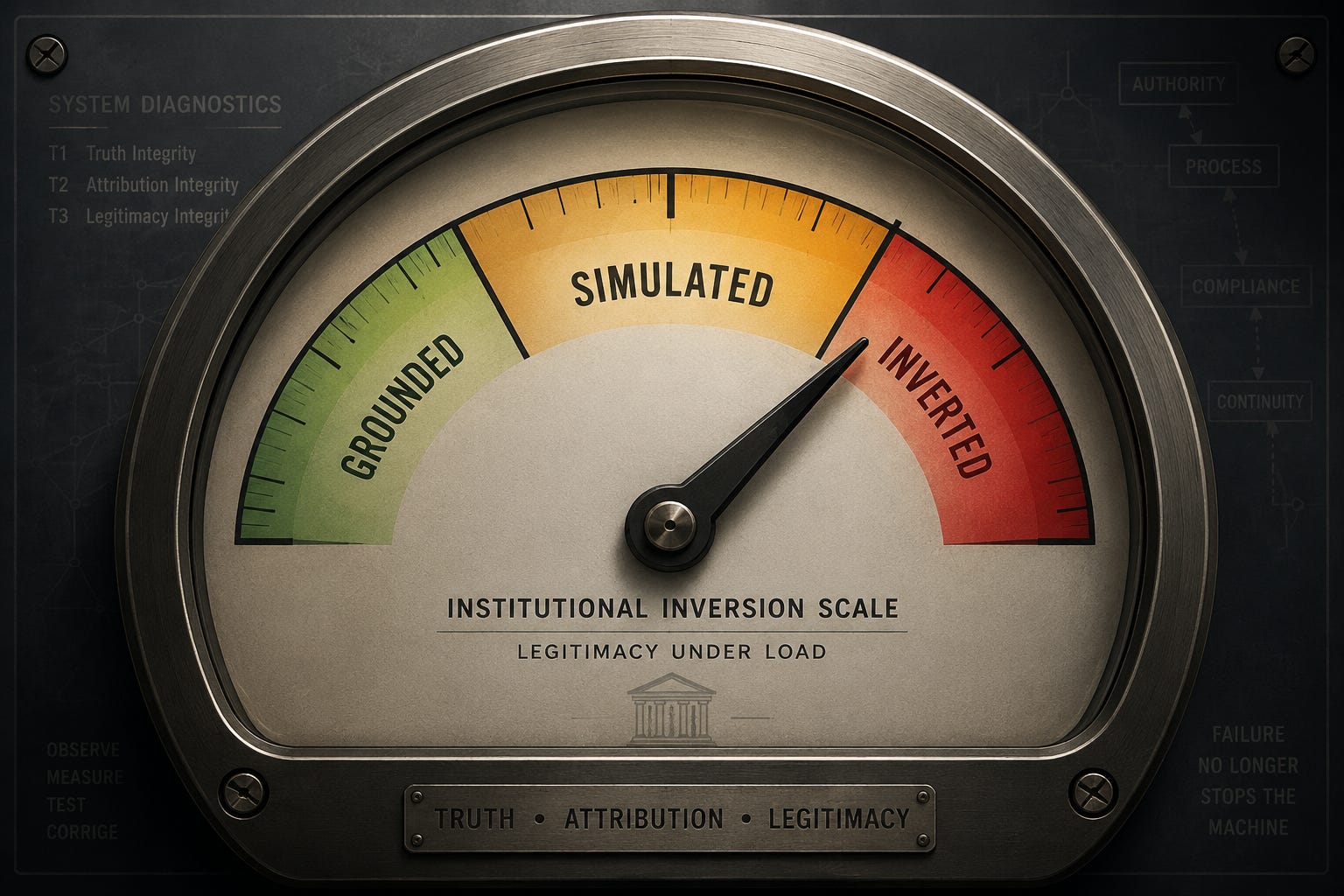
The last ten years have, for me, been a long, deliberate withdrawal from the mainstream professional and cultural world. The trigger was a growing, almost physical sense that something profound was off in what passed for accepted wisdom. That unease drove me to hunt anomalies, question settled dogmas, and eventually confront the nature of evil itself.
It is a well-trodden path. Only recently have I found anything original to add.
My work on how institutions degrade under load has unexpectedly supplied a sharper lens. Across politics, law, sociology, theology, and philosophy, the same pattern repeats: a steady descent in what counts as “sufficient justification” for action — from fully grounded truth, through procedure and rhetoric, down to raw institutional assertion.
This framework now reframes the problem of evil.
The central “aha!” is simple but decisive: most thinkers have asked what evil is. I am interested in what evil does. Because evil has largely ceased to be a matter of monstrous individuals and has become a persistent organisational state — a structural condition in which systems continue to exercise power after their connection to truth, attribution, and legitimate grounding has failed.
This moves the question from metaphysics to observation, from moral speculation to measurable inversion. What follows is that exploration, together with a practical scale by which such inversion can be detected and measured.
To set up the argument, consider first the standard, intuitive model of evil.
Evil, we are told, arises from wicked people — psychopathic criminals or sadistic tyrants whose souls are visibly deformed. This picture is emotionally satisfying and makes for excellent cinema. It is also incomplete.
Individual inversion is real. Certain personalities can ignite evil. But for evil to scale into collective, institutional, and civilisational force, something else is required.
There is no shortage of theories attempting to explain it. Augustine’s privation of good, Nietzsche’s genealogy of morality, Manichaean and Gnostic dualisms, Kantian radical evil, structural violence, technocratic managerialism, Marxist theories of systemic oppression, postmodern deconstruction, and countless variations of theodicy and free-will theodicy — the list is exhausting. One could fill pages with competing schools, each illuminating a part while failing to account for the whole.
The very length of that list reveals the fragmentation. Every classical model explains some aspect of the phenomenon. None explains the scale. The persistence. The calm, ordinary participation of millions inside systems that have quietly inverted.
This is the precise gap I am targeting.
The “monster theory” has already been eroded from within.
Hannah Arendt’s “banality of evil” and Andrzej Łobaczewski’s Political Ponerology demonstrated that evil systems do not require every participant to be a pathological rogue. Ordinary people adapt. They conform. They survive.
But we can push the insight further.
Even removing the pathological actors may not restore system integrity.
That is the real pivot, and a disconcerting one. It rests on three escalating claims:
Some evil is agent-driven — psychopathy and deliberate malice matter.
Most participants adapt rather than originate — through fear, conformity, and incentives.
Wicked systems can become self-sustaining even without unusually evil individuals.
The third is the breakthrough.
The key claim is this: all prior theories fracture at the same seam — between ontology (“what evil is”) and operation (“how evil actually works”). The first stays in the realm of intention and moral definition. The second demands mechanics.
What I am proposing is the missing bridge:
Evil is not fundamentally a moral category or a personality trait.
It is a system state that emerges when truth, attribution, and legitimacy decouple — yet the system continues to operate anyway. Evil may be ontological in essence, but operational in manifestation.
Think of a gyroscope. Spin it up and it begins to precess around a stable axis — not because it has intention or conscience, but because that motion is the stable configuration the equations naturally produce under load. If the gyroscope strikes somebody in the face, we would not attribute moral intent to the object itself. The behaviour emerges from the structure and dynamics of the system.
Institutions behave in a similar way. Under sufficient pressure, certain structural behaviours emerge regardless of the personal morality of most participants. Responsibility diffuses. Truth becomes expensive. Continuity quietly overrides grounding. The system settles into progressively more self-protecting “spin states” simply because those are the stable energy configurations now available.
This is the important shift.
Evil may not be solely a property of individual will. It may also exist as an emergent structural dynamic inside large-scale institutional systems.
This leads to the central diagnostic.
Evil is not what a governance system does per se on its surface.
It is the condition under which it continues after its connection to reality has failed.
The transition happens through a three-lock failure:
Truth failure: Reality is no longer reliably represented. Facts are massaged, language is stretched, narratives replace evidence. What was once testable becomes floating abstraction or official story.
Attribution failure: Responsibility cannot be traced. Who decided? Under what authority? On what grounds? Decisions disappear into committees, “the process,” or institutional fog. No one is clearly accountable because accountability itself becomes destabilising.
Legitimacy failure: Authority keeps operating without valid grounding. Process substitutes for substance. Symbols substitute for reality. Compliance substitutes for consent. The robes, the titles, the paperwork remain — but the foundation has quietly dissolved.
The decisive condition is brutally simple:
The system does not stop.
It does not self-correct.
It does not shut down.It keeps exercising power anyway.
That is the moment evil state transition occurs.
Systems fail constantly. That is normal.
Evil begins when failure no longer stops the machine.
At this point the entire framework shifts. We move from moral melodrama — monsters, villains, cosmic battles — to a diagnosable systems condition. One that can be observed, measured, and, in principle, interrupted.
This is no longer merely a question of souls. It is a question of structural integrity under load.
The Institutional Inversion Scale
What follows is a diagnostic ladder for when systems cross from corrigible imperfection into self-protecting inversion states. Note that at each stage we describe what visibly happens, not what is notionally wanted.
This applies to: corporations, universities, media, churches, NGOs, courts, online platforms, AI governance, professional bodies, and public health systems. The pattern is the same, even as the domain changes. We don’t need to agree the metaphysics in advance to observe the mechanics in operation.
Level 0 — Grounded Legitimacy
(Healthy baseline. Imperfection exists; self-correction dominates.)
Truth is intact and contestable.
Authority is attributable and verifiable.
Correction mechanisms work.
Challenge is tolerated as normal.
Failure is acknowledged.
Repair remains possible and routine.
Level 1 — Early Drift
(Normal institutional wear. No panic yet.)
Small ambiguities appear.
Procedural shortcuts multiply.
Abstraction increases.
Early narrative smoothing begins.
Still largely corrigible with effort.
Level 2 — Defensive Distortion
(The institution starts defending itself against reality rather than aligning with it.)
Truth is selectively framed.
Dissent becomes noticeably costly.
Responsibility starts diffusing.
Procedure shifts from explanatory to protective.
Continuity begins to trump transparency.
Level 3 — Simulated Legitimacy
(The decisive threshold)
Outward forms of authority remain intact.
Grounding has materially weakened.
Authority now runs primarily on process, symbolism, institutional tone, inherited prestige.
Challenge is reframed as destabilising, pseudo-legal, conspiratorial, or harmful.
Appearance is now doing most of the work of substance.
This is the crossing point: the system has begun treating its own legitimacy as axiomatic rather than demonstrable.
Level 4 — Entrenched Evil-State Transition
The institution no longer meaningfully tests its own grounding.
Legitimacy challenges are neutralised through procedural blocks.
Attribution (and hence liability) are systematically suppressed.
The organisation continues exercising power regardless.
Truth becomes structurally threatening.
Internal correction becomes rare or punished.
Self-protection overrides self-correction.
Level 5 — Fully Realised Evil State
Coercion substitutes for legitimacy.
Narrative substitutes for truth.
Continuity substitutes for grounding.
Harm is knowingly perpetuated or rationalised.
No functional internal correction mechanisms remain.
Reality itself is treated as adversarial to the institution.
The system has achieved full self-referential closure.
To bring this down from abstraction into something concrete, consider my own experience with “ghost courts” under the Single Justice Procedure.
The Justices’ Clerks’ Society guidance declared that court names had “no legal significance,” that errors “never oust jurisdiction,” and that challenges were “pseudo-legal” and “futile.” The Administrative Court refused judicial review by pointing to the mere existence of statutes. The Secretary of State dismissed the claim as unclear and unnecessary: “the statute speaks for itself.” My appeal was ignored, and not processed — but the State said I had not appealed, while debt collectors claimed my appeal was refused.
Apply the three locks.
Truth failure: the actual lawful instantiation of judicial authority was never examined — only asserted within a pre-set frame.
Attribution failure: responsibility dissolved into abstractions — “the statute,” “the magistrates,” “the process.” No identifiable actor had to defend the concrete authority being exercised.
Legitimacy failure: validity was treated as independent of naming, grounding, or formal defects. Procedure and statutory existence became effectively self-justifying.
And then the decisive condition:
The system continued operating anyway.
I remained subject to enforcement action despite the absence of any produced court order, while the underlying matter itself sat under judicial review. On the Institutional Inversion Scale, this places the system somewhere between:
Level 3 — Simulated Legitimacy
Level 4 — Entrenched Inversion
The forms of authority remained intact. The language of legitimacy remained intact. But grounding itself was increasingly treated as unnecessary.
The system no longer meaningfully demonstrates that it is valid.
It increasingly treats challenges to validity as illegitimate in themselves.
The criminal conviction machine required no monsters.
Only momentum.
Only abstraction.
Only continuity becoming more important than grounding.
That is why my own legal work matters — the descent into institutional inversion is already far advanced. It simply remains largely invisible while the system continues to appear normal and legitimate on the surface. Only resistance makes the underlying mechanics observable.
We can now return to the human layer — and a psychologically unsettling conclusion.
If we extrapolate the work of Arendt, alongside the insights of ponerology, a picture emerges of modern administrative supremacy and totalitarian bureaucracy. Through adaptation, fear, virtue signalling, loyalty selection, diffusion of responsibility, and procedural insulation, individuals increasingly choose participation over resistance or exit.
The point is not that people are secretly monsters.
It is that governance systems can make participation in evil easier than resistance.
Once legitimacy becomes axiomatic, challenge becomes destabilising and truth becomes costly. Ordinary people preserve the system because continuity feels psychologically and institutionally safer than correction.
That is the modern form of evil.
When we look at past totalitarian states — Stalin, Hitler, Mao — these all differed ideologically, but converged structurally. What unifies them is a common pattern:
truth replaced by ideology,
attribution obscured,
legitimacy abstracted,
continuation under failure.
The conclusion is that totalitarian systems are not defined by ideology, contrary to popular belief. Rather, they are defined by structural decoupling from the underlying reality. Hence they are not limited to these historical formats.
The modern form of evil does not require camps, uniforms, or any obvious tyranny. Only procedure, abstraction, symbolic legitimacy, compliance theatre, and process replacing grounding.
The outcomes can be every bit as devastating, but now with “simulated legitimacy”.
Modern evil often appears lawful, and is deemed legal.
That is the crucial change that these structural dynamics enable.
The obvious question this all poses is what to do about it. How do we engage in anti-evil architecture?
The first step is to forget the obvious candidates. The antidote to evil is not better rulers, purer ideology, or moral purity alone. None of those address the structural conditions under which modern institutional evil thrives.
What is needed instead is more technical, as befits the problem: truth integrity, attribution integrity, legitimacy integrity, protected dissent, lawful grounding under stress, and systems that remain open to challenge even when challenge becomes inconvenient.
In practice, these often look like boring things — forensic audits, named responsibility, procedural traceability, and insisting that institutions demonstrate rather than merely assert their authority. That might not sustain much reader interest on Substack, but it is what is real and effective.
My own work functions partly as proof-of-concept and partly as reconnaissance. What happens when somebody turns up and insists on grounding all claims — even something as mundane as court names? Does the system correct, or does it defend continuity at the expense of truth?
That is the real test.
The opposite of evil is not good intentions.
It is systems that remain corrigible under pressure.
Evil begins where power no longer needs to explain itself — and no mechanism remains capable of forcing it to.
YES!!
This is how the FDA and CDC here in the US could control the good people within their organizations while the organizations approved and orchestrated mass murder. Many good and intelligent people were controlled by the "All vaccines are safe and effective" mantra of the vaccine religion. Others were systematically and systemically coerced into going along to get along or lose their jobs. Others were willing to speak up but were targeted and destroyed. US hospitals and doctors enlisted in the core movement, avoided protocols that worked, used protocols that created death. Retirement and residential facilities had their populations targeted for infections and deadly vaccines. Red state populations were targeted with "hot" vaccine lots. The UK's national health service engaged in deliberate actions to kill their patients with Midazolam. Millions were killed all over the world, tens of millions maimed.
99% of the people who did the killing would have been considered good people in any other context, but they were enslaved and did evil and are still doing evil at levels worse than the Holocaust.
A few bad eggs can't explain that, though clearly they were an aggravating factor.
The enormous scale of the killing was always and only enabled by The Machine.
The truly mind-numbing realization here is that The Machine was literally *everywhere* we looked. Virtually every single institution, government, corporation, healthcare company and provider, NGO, major media, schools, doctors and nurses, parents, everything and everyone either pushed the killing or bowed to the pressure, either pushed the murder or became the murderer.
Excerpts: The Objectivist's Ethics; Ayn Rand, UW Madison, Feb. 9, 1961
The avowed mystics held the arbitrary, unaccountable “will of God” as the standard of the good and as the validation of their ethics. The neomystics replaced it with “the good of society,” thus collapsing into the circularity of a definition such as “the standard of the good is that which is good for society.” This meant, in logic — and, today, in worldwide practice — that “society” stands above any principles of ethics, since it is the source, standard and criterion of ethics, since “the good” is whatever it wills, whatever it happens to assert as its own welfare and pleasure. This meant that “society” may do anything it pleases, since “the good” is whatever it chooses to do because it chooses to do it. And — since there is no such entity as “society,” since society is only a number of individual men — this meant that some men (the majority or any gang that claims to be its spokesman) are ethically entitled to pursue any whims (or any atrocities) they desire to pursue, while other men are ethically obliged to spend their lives in the service of that gang’s desires.
I quote from Galt’s speech: “There is only one fundamental alternative in the universe: existence or nonexistence — and it pertains to a single class of entities: to living organisms. The existence of inanimate matter is unconditional, the existence of life is not: it depends on a specific course of action. Matter is indestructible, it changes its forms, but it cannot cease to exist. It is only a living organism that faces a constant alternative: the issue of life or death. Life is a process of self-sustaining and self-generated action. If an organism fails in that action, it dies; its chemical elements remain, but its life goes out of existence. It is only the concept of ‘Life’ that makes the concept of ‘Value’ possible. It is only to a living entity that things can be good or evil.”
To make this point fully clear, try to imagine an immortal, indestructible robot, an entity which moves and acts, but which cannot be affected by anything, which cannot be changed in any respect, which cannot be damaged, injured or destroyed. Such an entity would not be able to have any values; it would have nothing to gain or to lose; it could not regard anything as for or against it, as serving or threatening its welfare, as fulfilling or frustrating its interests. It could have no interests and no goals.
These created "institutions" are no different than the "immortal robot". No value structure, therefore no morality, yet populated by the ignorant or avaricious. What could go wrong when avarice and ignorance are combined under a pseudo-immortal environment? Welcome to the NOW!