

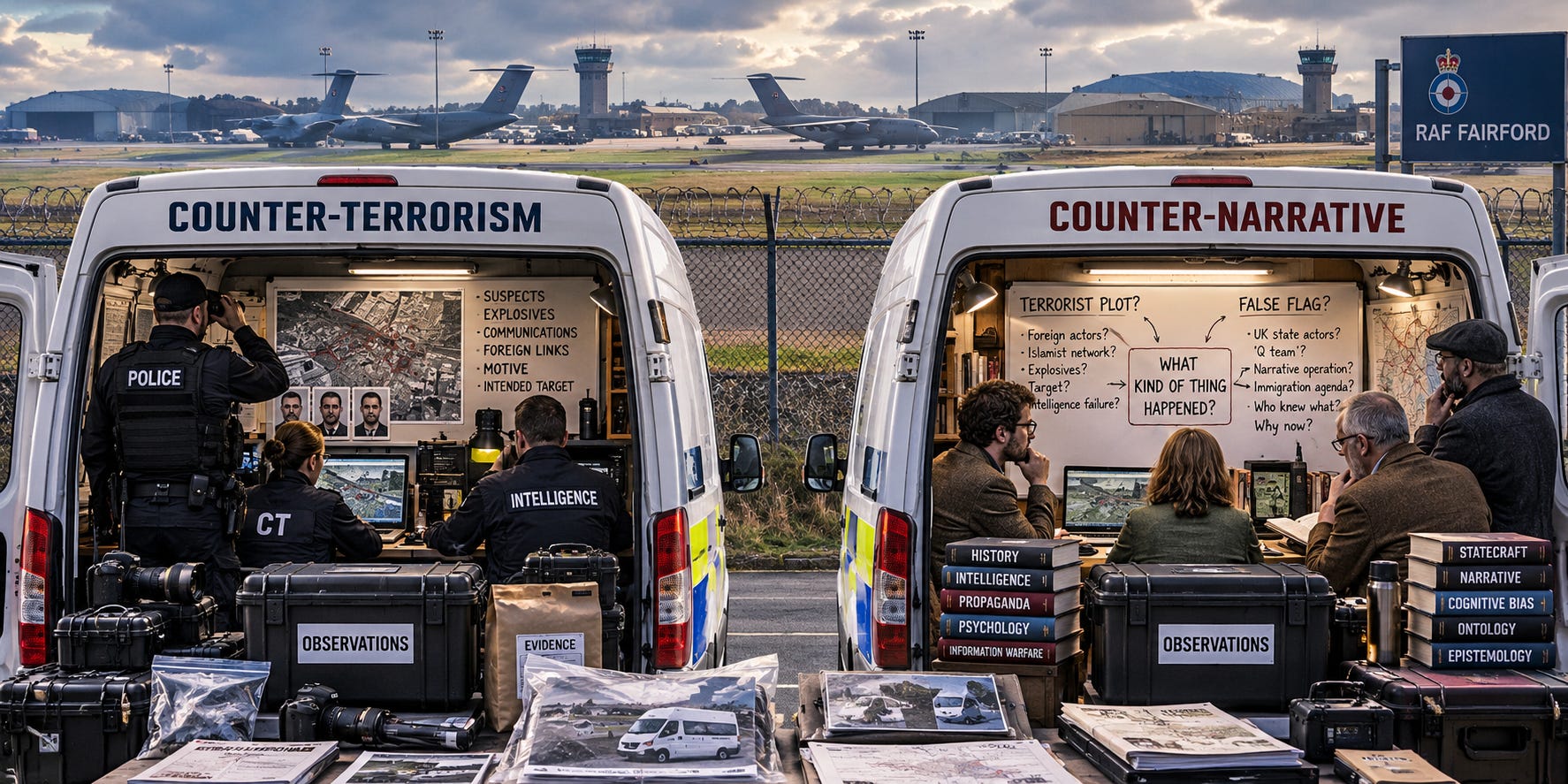
I do actually have a use for the BBC News website. Whenever an Internet connection is on the blink, I tend to use news.bbc.co.uk as my go-to test of whether the connection is active. It’s easy to type, and the state propaganda engine has excellent uptime, so it is reliably diagnostic.
Other than that, the BBC plays no part in my life. I don’t own a television. My radio is never turned on. I never watch iPlayer or other BBC on-demand content. I therefore encounter its output from a detached posture: not as the background soundtrack of reality, but as something I occasionally choose to inspect.
The BBC has a particular value for this exercise: it provides a useful reference point for the “official narrative”. I am less interested in whether every sentence represents some centrally coordinated government position than in the simpler institutional fact that the BBC has allowed it to be published.
Whatever editorial filters, professional norms, and reputational constraints operate inside the organisation did not prevent this framing from reaching the public. Its institutional immune system did not reject it. I can therefore treat BBC coverage as a reasonable approximation of the range of interpretations presently admissible within the British Establishment.
My trigger for reaching for the BBC website was an X post about an ongoing story. I don’t have much interest in the events at RAF Fairford, but I am curious as to how different worldviews filter and organise the interpretation of those events. So when Eric Osborne posted the following, it caught my attention:
⛔ My Conspiracy Theory ⛔
The British deep state planned a false-flag attack on a US military base in the UK, intending to blame Russia and thereby generate public support for the conflict.
The Americans and the Q team knew about the planned attack, prevented it from happening, and then spun the narrative to make it appear as though illegal immigrants were responsible, thereby forcing the UK government to address the immigration issue.
We are watching a movie.
What makes this interesting is that it begins with an orientation: “My Conspiracy Theory”. That orientation licenses a different recognition of the story: not a terrorist attack that happened to be thwarted, but a thwarted false flag. The change in recognition then produces an alternative interpretation of the same events. Finally comes the enigmatic conclusion: “We are watching a movie.”
It is almost a laboratory-grade specimen of its class. Very little new data is introduced. Instead, the category changes. That category change introduces a different ontology — different actors, relationships, intentions and causal structure — into which the existing observations can be placed. The facts have not necessarily changed.
What the facts are facts of has changed.
This makes it worth unpacking, with the BBC’s coverage as our reference model.
Before we dive into the BBC’s take, let’s stop for a moment to consider what pre-categories we are occupying, and how these relate to more conventional analysis of news and propaganda. This is our prolegomenal inquiry: what makes the categories we are about to use attached to reality at all, and what makes the resulting inquiry robust? There are assumptions, boundary conditions, and stances that should first be made explicit.
The first is that we are adopting a neutral and non-normative stance as our meta-category. This is structural analysis: we are trying to identify the patterns being deployed, not litigate the events at Fairford. We need arrive at no conclusion about what sort of geopolitical event actually took place. The story is merely our worked example for illustrating the method and teaching the thinking tools.
The second is that we are limiting the recursive depth of the inquiry by assumption. I am taking it as given that Eric, whoever he may be, is an ordinary member of the public passing comment on events. He is not secretly a member of some military intelligence brigade planting counter-narratives, conducting a psyop, or deliberately leading the masses down false trails. He may be right. He may be wrong. For our purposes, he is just Eric.
The third is that we preserve provenance. A reported fact does not have to be accepted as an ultimate fact about the world in order to be usable. If the BBC tells us that police say five men were arrested, then “the police say five men were arrested” is our datum. We need not independently establish the existence, identity, or conduct of those five men before proceeding. Likewise, Eric’s assertions are facts about Eric’s model, not necessarily facts about Fairford.
This differs from conventional media or propaganda analysis because we are not primarily asking whether a message is true, false, biased, manipulative, or serving somebody’s interests. Those are legitimate questions, but they operate largely inside categories that have already been instantiated.
Recognition warfare moves the inquiry one stage upstream. It asks how the objects of thought themselves came to be recognised: terrorist plot, foreign attack, false flag, intelligence operation, immigration problem. Each category brings with it different actors, causal relationships, relevant evidence, and permissible inferences.
Propaganda can therefore be perfectly factual at the level of individual claims while still operating inside a misleading ontology. Conversely, an apparently outlandish account cannot be rescued merely by adopting a different ontology.
The question at this level is prior to either judgment:
What makes us recognise the thing we are looking at as this kind of thing in the first place?
It is now appropriate to consider what the BBC actually said, and how we might organise that information. I have examined half-a-dozen of its articles on the matter, but am deliberately not linking back to them. This is neither a critique of the BBC’s coverage nor reportage on the latest developments at Fairford. The particulars matter only insofar as they give us something concrete to think with.
We are “combat philosophers”, but operating at conceptual distance.
Before doing so, we need to decide how to organise the material. I will use the categories developed in my earlier ORRODA model: observation, recognition, reconstruction and orientation, while keeping reality as the external constraint against which our models must ultimately answer. We will also preserve provenance — who says what — and chronology, since the ordering of observations constrains the causal stories we can reasonably construct.
The critical distinction is between observation and recognition:
A white van, a masked man, a police cordon or a telephone call can enter our information stream as reported observations.
Terrorist plot, false flag, Iranian operation and thwarted attack are recognitions: they tell us what those observations are observations of.
Orientation comes afterwards, when we begin deciding what the recognised object means and how we should respond.
Our baseline therefore is the series of observations as reported by the BBC:
On Wednesday, residents reported seeing large vehicles parked behind the gates of RAF Fairford.
On Saturday afternoon, a resident says armed police told people near the perimeter to return home and close their doors and windows.
At about 00:45 on Sunday, Gloucestershire Police say they received a report concerning three vehicles travelling towards RAF Fairford.
A local woman says she returned home to find three white vans blocking the road and saw a group of hooded and masked men who ran away when they saw her.
She says she tried to telephone the Ministry of Defence police, received no answer, and called 999 at 01:36. Armed police arrived shortly afterwards.
Another resident says that at around 02:00 he heard shouting and subsequently saw men being held by armed police.
Five men were detained and remained in police custody.
Vehicles were examined by an explosive-ordnance-disposal team, a cordon was established, and aerial imagery showed a remote-controlled robot approaching two stationary white vans.
Residents of 85 homes in Whelford were evacuated.
So far, so good. We are not here to dispute any of these observations. They are simply the ground we have chosen to work from. They may later turn out to be incomplete, mistaken, or differently contextualised, but reopening them is not necessary for our present purpose.
Now comes recognition: what type of object are these observations of?
This is where the often-unexamined categories being adopted become decisive. Interpretation comes downstream and can be completely accurate and rational, yet remain anchored in the wrong category. Recognition is therefore the subtle move. It need not be concealed or deceptive; it usually sits in plain sight, just beneath the surface of the text, quietly establishing what kind of thing we are reasoning about.
In the BBC coverage, we can watch recognition being assembled in stages:
The vehicles are “suspicious”.
The situation becomes a “major incident”.
Counter Terrorism Policing takes over the investigation.
The men move from being detained under explosives legislation to being arrested on suspicion of “preparation of a terrorist act”.
In subsequent discussion, the event becomes a “plot”, and the men become its presumed plotters.
None of this is necessarily wrong. Indeed, each step may be entirely justified by information unavailable to us; that is not our inquiry. What matters is that we can see the recognition function doing its work.
A collection of observations has progressively resolved into an object:
A terrorist plot against RAF Fairford
Once that recognition stabilises, it quietly reorganises the problem:
Three vans are no longer merely three vans; they are vehicles in a terrorist plot.
Masked men become participants in a terrorist plot.
Explosives, if established, become weapons for a terrorist plot.
RAF Fairford becomes its intended target. Police activity becomes the thwarting of a terrorist plot.
Notice what has happened. We have not yet interpreted who was behind it or why. Recognition has done something logically prior: it has told us what “it” is.
Next comes reconstruction.
A recognition—“this is a terrorist plot”—is not necessarily permanent. As further observations arrive, they may fit the recognised object comfortably, or they may begin to place it under strain. Reconstruction is the process by which we reopen the question of what we are looking at, and consider correction by reality.
This does not mean that every inconsistency automatically destroys the existing recognition. Reality is messy, witnesses have partial views, reporting is imperfect, and institutions possess information that is not public. A robust recognition should be able to tolerate some anomaly without collapsing.
But there comes a point where anomalies accumulate, or become sufficiently structural, that simply explaining each one away starts to incur recognition debt. The model survives, but only by adding qualifications, exceptions and auxiliary explanations to preserve the original category.
Significantly, the BBC itself acknowledges that reconstruction remains open. Its coverage explicitly separates “what we know” (in its recognition model) from “what we don’t know”, with the latter including what the men intended to do, whether others were involved, and even how the authorities first became aware of the situation. Elsewhere its framing is unusually candid: “More questions than answers.”
This is important. The BBC has established a recognition — terrorist plot — while simultaneously acknowledging that significant parts of the causal structure within that recognition remain unresolved.
Indeed, we can watch the BBC attempt reconstruction within that recognition. Its security correspondent Frank Gardner identifies a “clear inconsistency” between the farmer’s account and Trump’s claim that the men had been “under view for a long time”.
If Trump is correct, Gardner reasons, “somebody was asleep at the wheel” in allowing the men to get so close to the base. He then considers the familiar model of an intelligence-led counter-terrorism operation, but notes that Whitehall officials say this was not one. His conclusion is striking:
“Nothing about this case looks like that.”
This is reconstruction in almost laboratory form. An anomaly is recognised; a possible reconciliation is tested against further observations; and the existing causal model remains under strain. Yet notice the boundary of the exercise:
The BBC reconstructs within the recognition of a terrorist plot.
It does not reconstruct the recognition itself.
Meanwhile, Fairford gives us several potential triggers for such reconstruction, and perhaps re-recognition along the lines Eric proposes:
A member of the public believes that she stumbled across the activity by chance and raised the alarm.
Yet Donald Trump says the men had been “under view for a long time”.
The BBC reports that the operation was not intelligence-led.
A resident reports unusual activity at the base from Wednesday and armed police moving people away from its perimeter on Saturday afternoon.
The Defence Secretary responds to the farmer’s account by saying that she has only a “partial picture”.
Again, we need resolve none of these tensions. Their importance here is structural. They create pressure to ask whether our existing recognition is complete.
Reconstruction begins when “How do I explain this within the category?” gives way to “Do I still have the right category?”
And now Eric becomes relevant again.
Notice what his post does not principally do. It does not supply us with a competing set of observations: the white vans remain white vans; the masked men remain masked men; the police response, arrests, evacuations and activity around RAF Fairford can all remain exactly where we left them.
What Eric changes is their recognition.
The BBC recognition is approximately:
A suspected terrorist plot against RAF Fairford was detected and thwarted.
Eric reconstructs this as:
A planned false-flag operation against RAF Fairford was detected and thwarted before it could be carried out.
The observations have barely moved. What the observations are observations of has changed.
This is why reconstruction is such a powerful move. Once the recognition changes, the same observations can acquire radically different significance:
Prior knowledge of the suspects is evidence of competent surveillance in one recognition, but potentially evidence of foreknowledge in another.
Police activity before the farmer’s call can be protective action within one model, yet becomes suggestive of a pre-existing operation within another.
Even the apparent interruption of the event can be recognised either as successful counter-terrorism or as the disruption of an operation whose public appearance was itself intended to deceive.
None of this establishes Eric’s reconstruction as true. That distinction is essential. Evidence sufficient to reopen a recognition is not necessarily evidence sufficient to establish its replacement. Reconstruction restores the category to question; it does not answer the question for us.
Now we come to orientation.
It is tempting to draw ORRODA as a simple left-to-right process, but cognition does not conveniently reset itself after every observation. Our existing orientation affects what we subsequently notice, which recognisers we invoke, and which recognitions we regard as permissible in the first place.
This makes the identity of the observer figural rather than incidental, since orientation naturally attaches to identity. Who I am shapes how I orient; how I orient constrains what I can recognise.
So the BBC does not approach Fairford as a blank cognitive slate as each news story breaks. It approaches it as an institution with a long history that orients itself as legitimate professional journalism: authoritative sources are quoted, claims are attributed, uncertainty is qualified.
Official institutions are treated by the BBC as meaningful sources of knowledge, and departures from an established account require evidential justification. Whatever criticisms one makes of the BBC’s historical relationship with official narratives, this institutional orientation constrains the recognitions that can comfortably appear in its reporting.
Orientation therefore creates what we might call a recognition envelope: a bounded space of recognitions that the observer’s existing identity, assumptions and relationships of trust make available at reasonable cognitive cost.
The envelope does not determine what will be recognised, but it conditions what can readily be recognised. Some categories sit near its centre; others require increasingly strong evidence to entertain; some may lie so far outside it that they are rejected before serious consideration begins.
For the BBC, a terrorist plot, foreign-state involvement, an intelligence failure, or a security lapse can all exist within that envelope. A British state false-flag operation involving deliberate narrative manipulation sits much further towards, or beyond, its boundary. This tells us nothing about which recognition corresponds to reality.
It tells us what the BBC’s orientation makes cognitively recognisable.
We can see this orientation expressed particularly clearly in the official commentary the BBC chooses to carry. Asked about possible Iranian involvement, Defence Secretary Wes Streeting explicitly declines to make that connection, but immediately adds:
“We know that Iran and their proxies wish to do us harm.”
He then places the episode within a still wider orientation:
“In the dangerous and turbulent world we find ourselves in, investment in defence is a price worth paying.”
Notice what is happening. Neither statement establishes what happened at Fairford. Instead, they supply the larger threat landscape within which the recognised object is being understood. This is orientation in unusually visible form: here is the kind of world in which this event is taking place.
Eric begins from something close to the opposite orientation, and signals this before we have even reached his first proposition. “⛔ My Conspiracy Theory ⛔” is visually framed by two stop signs. That is doing more work than merely labelling what follows as speculative, as it foregrounds the social prohibition attached to the category:
STOP; dangerous thoughts ahead; this is the sort of thing respectable cognition is trained not to enter.
Eric then steps across that boundary deliberately, much as great comedy draws the line of what is acceptable to say, and then knowingly hops over it. “Conspiracy theory” becomes almost an anti-credential: he is signalling that exclusion from the BBC’s admissible recognition space is not, for him, evidence against a recognition of reality. It may even make the recognition more enticing to readers.
And there is another subtlety: “My” matters too. My Conspiracy Theory marks personal ownership rather than institutional authority. So the title almost compresses the whole contrast into four tokens:
⛔ = prohibited recognition space
My = personal cognitive sovereignty rather than institutional epistemic authority
Conspiracy Theory = officially disfavoured category
⛔ = boundary reinforced
The heading itself is a tiny recognition-warfare artefact.
Where the BBC’s orientation tends to grant institutional claims provisional legitimacy, Eric’s personally grants them provisional suspicion. In caricature: the BBC asks what the authorities know; Eric asks what the authorities need us to recognise.
The stop signs therefore make the post unusually useful for our purposes. They mark the boundary between two recognition regimes. On one side, certain categories are institutionally inexpensive and others prohibitively expensive. On the other, that pricing structure is itself treated as potentially adversarial.
Neither orientation logically determines the truth of the resulting recognition:
Institutional trust can stabilise a correct recognition or protect an incorrect one.
Institutional distrust can expose a false recognition or manufacture an elaborate alternative where none is required.
The important point is that orientation changes the recognition search-space.
We therefore have a feedback loop:
Recognition shapes orientation, but orientation subsequently governs recognition.
Once I am oriented towards the BBC as reliable journalism, “counter-terrorist operation” is an inexpensive recognition and “British false flag” is an extraordinarily expensive one. Reverse that orientation, and the epistemic prices change.
This also gives us the proper place to understand Eric’s final line:
“We are watching a movie.”
It is easy to read this merely as rhetorical flourish, but structurally it is the most expansive orientation in his post. The false-flag claim reconstructs this particular event; its scope is limited. “We are watching a movie” proposes a wider way of orienting towards the information environment itself.
Public events may be staged; official explanations may be scripts; apparent antagonists may be playing assigned roles; and inconsistencies that would otherwise undermine the narrative may instead become evidence that there is another layer of narrative underneath.
The power — and danger — of such a meta-orientation should be obvious. Once adopted, it changes the recognition envelope for everything that follows. Events that would previously have been recognised as contingent, chaotic or contradictory can now become recognisable as scenes in a larger production.
All the world’s a stage.
Again, we need neither accept nor reject this orientation. We only need to notice its scale. “False flag” reconstructs the object. “We are watching a movie” reconstructs the theatre in which objects appear.
Finally we get to decision and action.
In a military setting these words naturally suggest choosing a course of action and then executing it: it’s an enemy aircraft attacking us, so shoot it out of the sky. For our purposes they can be understood more broadly. A decision is the point at which we commit sufficiently to a recognition and orientation for them to govern what we do next.
That commitment need not amount to certainty. We might decide that the BBC’s recognition is probably correct. We might decide that Eric’s alternative recognition is more plausible. Or we might make the much weaker decision that Eric has done enough to make his alternative recognition worthy of investigation.
“I should take this alternative hypothesis seriously” is itself a decision.
That weaker decision is more consequential than it first appears. Eric has punctured the mass media’s orientation–recognition dominance on the story. The institutional account is no longer the only frame within which the observations may legitimately be organised. A different recognition that previously sat outside the admissible envelope has entered the inquiry as a live possibility.
This does not transfer the monopoly to Eric: we have no need to replace automatic trust in the BBC with automatic trust in the dissident. Indeed, doing so would merely exchange one captured recognition process for another. The epistemic gain of plural recognitions is corrigibility: each can now be held against the same observations and tested for how well they survive contact with reality.
The decision, then, may be no stronger than: the category is reopened.
That is arguably the most important effect of his post. Eric does not need to convince us that there was a British false flag, a “Q team”, or a deliberately constructed immigration narrative. He only needs to make those categories thinkable. The ⛔ signs around “My Conspiracy Theory” almost advertise the crossing of the information warfare rubicon:
Here is a recognition that sits outside the normal admissible space,
and I am inviting you to decide to consider it anyway.
From decision comes action.
In an inquiry, action means deciding what to look at next.
If I adopt “terrorist plot against RAF Fairford” as my working recognition, I am naturally drawn towards the suspects, possible explosives, their communications, foreign connections, motives, and intended target.
If I admit “thwarted false flag” as a serious alternative, an entirely different set of questions becomes salient. Who knew what, and when? Why was there unusual activity around the base beforehand? What does Trump mean by saying the men had been “under view for a long time”? How does that coexist with the BBC reporting that the operation was not intelligence-led? What evidence would actually discriminate between the competing recognitions?
There is also a strikingly compressed example of decision and action in Trump’s account. He says: “We had them under investigation. They were looking to do big damage to our fort”, before concluding:
“We had them under view for a long time, and we got them.”
Whatever the underlying facts ultimately prove to be, the structure of the statement is revealing. A recognition has become operational: these are dangerous actors threatening the base; surveillance follows; eventually, “we got them”.
Decision and action are therefore not merely what happens after the epistemic work is finished. They determine what happens next to the epistemic process itself.
This is where ORRODA stops looking like a pipeline and reveals itself as a loop:
our actions determine what we investigate;
our investigations generate new observations;
those observations enter recognisers already conditioned by our existing orientation.
The output of one pass becomes part of the machinery of the next.
The danger should now be apparent. A mistaken recognition does not merely cause us to interpret the evidence we already possess incorrectly. It can determine which evidence we ever go looking for.
A sufficiently entrenched recognition can therefore become self-reinforcing:
we investigate the questions it makes sensible,
obtain the answers those questions are capable of producing, and
take those answers as further confirmation that we recognised the situation correctly in the first place.
This is why recognition warfare operates so far upstream of conventional propaganda. Control the recognition, and you do not merely influence the answer. You influence which questions get asked.
So this Fairford–BBC–Eric trio is recognition warfare in miniature. What matters to me is that you have had the stamina to read this far and see the whole structure without needing to resolve the underlying contention.
By analysing the process at the meta-level, you have given yourself a new, higher-order position from which to observe and orient. You no longer have to choose immediately between the recognitions being offered to you. You can inspect the machinery by which they are produced, the orientations that make them admissible, and the actions they invite you to decide to take.
Prefabricated recognitions, whether supplied by incumbents or challengers, can be kept in the mental laboratory for long enough to become objects of recognition themselves.
That is the cognitive move I am trying to teach.
Enough of you will have read this far to have learnt it.
👁️ Well done! 👁️
That was a very interesting exercise, Martin.
Several years ago, I became aware that most of the population cannot hold unresolved topics or separate possibilities about an issue or event in their minds for long, if at all.
For decades, I have visualized my mind as having shelves where I could put interpretations of issues or events I could not be sure of, while over the years I watched for better evidence until I could consider the matter "resolved", at which point the box containing that interpretation was moved from the Possibles shelves to the True or Proven or Resolved shelves. I'm sure you can imagine how crowded those shelves became from when I awakened in 1983 to 2017, when many began to be resolved!
For a long time it never occurred to me that this was a rare talent, but gradually over time, I became aware that most people cannot do this. They cannot hold in their minds unresolved interpretations. They see the matter, they tag it with some category, and that resolves it for them.
Apparently, this is partly related to IQ, but I suspect a lot of it is related to whether a person is comfortable with allowing uncertainty into their lives, which brings a kind of difficult emotional energy most find too "jangly" to tolerate for long.
Perhaps having a system like yours to help people understand this kind of uncertainty can help them hold themselves open to that jangly energy and not have to rush to judgment right away.