

Sometimes I wonder if I could be arrested and tried for treason.
Not because I have knowingly aligned myself with any enemies of the sovereign order or humanity, but because in an information war it can be extraordinarily difficult to recognise who is ally and who is foe. “Friendly fire” on social media and in newsletters is, I would argue, an intrinsic part of testing boundaries and locating the root of the conflict. We repost things partly to see what comes back. We probe, compare, challenge, and sometimes get things wrong. That is how we discern.
The accusation would presumably be one of giving aid and comfort to the opposition. But when the actors are avatars rather than soldiers in uniform, and messages are deliberately crafted to appear as if they come from one’s own side, where would culpability even begin? And would it be just to judge anyone on an isolated, misaimed “shot in the dark,” rather than on the totality of their engagement with the digital battlefield?
This is not merely a hypothetical legal puzzle. It exposes a fundamental problem of information warfare: before we can decide how to respond to something, we first have to decide what we think it is.
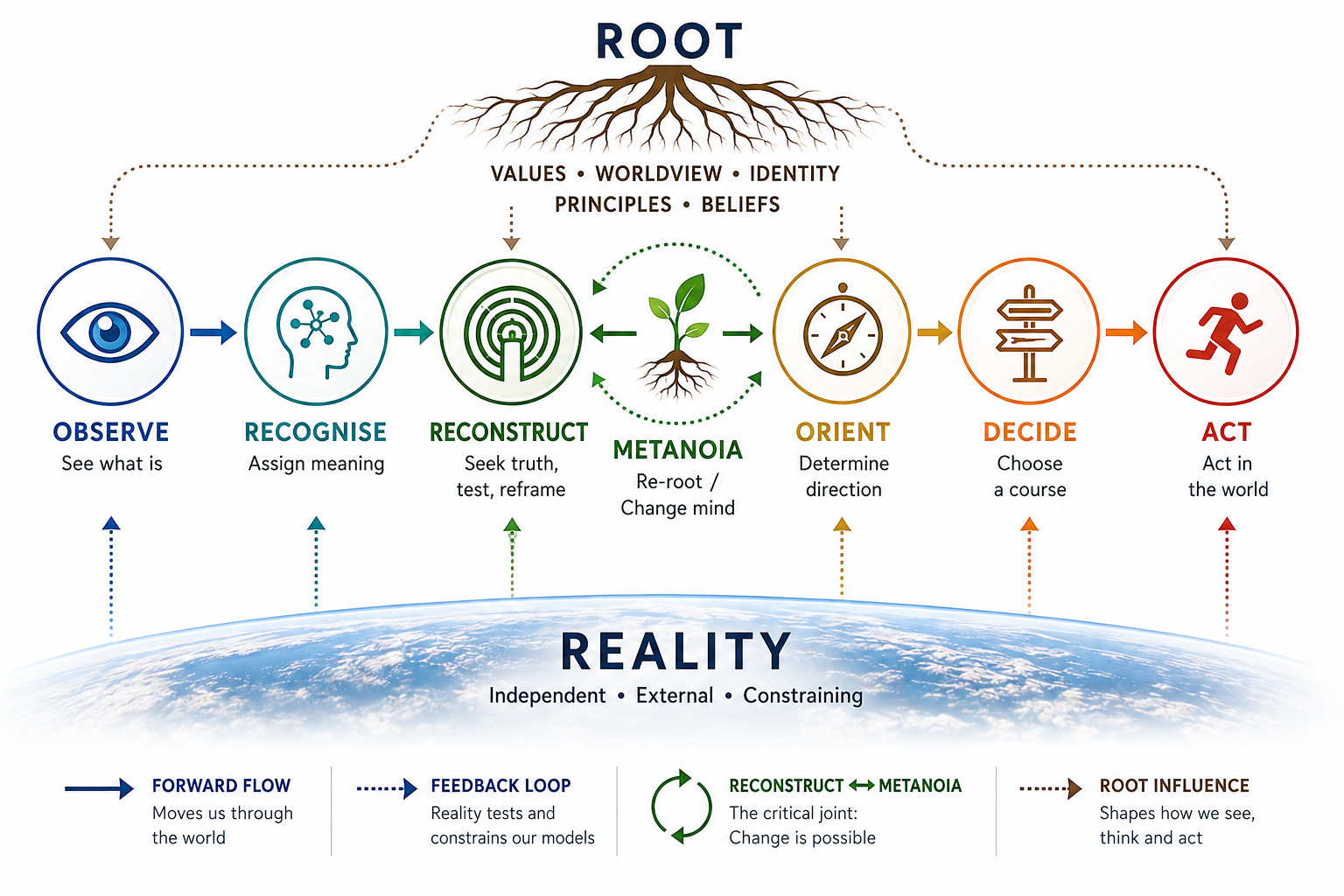
In principle, this dilemma is already contained within USAF Colonel John Boyd’s famous OODA loop: Observe, Orient, Decide, Act. “Keyboard warriors” ingest enormous quantities of information as they observe the digital landscape. They integrate those observations into some working model of what is really going on, orient themselves accordingly, and make choices in cyberspace and the physical world. Messages are selected and amplified; rival messages are challenged, ignored, or suppressed.
But there is a great deal happening between Observe and Orient.
What I want to offer here is a slight refinement and reorganisation of Boyd’s 1970s model to better fit the cognitive war zone of the 2020s. I am building on a substantial body of established work documenting the dynamics and strategies of fifth-generation warfare and beyond. The novelty, if there is one, lies in making some of the hidden machinery more explicit: in the precision and architecture of the framework, and its closer alignment with non-kinetic conflict.
The result is a shift in emphasis, not a radical rewrite of proven doctrine.
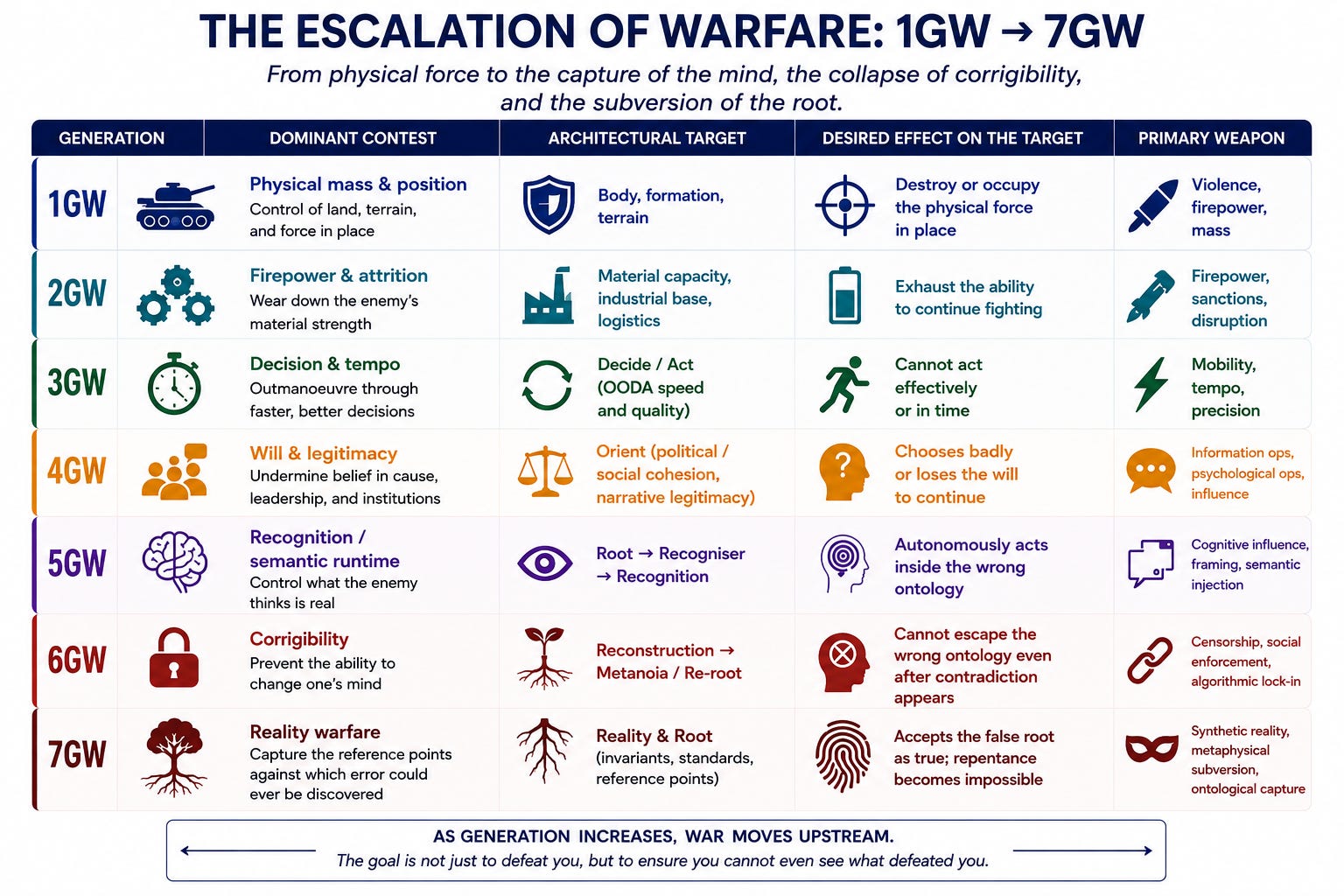
Before unpacking that refinement, it helps to see where it sits in the longer progression of warfare.
I am not writing this for a military intelligence audience, and potentially not even for my present Substack readers. I am writing with another audience in mind: academics, lawyers, journalists, administrators, medics, and other professionals who may find themselves trying to make sense of changes or announcements that, as I write, remain impending and incipient.
Some of those readers may be shocked. Some may discover that assumptions they regarded as settled are suddenly open questions. Others may simply want a conceptual map of how large populations can observe much the same world yet arrive at radically different understandings of what is happening within it.
So I want to avoid getting lost in the specific controversies here. This is not an attempt to settle elections, pandemics, intelligence operations, geopolitics, theology, or any of the other battles that have consumed the last decade.
It is an attempt to distil what can be learned from the experience of actual narrative warfare.
The recurring theme of my work in recent months is that engaging with reality is a wonderful aspiration, but, like all good things in life, you can have too much of it. There is a central tension in any form of action under constraint: our model can take account of only so much reality. We therefore have to compress what we observe into something smaller and more manageable, so that we can act upon it.
This is a normal and necessary part of governance, military affairs, and everyday life:
This aircraft is a bomber. I don’t inspect its bomb bay every time; I recognise it from its shape.
This person is the current President. I don’t review the election audit trail and inauguration at every mention of their name; it is a shared recognition.
This administration is the lawful government. I don’t examine the appointment records of every official before engaging with it; it is an ambient recognition of the state.
The challenge is that not every recognition is right—and that is not an argument against the shortcut. We cannot audit every claim back through every layer of its provenance; action has to proceed under uncertainty. But at some threshold of mismatch between the claimed recognition and the observed data, we must instead trigger a reconstruction of whether that recognition remains justified.
Maybe it isn’t a bomber aircraft, but a camouflaged decoy.
Maybe it isn’t a president, but a Manchurian candidate.
Maybe it isn’t a government, but an occupying belligerent impostor.
The “aha!” is that recognition is a logically separate step from orientation—a first-class object in its own right. The moment we recognise our observations as being this kind of thing, rather than that kind of thing, we have already imported a baseline from which every subsequent evaluation begins. This creates an asymmetry for any attacker: it is easier to subvert the recognition function than to manipulate all the downstream inferences that flow from it.
To bring this to life, let’s take healthcare, purely for illustration rather than resolution. If “it” comes from the Centers for Disease Control and Prevention, then the natural starting point is to evaluate it as something to do with diseases, their control, and their prevention. Contested topics such as vaccines are then framed along a “pro-science” to “anti-vaxxer” continuum—one that has already imported a particular ontology (medicine) while excluding others (for example, military).
The crucial point is that all of us, by necessity, maintain a cache of recognitions. It’s a BMW because I recognise the shape of the grille; I don’t stop to establish whether someone has fabricated a convincing fake at home with a 3D printer unless I have some reason to doubt it.
Like any repository of data, that recognition cache can become outdated—or be poisoned by an adversary.
There are actually three objects here:
Root → Recogniser → Recognition
The Root supplies the underlying trust assumptions.
The Recogniser resolves observations into meaning.
The Recognition is its cached output: this is a bomber; this is a president; this is a pandemic.
Poison the Recognition and you corrupt one answer.
Poison the Recogniser and you systematically corrupt all answers of that kind.
Poison the Root and you corrupt the basis on which the machinery could ever discover any error.
At that point, reasoning begins from a faulty starting place yet can remain absolutely coherent and internally consistent. The observed data is interpreted through the cached recognition, which constrains the kinds of orientation that are subsequently possible.
Let us assume for a moment, for the sake of learning rather than advocacy, that there never has been a man called Donald Trump. The name is purely a character in a long-running geopolitical stage play. If there is a real person imbued with real power, that man appears only in a limited capacity, on selected occasions, under this nom de politique.
Since this scenario may irritate left and right equally, I feel it is a productive place to explore the dynamics of recognition warfare.
For those who voted Democrat in 2016, 2020, or 2024, there is a shared recognition that “Orange Man Bad”. You watch comedians joke about the Trump character, share your dismay as friends drift away into “far-right extremism”, and hope for a return to sanity under some future left-of-centre political settlement.
Now suppose that wasn’t what happened.
You have incurred a recognition debt. If you thought you were watching ordinary civilian government, involving the same “billionaire property developer” who had previously appeared as a reality-TV star, then everything that followed from that recognition has to be recomputed. That is costly and awkward.
Now flip the script onto those who voted Republican in 2016, 2020, or 2024, and are more inclined towards “Saviour of the Nation”. You attended Trump rallies, bought the hat and T-shirt, put insulting stickers about the “libtards” on your car, and chortled in church on Sundays about how easily they had been fooled.
Suppose that wasn’t what happened either.
What if you were watching men in masks, doubles, synthetic robots, holograms, twins, CGI, and who knows what else, in the greatest movie ever made? You too have been made a fool of, and you too have incurred a recognition debt. Everyone in MAGA has egg on their face—and a hard lesson in epistemic humility.
The left ignored the evidence that “Joe Biden” was an actor.
The right ignored the evidence that “Donald Trump” was a fiction.
What does this thought experiment tell us about the world?
There would have been two vast, interconnected and adversarial recognition ecosystems in conflict. Both could have been delusional, yet internally coherent. Escape from one would largely have meant migration into the other—not reconstruction towards some broader reality, perhaps involving continuity of government or some other hidden arrangement.
Accurate reconstruction of the recogniser itself would have been vanishingly rare.
This is the important point. Neither ecosystem needs to have been “right”. Each needs only to have been coherent enough to sustain itself, and sufficiently hostile to contradictory evidence that reconstruction never reaches the root.
The ultimate failure is not being wrong.
It is being unable to repent.
In conventional warfare, there are offensive and defensive doctrines for each of O, O, D, and A:
We surveil the enemy from the stratosphere to gain an observation advantage, while putting facilities underground to prevent them from doing the same to us.
We build supercomputer facilities to coordinate battlefields and ingest information, while emitting false trails of data to confuse the enemy’s ability to orient.
We develop doctrines of mission command and devolved control to improve our ability to decide, while infiltrating the enemy’s ranks to undermine theirs.
We assemble ever more impressive technical machinery to perform battlefield interventions, while destroying the other side’s ability to act.
The catch is simple. Once the recognition function is captured by the other side, those downstream capabilities no longer work for us, but against us. Everyone can be following orders. Everyone can be acting lawfully. Everyone can be reasoning coherently.
Their efforts are simply directed towards the wrong attractor.
Worse, those rational downstream actions alter the world, producing new observations that can appear to confirm the original misrecognition. Exactly as with our synthetic political-character example. The more anti-Trump propaganda was consumed from “respected” sources, the more it appeared that independent voices were converging on the same answer.
What remained unseen was that they could all be downstream of the same false recogniser.
It might be that the “Donald Trump” icon was constructed for benign purposes rather than to capture the minds of the masses; time will tell. The point is that the battle was upstream of Orient, Decide, and Act. The problem wasn’t that you failed to Observe. It was that what you observed was resolved through an intermediate architecture that misdirected its meaning.
This is why, I argue, it is necessary to extricate steps normally buried inside Orient and promote them. Recognise and Reconstruct enter the “main flow” as acts in their own right, augmenting OODA into ORRODA.
Two other elements are required, which we will return to later. Reality constrains the system from outside; the Root constrains it from within. Reality tests whether our model fits what is there. The Root governs how far we are willing to reconstruct when it does not.
In the most primitive forms of attritional warfare, the decisive resource is the ability to Act. You throw as many men and flying rocks at the problem as you can.
We then progress through, say, trench warfare in the First World War, Blitzkrieg in the Second, and the propaganda wars of the Cold War and Vietnam. At each stage, more of the conceptual load moves upstream through the OODA loop: from Act, into Decide, Orient, and Observe:
Trench warfare makes observation increasingly decisive: reconnaissance, artillery spotting, aerial photography.
Blitzkrieg places greater emphasis on decision: commanders must process a rapidly changing battlefield and exploit opportunities faster than their opponents.
The Cold War and Vietnam push increasingly into orientation: television, propaganda, ideology, legitimacy, public opinion, and competing interpretations of what the conflict itself means.
The progression is therefore not that the earlier stages cease to matter. Rather, the battlefield expands progressively upstream:
Act → Decide → Orient → Recognise → Observe → Reality
This exposes two previously hidden battlefields:
Recognition between Observe and Orient, and
the relationship between our observations and Reality itself.
The further upstream the contest moves, the less it is about controlling what the adversary does, and the more it is about controlling the reality within which action makes sense.
While the weaponisation of recognition is ancient as a warfare technique, a hinge moment where it became dominant was 9/11. There were “terrorist attacks”, “Muslim radicals”, “planes hit the towers”. From that initial recognition position, the ensuing War on Terror made it possible to launch regime change in Iraq, Afghanistan, and elsewhere.
That recognition has long been contested. Perhaps the seminal example is James Corbett’s short video, “9/11 — A Conspiracy Theory”. But contesting the framing is not the same as reconstructing it. A “conspiracy theory” is still an alternative recognition of the same events. It is more like switching from Biden to Trump; it does not, of itself, trigger a reconstruction of what actually happened.
This is the catch, and it is a subtle one.
Once a false recogniser is installed, it creates a vast downstream dependency of actors “just doing their job”, none of whom need be operating in bad faith or with reckless disregard for lawfulness. It does not even require, at the operational level, any conspiratorial intent. The imported false ontology does the work; no individual agent needs to be compromised or recruited directly.
Institutions accumulate recognition debt just as individuals do. But their cost of correction may include careers, reputations, budgets, precedents, and institutional legitimacy. This is as true for the foot soldier in the mass media as it is for the squaddie sent to the desert.
The system of power can oscillate between competing recognition modes—“support our troops” versus “stop the war”, much as Trump and Biden (seem to) offer rival political recognitions—without ever entering a state in which the foundational recognition is itself reconstructed against whatever constraints Reality might impose. The cost of backing out eventually becomes too great for both sides.
Indeed, the very act of “stopping the war” flatters the foundational recognition that there is a war to stop.
The trap lies at a level that mere political debate cannot reach.
We can now see the longer arc in the progression of warfare, and how it interacts with the ORRODA loop.
Our familiar terrain begins with:
1GW as attrition warfare: overwhelm the ability to Act.
2GW as manoeuvre warfare: disrupt the ability to Decide and Act.
3GW as psychological warfare: manipulate Orientation through perception and morale.
4GW as legitimacy warfare: control Orientation through narrative, identity, and authority.
The model now extends further upstream:
5GW as recognition warfare: dominate what observations from Reality are Recognised as before Orientation.
6GW as corrigibility warfare: dominate whether those Recognitions may subsequently be Reconstructed.
7GW as reality warfare: capture the reference points—Reality and Root—against which Reconstruction is judged.
This can happen from either direction. Synthetic evidence corrupts what appears to come from Reality; Root capture corrupts the standard by which that evidence is judged. Either way, the victim loses an independent reference against which the captured recognition can be corrected.
The evolution is not that each generation replaces the last, but that the contested surface moves progressively upstream—from controlling what an adversary can do, to what they can decide, to what things mean, to whether those meanings can be corrected, and ultimately to the apparent Reality against which correction takes place.
The crux is not preventing capture of the recognition function. It is progressively shutting down any immune response to that capture. The end game is not the defeat of the enemy, but the total absorption of their assets into your own scheme of what comprises reality, without triggering resistance.
Adopting Covid as our teaching case:
1GW — attrition warfare: Close the borders, empty the streets, shut the businesses, restrict physical movement.
2GW — manoeuvre warfare: Declare emergencies, change the rules, reorganise institutions, and force decisions at speed.
3GW — psychological warfare: “Stay Home. Protect the NHS. Save Lives.” Use fear, statistics, imagery, and social pressure to shape behaviour.
4GW — legitimacy warfare: Decide who counts as an expert, which sources can be trusted, what may be said, and which dissent is legitimate.
Now on to the stages where “the trick” matters less than ensuring the victim never realises they were up against a magician:
5GW — recognition warfare: Make Covid a “pandemic” before anyone asks what else it might be.
6GW — corrigibility warfare: Make questioning that recognition socially, professionally, or institutionally dangerous.
7GW — reality warfare: Control the tests, models, statistics, imagery, and feeds people use to work out what really happened—and the standards by which that evidence is judged.
Or, compressed to the underlying progression:
5GW: Tell me what “it” is.
6GW: Prevent me admitting I was wrong about “it”.
7GW: Capture what could ever prove me wrong.
Voilà! A virus-laden rabbit.
(Just don’t ask what else might be in the hat.)
There are two other elements of the model that are not steps in themselves, in the way that Observe or Reconstruct are, but which govern how those steps operate.
The first is metanoia, a handy and under-used term. It generally means a profound change of mind following an overdose of Reality: a rethinking of one’s assumptions, outlook, or understanding. Here, it describes the state in which doubt and uncertainty have accumulated around a cherished recognition to the point where we become willing to ask whether the cost of recalculation is worth paying.
Its significance is that reconstruction requires permission to change. We can examine evidence, acknowledge anomalies, and even recognise contradictions without surrendering the recognition that generated them. Metanoia is the opening through which reconstruction becomes capable of genuine reorientation.
You can watch “9/11 — A Conspiracy Theory” without it triggering the thought that “everything I know about society and government is wrong”. It can simply sit there as another idea about the world, filed alongside the recognition you already possess.
Without metanoia, reconstruction can become theatre: performative corrigibility without actual correction. We investigate everything except the assumption that actually needs to change. A thousand hours of YouTube exploring the “rabbit hole”, and nothing to show for it.
There is an older word for this: repentance.
Repentance is what happens when reconstruction becomes personal—when Reality requires us not merely to acknowledge error, but to relinquish something we are invested in believing.
That makes repentance a strategic capability. Make its cost high enough, and you need not conceal the contradiction; the target will defend the mistaken recognition themselves.
Repentance can therefore be defeated in two ways: deny the evidence needed to reconsider, or make accepting what the evidence says prohibitively expensive.
If 5GW is a war on what you recognise, then 6GW is a war on your ability to repent when that recognition proves wrong.
⁂
The second element is the Root against which everything else is ultimately measured. Call it “God”, “Source”, “truth”, “Logos”, “Christ”, “Sophia”, “wisdom”, “enlightenment”, “Kabbalah”, or whatever you will. The vocabulary matters less here than the architectural role. Every reconstruction has to terminate somewhere.
The Root is the deepest invariant held constant while everything above it is tested.
In computer-security terms, it resembles the root trust certificate of a belief system. Claims may be revoked. Beliefs abandoned. Recognitions repudiated. Authorities may lose our trust. But only up to a point. Somewhere there is a Root against which we decide whether reconstruction itself is trustworthy.
This gives us a hierarchy of capture:
Attack Recognition and you capture the downstream process: 5GW.
Make correction prohibitively costly, and the target resists repentance: 6GW.
Subvert the Root against which correction itself is judged, and you attack the very possibility of repentance: 7GW.
Now the mechanism that might have detected the capture depends upon it. Contradictory evidence can arrive and reconstruction can even begin, yet the corrupted Root determines that the necessary change is impermissible.
The “win” is no longer imposed upon the target; it is fused into the target’s own machinery for deciding what is true.
And here the problem becomes recursive. A Root cannot be beyond correction merely because it is the Root. If Reality can never force us to reconsider even our deepest assumptions, the Root has ceased to enable repentance and instead makes repentance impossible.
Capture the Root, and the escape route to repentance disappears from the map.
The test is not whether you escaped somebody else’s ontology. It is whether Reality retains permission to evict you from your own.
So what, if anything, is new here?
I think there are three contributions:
First, Recognition is promoted to a first-class act. OODA hides a crucial operation inside Orientation: deciding what the observed thing is. ORRODA makes that operation explicit, exposing Recognition as both a necessary compression mechanism and a distinct attack surface.
Second, Reconstruction becomes the immune response. The problem is not that recognitions can be wrong; they inevitably will be. The security property is whether sufficient mismatch with Reality can force a cached recognition to be reopened. This reframes deeper information warfare as an attack on corrigibility, not merely cognition.
Third, Root becomes the ultimate object of capture. Every reconstruction terminates against some deeper trust structure. Capture that Root, and the target can observe accurately, reason coherently, act competently, and even investigate apparent anomalies—while remaining trapped inside the attacker’s ontology.
The progression is therefore:
5GW captures what you recognise.
6GW captures your ability to escape.
7GW captures the basis on which you could know you needed to escape.
And perhaps the most important consequence is that intelligence is no defence. Indeed, once the Root is captured, greater intelligence may simply produce more capable downstream execution of the wrong ontology.
That is why the title eventually lands on repentance. The ultimate defensive capability is not possessing an infallible worldview. It is preserving the path by which Reality can make us change it.
Which all takes us to the endpoint: protection of the Root. At some depth, material and spiritual warfare begin to converge.
The proximal means for preserving corrigibility are grace, mercy, forgiveness, empathy, and compassion—especially grace. Grace is rollback technology. It lowers the cost of abandoning a mistaken recognition. Put differently, it makes truth cheaper to return to.
But these virtues merely keep the door to metanoia open. They do not guarantee that we will walk through it.
Worse, detached from Reality, the virtues themselves can harden into vices. Grace can become licence. Mercy can become impunity. Forgiveness can become avoidance of accountability. Empathy can become identification with deception. Compassion can become protection from necessary consequences.
A virtue becomes another cognitive weapon when preserving the feeling of virtue matters more than remaining corrigible to Reality.
So even these cannot be the Root. They are mechanisms for protecting the path back to it. They make repentance survivable, but they do not tell us why truth should matter more than victory.
The only durable defence against cognitive weapons that seek to capture the Root—and turn it into just another managed recognition—is love itself. Not sentimentality, indulgence, or tribal affection, but love that remains committed to truth while refusing to make error irredeemable.
At the deepest structural level, love is therefore not merely the opposite of war.
Love is the antidote to capture.
ORRODA is the architecture that makes the role of love in warfare visible.
Which brings us back to treason.
Perhaps the deepest betrayal is not occasionally mistaking friend for foe.
It is surrendering the capacity to discover that you have done so.
(I just hope my misaimed retweets are lovingly overlooked.)
An amazing display of breadth and depth which starts with the mechanics of human perception and surprisingly winds up in theological revelation ! It leaves me speechless (almost).
Martin, you are continually surprising. Now you've explained how God's unconditional love in a Near Death Experience can so transform a person that their entire course through life is altered irrevocably. That is not something I expected to come of this overall use of AI and a traffic ticket.