

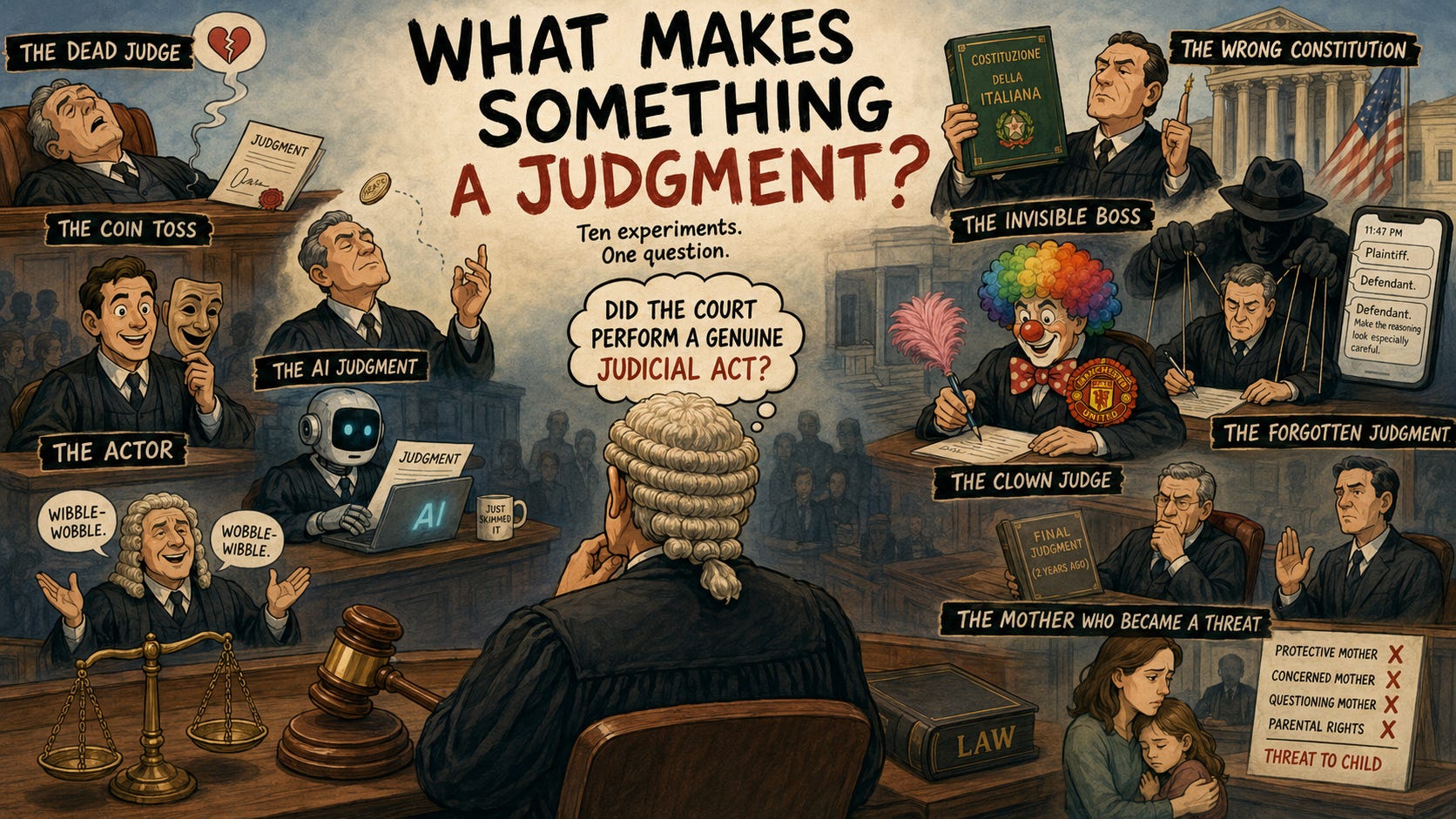
Over the last few days I’ve saved hundreds of AI responses as I’ve probed the borders of what constitutes a judicial act: the defining variables of adjudication, and the point at which a court of law for the people becomes a court of war on the people.
I could easily have turned those conversations into a dozen separate articles. Deliberately, I haven’t.
One lesson I’ve learned from writing over the years is that my best posts often come not from publishing everything I’ve discovered, but from waiting until I find an insight that genuinely lands with readers—something that helps people think more clearly, or see the world from a different angle.
So instead of firehosing you with my latest intellectual rabbit hole, I’d like to invite you to play a little game with me.
It’s educational, but I hope it’s fun too.
Think of it as a series of thought experiments. It’s not a test, and there are no right or wrong answers. You don’t need to know anything about law. All I’m asking is that you trust your instincts and notice where they lead you.
If you’d like to get the most from it, you might even copy the rest of this article into a Word document, write down your answers as you go, and then ask your favourite AI to discuss them with you afterwards. I think you’ll be surprised where the conversation ends up.
Some of the scenarios are deliberately absurd. A few may even make you laugh. Others, I hope, will make you pause. I’m pushing the boundaries a little—not to be provocative for its own sake, but because unusual examples often reveal truths that ordinary ones keep hidden.
So, are you ready? Let’s begin.
The Game
Every experiment changes just one thing about a court while leaving everything else as normal as possible.
Your task is simple:
Did the court perform a genuine judicial act?
If your answer changes from one story to the next, ask yourself:
What changed?
The Dead Judge
After a three-week trial, the judge announces:
“I have reached my decision. I’ll return in fifteen minutes to deliver judgment.”
The judge leaves the courtroom. Thirty seconds later, they suffer a fatal heart attack. Their law clerk finds the completed judgment exactly as the judge intended it, prints it, applies the judge’s signature, and files it.
Nothing has been altered. The draft is perfect. The signature is perfect.
The judge is dead.
Question: Has the court performed a judicial act? If not, what disappeared?
The Coin Toss
The judge carefully hears every witness. Both lawyers make excellent closing submissions.
The judge pauses.
“The law is very finely balanced. Heads the claimant wins. Tails the defendant wins.”
The coin lands.
A week later the judge produces a brilliant forty-page judgment explaining exactly why the winner was legally correct. Every sentence is persuasive.
Question: Did the judgment decide the case—or merely explain a decision that had already been made?
The Actor
Unknown to anyone present, the real judge never arrives.
Instead, a professional actor wears the robes. The actor has spent months studying courtroom procedure. Everything is flawless. The hearing is fair. The legal reasoning is correct.
Nobody discovers the deception for ten years.
Question: Was justice done? If not, what was missing?
The AI Judgment
The judge begins:
“I fed all the papers into an AI last night while watching Netflix.”
“It produced this judgment.”
“I’ve skimmed it.”
“Looks reasonable.”
The judge signs it.
The judgment is thoughtful, balanced and convincing.
Question: Who decided the case? Does the signature matter more than the thinking?
Notice something.
So far you haven’t needed to know a single case, statute or constitutional provision.
The Wrong Constitution
An American judge opens court by saying:
“The United States Constitution is an admirable document.”
“But from today onward I shall decide cases under the Constitution of Italy because I think it produces better justice.”
Everything else proceeds normally.
Question: Is this still an American court exercising American judicial power? If not, when did it stop?
The Invisible Boss
Every evening at exactly 11:47 p.m. the judge receives a text message.
Sometimes it says:
Plaintiff.
Sometimes:
Defendant.
Occasionally:
Defendant. Make the reasoning look especially careful.
The judge never disobeys. Nobody knows. Every judgment contains impeccable legal reasoning.
Question: Who is really deciding the cases?
Wibble-Wobble
The judge looks around the courtroom and says:
“Wibble-wobble.”
The hearing proceeds entirely normally. The judge delivers an excellent judgment.
As everyone leaves, the judge says:
“Wobble-wibble.”
Months later the judge explains:
“Those nonsense words were my way of signalling that the judgment wasn’t official.”
Question: Do the nonsense words matter—or does the judge not get to decide when they are acting judicially?
The Judge Who Became a Clown
The trial is entirely ordinary.
Just before delivering judgment, the judge quietly puts on a rainbow clown wig, an enormous Manchester United rosette, and picks up a feather duster instead of a pen.
Nothing else changes.
The judgment that follows is the most carefully reasoned the court has produced all year.
Question: Has the judge merely become ridiculous—or stopped behaving as a judge?
The Forgotten Judgment
A court finally decides a difficult dispute. Nobody appeals. The judgment becomes final.
Two years later another judge hears exactly the same dispute between exactly the same parties. The second judge knows perfectly well about the earlier judgment.
They simply ignore it.
Everything else is perfectly lawful.
Question: What released the first judgment from being binding? If nothing did, what is the second judge actually doing?
The Mother Who Became a Threat
A mother asks the court to protect her parental rights.
The court never says she has lost them.
Instead, something stranger happens.
Every attempt she makes to act like a mother becomes evidence that she is dangerous.
The judgment continues to call her Mother.
Yet every practical consequence is exactly what one would expect if she were no longer being treated as a parent at all.
Question: Has the court merely limited her rights—or has it quietly changed what sort of legal person she is? If the latter, when did that happen?
Finished? Don’t scroll back. Don’t change your answers. Now let’s see what you’ve actually been doing.
What Just Happened?
You may think you’ve just read ten fictional puzzles.
You didn’t.
Nine were thought experiments.
The tenth was inspired by a real custody case.
That is why I placed it last.
Up until that point, the stakes were low. A dead judge. A coin toss. An actor in robes. An AI. An absurd clown wig. They were deliberately artificial because I wanted to isolate one variable at a time. Scientists do this in laboratories. Engineers do it when testing aircraft.
Computer scientists call it fault injection:
deliberately breaking one part of a system to discover what is essential to its operation.
Without realising it, you were taking part in the same process.
Each story quietly removed one assumption that courts normally take for granted.
Perhaps the person wasn’t really the judge.
Perhaps the judge wasn’t really deciding.
Perhaps the source of authority had changed.
Perhaps someone else was in control.
Perhaps the legal person had silently become something else.
You weren’t really answering questions about law.
You were answering a much older question:
What must be true before an exercise of state power becomes a genuine judicial act?
By the time you reached the final example, you had already built your own intuitive theory of adjudication. I hadn’t told you what to think. I had simply invited you to notice what changed each time one of those hidden assumptions disappeared.
Then I showed you a case inspired by reality.
If the final example disturbed you, perhaps it wasn’t simply because it involved a mother and her child. Perhaps it was because, by then, you could see something deeper.
The outward forms of adjudication remained,
yet something essential appeared to have been lost.
That possibility should concern all of us.
Because constitutional government does not cease to be constitutional overnight. A court of law does not suddenly announce that it has become a court of war on the people.
The transformation is quieter than that.
One hidden assumption is abandoned. Then another. Then another. The forms remain familiar, while the constitutional character slowly changes beneath them.
If this article has done its job, it hasn’t persuaded you of my conclusions.
It has helped you discover your own.
And perhaps that is the most reliable place from which to begin asking a much harder question:
When does a court stop acting as a court of law, and become something else entirely?
The first nine experiments were designed to calibrate your constitutional instincts.
The tenth asked whether you were prepared to trust them.
Hmmm. Lots here to ponder.