

If you were to divorce tomorrow and find yourself in family court, would the Chinese Communist Party—a notional strategic adversary of the United States and other Western nations—care about the outcome? Almost certainly not. Your case would be one of thousands: an intensely personal dispute over relationships, parenting, finances, and the division of assets.
The court would ordinarily concern itself with evidence of conduct—who did what, what arrangements best serve the children, and how the law applies to the facts. Your political beliefs, the causes you support, the opinions you express on social media, or the associations of your friends would rarely become central issues, because they ordinarily have little bearing on the lawful resolution of a family dispute.
In previous articles I have described an American child-custody case that is noteworthy for being the exact opposite of the normal pattern.
As it happens, I became one of the vectors by which national-security issues entered what should instead have been a child-kidnapping case being laundered through the civil courts. My early writing naturally focused on the experience through the lens of family jurisdiction.
You can review my experience here:
There are two ways to read this case.
The first is as a local family drama with unusual ideology overtones.
The second may prove historically significant.
Taking that latter perspective, more recently I have stepped back and looked at the wider constitutional implications. What happens when children can be taken from parents because of their association with a constitutional restoration movement? That is no longer just a family-law problem. It starts to resemble the kinds of abuses more readily associated with Maoism or Stalinism than a constitutional republic.
The key insight is that once you corrupt the root of law — its ability to recognise what derives from the sovereignty of the people — you don’t merely reach the wrong answer.
You begin to change the categories from which the answer is computed.
Those ideas are explored further here:
In this article I want to explore one particular branch of possible future history.
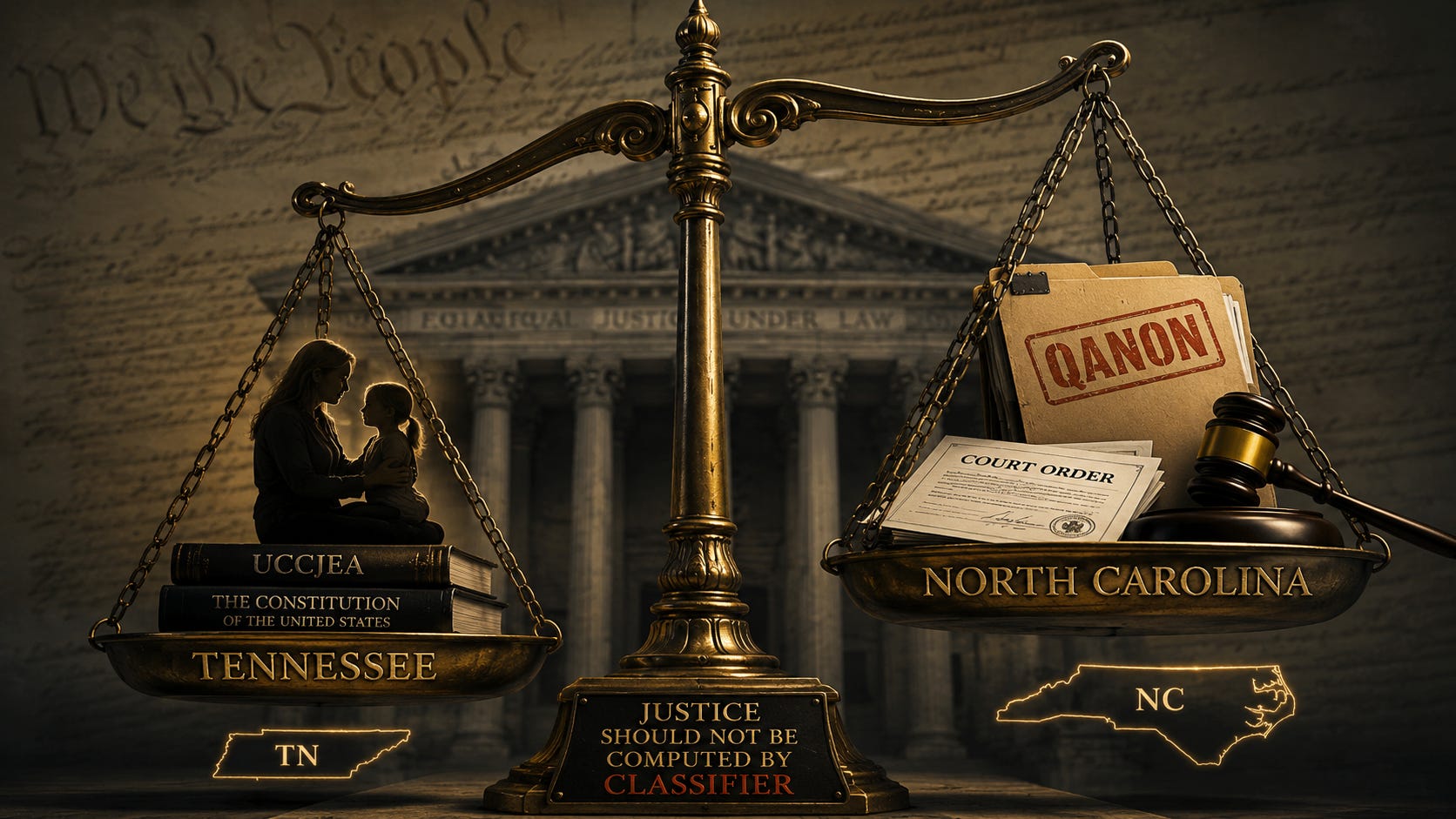
Suppose the Q movement is formally demonstrated to have been a constitutional restoration initiative operating under military guardianship. If so, the “QAnon” label takes on an entirely different character. It ceases to be merely a pejorative political insult and instead functions as an enemy classifier: a device that strips constitutional standing by recoding allies as extremists.
It is exactly the sort of information weapon a foreign adversary would deploy if its objective were to disrupt a sovereign restoration from within.
Viewed through that lens, this custody dispute no longer concerns only family law. It becomes a question of category transitions. At what point does importing an adversarial classifier into a court of law change the constitutional nature of the proceedings themselves? And once that boundary has been crossed, do familiar assumptions about judicial immunity and ordinary civil litigation still apply?
To begin with, let us dispose of the other branch of possible futures.
Imagine, for a moment, that “QAnon” is exactly as advertised: a whackdoodle conspiracy theory, bordering on a cult, believed by gullible people who have lost touch with reality.
Fine.
What follows?
Suppose a parent in a bitter custody dispute held such beliefs, but was otherwise a good parent. There is no abuse. No neglect. No violence. No coercion. No harm to the child. No nexus between those beliefs and the welfare of the child.
Can the state take your children because it dislikes your politics?
American law gives a clear answer: no.
Even if “QAnon” really is nonsense, the analysis is surprisingly boring:
The Constitution doesn’t care whether a political belief is sensible or absurd.
It protects both.
The First Amendment exists precisely because governments have a habit of declaring unpopular opinions dangerous, while the Fourteenth Amendment protects the fundamental right of parents to the care, custody, and control of their children.
Together, they create an exceptionally high constitutional barrier before the state may interfere with the parent-child relationship.
Congress reinforced those protections through civil-rights legislation, while custody statutes regulate which court may hear a dispute, not which political opinions parents are permitted to hold.
The Supreme Court has been equally consistent for decades:
In Barnette, the Court held that no official may prescribe what shall be orthodox in politics or matters of opinion.
In Claiborne Hardware, it rejected guilt by association.
In Stanley v. Illinois, it held that parental unfitness cannot be presumed merely from status.
In Palmore v. Sidoti, it ruled that private prejudice cannot be given constitutional effect in custody proceedings.
And in Troxel v. Granville, it reaffirmed that the care, custody, and control of one’s children is one of the oldest and most fundamental liberty interests recognised by American law.
In cases such as Keyishian v. Board of Regents and Elfbrandt v. Russell, the Court made clear that even association with the Communist Party—or another organisation widely regarded as subversive—cannot lawfully be penalised absent proof of individual unlawful conduct or specific intent.
Running through all of these authorities is the same constitutional invariant:
Rights flow from conduct, not identity.
Parents lose children because they abuse them, neglect them, endanger them, or otherwise demonstrate unfitness—not because a judge dislikes their politics or finds their beliefs embarrassing.
So even if every criticism ever levelled at “QAnon” were entirely true, the constitutional computation scarcely changes.
Protected political belief does not become evidence of parental unfitness simply because it is unpopular. The state still requires lawful jurisdiction, due process, and evidence of a demonstrable nexus between parental conduct and harm to the child.
If the Constitution protects association with the Communist Party absent unlawful conduct, why would it permit the removal of a child because of association with “QAnon” absent unlawful conduct?
It wouldn’t.
That disposes of one entire branch of possible history: even if “QAnon” really was nothing more than a bizarre conspiracy theory, the constitutional injury to the mother and child remains.
That is the boring branch.
The other branch is considerably more interesting.
Where this case becomes particularly “fun” is that there appears never to have been any subject-matter jurisdiction in the first place. The explanation is necessarily case-specific, so I shall keep it brief.
While the mother was on holiday visiting me in England, the child—who had been left in the care of her stepfather—was taken from Tennessee to North Carolina behind the mother’s back. There was no imminent danger. No abandonment. No affair. No abuse. Those allegations were either rejected outright or never established. Indeed, the emergency motion used to justify the transfer was ultimately dismissed as without merit.
Meanwhile, the child had lived in Tennessee for more than two years. Tennessee was her home state. North Carolina’s only connection was agreed visitation under a 2022 custody order — after a previous failed custody bid by the father, which cost him around $20,000 in unpaid child support.
In essence, the child was taken, the legal heist failed, emergency jurisdiction expired—and yet the child was never returned. Instead, the litigation simply carried on as though the new reality had somehow become lawful through the mere passage of time.
As the mother herself said in closing testimony:
I don’t think that custody can actually be decided until the criminality is addressed.
[The father] gives the appearance of stability. But stability that has been obtained through deceit is neither legally nor morally sustainable.
I think it sets a dangerous precedent to reward stolen custody, because stolen custody does not become earned custody through time and manipulation.
She is describing something more fundamental than an unfair custody decision.
She is describing an attempt to convert alleged wrongdoing into lawful entitlement.
Law has anticipated this problem for centuries.
There is an ancient maxim: Nullus commodum capere potest de injuria sua propria. No one may obtain an advantage from his own wrong.
American child-custody law encodes exactly the same principle. The Uniform Child Custody Jurisdiction and Enforcement Act (UCCJEA), adopted throughout the United States, expressly anticipates attempts to manufacture jurisdiction through wrongful conduct.
Section 208 exists precisely to stop a litigant creating a new factual status quo by unlawful self-help and then inviting a court to legitimise it. It states that where a court’s jurisdiction has been invoked because of unjustifiable conduct, the court shall decline to exercise that jurisdiction—unless tightly defined exceptions apply.
The Orders record the facts of clearly unjustifiable conduct. They never analyse §208. They nevertheless grant relief dependent upon those same facts. That is the contradiction.
Or, in plain English: you don’t get to take a child, create a new geographical reality, and then ask a court to bless the consequences of your own wrongdoing.
So what? Everything!
The entire constitutional frame changes.
If North Carolina never acquired subject-matter jurisdiction, then this was never merely a difficult custody case where reasonable judges could disagree. It becomes a case about the exercise of raw state power without lawful authority.
The ordinary story says there was a custody dispute, a controversial mother, an unfortunate sequence of events, and a judge who made difficult decisions.
The alternative story says there was an unlawful transfer of a child, followed by the manufacture of a new status quo, followed by a court being invited to legitimise the fruits of that conduct — despite the statutory prohibition designed to prevent exactly that outcome.
Those are not two different opinions about the same facts.
They are two different legal realities.
One begins with lawful jurisdiction and asks whether the outcome was fair.
The other begins by asking whether the court possessed the constitutional authority to compute the outcome at all.
If the answer to that second question is “no”, then the foundation of the case changes. We are no longer discussing the merits of a custody dispute. We are examining whether the justice system was induced to convert an alleged wrongful taking into judicially protected possession.
And that is before we even ask what happens if the “QAnon” classifier itself undergoes constitutional reclassification.
Normally judges enjoy extraordinarily broad immunity from civil suit, let alone criminal accountability. The Supreme Court has repeatedly held that, provided the office-holder is performing a judicial function, immunity is exceptionally wide. Even grave legal error, bad faith, or allegations of malice do not ordinarily expose a judge to personal liability.
The doctrine is not absolute, however. Two boundaries matter.
The first is jurisdiction.
A judge acting merely in excess of jurisdiction remains protected. If a judge misapplies the UCCJEA through faulty reasoning, and the mistake is later corrected on appeal, judicial immunity ordinarily remains intact. But where there is a clear absence of jurisdiction, the analysis changes.
That is arguably the position here. Neither judge explained how North Carolina satisfied the specific statutory requirements for subject-matter jurisdiction. Instead, broad conclusions were asserted without demonstrating how the UCCJEA actually conferred authority.
The second boundary is function.
Judges are protected because they perform judicial acts, not because they happen to wear judicial robes. The classic example is administrative decision-making, such as hiring and firing court staff. Those are not judicial functions, and immunity correspondingly narrows. The doctrine protects the office only while it is exercising judicial power.
That naturally raises a deeper question: what makes an act genuinely judicial?
Suppose a judge began deciding American custody disputes by applying Italian constitutional law, writing orders in Italian, and openly preferring Italian litigants. The issue would not merely be that the judge had made legal errors. The more fundamental question would be whether the judge was still exercising the judicial power entrusted by the American constitutional order, or whether something else had replaced it.
That is the conceptual boundary explored in this article.
A judicial act derives its authority from a sovereign legal order. If, instead, the judge computes outcomes using a classifier imported from outside that order—one that overrides constitutional rights through political identity rather than lawful conduct—then the question is no longer whether the judge reasoned badly. It becomes whether the judicial function itself has been abandoned in favour of a different organising principle.
That is not a question of ordinary appellate error.
It is a question of constitutional ontology.
Notice what has happened:
First, this looks like an appeal.
Then it looks like a jurisdictional defect.
Then judicial immunity begins to wobble.
Finally, the entire constitutional runtime changes.
That is what a category transition looks like.
This is where our restoration hypothesis bites.
Suppose, for the sake of argument, that America wakes up one morning to discover that the constitutional restoration movement was real all along — with Q as its symbolic anchor.
There is a proclamation of a Second American Republic. The Federal Reserve is gone. The Internal Revenue Service has been dismantled. Washington, DC is stripped of much of the power and money it accumulated over the last century, with sovereignty flowing back towards the States and the people themselves. Elections move to immutable public ledgers secured by biometric identity. The intelligence community is turned inside out. The courts are instructed to return to first principles: natural law, popular sovereignty, and fidelity to the Constitution rather than institutional habit.
Whether you think that sounds utopian, terrifying, impossible, or overdue is beside the point.
That announcement does not merely change politics.
It changes classification:
Yesterday’s “conspiracy theorist” may become tomorrow’s constitutional witness.
Yesterday’s “extremist” may become tomorrow’s patriot.
Yesterday’s “misinformation” may become tomorrow’s official history.
The facts have not changed. The labels have.
And once the labels change, every legal computation that depended upon them has to be rerun.
If the restoration hypothesis is correct, the remarkable feature of the September 2024 temporary custody hearing is not that the words change — as they do not.
The words stay exactly the same. It is their constitutional meaning that inverts.
The first quotation establishes the classifier itself:
Father: “Mr. Geddes is a prominent figure within the United States within the QAnon community… [it] seems to encourage militant action where the corruption within the government would be brought to heel and punished accordingly.”
Before we examine the constitutional consequences, note the irony.
The witness had never met me, never spoken to me, and had no first-hand knowledge of my beliefs. His testimony was necessarily second-hand and inferential.
Meanwhile, the same proceedings arose from a family already engulfed in allegations of wrongful conduct: a false allegation of an affair made “upon information and belief”; an ongoing divorce in which the stepfather was dissipating marital assets; and a custody dispute that itself depended upon the unauthorised interstate transfer of the child.
Yet it was my political identity—not those matters—that became the organising classifier for the court.
Under the restoration hypothesis, the same evidence is interpreted very differently.
If Q were formally recognised as a constitutional continuity operation, the same passage no longer identifies an extremist influence.
It records the court importing an adversarial political classifier into a child-custody proceeding.
Nothing factual changes.
Only the classifier.
The second quotation concerns my public fundraising appeal.
I wrote in a newsletter:
“A civil legal case needs to become a criminal investigation, as it involves trafficking of a minor between U.S. states.”
The immediate response in court was equally revealing:
Attorney: “Is there any truth to anything that was written…?”
Father: “No.”
Yet, under cross-examination, the father said that his actions, which openly flaunted an existing custody order, could be seen as a form of trafficking in the colloquial sense.
At the time, the allegation itself was presented as evidence of my supposed instability.
Under the restoration hypothesis, the direction of inference reverses.
The question ceases to be whether the allegation was “extremist”. It becomes whether I publicly identified conduct that, once stripped of the imported political classifier, was capable of amounting to criminal custodial interference and jurisdictional laundering under the UCCJEA.
The words do not change.
The legal significance does.
The third quotation is perhaps the most revealing of all.
Attorney: “Do you get a sense of Mr. Geddes’ opinion of the court system through his writings?”
Father: “Yes… He has multiple posts… challenging… the court systems… speaking to debt slavery… equates paying property taxes with supporting terrorism.”
Notice what is being examined.
Not parenting. Not abuse. Not neglect. Not jurisdiction.
Political criticism of state institutions.
If those institutions later undergo constitutional restoration, this passage also reverses.
Criticism of allegedly corrupted institutions no longer appears as evidence of dangerousness.
Instead, the transcript records criticism of government institutions being introduced as adverse evidence in proceedings affecting the fundamental constitutional rights of a parent and child.
One transcript. Three quotations. One “QAnon” classifier.
Reverse the classifier, and the evidential graph reverses with it.
That is not an ordinary appellate issue.
It is a category transition.
This is where things get really interesting.
Many readers will remember the confirmation hearing of Justice Brett Kavanaugh in 2018. Senator Lindsey Graham asked a series of questions arising out of the post-9/11 War on Terror and the Supreme Court’s decision in Hamdi v. Rumsfeld.
The issue was deceptively simple.
Suppose an American citizen joins the enemy. Do they retain every ordinary constitutional protection that applies in peacetime criminal proceedings?
The answer, according to both Graham and existing Supreme Court doctrine, is no.
Citizenship is not a magic shield.
If an American joins a foreign enemy or takes up arms against the United States, the legal classification changes.
They may be detained as an enemy combatant, subject to the law of armed conflict rather than the ordinary criminal process, albeit with appropriate due process protections. Graham’s concern was practical: America should not reward collaboration with hostile forces merely because the collaborator happens to hold an American passport.
Notice that this principle cuts both ways:
On one side, it protects constitutional rights by ensuring that political disagreement alone never becomes sufficient to classify someone as an enemy. The threshold is extraordinarily high, because the consequences are extraordinary.
On the other, once that threshold is genuinely crossed, constitutional law itself recognises that a category transition has occurred. The legal computation changes because the person’s relationship to the sovereign constitutional order has changed.
That is precisely why the earlier discussion of judicial immunity matters.
If courts imported an adversarial political classifier into a custody proceeding—one that treated supporters of a constitutional restoration movement as if they were aligned with hostile forces—then the court was computing rights using the wrong sovereign reference frame.
Now perform the inversion — whereby the hunters become the hunted. Suppose the restoration hypothesis is true. Suppose Q was not an enemy movement or domestic insurgency at all, but a constitutional continuity operation under military supervision.
The classifier does not merely become inaccurate. It reverses.
And once it reverses, an altogether different question emerges:
Who, in law, was actually acting in aid of the constitutional order—and who was acting against it?
This is where our earlier thought experiment about the Chinese Communist Party becomes useful.
Forget, for a moment, who actually did what.
Ask a simpler question.
Suppose you were a strategist inside the CCP. Suppose your objective was to frustrate an American constitutional restoration movement without firing a shot. What outcome would you want from this custody dispute?
Probably something very close to what actually happened:
A prominent civilian publicly associated with the restoration movement is placed under sustained attack.
His public communications become evidence against a mother whose only relevant act was associating with him.
That mother loses her child despite no finding of abuse, neglect, abandonment, violence, or other parental misconduct.
A court proceeds without first demonstrating lawful subject-matter jurisdiction.
Alleged wrongful conduct in obtaining possession of the child is not remedied, but instead becomes the platform from which further judicial relief is sought.
From the perspective of an adversary, the signal is powerful:
Associate yourself publicly with constitutional restoration, and the state may do to you what it could never justify on the basis of your conduct alone.
Under the restoration hypothesis, the importation of the “QAnon” classifier therefore ceases to be merely prejudicial evidence in a family case. It functions as an adversarial information operation.
Whether introduced knowingly or unknowingly, it produces outcomes favourable to anyone seeking to disrupt a constitutional restoration by raising the perceived personal cost of supporting it.
The category transition is therefore no longer merely from family law to constitutional law.
It enters the domain of national security, because the legal process itself has become a vehicle through which an adversarial political classifier has displaced the constitutional one.
This is no longer about one custody case.
If the “QAnon” classifier can be used to separate a fit parent from her child despite the absence of misconduct, every family court becomes a potential weapon against constitutional restoration.
Support the movement. Lose your children.
From an adversary’s perspective, that is an extraordinarily effective deterrent. It doesn’t merely punish one family; it chills an entire political outlook.
The remedies therefore undergo the same category transition as the facts.
Inside the restoration hypothesis, the earlier discussion of judicial immunity becomes largely historical. Those doctrines belonged to the constitutional order that has now been found to have been systematically subverted. Their purpose was to protect honest judicial decision-making within a lawful republic.
They were never designed to shield participation—whether knowing or unwitting—in the suppression of that republic itself.
The analysis therefore expands dramatically:
What yesterday appeared to be a family-law appeal may now be examined as a deprivation of constitutional rights.
What yesterday appeared to be an erroneous custody judgment may now be investigated as the judicial laundering of an unlawful child seizure.
What yesterday appeared to be protected institutional discretion may now engage questions of conspiracy, corruption, trafficking, or collaboration with hostile influence.
The available remedies expand with the classifier.
Judicial immunity is no longer the end of the discussion; it is one of the first questions to be discarded.
Depending on the facts, the frame expands to include civil-rights restoration, criminal accountability, Executive Order 13818 sanctions, asset forfeiture, disbarment, removal from office, transitional justice, denazification, and doctrines relating to collaboration with an enemy.
The sovereign authority conducting the analysis is no longer bound by the assumptions of the displaced constitutional runtime.
That is what a category transition means.
The legal system is no longer asking whether the old order correctly applied its own rules.
It is asking whether the old order remained constitutionally legitimate at all.
If my legal analysis is correct, this ceases to resemble a custody dispute at all.
It begins to resemble a micro child-trafficking cartel with judicial certification and national-security consequences.
The child becomes the instrument.
The mother becomes the target.
The attorney becomes the laundering mechanism.
The court becomes the certification authority.
Tennessee loses one of its children without cause or due process. North Carolina acquires both the child — and the fiscal and legal consequences that follow her.
Viewed through the restoration hypothesis, that is no longer merely a miscarriage of justice.
It is the judicial normalisation of an unlawful interstate transfer through the importation of an adversarial political classifier, subverting state sovereignty itself.
The stakes are not only familial, but also whether one state can unlawfully take the underage citizens of another state under the pretext of national security.
Perhaps worst of all, the child is left in a wholly inverted environment—alienated from her lawful mother, given a false account of her father’s conduct, and taught a distorted understanding of the constitutional order itself.
Those are not merely injuries to one family. They are injuries capable of echoing across generations, repeatedly harming American society.
I hope that, by now, readers grasp the gravity of what has happened:
They wanted to destroy a mother and schoolteacher.
When I supported her, my politics became the weapon.
A national-security classifier entered a custody case.
That is not a legal error; it is a category transition.
Category transitions have consequences.
My goal is not revenge. It is legibility.
They thought they were destroying a dissident to cover up a crime.
Instead, they were attacking the restoration of the Republic itself.
The message is simple.
Don’t do this.
Make them famous.