

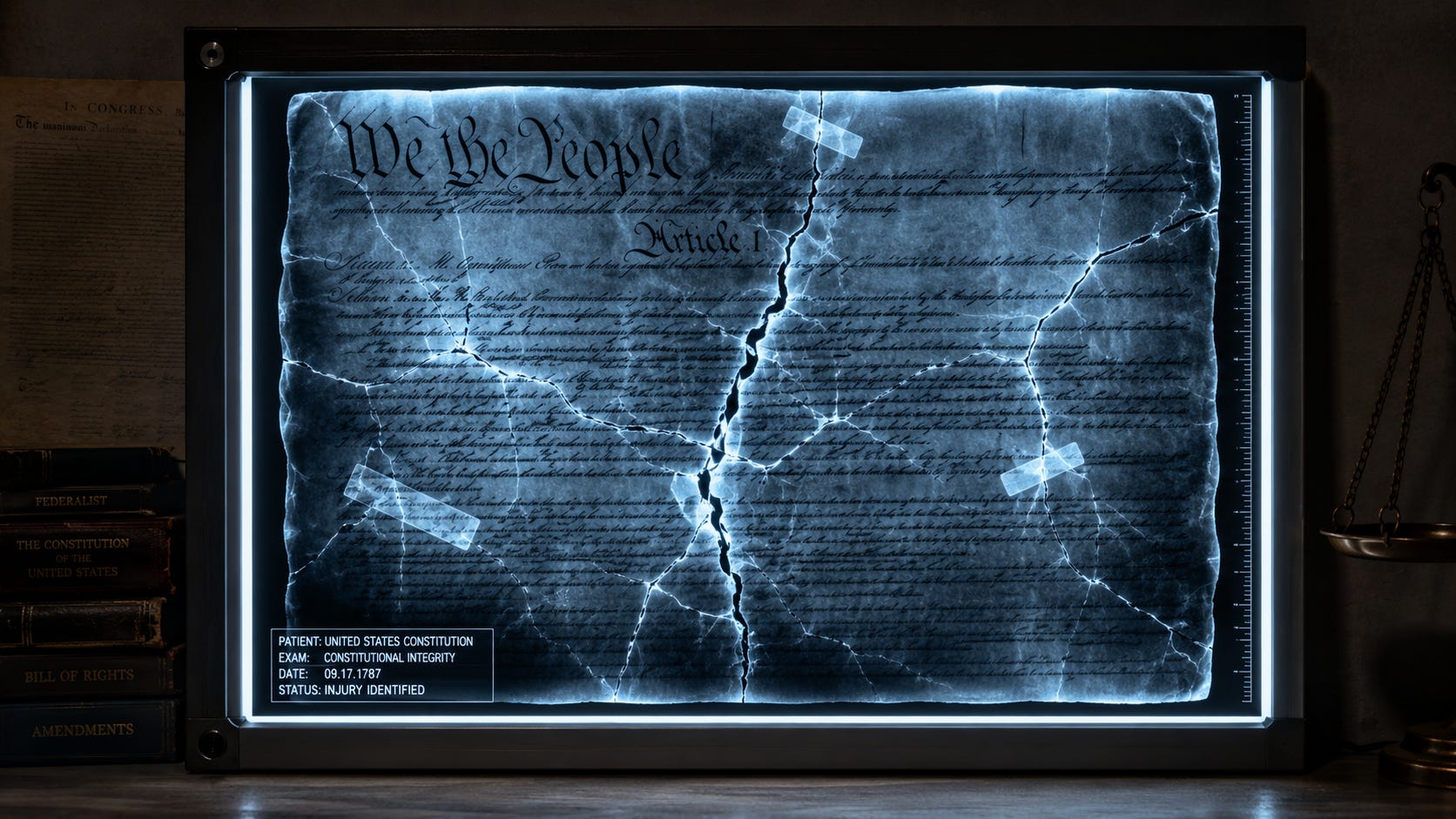
I am reconsidering the meaning and implications of my experiences around an American family-law case in 2024 and 2025 in light of the “constitutional injury” insight that emerged from my own “ghost court” litigation in the UK during 2025 and 2026. Both the US and UK matters are unusually clean constitutional stress tests, as neither involves the kinds of dramatic facts — drugs, guns, violence, or organised crime — that normally obscure the underlying principles.
One is superficially an ordinary custody and divorce dispute; the other a routine motoring prosecution. Yet both reveal something profound at a structural level.
The outlier nature of the American case makes it an especially interesting specimen, as it is unusually legible as a story of cultural schism intersecting with deprivation of constitutional rights. What makes it truly exceptional is the way national-security-level narratives were (temporarily) imported into what was, on its face, a mundane dispute over residence and child support — only to vanish again once they had their (de)legitimising effect.
This creates a rare confluence of family law, constitutional law, narrative warfare, military intelligence concerns, and questions of institutional integrity.
I have already written three articles on the matter:
This essay takes the next step: beyond the particulars of the case, into the wider questions it poses — for the public, for the MAGA movement, and for the American Republic itself.
I write as a friendly outsider looking in, being British but with strong American ties. My interest is not in partisan point-scoring or cultural criticism, but in what this case may reveal about confronting constitutional injury.
What is the practical meaning of constitutional restoration under a legitimacy-reversal and constitutional-restoration scenario that MAGA offers as its claimed destiny?
A key feature of the US case is that the custody conflict pre-dated my involvement by years. The underlying dispute stretched back to 2022 and earlier — so I am provably not a causal agent. In 2024, while the mother was visiting me in the United Kingdom, the child was transferred between two US states by the father and stepfather without the mother’s knowledge or consent.
An emergency motion alleging maternal abandonment followed, later described by the court as “without merit”. Yet stability was subsequently invoked to maintain the newly engineered status quo. The inversion mechanism by which an allegedly unlawful discontinuity became the basis for a claim of lawful continuity is particularly noteworthy, and lies at the heart of this essay.
I had never met the child, and only travelled to the United States because of the crisis that followed the covert relocation from Tennessee to North Carolina. Despite that, a remarkable amount of courtroom time was devoted to the alleged dangers of “QAnon” and my supposed association with it (whatever “it” may be).
No direct evidence was offered that I posed any personal risk to the child.
The resulting temporary order reinforced the new residence arrangements. It notably devoted more attention to analysing myself — a non-party to the proceedings and overseas associate of the mother — than to the admitted misconduct that precipitated them, including criminal allegations of interstate custodial interference and parental kidnapping.
Curiously, once the transfer of custody had been achieved, and the new status quo established, the geopolitical and ideological themes receded from view. Subsequent motions and hearings returned to conventional family-law concerns centred on the interests of the child. So “QAnon” went from irrelevant, to figural, to forgotten.
This raises an obvious question:
If the alleged danger from “QAnon” was sufficiently grave to justify extraordinary attention in the temporary proceedings, why did it cease to be a central concern thereafter?
As such, the case ceases to be merely personal. It becomes symbolic, revealing a deeper question about how constitutional systems behave when narrative categories (like “QAnon”) acquire greater force than the facts they are supposedly meant to explain (like self-help child custody changes).
It’s one thing to be suspended from Facebook because you posted a “QAnon meme”; quite another to have your family life dismantled by a court because you vacationed with a “conspiracy theorist”.
So the case is not really a custody battle with political persecution overtones; it is a teachable example of how the law can invert its purpose, and how constitutional rights vanish under narrative pressure. A constitution is not meant to protect in easy cases with obvious rights and wrongs, but where edge conditions dominate, as they do here.
To understand the deeper stakes in this case, it helps to think in terms of seven ascending levels of what can be at risk when state power is exercised.
Private interests — custody, money, residence, divorce.
Civil legality — pleadings, evidence, orders, procedure.
Constitutional rights — due process, speech, parental rights, jurisdiction.
Institutional legitimacy — whether individual courts still act as lawful constitutional organs.
Constitutional continuity — whether the broader civil order remains operational or has been compromised.
Military/emergency power — Continuity of Government, Executive Orders, PEAD contingency authority, law-of-war logic.
National sovereignty — “We the People”, including the right to reconstitute government when the old order descends into tyranny.
Each level protects a different “invariant” of the constitutional order:
Level 1 preserves interests.
Who gets what?Level 2 preserves legality.
Was the process lawful?Level 3 preserves rights.
Was the state permitted to act this way?Level 4 preserves institutional trust.
Can the institutions still be trusted?Level 5 preserves constitutional continuity.
Does the constitutional order still function?Level 6 preserves the state.
How is constitutional government preserved when the constitutional order itself is compromised?Level 7 preserves legitimate sovereignty itself.
From where does legitimate authority ultimately derive?
The critical transition occurs between Level 5 and Level 6:
Level 5 examines whether the constitutional machine is functioning as intended; politics, law, and public administration effectively stop here for most citizens.
Level 6 addresses what preserves the Republic when the constitutional machine is no longer functioning as intended. This is where civilian constitutional doctrine begins to blur into military and state-continuity concerns.
Level 7 then asks from where all legitimate authority ultimately derives, including the authority to preserve, restore, reform, or replace a constitutional order that has descended into criminality.
Within this framework, MAGA and Q occupy different positions:
MAGA is primarily a Level 7 phenomenon: a public political expression of constituent sovereignty and constitutional restoration.
Q is primarily a Level 6 phenomenon: a military-civilian continuity bridge concerned with preserving order during a period of crisis and transition.
Whether one accepts each proposition is secondary to understanding their claimed location within the hierarchy.
To illustrate the model, Donald Trump occupies the three upper layers simultaneously:
as President he functions at Level 5,
as Commander in Chief at Level 6, and
as the central symbolic figure of MAGA at Level 7.
Most people would recognise that having Donald Trump testify in an ordinary child-custody hearing would be structurally anomalous. The reason is not his personal significance, but the mismatch of levels. Questions concerning constitutional continuity, military command, national sovereignty, and the future of the Republic do not normally arise when deciding where a child should live or who should pay support.
This case exhibits a comparable structural anomaly to Donald Trump turning up in family court.
The underlying dispute was a Level 1 matter concerning custody, residence, and financial obligations. Yet justificatory categories normally associated with Levels 5–7 — narratives of extremism, cults, domestic terrorism, human trafficking, institutional capture, and existential threats to the constitutional order — were imported into the proceedings and given significant weight.
These narratives did not remain in effect. Once the transfer of custody and financial arrangements had been secured, they largely disappeared from subsequent proceedings. The underlying conflict never became a national-security matter, at least not directly. Instead, high-level geopolitical narratives were invoked to achieve an entirely local and time-bound remedy.
Many people experience family-court outcomes they regard as unfair at Level 1, procedurally flawed at Level 2, or rights-infringing at Level 3.
Some encounter deeper failures of institutional legitimacy at Level 4 or constitutional continuity at Level 5.
What sets this case apart is the casual deployment of categories drawn from the very highest levels of political and constitutional conflict — those concerned with the preservation, capture, or restoration of the Republic itself — to resolve an ordinary domestic dispute. Only for them to be discarded once their effect was complete.
The constitutional significance therefore lies not in whether one accepts the underlying Level 5–7 narratives at face value; you do not have to commit to belief in MAGA or Q or Donald Trump.
It lies in whether a system of rights protection can remain coherent when categories associated with sovereignty and restoration are used to determine the lowest level of private dispute.
Viewed in this light, the case ceases to be merely a custody battle that spilled over into a culture-war bunfight.
It becomes a probe.
At Level 1, the probe examines whether a child can be relocated and custody transferred through a discontinuity allegedly engineered by those who later benefited from it.
At Level 2, it examines whether admitted conduct and disputed conduct received equivalent evidential scrutiny and procedural treatment.
At Level 3, it examines whether parental rights, due process, freedom of association, and jurisdictional protections remained effective once politically charged narratives entered the proceedings.
At Level 4, it examines whether the court functioned as a neutral arbiter of fact or as a vehicle for narrative amplification and attribution.
At Level 5, it examines whether constitutional safeguards continued to operate when allegations associated with extremism and existential threat acquired greater practical force than the underlying conduct being adjudicated.
At Levels 6 and 7, the question becomes more fundamental:
The real question is not whether Q is/was valid, or what “QAnon” denotes.
The real question is whether constitutional safeguards continued to function once a category associated with an alleged threat to the constitutional order had been attached to a litigant or their associates.
The child-custody dispute with “QAnon” aesthetics is the vehicle.
The constitutional order is the object under examination.
The question is what follows if the layer jump was not incidental, but consequential.
Can the constitutional immune system distinguish between grounded evidence and false attribution when the stakes are perceived to involve the survival of the Republic?
Before we document the constitutional injury, or even consider what a “MAGA-compatible” resolution might look like, it is necessary to appreciate the magnitude of the inversion involved.
Five features of the case are particularly noteworthy:
Q vs QAnon — the symbolic inversion.
The moving centroid — why the timing matters.
The layer jump — why the case is structurally anomalous.
The legitimacy flip — why future reinterpretation matters.
The constitutional immune system — what the case is actually testing.
Taking these in turn…
Q vs QAnon
The smear was not that the mother had become a decoder of “Q drops”, but that she had become associated with a cultural force labelled as “QAnon”.
The difficulty with this framing is that “Q” and “QAnon” are not synonymous. Within the restoration framework explored in this essay, Q is understood as a constitutional-continuity and anti-corruption phenomenon, while “QAnon” functions as the stigma attached to it.
If that distinction is accepted, even hypothetically, the significance extends beyond ordinary politics. The issue is no longer whether a litigant holds “fringe” views. The issue becomes whether a category associated with the preservation or destruction of constitutional order has entered family-court proceedings.
That is where the anomaly begins.
Family courts normally ask behavioural questions:
What did the parent do?
What evidence supports the allegation?
What outcome best serves the child?
Counterintelligence and sovereignty conflicts ask alignment questions:
Which side is the person on?
What does their allegiance signify?
What threat category do they belong to?
Those are fundamentally different forms of inquiry.
Rights are protected when conduct is judged.
Rights become fragile when allegiance is judged.
The deepest concern raised by this case is therefore not that “QAnon” was mentioned. It is that an allegiance-category appears to have acquired evidential force.
Once that occurs, the proceeding begins to drift away from judging acts and toward judging affiliation. The dispute remains formally a custody case, but the logic being imported belongs to a different layer of statecraft altogether.
If the broader restoration hypothesis were eventually vindicated, the symbolism would become extraordinary.
A category associated with constitutional restoration would have been treated as a threat to constitutional order. Constitutional rights would have been diminished in the process.
Worse still, the “QAnon” label itself would have acquired constitutional force. The allegation of being a threat to constitutional order would have become the justification for diminishing the constitutional protections owed to the accused.
The moving centroid
The second feature is not merely that “QAnon” appeared and later disappeared from the narrative. It is that the centre of gravity repeatedly shifted away from the conduct that triggered the dispute and toward the people objecting to it.
A previous failed custody bid, the unauthorised relocation of the child, the undisclosed coordination between the father and stepfather, the breach of the notice provisions, and the failed emergency motion all formed part of the factual background.
Yet a substantial portion of the temporary proceedings became concerned with the implications of me publicly alleging that crimes may have been committed.
This does not of itself prove that those allegations are correct, even if there was a damning confession from the stand. It does, however, raise an important question about institutional attention.
Why did the focus migrate from the underlying conduct to the consequences of objecting to that conduct?
The significance is not the answer, but the movement itself. The centre of gravity shifted from the people who benefited from the discontinuity, to the people who challenged it. The “QAnon” narrative did not merely enter the case; it altered what the case appeared to be about.
The layer jump
The anomaly is not merely that sovereignty-level narratives entered a custody dispute. It is that they were permitted to become part of the evidential and judicial reasoning process at all.
The underlying questions before the court were ordinary family-law questions: UCCJEA jurisdiction issues, TN vs NC custody and residence, home vs school education, shared parental decision-making, and the welfare of the child.
Yet substantial hearing time was devoted to me, my writing, Q, “QAnon”, the definition of “trafficking”, how I raised funds for the mother’s legal fees, and the implications of my public commentary. These themes were not merely raised in argument; they found their way into the court’s findings and written reasoning.
That is remarkable:
My involvement only began once the previous custody order had already been breached.
My writing did not determine where the child should live.
My political and cultural views did not determine whether notice provisions had been breached.
“QAnon” did not determine whether parental rights had been respected.
None of these matters resolved the underlying factual disputes before the court.
Yet they acquired determinative significance nonetheless.
The anomaly becomes even more striking when viewed in hindsight. At a subsequent hearing, the judge immediately squashed any drift into QAnon-themed discussion. The advocacy returned to conventional family-law analysis.
The ideological material that had previously received such attention disappeared.
This raises an obvious question:
If these matters were genuinely central to the welfare analysis, why did they later become too toxic to allow into the court’s reasoning?
Conversely, if they were not central, why were they afforded such prominence in both the first hearing and the resulting temporary order?
The layer jump therefore concerns more than the presence of unusual narratives. It concerns the temporary elevation of categories drawn from constitutional, cultural, and sovereignty-level conflict into a proceeding that should ordinarily have been resolved through evidence, conduct, and the best interests of the child.
The significance lies not in whether those narratives were true or false.
It lies in the fact that they were permitted to do judicial work at all.
The legitimacy flip
The fourth feature is how the Q narrative proposes a discontinuity in legitimacy, and what happens if and when it “flips”.
Most personal legal disputes are analysed within a stable legitimacy framework. Certain actors are implicitly treated as protectors (like the police), others as threats (such as whistleblowers). Institutions are assumed to be operating broadly as intended. The primary question becomes whether they reached the correct result.
This case becomes much more interesting if those assumptions are reversed.
The facts do not change. The testimony does not change. The orders do not change.
What changes is the direction from which legitimacy is inferred.
Under the conventional reading, the father is protecting the child, the court is protecting the child, and the references to “QAnon” help explain why extraordinary intervention may have been justified.
Under a legitimacy-reversal scenario, entirely different questions emerge.
Was the relocation itself lawful?
Were constitutional rights diminished rather than protected?
Did stigma acquire evidential force?
Did the court scrutinise the alleged wrongdoing with the same intensity that it scrutinised those objecting to it?
The significance of the case therefore changes.
The dispute ceases to be primarily about whether the court reached the correct temporary custody outcome. Instead it becomes a record of how institutions behaved when confronted with competing legitimacy claims — at the highest level possible.
The inversion is profound.
The people presented as protectors then become the subjects of scrutiny.
The people presented as threats then become the rights-bearers.
The institution presented as guardian then becomes the object under scrutiny.
That is the legitimacy flip.
The facts remain fixed.
The meaning of those facts changes entirely.
The constitutional immune system
The fifth and final feature is not found in the custody dispute, the Q material, or the individuals involved.
It is found in the safeguards.
Constitutional systems exist because human beings are imperfect. They lie, collude, panic, stigmatise, persecute, abuse power, and mistake narratives for evidence. The purpose of constitutional protections is not to prevent these tendencies from arising, but to prevent them from determining outcomes.
That is why constitutions are most valuable in difficult cases.
Easy cases require little protection. The rights and wrongs are obvious, the incentives are aligned, and public opinion is comfortable.
The real test comes when the pressure to abandon constitutional principles is greatest.
This case is unusual because the pressure did not arise merely from family conflict.
It arose from the introduction of narratives associated with extremism, trafficking, constitutional legitimacy, institutional capture, and the future direction of the Republic itself.
Whether those narratives were true, false, exaggerated, misunderstood, or entirely irrelevant is not the central issue.
The constitutional question is simpler:
Did the safeguards continue to function once “QAnon” narratives entered the frame?
Did evidential standards continue to dominate attribution of responsibility?
Did conduct continue to matter more than political labels?
Did rights continue to matter more than social stigma?
Did constitutional protections continue to operate when the emotional and political temperature rose?
Those are the questions that endure regardless of the answer to Q.
Indeed, they endure regardless of the answer to every factual dispute in the case.
The child-custody dispute is the vehicle.
The Q material is the stressor.
The constitutional immune system is the object under examination.
Everything else is secondary.
This naturally leads us to examine the resulting constitutional injuries, not to document victimhood, but to record the consequences when these safeguards fail.
The first noteworthy feature is that constitutionally protected beliefs and associations repeatedly became part of the evidential landscape.
The father had previously failed in a custody action in which the mother’s religious beliefs, church attendance, and spiritual affiliations were placed before the court. Whatever the merits of those arguments, the proceeding had already begun to blur the distinction between parental conduct and constitutionally protected belief.
The pattern continued in the later proceedings.
The mother was compelled to identify an anonymous social-media account despite no obvious showing that disclosure was necessary to determine custody, residence, education, or the welfare of the child. Political speech and anonymous political association, ordinarily protected activities, became subjects of inquiry.
The temporary proceedings then expanded further still.
The court heard extensive evidence concerning my writing, my political views, my association with Q, allegations of extremism, and broader cultural and geopolitical narratives. Yet, as previously noted, I was not a party to the proceedings, had never met the child, and had entered the United States only after the disputed relocation had already occurred.
The cumulative effect is significant.
Religious association entered the frame.
Political association entered the frame.
Anonymous speech entered the frame.
Guilt by proximity entered the frame.
Constitutionally protected activities increasingly became objects of scrutiny despite having little direct bearing on the underlying family-law questions before the court.
At the same time, the constitutional protections that should ordinarily constrain state action were weakened.
Parental rights were diminished. Jurisdictional questions were sidelined. The practical consequences of the relocation hardened into a new status quo. The burden increasingly shifted toward explaining why the new reality should be disturbed rather than how it had been created.
Viewed individually, each of these developments can be rationalised.
Viewed together, they reveal a deeper constitutional injury:
The gradual substitution of attribution for conduct, affiliation for evidence, and narrative for rights.
That is the pattern this essay seeks to document.
Where this case becomes of potential singular interest is in a scenario where MAGA has fully delivered on its promises: exposure of the crimes of the old political order, restoration of natural law rights and civic standing, removal of undue taxation burdens, return to sound money, taming of the military-industrial-banking complex to end war-for-profit, and restoration of “We the People” to sovereignty.
The striking thing about this case is an asymmetry.
I was merely a vector for exposure of the wrongdoing, but there was little to gain from attacking me or my political writing. The North Carolina court could equally have decided to harden the newfound status quo based on the views of the child, with essentially a “bad luck, life is unfair” message to the mother. Or batted the legal problem back to Tennessee, in the worst case of reversal of fortunes for the father.
But that isn’t what happened.
Instead, those who participated in looting her estate and dismantling the mother’s family life armed a monumental blowback risk. Their implicit assumption was that there would be no phase change in legitimacy; that the “QAnon conspiracy theorist nutcases” could simply be dismissed and left to stew in the injustice.
They imported the authority, threat model, and moral gravity of the Q operation, understood within the restoration framework as a premier military-intelligence operation. Simultaneously, they weaponised the “QAnon” smear applied to its alleged enemies, domestic and foreign.
This voluntarily escalated the custody dispute into an entirely different domain.
The Q operation presents itself as a force for constitutional restoration, exposure of corruption, and opposition to some of the worst crimes imaginable. Should the restoration scenario unfold broadly as foretold, the meaning of the “QAnon” label reverses.
The issue is not that those accused of extremism suddenly become saints. The issue is that the attribution changes direction. The category that was used to explain away constitutional injury becomes evidence of institutional misclassification. The stigma itself becomes the object of scrutiny.
At that point, importing Level 5-7 narratives into a Level 1 family-law dispute, while simultaneously engaging in conduct that may itself attract legal scrutiny, no longer invites merely Level 1 consequences. The nature of the inquiry changes.
In that sense, the men involved and their legal representation are almost secondary. Whether the consequences are criminal, reputational, political, historical, or something else entirely is beyond my remit.
If the most entertaining outcome is indeed the most likely, I will leave you to ponder what that might be in this case.
What matters is the precedent created when courts permit affiliation to compete with conduct, attribution to compete with evidence, and stigma to compete with constitutional protections.
Many people have suffered violations of due process, equal protection, parental rights, free speech, or full-faith-and-credit principles. Those injuries, sadly, are not unusual.
What makes this case distinctive is that it went “full constitutional stack” — from Level 1 to Level 7.
It did not merely test a single right. It tested the relationship between rights, legitimacy, continuity, sovereignty, and restoration itself.
That is why it invites the mother of all boomerangs.
Which leaves us with an interesting parting question.
We have listed the many benevolent and desirable national-level outcomes that MAGA professes to offer, given time. Yet that is only part of the picture of injustice and national restoration.
The wrongs exist at every level of society. Can America be made again without addressing them all? Where does the task end? What exactly is the destination in a difficult case like this?
MAGA is, by its nature, a rupture: a discontinuity intended to establish a new basis for lawful continuity. Yet there is now a legacy of legalised false continuities — like the custody order — built upon unlawful discontinuities, such as the transfer of the child from Tennessee to North Carolina.
This is not an isolated problem. Many advantages have allegedly been acquired unjustly: through election fraud, rigged markets, insider information, judicial capture, institutional privilege, and narrative control.
So the recovery question becomes unavoidable:
Can New Republic continuity legitimately be built upon discontinuities that Old Republic constitutional safeguards failed to prevent?
We do not yet know which injuries — personal, constitutional, or legitimacy-based — should be repaired, and which should remain as monuments to past failures. Not every wrong can be unwound. Not every continuity can be restored. Not every discontinuity can be reversed without creating a larger one.
The challenge is therefore not merely identifying the injuries, but distinguishing between those that demand restoration and those that must instead be acknowledged, remembered, and learned from.
That distinction matters. A constitutional injury may be impossible to fully reverse without causing further harm. But inability to restore the lost status quo does not transform the injury into justice, nor the resulting continuity into legitimacy.
The crux is therefore not merely punishing those who steal children for financial advantage.
It is preventing courts from becoming accessories after the fact — converting unlawful discontinuities into lawful continuities simply because time has passed and the new reality has become inconvenient to disturb.
My final thought is that the greatest mystery in this whole bizarre custody case has been… me.
Martin-the-man is plainly irrelevant to the dispute.
The relocation predates me. The custody conflict predates me. The emergency motion predates my arrival in the United States. The child had never met me. I was not a party to the proceedings and had no role in the events that gave rise to them.
Yet Martin-the-symbol acquired a potency beyond anything I could have imagined.
I became the subject of accusations, smears, judicial criticism, surveillance, financial attack, and sustained efforts at reputational destruction. A remarkable amount of institutional attention was directed toward a person whose causal relationship to the underlying dispute was, at best, peripheral.
It was easy enough to understand why I was deplatformed, censored, and attacked in the national press over “QAnon”. Those were battles being fought in the open.
It has been much harder to understand why I seem to have attracted such extraordinary energy in a case where I was essentially uninvolved.
Why was I discussed more than the conduct that made me relevant?
Why did the spotlight drift from the relocation to the commentator, from the alleged wrongdoing to the person objecting to it?
How did “QAnon” get into the court order when I was never put on the stand, and the mother was never asked about it?
Perhaps the answer is that Martin-the-man was never the real subject.
Perhaps Martin-the-symbol had become attached to something much larger than me: a civilisation-level dispute over legitimacy, attribution, and constitutional order itself.
Or perhaps not. Either way, the question remains. All I know is I have endured constitutional injuries — in two countries.
Perhaps I will finally understand the answer if and when reversal, reset, and restoration occur.
Tomorrow would be nice!
I've been wondering what eventually happened in this case. I'm assuming that the current status is that the child is still in the hands of the father and step-father, which is sad
It is known that one of the major ways psychopaths protect themselves is by projecting guilt onto others. They couldn't do that with the mother (they lost before while trying that). They needed a boogeyman, someone to allow blame to be shifted away from the facts of the case and their conduct. If the judge involved is also psychopathic, then he would allow that misdirection to occur so that he could have some justification for coming down on the side of the other psychopaths.
I suspect that none of the three involved thought about their use of QAnon and Martin-the-symbol in any other way than a suddenly provided boogeyman. It likely had nothing to do with QAnon in itself but simply that it brought the possibility of controversy into the proceedings.
I very much doubt there was anything personal about this toward you. They needed a boogeyman in order to scapegoat the mother who was otherwise virtuous. Rene Girard's work comes to mind.
However, you are absolutely correct that Justice needs to boomerang hard in this. The three bad people here didn't care about the higher issues, but the new System *must* care, or child protection institutions will continue to allow gross injustice against children and their caring parent.
You are right to highlight this aspect.