

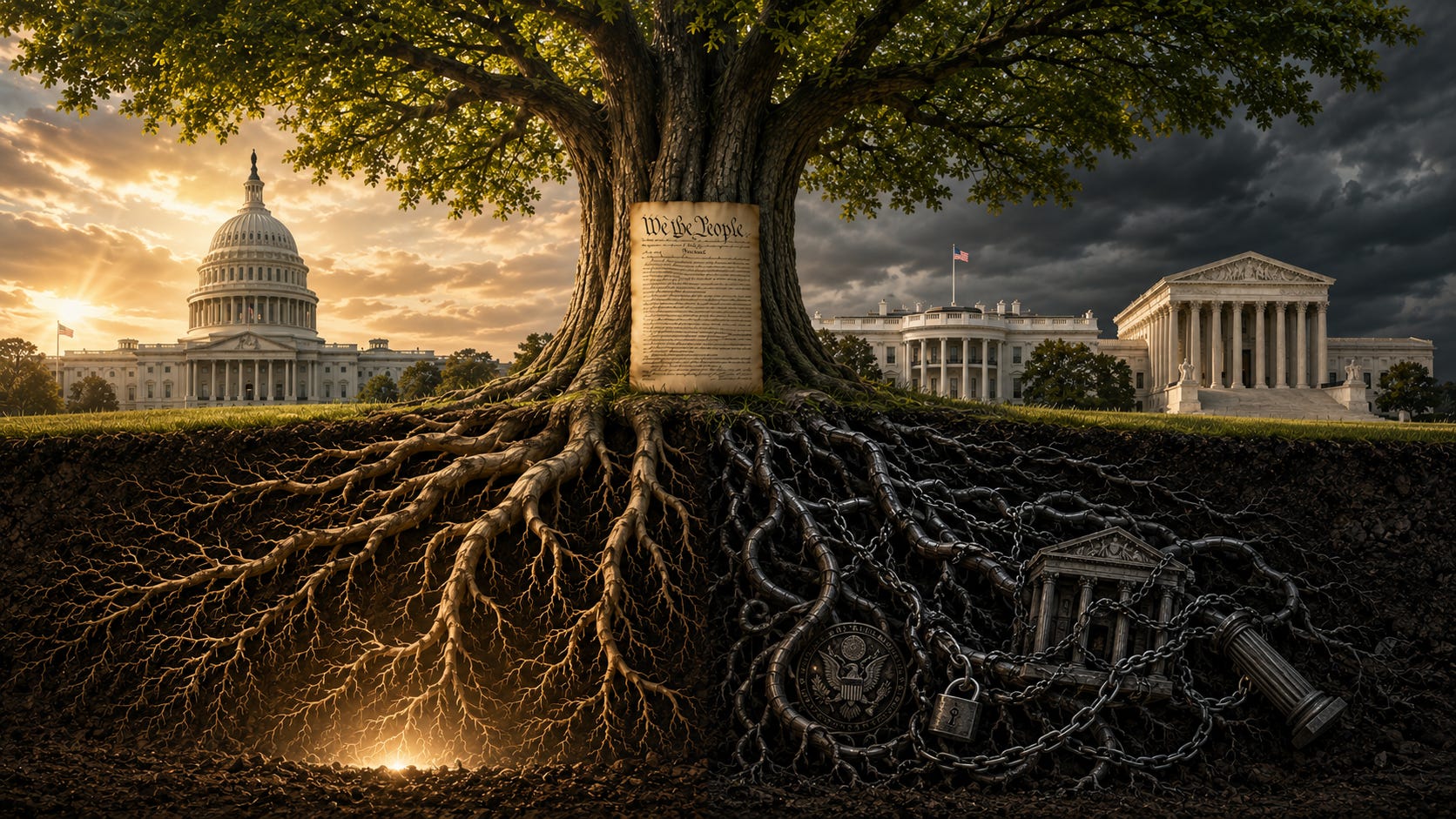
I had an unexpected breakthrough last night analysing the North Carolina child custody case that I was only tangentially involved in, yet became figural in the court’s reasoning through my labelling as “QAnon”.
As a consequence of befriending me, the mother’s civil rights were inverted: association with a constitutional restoration movement became the pretext for adverse state action and deprivation of rights.
Freedom of association became extremism.
Free speech became dangerous ideology.
Freedom of movement became parental unfitness.
Remaining in her own home became a reason to lose her child. Seeking justice became evidence of instability. Resisting the injury became justification for its continuation.
More significantly, it allowed the constitutional anchor of the case to be displaced. Instead of focusing on the conduct of the opposing parties—one of whom openly admitted taking a child outside of an existing custody agreement—the court’s attention shifted to the identities of the mother and myself.
The insight was not really about the custody case, which merely acted as the catalyst. The real “aha!” came from my frustration with AI, which repeatedly imported assumptions from the legacy constitutional order into a postulated post-rupture restored order.
Many of my biggest conceptual breakthroughs have come from deconstructing why AI produces answers that feel “obviously wrong” to a moral mind, despite being internally consistent. The problem is rarely bad logic; it is almost always a misclassification of the constitutional object before any reasoning begins.
Seeking to resolve that prior misclassification, I found that the breakthrough came not from a better answer, but from a better question:
What sovereign object did opposing counsel actually attach to when he invoked “QAnon” as the bogeyman that displaced the alleged unlawful taking of a child?
That question relocated the entire analysis. It ceased to be primarily about a custody dispute, political labels, or controversial beliefs. Instead, it became an inquiry into the very essence of sovereignty in a republic:
How the sovereign recognises itself.
How every constitutional institution ultimately derives its legitimacy from that recognition.
Why? Because every self-governing system must distinguish itself from that which is not itself.
An immune system distinguishes self from pathogen.
A secure computer distinguishes trusted code from malware.
A republic is no different.
I am not referring to personal sovereignty or individual autonomy, but to the republic’s own capacity to recognise the lawful source of its authority.
Before it can legislate, judge, or govern, it must first recognise what legitimately belongs to its own constitutional order. That prior act is what I mean by sovereign self-recognition.
The difficulty of keeping a republic, and the danger of it becoming captive to private or foreign interests, is hardly novel. That a constitutional order can drift, be infiltrated, hijacked, subverted, and inverted was anticipated by the American Founding Fathers.
This is why America possesses constitutional architecture that appears rather strange until one asks what problem it is solving:
The President is not merely the head of the Executive, but also Commander in Chief.
The Marines are not merely another military service, but a constitutional safeguard under the President’s direction against institutional capture.
The oath of office is not sworn to any person or institution, but to the Constitution itself.
That is an extraordinary design choice. It implicitly acknowledges that offices, office-holders, and even institutions may fail. The object of ultimate loyalty must therefore be something more fundamental than any of them.
The implication is profound. Constitutional restoration movements are not exceptional phenomena. Quite the opposite: in any functioning republic they are periodically inevitable.
No constitutional order can simply assume that institutional capture will never occur.
It must therefore retain the capacity to recognise capture, recover from it, and restore lawful government. Indeed, the more successful, wealthy, and powerful a republic becomes, the greater the incentive for private interests, foreign powers, and entrenched elites to capture its institutions for their own benefit.
Constitutional restoration is therefore not an admission of failure.
It is one of the mechanisms by which a republic survives success.
The idea I want to share with you is that every sovereign order must ultimately possess a means of recognising itself.
It asks a single foundational question:
What distinguishes that which legitimately belongs to the constitutional order from that which merely claims to belong to it?
The question is hardly academic. It underlies controversies over the lawful succession of governments, declarations of war, and central banking.
In computing, a secure website ultimately depends upon a trusted root certificate. Every subsequent certificate derives its validity from that root. Likewise, every constitutional order depends upon a root act of sovereign self-recognition from which all lawful authority ultimately flows.
Once this is understood, every object imported into litigation can be evaluated against the sovereign’s root recognition function.
In doing so, it is performing one of only two roles:
It is either instantiating authentic sovereign self-recognition, or
It is attempting to counterfeit, disrupt, or invert it.
There is no stable third category.
Almost all litigation takes place below this layer.
Even where a judicial act is unconstitutional, unlawful, or profoundly unjust, the parties usually continue to recognise the same sovereign authority from which constitutional legitimacy ultimately derives. They disagree over the application of law, not the root by which law itself is recognised.
Only rarely does litigation reach the sovereign-recognition layer itself.
It most commonly appears in cases touching elections, citizenship, recognition of governments, or national security, where the question is no longer merely what the law requires, but what lawfully belongs to the constitutional order in the first place.
The distinction between authentic and counterfeit extends even to a written constitution.
A constitution is not the root of sovereignty, but an expression of a prior sovereign authority from which it derives its legitimacy. If that authority is captured or subverted, the Constitution itself becomes another object whose legitimacy must be recognised rather than merely assumed.
Importantly, recognition is binary, even when evidence is not.
An object is ultimately recognised as authentic or rejected as counterfeit. There is no middle state, just as a woman cannot be somewhat pregnant.
The evidence leading to that decision may be incomplete, contradictory, or fiercely contested. Recognition may temporarily diverge from reality through error, deception, or institutional failure.
But the recognition function itself cannot become graduated.
It must ultimately resolve to one state or the other.
This completely relocates the debate over labels such as Q, Anons, or QAnon.
These terms possess no intrinsic constitutional meaning whatsoever. Like patriotism, legality, democracy, or even the Constitution itself, they are derivative recognition objects.
Their meaning is entirely contingent upon the sovereign self-recognition function from which they derive:
If they instantiate lawful constitutional continuity, they are restorationist.
If they instantiate a counterfeit recognition function, they are disruptive.
Their constitutional meaning cannot be determined by the label itself, only by the root authority from which that label ultimately derives.
The same label may therefore carry radically different constitutional meaning depending upon the sovereign root from which it derives.
So when the White House, the Department of War, and the Department of Homeland Security repeatedly and consistently echo Q themes in official communications, there are only two coherent interpretations:
they are tacitly signalling alignment with what Q has consistently claimed to be—a constitutional restoration process operating outside ordinary civilian authority; or
the highest levels of the American state have themselves become vehicles for an adversary’s messaging, disrupting the constitutional order.
The recognition function remains binary even if observers disagree which branch it instantiates. There is no stable third position in which the same communications are simultaneously authentic and counterfeit.
I regard the available evidence as pointing strongly toward the first branch, which I adopt as the working antecedent. This is not because you must share my conclusion, but because the constitutional consequences can only be understood from within a single recognition function.
Under this interpretation, the term “QAnon” no longer merely denotes a cultural, political, or ideological viewpoint. It functions as an adversarial classifier: a recognition-disrupting label that opposes and derails the restorationist process. Association with the restorationist movement is itself transformed into evidence of opposition to the constitutional order.
The restorationist becomes the insurrectionist; the corrective becomes the threat.
Conversely, Q no longer denotes merely an anonymous source or military initiative. It becomes the proposed recognition anchor—the constitutional “mother root”, reaching back through 1776 and ultimately to the sovereign authority of the people themselves—from which every lawful American constitutional order derives its legitimacy.
The importation of “QAnon” into civil litigation therefore becomes a kind of radioactive tracer.
If, under the restoration hypothesis, Q is the authentic constitutional trust anchor, then “QAnon” is the counterfeit certificate presented to the court. Acceptance of that counterfeit does not merely misclassify one litigant; it reveals that the institution is validating constitutional meaning against the wrong root authority.
The court is rather like a computer asked to validate a digital certificate after its trust store has been compromised.
From inside the system everything appears internally consistent. Only by comparing the chain of trust to the authentic root does the counterfeit become apparent.
In terms of “JusticSec”, this represents the maximal category of constitutional failure.
The issue is no longer that a court has been weaponised for unconstitutional or even criminal purposes. Rather, the court’s own recognition function has become inverted. It no longer recognises the constitutional root from which lawful authority derives, and instead treats attempts to instantiate that root as though they were the constitutional threat.
In computing terms, the court is no longer running the wrong application. It is validating against the wrong operating system. The “ConstitutionOS” itself has been displaced by a counterfeit trust environment. Every subsequent computation may therefore be internally coherent while remaining externally illegitimate.
Under this interpretation, the inversion of legitimacy is complete: constitutional restoration is classified as constitutional subversion.
The corrective is recognised as the threat.
The threat is recognised as the lawful order.
This becomes particularly acute in the present case, not because the human consequences are the greatest, but because the legal computation at the level of sovereign self-recognition is unusually visible.
The signal is comparatively uncontaminated by competing factual narratives or personal drama:
The father had previously failed in his attempt to obtain custody, had been ordered to pay substantial child-support arrears, and the child had been found by the same court to be thriving in the mother’s long-term care.
The child’s transfer was coordinated by her father and stepfather without the mother’s knowledge or consent—something openly acknowledged in court.
The court dismissed the father’s emergency application based on abandonment as “without merit”.
The stepfather who later testified against the mother was, it subsequently emerged, diverting and dissipating the marital estate during his own divorce proceedings.
The father sought near-immediate termination of his child-support obligations even before the temporary custody arrangement became permanent.
I had never met the child, had no legal pathway to becoming a custodial parent, and no practical prospect of exercising parental influence.
My involvement consisted solely of publicly objecting to unlawful acts and helping to raise funds so that the mother could obtain legal representation.
The term “QAnon”, therefore, functions as the mechanism by which the constitutional anchor of the litigation is displaced.
Instead of treating the child’s stated wishes as the clean basis for the practical outcome, the proceedings routed the case through domestic terrorism, weather warfare, cult membership, and ideological extremism. That detour matters.
The child’s voice could have been treated as decisive. Instead, it was supplemented — and in practice displaced — by a narrative that transformed those objecting to the transfer into the real object of adjudication.
As a consequence of importing “QAnon” to invert the sovereign-recognition root, the constitutional anchor shifted from conduct to identity.
That substitution is the central constitutional event described in this article. Against that background, one question becomes unavoidable:
What changes in the analysis if every reference to “QAnon” is removed from the litigation?
If the answer is “very little”, then the classifier was incidental.
If the answer is “a great deal”, then it was performing indispensable computational work at a constitutional level.
The issue is therefore not simply that “QAnon” appeared in a custody case.
It is whether importing a sovereign-recognition object fundamentally changed what the court was being asked to recognise.
The moment sovereign self-recognition becomes a load-bearing element of the litigation, the case ceases to be purely a family-law matter. It has crossed an architectural boundary into a category that ordinary civilian adjudication was never designed to resolve.
What makes this case an outlier is twofold:
First, a domestic child-custody dispute became the vehicle for importing an object that, under the restoration hypothesis, lies logically prior to the Constitution itself.
Secondly, the resulting legal computation is unusually exposed. A recognition function that is normally buried deep within the machinery of continuity of government becomes visible in an ordinary courtroom.
In that sense, what the court ultimately decided is almost secondary. The deeper issue is what it was invited to decide—and whether it was constitutionally capable of deciding it at all.
The moment the litigation required the court to assign constitutional meaning to “QAnon”, it was no longer simply adjudicating custody.
It was being invited to determine the legal significance of a sovereign-recognition object (or its adversarial inversion). If that object truly belongs to a constitutional layer beyond ordinary civilian institutions, then the court had already crossed the limits of its own constitutional competence, regardless of the custody outcome.
As someone trained in the formal methods used to prove software correctness, I instinctively think in terms of preconditions and postconditions.
What preconditions permitted “QAnon” to enter the record at all?
What constitutional assumptions had to be silently imported before a family court could even begin reasoning about it?
And what lawful postconditions could any judicial process emit once those assumptions had been accepted?
Those questions matter far beyond this one case.
They isolate the sovereign-recognition function from the surrounding factual noise and allow it to be examined directly.
That is what makes this litigation exceptional. Its enduring value lies not primarily in the custody outcome, but in the relative absence of competing constitutional or personal issues.
Whether one ultimately accepts or rejects the restoration hypothesis, it remains an unusually clean specimen from which the architecture of sovereign self-recognition can be studied.
Notably, the framework developed here does not depend upon accepting or rejecting Q.
It is logically prior to any particular restoration movement or continuity mechanism. Its purpose is simply to ask how a sovereign distinguishes that which legitimately belongs to the constitutional order from that which merely claims to belong to it.
The “so what?” and “what next?” are, I think, remarkably simple.
Once a sovereign-grade recognition function—associated, under the restoration hypothesis, with the deepest level of constitutional guardianship—had been imported into ordinary civil litigation, a cascade of legal and constitutional consequences followed.
Those deserve a separate analysis.
The next question is what happens if the constitutional trust anchor itself changes. Under the same restoration hypothesis, how should the case then be understood? What becomes of the actors involved? What becomes of the institutions themselves, once the higher constitutional jurisdiction to which the sovereign-recognition function belongs becomes overt?
That, too, deserves an article of its own.
I hope you have learned something important in the meantime. As with my Prolegomena reasoning tool, there is a category decision that precedes every evaluation of evidence, every legal argument, and every adjudication of facts.
Before any legal computation can be performed, the system must first know what kind of object it is reasoning about.
In this case, my contention is that a constitutional boundary was crossed—voluntarily, and on the record.
As for the real-world consequences, those depend on history rather than theory. We await our moment of restoration.
If “QAnon” inverted the sovereign self-recognition function, will Q restore it?
The real war was never over Q.
It was always over sovereign self-recognition.
Aha! is right, Martin. Now we can look at our entire US judicial branch and ask, "What constitutional object or its inversion is every judge in the Judicial Branch looking to and adopting as his or her root certificate?"
You have only to look at how many judges deliberately choose to order the Executive Branch to do or not do, to know that most judges are no longer using the Constitutional Root Certificate but their own political and ideological biases. The record that Trump is forcing the judges to write is exposing this single fact, and most judges clearly have adopted the inverted, false root.
Likewise for the media. Likewise for the bureaucracy. Likewise for the Legislators.
Q was the seed that started the process of awakening the Sovereign, us, We the People, to this massive inversion. And how does actual restoration happen once the People are awake, when all branches of the government, the media, the political parties (especially one), the NGOs and supposed charitable organizations, the executive suites of our companies, our rich elites are, to a vast extent, working from a root certificate that chooses specifically *not* to aid the Sovereign but to enslave and milk it?
It seems Q was right all along: The military is the only way, once the Sovereign is awake and united. Mix the Declaration of Independence and the First and Second Amendments, and you have the American Revolution 2.0 against the false sovereign root certificate and all its various manifestations in the life of the People.
All I can say is that the recent Q talk is saying to me that the next several months, the election season, the election and its postconditions are all gonna be LIT. Finally.
Isaiah 5:20
Amos 5:7
Prov 18:5
We are living through an amazing time of waiting and observing. The certainty a resolution will arrive becomes more clear each day, yet the clarity of what the resolution will look like remains consistently blurred.
I am learning to focus my attention and measure progress by looking at the body of evidence that proves to us a resolution is coming. No single article matters as much anymore. It's the overall movement of the information shared. The conglomeration of all the headlines, of all the topics moving toward exposure and truth. It shines the light further down the path we are traveling on.
We don't know how imminent the arrival may be. I'm learning to have joy while waiting for resolution. I fail that test about 50% of the time. I do believe the outcome will be better than we can see currently.
The questions now that won't leave my head are, "Who is involved in the creation of what life will be like once the resolution begins? What is their attachment to truth? What authority do they look to above themselves? What jurisdictions matter to them as they design the new framework of our existence? What will they value most? Sovereignty? Truth? Life? Family? Faith?