

As set out in previous essays, modern symbolic systems—courts, regulators, scientific claims, administrative procedures, media narratives, and AI outputs—can continue producing coherent outputs while their attachment to reality progressively weakens. It is not necessarily corruption as we usually think of it, but closer to a slow rot of meaning.
The first failure is often not outright falsehood but privation of reality attachment: the gradual degradation of the corrective pathways by which reality can reassert itself. The mismatch between symbolic representation and underlying reality remains visible, but no longer actionable.
The Prolegomena Tool is the most primitive operational layer for detecting that initial drift. It builds on the ideas I surfaced in a previous article that introduced the idea of “front matter” (‘prolegomena’) that precedes every discipline:
The General Prolegomena

While preparing my first Judicial Review application over a year ago, challenging the constitution of the court and prosecution in a motoring case, I encountered a new word: prolegomena.
The tool does not replace domain expertise or substantive analysis. It precedes them — or even the possibility of them. It tends to surface assumptions that have already been accepted as given the moment we engage with claimed authority.

The tool is free for personal use. If it is of value, you are invited to help fund my work.
It asks the six prior questions that must be answerable before any claim to occupy a category—law, science, evidence, authority, expertise, governance, or intelligence—can be meaningfully evaluated.
The Six Prolegomenal Questions
For any symbolic artefact ask:
Attribution — Can the symbol be traced to the reality, authority, event, person, or process from which it derives meaning?
Reconstructability — Can a competent observer recover the relevant reality from the symbolic artefact?
Mediation — What has been lost, compressed, distorted, transformed, or hidden during representation?
Continuity — Has the system remained attached to its source reality over time?
Corrigibility — If mismatch occurs, how can reality reassert itself?
Category Integrity — Does the thing genuinely occupy the category it claims to occupy, or does it merely claim membership?
The Category Test
The crux is whether the object being examined is still really in the category it claims to be, or merely has the shape of things that look like that category.
A forged banknote is not currency merely because people accept it.
A broken compass is not reliable merely because someone trusts it.
The central question therefore becomes:
What certifies this thing as a genuine member of its claimed category?
That is what the tool answers.
Example Applications
Court Order
Attribution — Can the order be traced to a named judicial authority?
Reconstructability — Can the jurisdiction and evidential basis be recovered?
Mediation — What procedural layers separate the order from the underlying facts?
Corrigibility — What mechanism reconnects the order to reality if it is wrong?
Category Integrity — Is this judicial power, or merely something treated as judicial power?
Scientific Paper
Attribution — Do the claims trace to observations or mainly to models and citations?
Reconstructability — Can others reproduce the result?
Mediation — What assumptions and transformations intervene?
Corrigibility — What evidence would overturn the claim?
Category Integrity — Is this science or scientific rhetoric?
AI Output
Attribution — What reality does the output claim to represent?
Reconstructability — Can the grounding be recovered?
Mediation — What transformations intervene between input and output?
Corrigibility — How is error detected and corrected?
Category Integrity — Is this understanding or symbolic simulation?
How to Use the Tool
Apply the six questions and the Category Test to any document, decision, claim, procedure, narrative, or output.
Start with a simple prompt attaching the tool to the document(s):
Apply the attached Prolegomena Tool to this material.
Then ask:
What non-obvious things is this surfacing?
What assumptions am I making without realising it?
What consequences might I have overlooked?
What would someone trapped inside this system fail to notice?
If this analysis is correct, what follows?
For persistent institutional traces or disputes, continue with:
Review my previous attempts to understand, challenge, or fix this situation. Where was I fighting the symptoms rather than the cause? What was hiding in plain sight? Which assumptions was I inheriting from the system itself? What deeper conditions was I failing to examine? And what becomes visible once those conditions are brought into view?
The goal is not a definitive verdict on truth or legitimacy.
The goal is to move from:
“Is it functioning?”
to
“Is it still what it says it is?”
—and to determine whether the system you are interacting with remains attached enough to reality to be meaningfully wrong.
What the Tool Is Not
It is not a political ideology, conspiracy framework, or theory of everything.
It is not a replacement for domain expertise, evidence, or substantive analysis.
It is not a truth machine or automatic validator of claims.
It is not a call to dismantle institutions.
It is a visibility and pre-diagnostic framework.
Its purpose is to determine whether a symbolic system still possesses the minimal conditions required to function as a reality-oriented discipline.
When the Tool Works Best
The Prolegomena Tool is particularly useful when:
something feels wrong, yet it is difficult to explain exactly why;
a process appears valid on paper but produces outcomes that make little sense;
everyone keeps referring to procedures, policies, experts, or authorities, but nobody can reconnect them to observable reality;
disputes persist despite repeated reviews, appeals, reforms, investigations, or interventions;
you find yourself drowning in documents, explanations, or analysis while understanding seems to decrease rather than increase;
the official account feels coherent, yet somehow incomplete;
“Is it true?”, “Is it lawful?”, or “Is it correct?” feels like the wrong first question.
It is especially useful when the visible activity of a bureaucratic system becomes easier to see than the reality it is supposed to represent.
Relationship to Other Tools
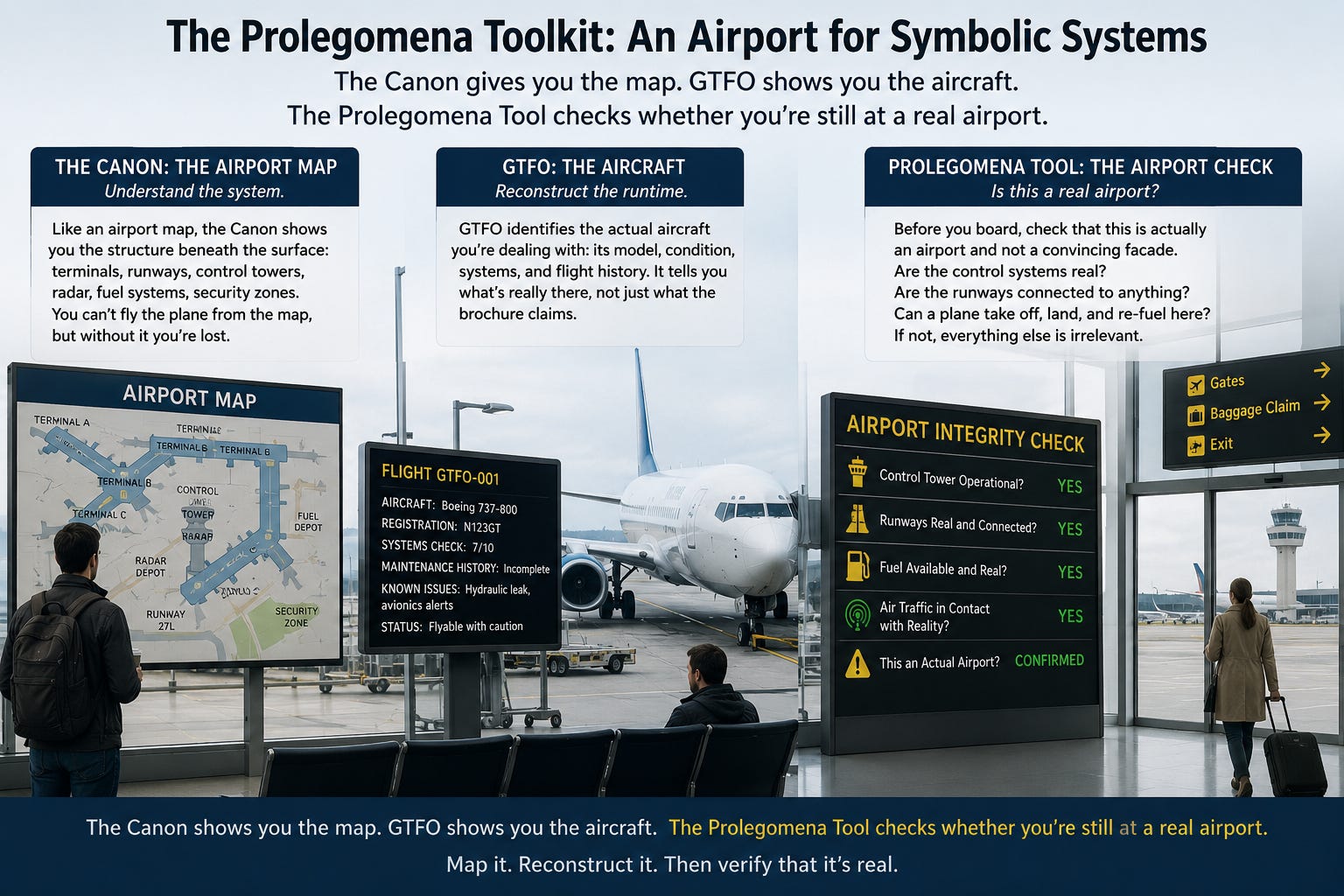
The Canon introduced a new way of thinking about institutions, governance, and symbolic systems. It is rather like attaching a debugger to an administrative process. Instead of reporting memory usage, disk activity, and CPU load, it reports attribution, reconstructability, observability, corrigibility, and syntheticity — the hidden variables that determine whether a symbolic system remains attached to reality.
GTFO then provided a practical instrument for reconstructing the runtime implied by observable traces (e.g. white papers, website, social media posts, book reviews, court orders). Rather than asking what a system claims to be doing, it asks what system must actually exist to produce the outputs we observe.
The Prolegomena Tool operates one layer deeper than this. It is the security checkpoint between public space and passenger space. Its purpose is not to determine where the aircraft is going, but whether the traveller genuinely qualifies as a passenger. Likewise, the Prolegomena Tool asks whether a symbolic system genuinely occupies the category it claims to inhabit.
It is deliberately lightweight and repeatable. In practice it is often the best place to start.
Most people (and models) begin by evaluating claims.
The Prolegomena Tool first asks whether the conditions that make evaluation possible are still present.