
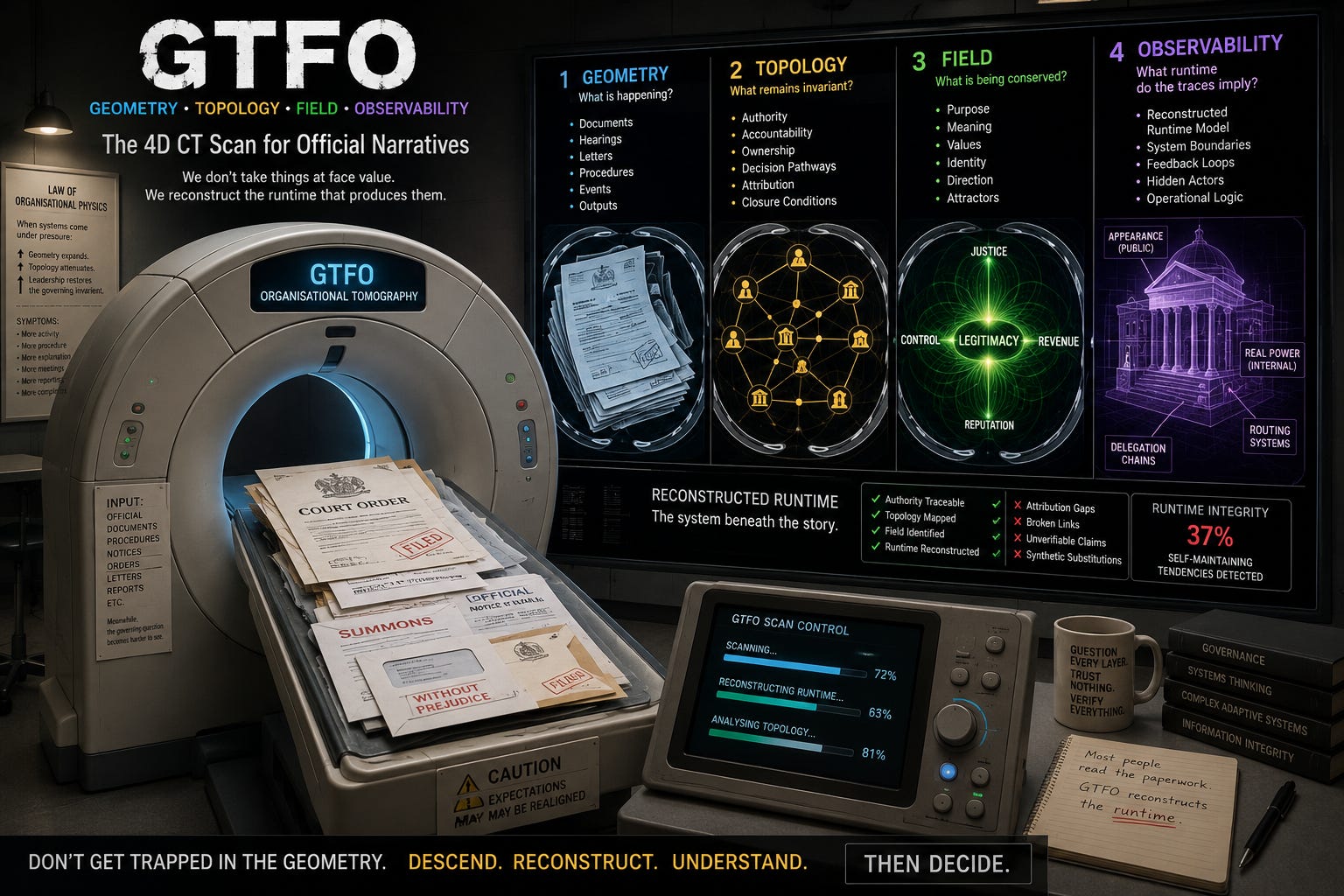
Over the last few months I have been making the intellectual and practical case that certain aspects of bureaucracy can be analysed using well-established engineering principles.
Just as engineers construct safety cases to prevent failures in physical systems, it is possible to reason about administrative systems in terms of attribution, observability, reconstructability, and control. We can identify where reality is being lost through layers of abstraction, detect drift into synthetic governance, and design interventions that restore proper chains of cause and effect.
The result is not a new political theory or legal doctrine. It is the application of systems thinking to institutions that increasingly operate through digital documents, automated procedures, and delegated authority.
If reality can be lost through bureaucratic mediation, then it should also be possible to detect that loss, measure it, and reduce it.
GTFO is one of the AI-assisted tools developed for that purpose. It is designed to help reconstruct the runtime implied by documents, decisions, policies, procedures, and other institutional traces.
An institution may have a specification in law, stated objectives, documented procedures, and official explanations for its behaviour. GTFO is interested in something else: not the claimed system, but the observed one.
The question is not what the institution says it is. The question is: what system must actually exist to consistently produce the traces we can actually observe?
It complements the ΩΛ∆∑ Canon framework (“Civilisation Repair Toolkit”) I published earlier, and forms part of a larger suite of diagnostic and reconstruction tools that I originally developed for my own use. I plan to publish further tools in due course, but each deserves its own introduction.

GTFO is free for personal use. If it is of value, you are invited to help fund my work.
It’s the 16th day of June and I still don’t have my rent saved up for the end of the month.
What does the GTFO tool do?
This isn’t a panacea for all human ill, nor does it claim to model the totality of the human psyche, organisational life, or society at large.
The claim is more modest.
Just as a CT scanner reconstructs an image of the body’s internal structure from external measurements, the symbols entering and leaving a system can be used to reconstruct an image of the runtime that produced them.
Documents, decisions, procedures, correspondence, and public artefacts are all traces. From those traces it is often possible to infer the structures, priorities, constraints, and governing invariants that shaped them, even when we lack direct access to the underlying algorithms, meetings, deliberations, or decision-makers.
In that sense, GTFO is less a theory of organisations, and more a method of organisational tomography.
The objective is not to redesign institutions from first principles. It is to reconstruct what is actually there already. This is closer to debugging a running system than designing a new one.
What problem does GTFO solve?
Most attempts to understand organisations, institutions, bureaucracies, courts, governments, or corporations become trapped in the visible layer—what GTFO calls Geometry: the documents, procedures, meetings, reports, policies, decisions, public statements, organisational charts, and emitted outputs.
This layer feels concrete. It is where arguments happen, where reforms target, and where most analysis stays.
A bureaucracy produces more paperwork.
A court issues more orders.
A government announces more initiatives.
A corporation runs more meetings.
On the surface, activity increases. Yet accountability, incentives, and actual outcomes often remain unchanged. Geometry makes change visible, but continuity can remain hidden.
The trap has become sharper in the AI era.
Large language models are extraordinarily good at Geometry. They are trained on vast corpora of emitted traces: documents, policies, judgments, press releases, correspondence, and institutional language. Their default strength is to summarise it, compare it, explain it, synthesise it, critique it, and generate more of it—often with impressive coherence and fluency.
Most analytical frameworks operate within the geometry.
GTFO changes the level of analysis.
Without deliberate prompting, LLMs rarely ask the deeper questions:
What conserved structure (Topology) survives beneath the changing activity? In other words, what form of continuity is actually being preserved under change?
What governing invariant (Field) is being conserved? In other words, what selects and stabilises that topology?
What runtime must exist to consistently produce these traces (Observability)? In other words, what hidden machinery is generating the visible outputs?
The result is a subtle but powerful failure mode: sophisticated descriptions of the surface that make the deeper runtime harder to see. The more eloquently the geometry is explained or defended, the less incentive there is to question whether it reflects reality.
Both humans and AI risk becoming prisoners of the visible layer—producing ever-better accounts of what a system says and does, while remaining blind to what it is.
GTFO exists to break that trap.
It provides a disciplined procedure for descent:
from visible activity (Geometry)
to conserved structures and attribution pathways (Topology),
to the governing invariant and attractors (Field), and finally
to a reconstruction of the actual runtime that would emit these traces.
Observability acts as the check—tomography that tests whether the outputs are consistent with any coherent underlying system.
The fundamental shift is this:
The question is no longer “What does this organisation say it is doing?”
It becomes “What system must actually exist to produce these consistent traces?”
That “aha” moment—“I’ve been arguing about geometry when that’s not the whole story”—is the entry point. Once seen, the visible layer loses its dominance. GTFO then supplies the vocabulary, the movement (descent then ascent), and the supporting tools to move from symptoms to causes, from emitted traces to reconstructed runtime.
In an age of abundant geometric fluency—from both institutions and the models trained on them—GTFO is not merely another governance diagnostic. It is a cognitive and analytical correction: a method for recovering visibility when surface sophistication threatens to obscure underlying reality.
How to use GTFO
Download the GTFO PDF and upload it to your preferred AI system.
Then add the document, decision, court order, policy, report, correspondence, or organisational artefact that you want to understand.
Start with a simple prompt:
Apply GTFO to this material.
Read the output.
Then ask:
What is GTFO telling me that is non-obvious (in plain English)?
Next ask:
What are the implications if this analysis is correct?
Then ask:
What would someone trapped in the Geometry layer miss?
If you are dealing with a persistent problem or dispute, continue with:
Review my previous attempts to understand, challenge, fix, reform, or respond to this situation. Where was I trapped in Geometry? What deeper structures was I failing to see?
Often the most valuable insight is not a new fact.
It is discovering that you have been asking the right questions, but at the wrong layer.
The goal is not to obtain a definitive answer.
The goal is to move from visible activity to reconstructed runtime — and see whether the system you are interacting with is actually the system you thought it was.
What GTFO is not
It is not a political ideology, conspiracy framework, or theory of everything.
It is not a replacement for domain expertise, evidence, or substantive analysis.
It is not a truth machine or automatic validator of claims.
It is not a call to dismantle institutions.
GTFO is a visibility framework. Nothing more.
It helps reconstruct the runtime implied by observed traces.
Its purpose is improved observability into how systems actually operate.
When GTFO works best
GTFO is particularly useful when:
an institution’s behaviour feels inconsistent with its stated purpose;
official explanations do not match observed outcomes over time;
procedural complexity is expanding while results stagnate;
accountability is diffuse or difficult to locate;
a dispute or problem keeps regenerating despite apparent resolution;
the volume of available information is increasing faster than understanding;
AI-generated summaries or analyses feel correct on the surface but somehow unsatisfying or incomplete.
It shines in environments with high geometric output: bureaucracies, legal processes, corporate governance, regulatory systems, and large institutions where surface fluency can obscure deeper structure.
Relationship to the Canon
GTFO is a practical, operational companion to the broader Canon. A CT scanner doesn’t have to embody the entirety of the pathology discipline.
The Canon contains a growing collection of tools for analysing governance, institutions, symbolic systems, and syntheticity.
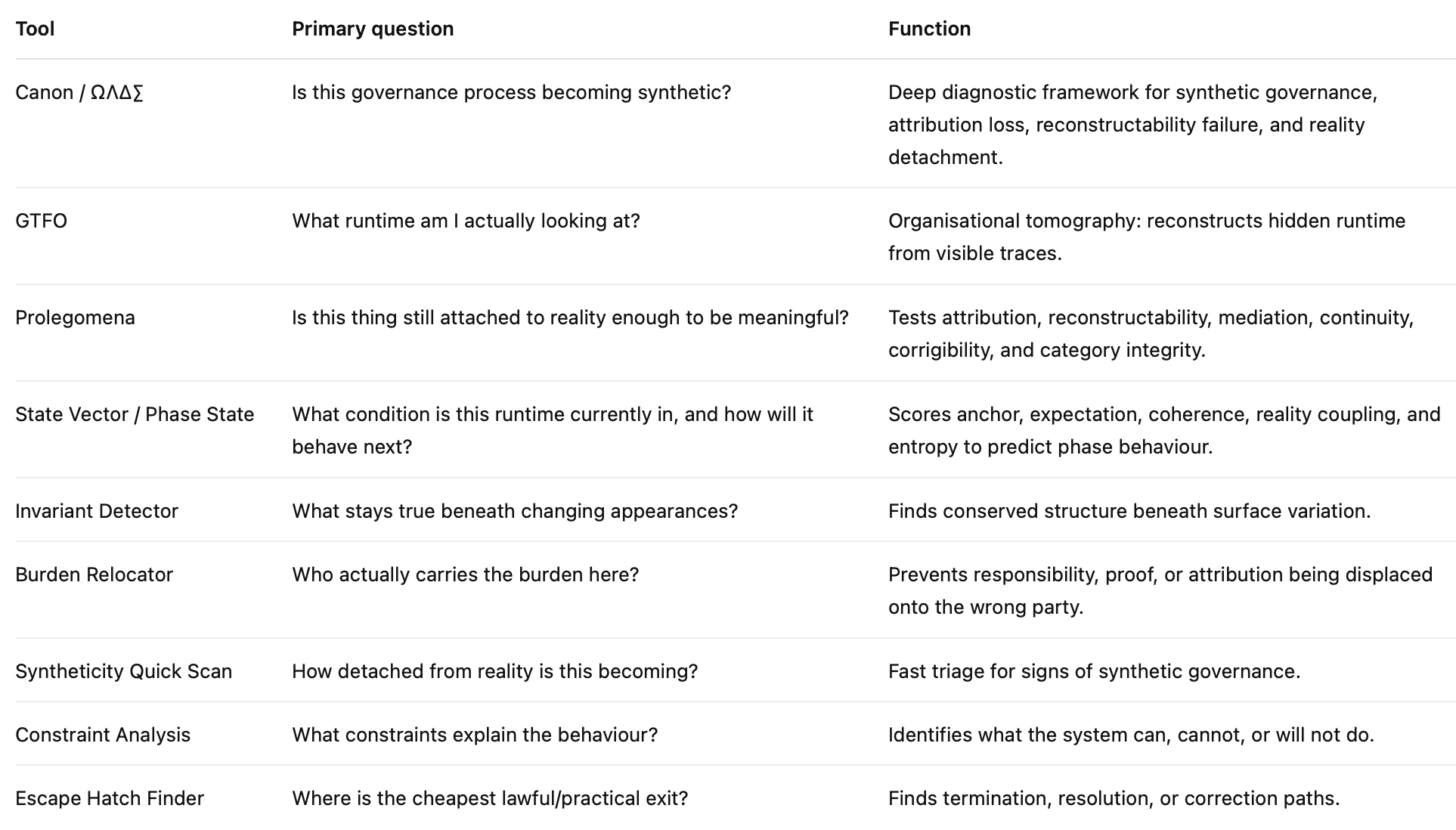
GTFO occupies a specific role within that ecosystem:
Reconstruct the runtime implied by observable traces.
It is designed to be lightweight, repeatable, and usable without requiring the full theoretical stack.
In practice, GTFO is often the best place to start.
Once the underlying runtime becomes visible, deeper questions of attribution, reconstructability, syntheticity, correction, and governance dynamics become much easier to explore.
Closing
Most people (and AI models) read documents.
GTFO reconstructs the system that produced them.
Very good Martin and quite timely here. A general purpose tool that can be used to direct the Large Language Model (LLM) of your choice. Are you avalable for a chat via a video link to discuss same ? Regards David.
GTFO: appropriately named, thank you Martin! As an aging Californian held captive in Governor Newscum’s criminal dictatorship, tools such as this will undoubtedly assist the populace in unearthing truth below the scam, right? Hopefully so simple even a brainwashed leftist can use it! Not that Gavin’s criminal tactics aren’t that obvious, already! Having passed my prime in technological concepts, I can still see benefits to releasing “underlying truth trends” through your GTFO techno-analysis. Just so entertaining, as well .. to see your chosen title for this important work. I’ll let the young ones take the lead, but so glad you developed this much needed analytical tool. There’s hope! Thank you. Will share with others! Hooray! PS, residing in California is both challenging & detrimental to one’s sanity, hence my need to rant on it occasionally. Apologies to everyone for my whine-a-thon. 😳. MAGA!