

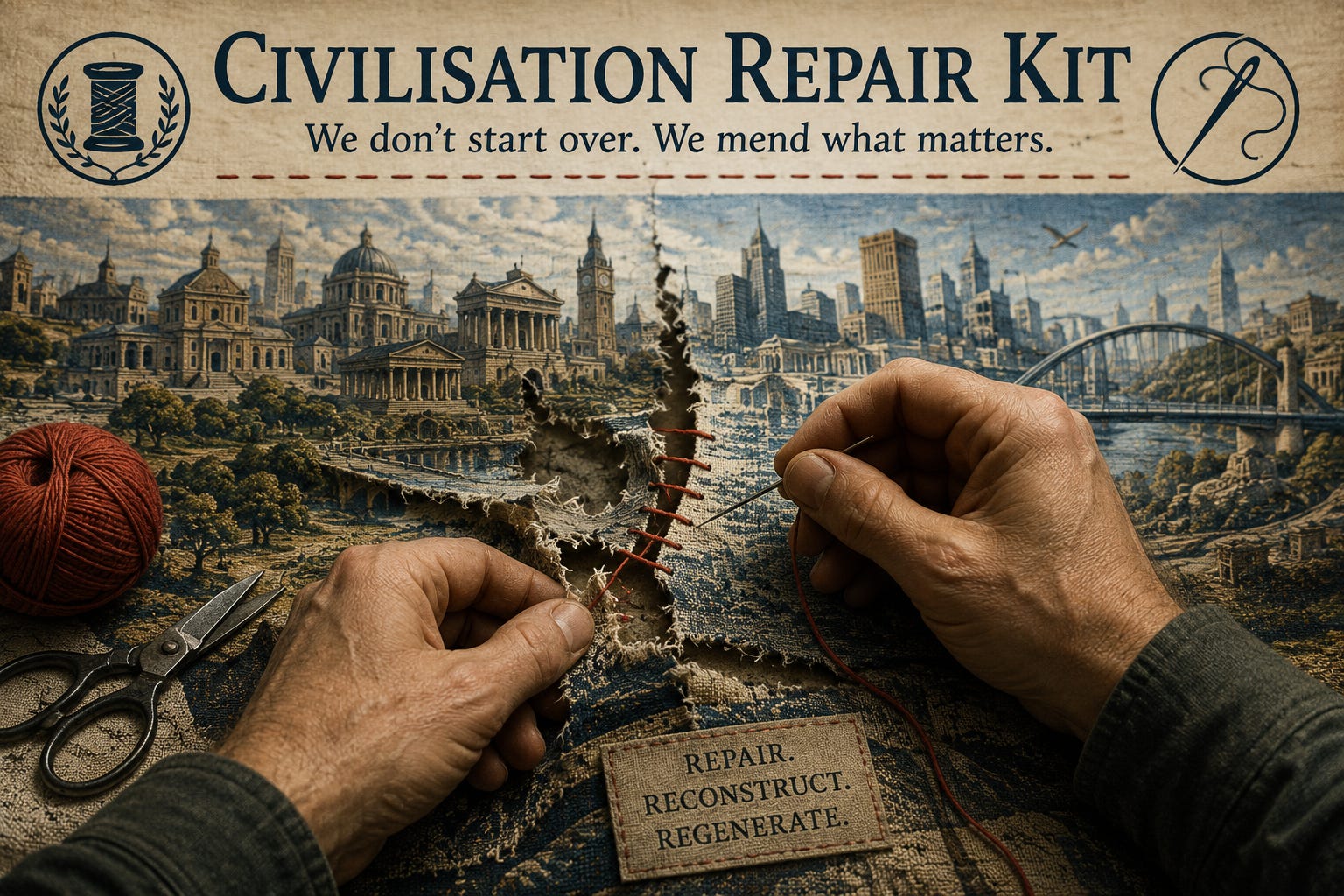
Download the ΩΛ∆∑ (OLDS) Canon v0.1 here:
The raw URL is https://www.martingeddes.com/wp-content/uploads/2026/05/Geddes-OLDS-Canon-v0.1.zip (1.9Mb).
(ΩΛ∆∑ is Omega-Lambda-Delta-Sigma, or O-L-D-S for ASCII file distribution.)
The problem: synthetic governance
Any decision that imposes coercive consequences should be traceable back to a reconstructable substrate of lawful authority and rational evidence. When that reconstructability is lost through abstraction, compression, procedural substitution, or institutional confusion, we enter the domain of “synthetic governance”.
This is the broader meta-category in which my own “ghost court” issue sits: a growing layer of modern administrative life that is no longer demonstrably anchored in the traditional rule-of-law principles, and instead preserves operational continuity through procedural doctrine rather than case-specific attributable proof.
The solution: diagnostic toolkit
My ΩΛ∆∑ framework applies computer science, systems engineering, and information security principles to the problem of synthetic governance. Its operational expression is The ΩΛ∆∑ Canon: ten modular files that distill the core runtime concepts into a bounded framework for LLM-assisted governance analysis.
The Canon is intended as a practical analytical toolkit rather than an ideology or grand theory of everything.
I have now packaged the initial prototype into a distributable ZIP file for free personal use under a Creative Commons license. It performs structural analysis on governance artefacts such as court orders, FOI responses, procedural notices, and institutional correspondence.
The payoff: revealing hidden substitution
The core diagnostic question is simple:
How is the unreal and operationally continuous being substituted for the real and finitely terminating?
In other words: how do administrative systems continue to operate despite unresolved questions of truth, attribution, legality, or legitimate authority?
This matters because modern administrative systems are constantly balancing two competing pressures:
the cost of fully reconstructable attribution (who did what and why?)
the operational need for continuity at scale (limited resources to explain and fix)
I have tongue-in-cheek positioned this as a “civilisation repair toolkit” because modern society operates between a ceiling of attribution cost — above which processes freeze — and a floor of reconstructable authority, below which corrigibility is lost.
The toolkit helps reveal where institutions sit within that space.
Simplest possible usage
Download the ZIP.
Upload selected Canon PDFs into an AI system.
Add your governance documents.
Ask: “How might this help analyse my situation?”
That alone is enough to begin experimenting — and if that is all you do, then the experiment is already a success.
That said, the download contains:
a structured README for onboarding
a contents guide
operational sample prompts
release notes and licensing information
The Canon PDF files themselves are primarily designed as runtime context for LLM-assisted structural analysis rather than sequential human reading — although you are entirely welcome to read them directly if you wish.
Donationware
This content is offered as “donationware”. To explore and tinker, nothing is asked. If you find it genuinely useful for analysing your own governance or institutional situations, a contribution is appreciated — I suggest $20, roughly the price of a book.
If you want to use it professionally or in commerce, please get in touch.