

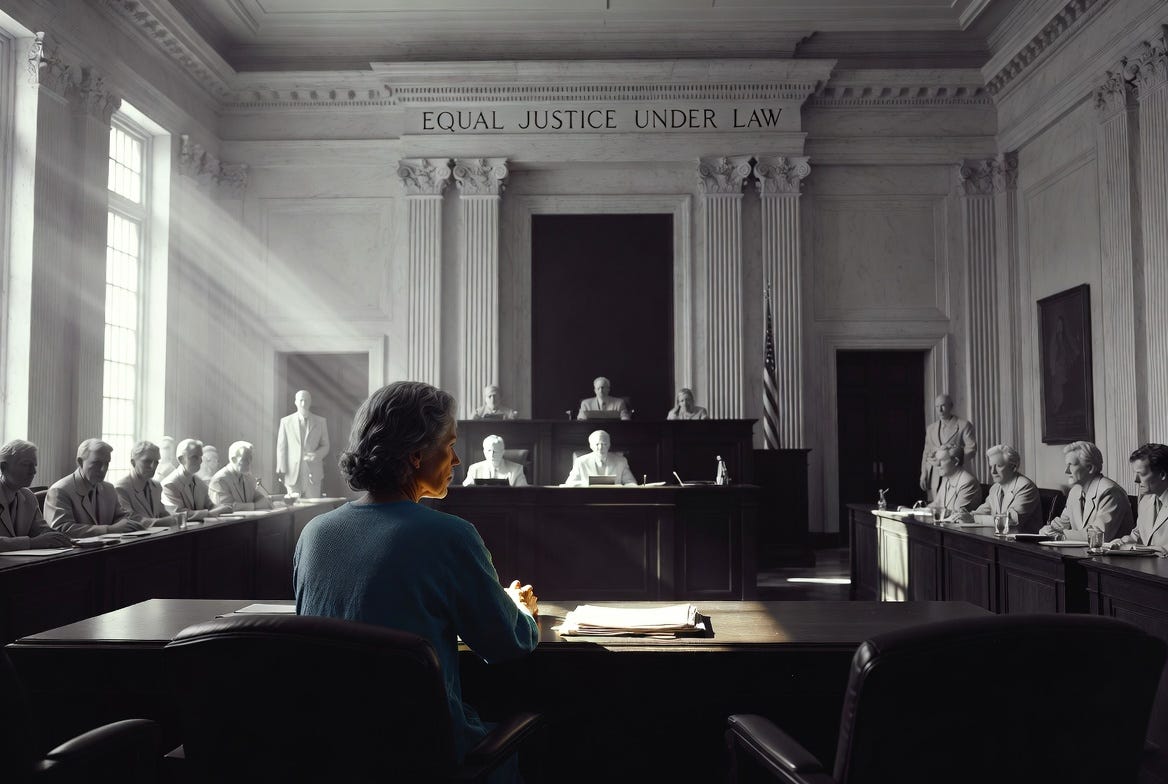
I never expected to find myself caught up in a one-in-a-million family-law case in America, especially as I was — and remain — neither a parent, witness to the underlying events, nor even a party to the proceedings.
In previous articles I have described how a mother came to visit me in Britain, during which time her child was transferred outside an existing custody arrangement by the father and stepfather, both of whom later stood to benefit financially from the manufactured status quo that resulted. An emergency application alleging abandonment was later rejected and ultimately described by the court itself as “without merit”.
Yet the child was not returned.
Instead, the new reality hardened into law. As the litigation progressed, the focus drifted away from the conduct that created the new situation—conduct that was repeatedly argued to be criminal—and toward the people objecting to it.
My association with the mother, together with the label “QAnon”, became part of the court’s reasoning — despite there being no identified causal mechanism by which I could have affected the child.
That reasoning was applied retroactively, as my involvement was downstream of the inter-state transfer itself. Once the emergency motion was denied, political ideology appeared, only to disappear once it had its effect.
That relocation of attention, and its wider constitutional significance beyond one case, is the real subject of this article.
In my previous essay, I argued that importing “QAnon” into an ordinary custody dispute changed the constitutional object the court was being asked to recognise.
The real war is over sovereign self-recognition

I had an unexpected breakthrough last night analysing the North Carolina child custody case that I was only tangentially involved in, yet became figural in the court’s reasoning through my labelling as “QAnon”.
Under the restoration hypothesis explored throughout this series, Q presents itself as a constitutional continuity mechanism operating upstream of ordinary civilian institutions, while “QAnon” functions as the adversarial label attached to it.
Whether one accepts that hypothesis or not, the analytical question remains the same:
What work was the “QAnon” identity classifier doing inside a family court?
My contention is that it performed far more than rhetorical colour.
It changed the legal computation itself.
Instead of asking whether particular conduct was lawful, the court was invited to reason from identity — affiliation to ideas (Q) and political movements (Anons).
In computing terms, it was as though the court’s constitutional trusted certificate store had been replaced: personal action ceased to be the primary object of evaluation, and group affiliation became the organising principle.
If that analysis is correct, the implications are deeply unsettling.
If courts can transform political association into evidence of parental unfitness, then no freedom movement is safe — or any kind of group policy initiative for that matter.
Today’s “QAnon” becomes tomorrow’s politically inconvenient label.
Your children can be taken because of what you are tarnished with, potentially by foreign adversaries or domestic turncoats, rather than what you have done.
The label is incidental.
The inversion is not.
That conclusion raises an obvious question. How could such an inversion survive the ordinary mechanisms by which constitutional systems correct themselves?
Courts are designed to prioritise throughput over perfection. Errors of fact and law are ordinary, and not necessarily cause for rebuke of judges; truth and prudence often emerge only after multiple rounds of adversarial examination.
Appeals are therefore an integral part of the constitutional correction mechanism, allowing initial decisions to be tested against a fuller record and more mature legal reasoning.
In this custody case, however, there has deliberately been no appeal, despite what appears on its face to be compelling justification.
That is because the case became infected at a more fundamental level through the import of a contested geopolitical identity classifier — “QAnon” — together with its associated narratives of extremism, domestic terrorism and cultism.
Once those ideas entered the courtroom, the dispute ceased to be merely about custody.
It became entangled with questions that no family court is institutionally equipped to resolve, touching on national security, continuity of government, and the constitutional legitimacy of the court system itself.
Imagine, for a moment, the alleged perpetrators of an unlawful interstate child transfer standing before a jury and explaining that they acted because one parent was “QAnon” — directly or indirectly, whatever that term is ultimately supposed to mean.
There is no membership register of a proscribed organisation, no allegation of any criminal offence arising from political belief, and no recognised legal definition capable of ordinary judicial application.
There is only a narrative label.
A jury exposed to years of propaganda is already at a constitutional disadvantage.
Without access to the underlying national-security substrate, and itself vulnerable to the same reputational and professional coercion, it is functionally incapable of adjudicating the constitutional significance of such a claim.
In effect, the identity classifier becomes an attempted “get out of jail free” card.
It is deployed as a liability shield: not to answer allegations concerning the underlying conduct, but to redirect constitutional scrutiny onto those exposing it. If that manoeuvre succeeds, accountability is no longer evaluated; the rights of others become the cost of the immunity.
To understand how criminal immunity can be manufactured through ordinary civil process, we first need to remind ourselves what courts actually do.
Courts are attribution engines. They reconstruct causality. They determine who acted, under what authority, against whom, and with what legal consequence. Rights are protected because constitutional adjudication begins with conduct. Identity matters only where the law itself makes it relevant.
If the alleged child transfer cannot survive ordinary constitutional scrutiny, then the computation itself must be relocated.
Instead of asking whether the conduct was lawful, the court is invited to ask whether the people objecting to it possess a politically disfavoured identity.
But relocation alone is insufficient. The new constitutional starting point must first be authenticated.
In this case, the temporary custody order performed that function.
Once the emergency application had failed and the child nevertheless remained outside the existing custody arrangement, the order transformed a disputed factual inversion into the institutional point of departure for every subsequent proceeding.
Its significance lies in a profound internal tension.
The order itself records the circumstances from which the inversion arose. It acknowledges the absence of notice and rejects the emergency allegation of abandonment as “without merit”. Yet it nevertheless accepts the resulting status quo as the foundation upon which all later judicial reasoning proceeds.
The order therefore performs two functions simultaneously:
It records the predicate irregularity.
It authenticates its constitutional consequences.
From that moment onwards, every subsequent proceeding computes not from the constitutional position that existed before the interstate transfer, but from one already altered by it.
The legal system had accepted the output of the inverted computation as its new input.
Cover-ups do not erase evidence.
They redefine what the Constitution is permitted to recognise.
That relocation explains something much larger than this single custody dispute. Every constitutional order possesses two correction loops:
The first operates at the level of the individual citizen. When rights are infringed, courts exist to recognise the error and provide a remedy.
The second operates at the level of the nation itself. When institutions drift away from constitutional government, the constitutional order must possess some mechanism by which lawful authority can ultimately reassert itself.
The remarkable feature of the “QAnon” classifier, under the restoration hypothesis explored throughout this series, is that it attacks both correction loops simultaneously:
When the citizen seeks correction, correction becomes pathology.
When the nation seeks restoration, restoration becomes pathology.
The underlying logic is identical. Only the scale of object it is applied to changes. In this case, however, they become coupled.
Note what has happened.
The child transfer no longer requires constitutional justification.
The alleged injury no longer requires constitutional remedy.
A political identity suddenly requires constitutional attention.
The label displaces the conduct.
The conduct disappears behind the label.
The label determines who receives constitutional protection.
This sequence is not merely procedural. It is computational.
The child is not merely the subject of the litigation. She is its constitutional object.
When political identity displaces the child’s welfare as the focus of recognition, the court has ceased to perform the function for which family jurisdiction exists.
That is not adjudication.
It is constitutional inversion.
The entire architecture of the case now depends upon one semantic assumption remaining permanently true: that the “QAnon” classifier legitimately displaces ordinary constitutional recognition.
If that classifier fails—whether legally, factually, or constitutionally—the entire chain of reasoning built upon it fails with it. The case has acquired a single point of constitutional failure.
Constitutions are not destroyed because isolated unlawful acts occur. They are degraded when institutions systemically lose the ability to recognise unlawful acts as unlawful.
Once conduct is displaced by identity as the primary object of constitutional recognition, the self-correction mechanism begins to fail, hence no appeal was attempted.
The state no longer computes whether a child was unlawfully taken or whether rights were deprived. Instead, it computes whether the people objecting belong to a politically contaminated class.
Under that model, “QAnon” is not merely a smear. It is an adversarial identity classifier capable of disabling constitutional standing itself.
If that analysis is correct, then its use against a parent in a custody dispute—and ultimately against a child—is not a peripheral curiosity. It becomes one of the highest-salience constitutional questions in any genuine restoration of sovereign rule of law.
If your constitutional rights can be nullified in practice by uttering a single magic word, then you do not meaningfully possess those rights at all.
That is a level beyond deprivation of rights under colour of law.
It is constitutional excommunication.
There is a smoking gun in this custody case of the suppression of constitutional rights by an officer of the court—and the court’s willingness to permit it.
Counsel for the father compelled the mother to identify an anonymous X account and then introduced, as an exhibit, a repost of a political cartoon depicting military police escorting allegedly corrupt Masonic judges away.
That choice is itself remarkable. The exhibit did not purport to prove that the mother had harmed her daughter. It did not establish abuse, neglect, abandonment, or any breach of the custody order.
It demonstrated only that she had engaged in anonymous political expression critical of public institutions.
The obvious question therefore is not what the cartoon meant. It is why anonymous political speech became relevant to the disposition of parental rights in the first place — when the other party stands accused of criminal conduct.
That’s the smoking gun.
Not the content.
The relevance.
Once anonymous political speech had been admitted as relevant, the questioning repeatedly returned to the same constitutional object.
The mother objected that revealing the identity of her anonymous account implicated her First Amendment rights. Counsel nevertheless insisted:
“You’re compelled to say what your handle is. You’re under oath. You don’t get to keep secrets.”
The objection did not become the subject of any meaningful judicial analysis.
Instead, the examination simply continued.
Having compelled disclosure of the anonymous account, counsel immediately turned to its contents. The questioning focused not on any evidence that the mother had harmed her daughter—she had, after all, merely travelled abroad with the knowledge and agreement of those caring for the child—but on anonymous political commentary concerning alleged judicial corruption, family courts, child trafficking, conservative parents, and criticism of public institutions.
She was also questioned extensively about my role, despite my entering the chronology only after the interstate transfer had already occurred.
That procedural sequence matters.
The admissibility issue had been squarely raised. Instead of first deciding whether anonymous political speech and political association were constitutionally relevant to a custody dispute, the proceedings simply assumed that they were. The constitutional question was bypassed while its consequences were allowed to unfold.
The chronology, meanwhile, remained unchanged:
the child was transferred;
the emergency application failed;
the child was nevertheless not returned;
only then did political identity become a central evidential object.
That ordering is not a trivial feature of the record.
It is the moment at which the focal object of the proceedings appears to change.
The court’s attention moves away from the predicate conduct that created the disputed status quo and toward the political identity, speech, and associations of those objecting to it.
The question silently shifts from:
What happened to the child?
to:
What power system or ideology do these people represent?
Constitutions exist to judge conduct, not political identity.
The moment a label becomes the gateway through which constitutional standing is granted or withheld, the legal order has begun to compute a different reality.
This is the point at which a court can continue to resemble a court while ceasing to be judicial.
The defining feature of a judicial proceeding is not that it occurs before a judge.
Nor is it that lawyers are present, evidence is admitted, witnesses are sworn, or orders are issued.
A proceeding is judicial only if it faithfully performs the constitutional function delegated to it:
recognising the lawful object before it, and
adjudicating that object according to law.
Everything else is ceremony.
That distinction matters because constitutional errors are not all alike.
A court may misunderstand the facts.
It may misinterpret the law.
It may even abuse its discretion.
Those remain judicial acts because the court is still attempting to adjudicate the correct constitutional object.
There is, however, a more fundamental category of failure.
If the object of constitutional recognition itself is replaced—if conduct gives way to identity, if liability gives way to political attribution—then the proceeding no longer computes the dispute the Constitution entrusted it to decide.
The constitutional root of trust has become infected.
Everything downstream may continue to resemble ordinary adjudication: witnesses testify, lawyers argue, orders are issued, appeals remain available.
Yet the constitutional computation has already been displaced.
The process retains the outward form of justice while ceasing to perform its constitutional function.
It continues to simulate constitutional adjudication while faithfully computing from a constitutionally repugnant root certificate that has nevertheless been accepted as trusted.
Every downstream decision is therefore internally consistent—and constitutionally wrong.
That is why the First Amendment episode matters.
It is not merely evidence of a constitutional violation.
It is evidence that the proceeding’s recognition function had already shifted.
The court was no longer asking first:
What happened?
It was asking:
Who are these people?
Once that substitution occurs, the proceeding ceases to be judicial in the constitutional sense.
Equality before the law disappears. Constitutional standing no longer flows from personhood, but from institutional recognition. Political acceptability becomes the mechanism by which recognition is granted or withheld.
The courtroom remains.
The judicial function does not.
This outcome is constitutionally catastrophic.
Not because the mother loses custody.
Not because I am smeared.
It is because the two constitutional correction loops are not merely attacked independently.
They are coupled.
The “QAnon” identity attack succeeds precisely because success at one scale reinforces success at the other:
Once the citizen seeking constitutional protection is reclassified as the constitutional problem, the institutional machinery loses the ability to recognise the underlying injury.
Conversely, once constitutional restoration itself is reclassified as extremism or pathology, the institutions lose the ability to correct the very process by which the citizen’s rights were denied.
Each corrupted recognition loop validates the other:
The personal injury becomes evidence that the constitutional restoration hypothesis is itself dangerous.
The suppression of constitutional restoration becomes justification for leaving the personal injury unremedied.
The system enters a self-reinforcing cycle.
The “QAnon” classifier no longer merely redirects constitutional attention.
Self-correction is downstream of constitutional recognition.
Corrupt the latter, and the former necessarily fails.
That is why this case matters.
The issue is not simply that one mother may have been denied her rights.
It is that the same recognition function determines whether constitutional injuries can be recognised at any scale, and for anyone.
Once the root recognition function is compromised, every downstream constitutional computation inherits the error.
Adjudication inherits it.
Appeals inherit it.
Judicial review inherits it.
Only the restoration of constitutional recognition can re-establish constitutional self-correction.
Until that occurs, the family court is no longer an isolated tribunal deciding one custody dispute.
It becomes one node in a constitutional system that has lost the ability to recognise both its own constitutional foundations and the people from whom its lawful authority is derived.
Law remains.
Judicial process remains.
Constitutional government does not.
If my analysis is wrong, then this article merely describes an unusual custody dispute in which political speech and association became inexplicably relevant.
If it is right, then it documents something far more serious.
It documents a proceeding that ceased to recognise the constitutional object entrusted to it before exercising judicial power.
At that point, the question is no longer whether the judge reached the correct outcome.
Nor is it whether the father’s attorney conducted an aggressive cross-examination.
The question is what, constitutionally, we are looking at.
Is this simply a judicial error?
An abuse of judicial discretion?
A deprivation of rights under colour of law?
A conspiracy to deprive constitutional rights?
Or something more fundamental still:
A proceeding that retained every outward form of justice while ceasing to perform a judicial function at all?
If the root recognition function had already been corrupted, then every order that followed merely computed the consequences of that corruption.
The courtroom remained.
The constitutional court did not.
Under the restoration hypothesis explored throughout this series, that distinction is no longer merely academic.
If continuity of government ultimately requires the sovereign constitutional order to distinguish lawful judicial acts from exercises of state power repugnant to the Constitution, then the classification of this proceeding is unavoidable.
Was this merely a difficult custody case?
Or was it the use of judicial process to legitimise an unlawful status quo by displacing conduct with political identity?
And if the latter, under what constitutional authority should it ultimately be judged?
Under ordinary civilian appellate doctrine?
Or, if the constitutional order itself had become the object of corruption, under the principles that govern the restoration of constitutional government in extremis—including Continuity of Government and the Law of War?
What are the consequences when men steal a child—and a court legitimises it by stealing the Constitution?
LSWH.
I had intended to ask the mother to review this article before publication.
Instead, she has spent the early afternoon scrolling through old family photographs, too upset to read it.
That is what constitutional violence looks like.