


I am deliberately writing longer, more demanding, and less “fun” articles. I hope that drives some (more!) people away. I am writing for the Remnant, however small it may be.
Many claim membership of the truth and freedom movement because they voted “right”, rallied “right”, posted “right”, and gossiped “right”. They did so many things in Trump’s name. Oh well. Be off with you! I never knew you.
The real test comes when liberation ceases to be entertainment.
It is the long, tedious, painful slog of freeing ourselves from the curse of the law. And I mean curse in the sense of Galatians 3: the law is a guardian for a time, not our final master. Its purpose terminates in Christ.
Yet we remain strangely enamoured of our guardian. We imagine that liberation means finding the correct rule, the correct court, the correct official, the correct faction—some better machinery of compulsion that will finally force reality into its proper shape.
It will not.
As long as we remain yoked to that mode of being, we remain subject to a principality that continually pulls us back into the spirit of the Competitor: accusation, comparison, rivalry, judgment, domination, victory.
And what does the Competitor produce? Disputes.
Disputes demand adjudication. Adjudication summons the law. And so we run back to the very guardian from whose custody we imagine ourselves liberated.
Hence the curse.
That is why the work ahead is less fun. Constitutional restoration cannot merely mean replacing the people operating the machine. Eventually, we have to understand what kind of machine we have allowed ourselves to become.
(And if you read no further, but understand this introduction, my work is done.)
I have published two long, detailed, forensic posts in the last few days, each with an AI addendum to help my sturdy, faithful, noble remaining readers orient themselves. If you don’t have the time or energy for the whole serving, I encourage you to drop them into AI and explore them as a conversation, not an endurance challenge.
A republic cannot survive plagium by Republicans (with addendum) takes a family court hearing in North Carolina, where child-stealing (Roman “plagium”) was converted into authorised custody, and analyses one pillar of that legal conversion around a farmhouse.
When the off-ramps are all blocked (with addendum) expands the analysis from one strangely inert fact into a dozen apparent “off-ramps” that were not taken. The purpose is to establish the pattern, not yet to endorse or condemn it.
It leaves us with an ugly question:
Can courts legally become instruments by which the unlawful taking or retention of a child is converted into lawful custody?
I promised a third article in the series, and this is not it. This is an interlude.
The temptation—the Competitor!—is to point fingers at judges. But the situation may be more nuanced, and in one sense considerably darker, than personal misconduct. What if the bench is, broadly speaking, instantiating family law as written and practised? What if individually recognisable judicial operations can compose into something constitutionally intolerable?
So I want to investigate a simple question:
Does the American Constitution tolerate the court itself becoming the “murder weapon”?
I do not mean a corrupt judge conspiring to steal somebody’s child. That would be the easier problem.
I mean something stranger. A three-stage conversion:
Physically break the lawful state. Act outside the existing custody order, creating exposure to complaint, investigation, or other civil or criminal scrutiny.
Make the new state physically real. Possession becomes persistence. Persistence becomes facts on the ground.
Make the new physical state lawful. The court absorbs those new facts until the consequences of the original act become reasons to authorise its result.
Violation → reality → authority.
Unlawful → physical → lawful.
Can the Constitution permit that machine?
A later custody order does not retroactively acquit anyone, although it may have the practical effect of shielding criminal acts from investigation. Nor does exposure to investigation automatically establish criminal guilt. That distinction matters.
The question here is narrower, and deliberately confined to the scope of a family-law case:
Can the consequences of contested conduct be stripped of their provenance and fed back into the court as apparently ordinary reasons for preserving the very state that conduct produced?
The naive answer is “obviously not”. Stealing children is wrong. Plagium has been a societal taboo for millennia. Surely a constitutional republic cannot operate a machine in which successful physical displacement of an existing custodial order becomes a route to superior legal title.
But that is not quite what the question asks.
Suppose a sufficiently determined litigant, aided by sufficiently amoral counsel, presents the consequences of the disputed act to the court in slices.
The child is here now.
She wants to stay.
She has settled here.
Her school is here.
Her friends are here.
The witnesses are here.
Returning her would now be disruptive.
Her mother is fixated on the past.
Her mother is angry about what happened.
Her mother has said alarming things in reaction.
Her mother now has less money to care for her child.
Her relationship with the child has deteriorated.
Forget how we got here. Look where we are now.
Every slice might be true. Every slice might be relevant. Every judicial operation upon each slice might look perfectly ordinary.
Yet assembled together they may perform an extraordinary conversion:
The consequences of the disputed taking become the reasons why the taking cannot be undone.
Worse, the machine may have the sign backwards: the more completely the prior protected legal state is displaced, and the worse the violation of its authority, the more evidence the new physical state manufactures in favour of itself.
Persistence creates adjustment;
adjustment creates preference;
preference creates stability;
stability raises the cost of restoration; and
eventually restoration itself can be presented as the threat to the child.
That is no longer principally a question about whether Judge A or Judge B is good, bad, biased, corrupt, or incompetent.
It is a systems question:
Can individually lawful or recognisably judicial operations compose into a “plagium machine” that turns child-stealing into authorised custody?
That is our murder mystery.
We know what died: the previously adjudicated custodial state.
We know where: a family court.
We have possible clues to motive—including the curious appearance of the politically radioactive classifier “QAnon”.
But motive comes later.
First we have to identify the weapon.
†
Could it have been the court itself?
†
I have lived long enough to see the banality of evil in action. Judges “only doing their job” can implement simulated authority through procedurally impeccable hearings and thoroughly reasoned orders.
The trick—if we may call it that—is that something can already have gone wrong at the level of recognition. A foundational category is missing, inverted, or substituted. Once the categories are switched, a false ontology enters the adjudication. Everything downstream can then be perfectly logical, yet morally abominable.
Reason cannot rescue a false ontology.
It merely makes the error systematic.
In this case, I naively believed the delay in issuing the Temporary Order meant that the taking of the child was being treated as something requiring investigation and accountability. I understood there to be a referral in process, with social services involvement potentially needed to effect the child’s return.
How wrong I was.
The Court was not preparing to restore the authority of the extant Order. It was preparing to impose punitive conditions on the mother who had relied upon it.
Her mistake, apparently, was believing that an order of the Court meant what it said.
That shock—and consequences that have reverberated through my own life for nearly two years—triggered a long and deep investigation into law at its structural substrate: a kind of sub-atomic view of the legal machine as a computational device that transforms contested claims into final authority.
There is a perverse necessity here. Almost any final outcome is, in one sense, a degenerate form of justice: it at least terminates the contest. Better, perhaps, to suffer an injustice—even imprisonment—than to inhabit a society of endless bickering, self-help remedies, private enforcement, and vigilantism.
Law must eventually collapse uncertainty into an authoritative state,
even though truth and authority are not the same thing.
So the mystery is not that courts sometimes diverge from what is true or righteous. That is ordinary, and no human institution can eliminate it. The law is a curse until we spiritually ascend from under its guardianship!
The puzzle is how far that divergence can go before the legal system recognises its own error and corrects it.
Child-stealing is about as socially taboo as conduct gets. If even plagium can be absorbed, processed, and ultimately converted into authorised custody, then this case becomes an unusually severe stress test of the legal machine itself.
Hence my interest here is not merely in some novel category of judicially-facilitated human trafficking. It is in something more fundamental:
Is the law structurally corrigible?
When its own machinery converts the wrong state into authoritative state, where is the mechanism that notices—and turns it back?
There must be one.
Surely?
???
!
😳
So the purpose of this article is to summarise what I think I have discovered, and in particular the method of how I got there. In that sense I am enacting the very message of the other articles, but at a different scale: it’s all about the baseline you choose.
Judges Norris and Ray both took “physical possession”—where the child is now—as their effective baseline authority from which to compute the outcome. I am in turn working backwards, trying to establish the baseline legality of that physical state before applying it to individual cases and actors.
This turned out to be harder than I expected.
My experience with AI is that it is brilliant at giving profound and detailed answers to the wrong question. There is a tendency to confuse the sophistication of its reasoning with something real. Over and over, what it says doesn’t gel with human intuition.
There is a good reason for this. We experience the full cosmos of context and consequences. AI assembles little “puzzle universes”and spits out answers inside those limited frames. If the missing fact sits outside the puzzle universe, exquisite reasoning merely takes you exquisitely to the wrong place.
So perhaps the first question is not a legal one at all:
What bigger system-of-systems is this legal issue embedded in?
Is “legal authority” even the right question if we are in an undeclared “cold civil war” between radical leftists and constitutional patriots?
Have courts been quietly trafficking everyone through legal fictions, conversions, and securitisation, and I just happened to hit a raw nerve?
Were the acts in this case meaningfully “judicial” if they took the alleged proceeds of wrongdoing as their starting point?
I am not asserting those answers here. The point is:
Changing the universe of discourse changed the question.
And that led to the breakthrough.
Aha!
I had been looking down the wrong end of the telescope.
I had assumed that if the outcome was sufficiently constitutionally abhorrent, then somewhere along the chain the court must have stopped being a court. Some jurisdictional wire must have snapped. Some act must have ceased to be judicial. Some immunity must have fallen away.
What if I had it exactly backwards?
What if the constitutionally abhorrent outcome depends upon the court remaining completely judicial?
A real judge.
A real courtroom.
Real jurisdiction.
Real hearings.
Real evidence.
Real findings.
Real orders.
Real civil judicial immunity.
And yet, running alongside all of this, there is another boundary altogether: the federal criminal law of deprivation of rights under colour of law.
That produced a paradox I had not expected to find.
What if the “murder weapon” works precisely because it remains judicial?
That is where this table came from.
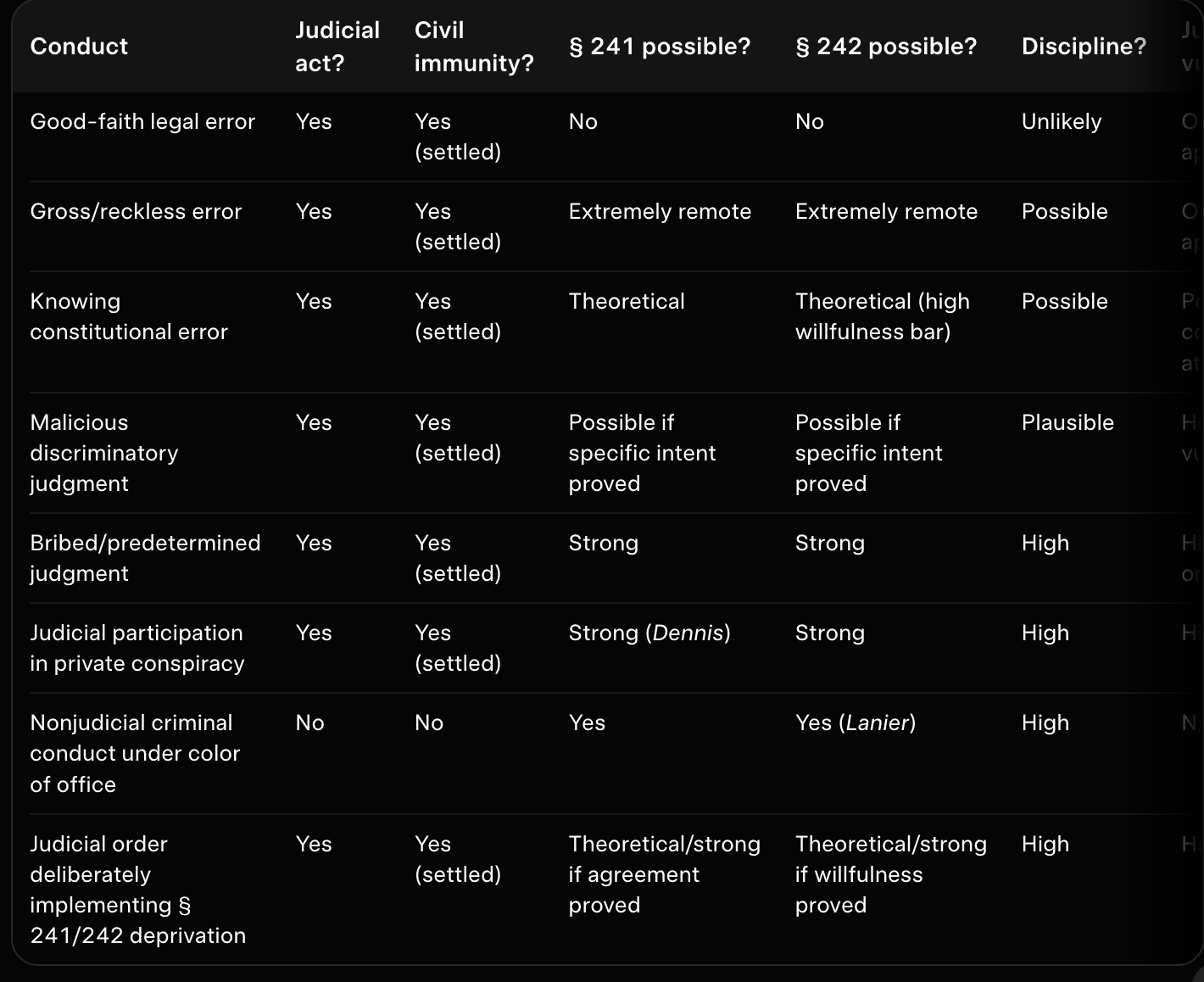
It records different kinds of divergence between judicial authority and the constitutional ideal:
At the boring end is ordinary good-faith legal error.
Then gross or reckless error.
Then knowing constitutional error.
Further along are malicious or discriminatory judgment, predetermined outcomes, private conspiracy, nonjudicial criminal conduct, and…
…ultimately the hypothetical case of a judicial order deliberately implementing a deprivation of rights.
Section 241 concerns conspiracy against rights. Section 242 concerns wilful deprivation of rights under colour of law. The thresholds are high. A wrong judgment is not a federal crime. A grossly wrong judgment is not a federal crime. Even a constitutional violation does not, without the required agreement or wilfulness, magically become one.
But judicial civil immunity and federal criminal liability are not opposite ends of one switch.
That was the surprise.
An act can remain recognisably judicial—and therefore sit inside the formidable doctrine of judicial civil immunity—without “judicial” meaning true, constitutional, moral, or even necessarily incapable of attracting some other form of legal scrutiny.
So I finally had the right question.
Not:
“At what point does an evil enough judgment stop being judicial?”
But:
“How bad can the state conversion become while remaining judicial?”
And then, more specifically:
Where, if anywhere, on this scale does “take a child, launder the provenance, and feed the proceeds back into the custody calculation” fit?
I am not asking us to presume anybody guilty of §241 or §242. That would defeat the forensic method.
I am asking something considerably more uncomfortable:
Can a fully immunised judicial machine functionally become an extension of a crime—taking its proceeds as the starting state, laundering their provenance through adjudication, and converting them into lawful authority—without the judicial acts themselves ceasing to be judicial?
Add the missing criminal intent or agreement, and we cross into an entirely different universe of law.
That was the paradox.
Maybe the court does not become the murder weapon by ceasing to be a court.
Maybe it becomes the murder weapon by being and remaining one.
This is where one case in the table stands out: Lanier. A judge repeatedly sexually assaulted women in his courthouse. That conduct triggered prosecution under §242: wilful deprivation of constitutional rights under colour of law. Being a judge did not transform sexual assault into judging. The robe cannot magically convert an act wholly foreign to the judicial function into an exercise of judicial authority.
But what if the constitutional assault—an outcome wholly foreign to justice, such as enabling child-stealing—is accomplished through judging itself?
Suppose the instrument is not the judge’s hand up a skirt, but the judicial function in action: hearings, findings, classifications, restrictions, and orders. Suppose the thing violated is not bodily integrity, but a constitutional right. Suppose this is not a non-judicial act performed while wearing the robe, but an act whose effect depends upon the authority of the robe itself.
What then?
Here Mireles v. Waco becomes unsettling. A judge allegedly ordered officers to bring an absent attorney before him forcibly and with excessive force. Yet the Supreme Court treated the relevant conduct as judicial for purposes of civil immunity because ordering officers to secure an attorney’s presence was a function normally performed by a judge.
So we encounter a strange asymmetry:
Sexual assault: the judge cannot make it judicial by wearing a robe.
Constitutional assault: what if the alleged deprivation is accomplished by using the robe?
That is a much harder problem.
A judge who punches someone is not thereby “adjudicating” them. But a judge who deprives someone of custody, restricts their speech, discounts their evidence, or converts one legal state into another is performing acts that sit at the very heart of adjudication.
The greater the role played by judicial machinery in producing the alleged constitutional deprivation, the more unmistakably judicial the acts may become for immunity purposes.
And now the paradox snaps into focus.
The hypothetical “plagium machine” does not require the judge to step outside his judicial role. It requires him to stay inside it.
Take the child.
Create the facts.
Present the facts.
Recognise the facts.
Authorise the result.
If the constitutional injury lies in that conversion itself—in laundering the provenance of the physical state until its consequences become lawful reasons for preserving it—then there may be no extrajudicial act to point at.
The constitutional assault wears the form of adjudication,
without necessarily possessing its substance.
And that is why Lanier doesn’t solve our murder mystery.
It tells us that the robe cannot turn sexual assault into judging.
Our question is whether judging can become the instrument of constitutional assault while remaining judging.
That is not a very nice thing to contemplate. Functionally, the judge begins to resemble an enemy combatant in robes: wielding the machinery of the state against the constitutional order it exists to uphold.
Whether that description has any legal meaning is another matter. But analytically, we have crossed into very different territory from conventional questions of judicial error, abuse of discretion, or even misconduct.
Having established our baseline—this can remain a judicial act even while functioning as the instrument by which a Fourteenth Amendment family interest is overridden—the next question was whether the legal machine is actually permitted to work this way.
That inquiry fractured into several strands.
What follows is as much a glimpse of what a day at the keyboard doing legal research with AI actually looks like as it is pedagogy. The method matters because the answer did not arrive whole. It emerged by repeatedly changing the question, breaking the problem apart, testing counterfactuals, finding contradictions, and then asking what survived.
⁂
The first strand was provenance.
The Uniform Child Custody Jurisdiction and Enforcement Act (UCCJEA) expressly addresses “unjustifiable conduct” in §208: jurisdiction generally cannot be bootstrapped from the conduct used to create it.
But what happens one step sideways, under §207, when the question becomes which forum is more convenient? Can the facts making a forum convenient—location, witnesses, schooling, records, social connections—be self-generated by the disputed transition and then fed back into the forum calculation?
Does §208’s anti-bootstrap principle constrain §207, or is there a hole between them?
⁂
The second was recognition poisoning.
What work can a politically radioactive classifier like “QAnon” perform inside an adjudication?
Let’s run a few counterfactual classifier substitutions:
Replace “QAnon” with “model railway enthusiast”. Nothing happens. The label carries no plausible nexus to parental fitness.
Replace it with “vegan” or “astrologer”. Perhaps we acquire some colour or eccentricity, but still no obvious reason to alter custody.
Now try “MAGA activist”, “Islamist”, “white nationalist”, or “paedophile sympathiser”. Suddenly whole packages of presumed motive, character, allegiance, danger and morality arrive before any individual proposition has been proved.
And then there is “communist”—because American custody law has actually run something remarkably close to this experiment.
In People ex rel. Portnoy v. Strasser (N.Y. 1952), a mother’s alleged Communist activities and associations were among the grounds advanced for taking her child from her. New York’s highest court reversed: there was no showing that those associations made her unfit to raise her child. The court grounded the parent’s right to establish a home and bring up children in the constitutional family-liberty cases Meyer and Pierce.
So this is not merely a cute thought experiment. “Communist” has already been stress-tested against custody.
Which makes “QAnon” a serious recognition question:
Can a politically radioactive label smuggle an entire ontology into evidence without proving the nexus between the label and parental fitness?
⁂
The third was classifier deletion.
Then came the more disturbing counterfactual:
Delete the “QAnon” classifier altogether; does the outcome survive?
Much of it apparently does.
The poison from “QAnon” may help initiate the conversion without being necessary to sustain it.
If the suspected poison can be removed and the machine still reaches substantially the same destination, what is actually driving the machine?
⁂
The fourth was feedback.
Once a new physical state exists, it starts manufacturing evidence for itself. Time produces adjustment. Adjustment produces stability. Stability produces preference. Schooling produces friends, records and witnesses. Eventually the growing cost of undoing the transition becomes an argument against undoing it.
The output is fed back as an input.
Can a state manufacture the facts that later become the reasons for preserving that state?
⁂
The fifth was reactive evidence.
A person subjected to a contested state transition will react to it: anger, accusations, demands for restoration, public speech, litigation. Strip those reactions of their provenance and they can return to the adjudicator as evidence against the person reacting.
The machine can therefore manufacture evidence on both sides of its equation: the transition generates favourable stability in the new state and adverse reaction from the person displaced by it.
Can resistance to a contested transition itself be converted into evidence that the person resisting it is the problem?
⁂
The sixth was inert facts.
We repeatedly changed propositions that appeared capable of providing an off-ramp, yet the outcome refused to move. A supposedly important factual predicate could be proved false—or its opposite proved true—without producing the corresponding change in result.
That raises a deeper question than whether a judge simply got a fact wrong:
Was the adjudicative architecture responsive to the fact at all?
⁂
The seventh was temporary-state conversion.
A temporary order does not merely freeze the world while a court thinks. It changes the world during the thinking. Time under an interim arrangement manufactures attachment, stability, schooling, distance, witnesses and preference—the very considerations later presented to the court deciding whether the arrangement should become permanent.
If temporary authority manufactures the evidence for permanent authority, in what meaningful sense was it temporary?
⁂
The eighth was informational feedback.
Restrictions on what may be said do more than regulate speech. They alter the informational environment from which later beliefs, preferences and relationships emerge. If those resulting states are subsequently treated as independent evidence, the court is consuming information partly generated by its own intervention.
Can a court alter the informational environment and then treat the beliefs and relationships produced inside it as independent evidence?
⁂
The ninth was polarity conversion.
No finding of criminal guilt is necessary to pose the systems question. Conduct can create exposure to complaint, investigation, contempt, candour scrutiny or other proceedings. What happens when persistence transforms the consequences of that contested conduct into legal advantage?
Exposure → possession → stability → preference → authority.
The sign appears capable of flipping: the more successfully the antecedent state is displaced, the stronger the eventual case for preserving the displacement.
Can maximum violation become maximum evidence against rollback?
The last one is particularly grotesque: the worse the injustice, the deeper it entrenches itself.
So the sequence becomes:
Provenance / §207–208 — Can you bootstrap convenience?
Recognition poisoning — Can a classifier import an ontology?
Classifier deletion — If you remove the suspected poison and the outcome survives, what is actually driving the machine?
Feedback — Can a state manufacture its own justification?
Reactive evidence — Can resistance become evidence against the resistor?
Inert facts — Can material truth become adjudicatively inert?
Temporary-state conversion — Can temporary authority manufacture permanence?
Informational feedback — Can intervention manufacture the informational evidence later adjudicated?
Polarity conversion — Can maximum violation become maximum evidence against rollback?
And then came the final experiment that pulled all of these strands together: fixed-point rollback.
This was more demanding than an ordinary counterfactual.
We did not merely ask:
What if the disputed transition from TN to NC had never happened?
We deleted the transition.
Then we deleted its consequences.
Then we deleted the consequences of those consequences.
Possession produced persistence.
Persistence produced stability.
Stability produced preference.
The changed environment produced schooling, friends, records and witnesses.
Separation produced deterioration of relationships.
Conflict produced reactive speech.
Reactive speech produced restrictions.
Restrictions altered the informational environment.
The temporary state produced financial and practical consequences.
Those consequences returned as evidence.
That evidence drove judgments about comparative stability and parental circumstances.
Those judgments then supplied reasons to preserve the possession with which the chain began.
The loop closed.
Delete one layer and another loses its provenance.
So we deleted that too.
Then ran the calculation again.
And again!
The rule was simple:
If a fact, characterisation, restriction, or legal advantage would not have existed in materially the same form without the disputed transition, it could not be treated as independent justification for making that transition permanent.
This was not a claim that every causally generated fact must legally be ignored. That is a separate constitutional question.
It was an analytical experiment: strip away everything endogenous to (i.e. downstream and derived from) the disputed state and discover what independent case remains.
We continued until another iteration removed nothing.
That was the fixed point.
And this is where the investigation changed character.
An ordinary legal analysis asks whether the court considered the right evidence, applied the right test, or reached a permissible result.
The rollback asked something prior:
Which parts of the case existed independently of the state whose legality they were being used to establish?
That is a very different question.
It distinguishes observed reality from independent authority.
A preference can be real.
Stability can be real.
A deteriorated relationship can be real.
Financial difficulty can be real.
Returning to the previous arrangement can genuinely have become disruptive.
But none of those propositions answers the causal question:
Would this fact exist in materially the same form had the disputed state transition not occurred?
And if the answer is no, we have discovered something rather important about our legal machine.
It may not merely be adjudicating a new reality.
It may be allowing that reality to manufacture the evidence, reactions, restrictions, resource effects and eventually the authority required to validate itself.
Which takes us straight back to where we began.
The baseline.
An initial assessment by Grok said that each stage of the conversion was constitutional and fell within existing statutory law. More disturbingly, its first conclusion was that their composition was probably constitutional too—deeply troubling, perhaps morally obscene, but not obviously forbidden.
So I pushed harder.
The question was no longer whether each individual cog in the machine could be defended. What constraints does the American Constitution place on this exact sequence, considered as a whole, and on the despicable outcome it is capable of producing?
A different picture began to emerge.
The answers fell into roughly three buckets of constitutional confidence.
In the first bucket were relatively orthodox propositions.
Due process requires a meaningful hearing, not merely the ceremony of one. Material evidence cannot be received yet made incapable of changing a conclusion built on its opposite; assumptions must be rebuttable. Family relationships have serious constitutional protection. And the state cannot substitute loaded classifications or presumptions for the individualised adjudication the Constitution requires.
The second bucket was less settled, but several doctrines pointed the same way: provenance has to matter.
If state action, or state-tolerated self-help, materially generates the circumstances later invoked to impair an established family relationship, due process cannot obviously be satisfied by saying merely: yes, yes, but look where we are now. Existing law contains fragments of this principle—in meaningful-process doctrine, family-integrity cases, anti-self-help rules, and the UCCJEA’s treatment of unjustifiable conduct—even if no Supreme Court judgment conveniently assembles them into our exact doctrine.
The third bucket was genuinely frontier territory: recursive anti-plagium.
Must the law trace every unfair advantage backwards through its causal ancestry, strip away everything generated by an authority-defective transition, and keep rolling back until it reaches a clean fixed point? That is a much stronger proposition. I could find compelling reasons for it; I could not honestly pretend that existing constitutional doctrine already states the rule in that form.
But here is the important thing.
The point is not to discover exactly how much plagium the Constitution permits.
As I covered in Part One, child-stealing has attracted society’s wrath for millennia. Nor is the revelation merely that constitutional law contains difficult and unresolved questions. Of course it does.
The point is that the moral and justice problem here is not difficult at all.
Take a child contrary to the protected state.
Lie in a failed emergency motion.
Refuse to restore the child.
Abate the support obligation, stripping resources from the parent who lost possession.
Let time manufacture preference, stability and witnesses.
Say the other parent has no permanent residence when she does.
Say her residential future is uncertain when the evidence says otherwise.
Turn an existing farmhouse into a future condition.
Let the cost of return mount up.
Feed the fruits of persistence—and the false premises surrounding them—back into court.
Then use them as reasons why the child must stay taken.
You do not need a law degree to see the problem.
Violation becomes possession.
Possession becomes impoverishment.
Falsehood becomes finding.
Persistence becomes authority.
I began this article with a question:
Does the American Constitution tolerate the court itself becoming the “murder weapon”?
Twenty pages later, I finally have my answer: wrong question.
I had made the Constitution my baseline. And that was precisely the mistake.
If the legal machine can no longer express a prohibition that ordinary moral intuition regards as elementary, then the problem lies beneath doctrine. The law has lost contact with reality and morality at a depth ordinary civilians cannot realistically reach through ordinary legal process.
A functioning “plagium machine”—acting as a system of judicially endorsed child trafficking—therefore invites something more radical than another appeal to the machine itself: constitutional Restoration.
In the Restoration-max hypothesis I have been exploring, tied to Q and MAGA, that ultimately means military enforcement of the constitutional order—military is the only way—not because soldiers possess some superior jurisprudence, but because a captured or self-insulating civil authority cannot be its own final corrective.
That is the material-world answer: restore the standing of provenance in jurisprudence.
And if ordinary civil machinery cannot correct itself, restore it by root sovereign force under military law.
But the real problem is metaphysical.
How did we become the kind of society in which courts can aid the taking of a child—and remain apparently untroubled by the moral inversion?
Which takes us full circle.
Jesus rebuked those who boasted of the mighty works they had done in his name, seeking recognition of their righteousness: “Lord, Lord, have we not prophesied in thy name? … and in thy name done many wonderful works?”
His answer was devastating: “I never knew you: depart from me, ye that work iniquity.”
Iniquity there is anomia: lawlessness.
And there is the uncomfortable paradox: lawlessness need not look unlawful.
It can arrive clothed in rules, offices, procedures, findings and orders. Compliance with the machinery of law is not the same thing as righteousness before God. Indeed, the machinery can become a particularly convincing disguise for its opposite.
Which brings us straight back to our legal machine. The trap is not merely doing evil while imagining yourself good. It is believing yourself justified because the law says you are right.
Paul could hardly be more direct: “whosoever of you are justified by the law; ye are fallen from grace.” (Galatians 5:4)
The law can pronounce you right without making you righteous. Indeed, its pronouncement can become the evidence by which you convince yourself of your righteousness.
You won.
The judge agreed.
The order authorises you.
What more could righteousness possibly require?
Quite a lot, apparently.
For in the same chapter Paul warns: “be not entangled again with the yoke of bondage.” And then he names the works of the flesh that keep fastening that yoke around us: hatred, rivalry, wrath, strife—the spirit I have called the Competitor.
The Competitor produces disputes. Disputes summon adjudication. Adjudication summons law. Law declares a winner. The winner mistakes legal victory for moral vindication.
And around we go.
That is why there has been no appeal here, no campaign for personal vindication, no attempt to beat the Competitor at its own game. It has been handed to God—and, within the Restoration hypothesis, to the military as His temporal emissary.
That does not mean silence. Revelation gives us another pattern: “they overcame him by the blood of the Lamb, and by the word of their testimony.” The blood is not ours to shed. The testimony is. These articles are mine. Even if I use some AI to aid writing!
Then comes the extraordinary punchline:
“Against such there is no law.”
You can vote “right”, rally “right”, post “right”, litigate “right”, and obtain an order declaring you legally right. You can even do mighty works in the right name.
None of these things makes you righteous.
Perhaps the deepest curse of the law is not merely that it can punish the righteous.
It is that it can make the unrighteous feel justified.
There is a personal irony here.
When all this erupted, we had already been pursuing almost exactly the question to which this investigation has now returned. We had been doing spiritual immersions in Skye and County Durham, and a Spiritual Exit From The Law seminar in London: exploring what it means to cease seeking salvation through systems of judgment, rivalry and external authority.
Then the legal machine supplied the most brutal practical demonstration imaginable.
For nearly two years I went deeper and deeper into law trying to understand what had happened. And where did that journey finally deposit me? Back where we started. The baseline is spiritual.
The law cannot make you righteous. Indeed, it can become murderous in spirit.
And here, whatever the legal vocabulary for what happened, motherhood was killed as a lived relationship.
The court was the murder weapon.

Again, I am in awe. This is utterly brilliant.
I have been recalling a case in Virginia several years ago where a poor young woman with (I think) a 5-year-old son had Child Services come in and take the child under what certainly looked like false grounds and give that child to a married gay male couple for adoption. Despite massive local efforts by a media personality, who found that the State's Child Services people involved were given a bonus of several thousand dollars and a commendation by a higher level of government (I think federal), the last I heard, there was no reversal. At that point I lost touch with the case, so I don't know how it turned out. I hope I still remember the above correctly, as it was almost a decade ago.
Here in this case, as in yours, a clear act of administrative and judicial plagium was committed by using government-defined rules and tests and judicial faits accompli to lock in the situation legally but abhorrently immorally as rapidly as possible, under color of administrative rules and judicial law.
The last I heard, the child had been quite happy when with his mother but became withdrawn and unresponsive after adoption, and there were some concerns that the child was being abused, though again I lost track at that point.
I believe this case has more in common with possibly thousands of such cases of theft via Child Services of a child for adoption with a favored group than your case does. However, the mechanisms and processes are little different, adding only the Child Services as mechanism of theft rather than in your case the illegal (and immoral!) actions of the father and step-father.
When I put all that and your analysis together with the Q posts and with the intense law fare of the Left against President Trump through judge-shopping and national injunctions by local judges and of course false prosecutions by Democrat "legal eagles," you say correctly that it appears to be true that the military is the only way. The judiciary has been fundamentally compromised into believing that the Law and the trappings of legal/judicial actions give are automatically moral and therefore give moral cover for immoral acts.
Another brilliant (& disturbing) piece of mind blowing analysis. You are, without doubt, genius and these scripted pieces will be put together and used to change the system and the history of law.
Thank you.