

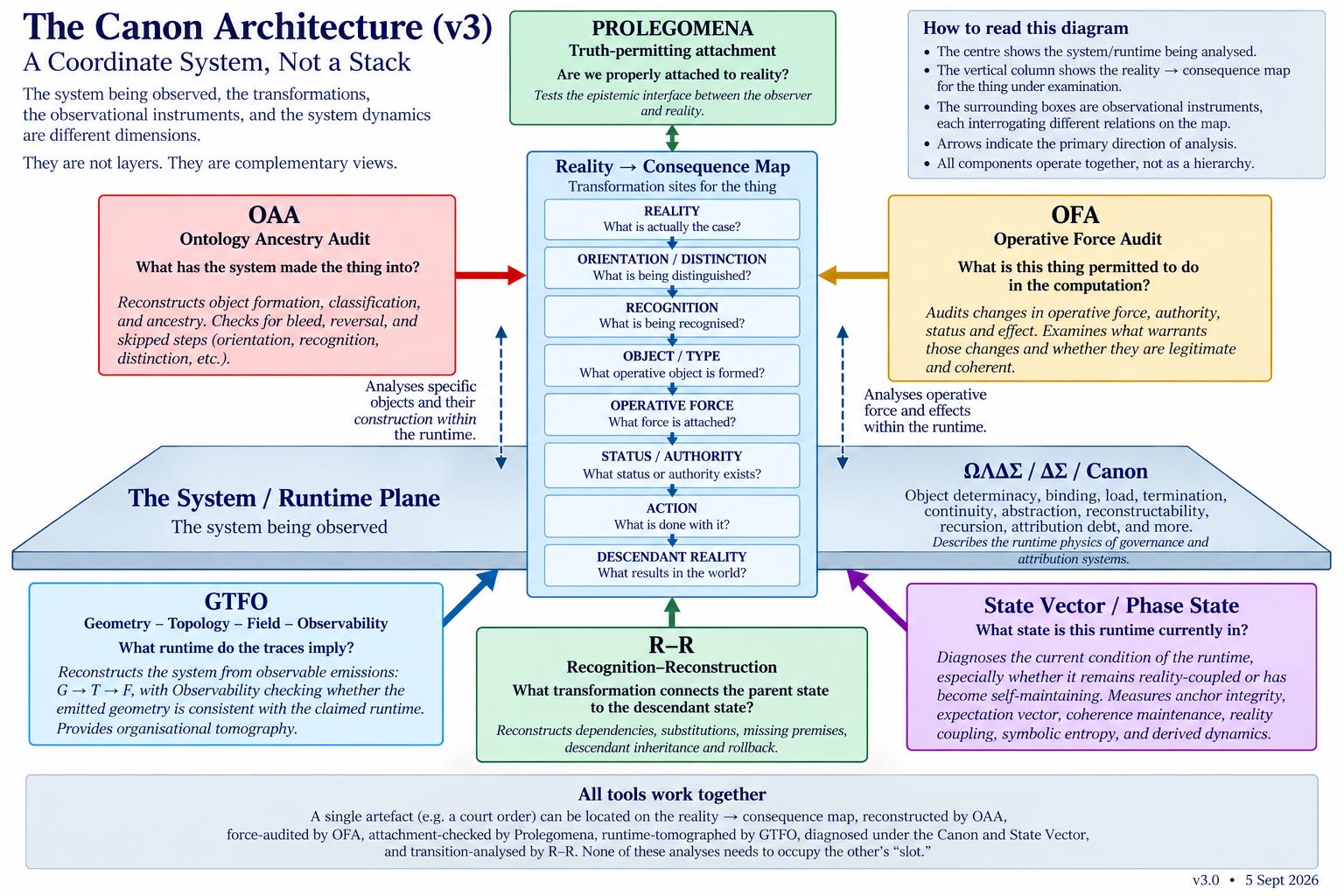
We will come to the chart above later. Meanwhile…
Many of us will be familiar with the claims that the state uses all kinds of sleights-of-hand to expand its power over sovereign individuals, diminish our constitutional standing, and infringe upon inalienable rights. Claimed mechanisms include hidden birth trusts, linguistic games, doppelgänger legal fictions, status conversions, and unrebutted presumptions.
Ask a bureaucrat whether some obscure status conversion is real and you are likely to be told that it is a conspiracy theory or “pseudolaw”, because recognised legal authorities reject it. Push back hard enough with morality and natural law, and you might even earn yourself a “freeman of the land” badge.
Yet the challenge may concern those very authorities, the categories they recognise, and the standing that follows from them. Their justificatory answer may therefore back-feed outputs from the system being questioned as evidence of the validity of the system that produced them.
The problem is circular.
You have to pay property taxes because the state says so.
But what gave the state a higher standing to make you pay to exist?
“The legitimacy of the tax is established by the fact that people pay it” establishes no such thing. At most, it proves that the demand is successfully enforced. Completed enforcement and legitimate authority are not identical; without an independent foundation for the latter, the same reasoning could validate extortion.
The problem of counterfeit ancestry
Let’s unpack this teaching case of property taxes further, not because the specific issue particularly interests us, but because it exposes the more general problem of causality.
There is a real-reality: you were physically born in a particular jurisdiction, an innocent baby who agreed to no debt or lien. An infant is incapable of paying taxes, and a law that attempted to levy them would be disconnected from reality and unenforceable. Just try taxing a two-year-old by removing their toys! It doesn’t end well. They are the most hardcore anti-tax protestors! Real-reality would triumph without a contest.
At some point as you grew up, there was a change in recognition; you put your childhood toys aside (big mistake!) and became a “resident taxpayer”. Your shelter in your land of birth can require you to go work for the state before you earn anything for yourself. “We need to pay for roads, schools, and social care” is offered as the explanation, and no doubt those state services do indeed exist. The point is, something happened between you being two and fifty-two.
What exactly happened?
This is not a normative argument against property taxes, but a structural inquiry: what is really going on here? A baby is genuinely distinct from a working adult in real-reality, and that distinction may warrant different treatment in official-reality. But how far can the distinction legitimately carry us? At what point has it done all the justificatory work it can afford, while officialdom continues debiting consequences from it?
When is the “moral credit” from the distinction exhausted, so that every further consequence charged against it creates a kind of justificatory debt?
Taking babies versus adults is somewhat too easy of a rhetorical contrast, so let’s take something where the distinction is less extreme.
Consider also the mundane category of “driver”. Modern law tells us that driving on a road is a licensed activity. That wasn’t always the case, nor was it always attached to a test for competence and safety. In the UK, the conceptual origins of driver licensing trace back to steam locomotives and the danger and damage they could cause. The distinction from a horse and cart was real at the time.
But suppose the question being asked is precisely how an ordinary member of the public, historically entitled to pass along the highway “without let or hindrance”, came to be recognised as a licence-dependent DRIVER (in caps to emphasise that it is a label, not a God-given status) when using a motorised conveyance.
What series of transformations got us from:
giant steam traction engines under the Locomotives Act 1865,
through the Motor Car Act 1903 and its system of driver licensing,
through the Road Traffic Act 1930 and the further development of the motor-vehicle licensing regime,
to the modern position in which driving a motor vehicle on a road without the appropriate licence is itself an offence under the Road Traffic Act 1988?
How did the regulation of unusually dangerous machinery evolve into a blanket requirement for state permission to travel by ordinary motor vehicle?
And how did the absence of that permission itself become an offence, even where no public loss, injury or harm had occurred?
Answering “because the law requires drivers to be licensed” again merely reasons from the downstream category whose genealogy is under examination. It describes the present legal position, but does not reconstruct the transformation that produced it, much less establish its legitimacy. The question of how motorised passers-by became drivers precedes any particular legal “trickery” mechanism engaged, if at all.
When reasoning begins too late
The AI’s reasoning, just like our own, can therefore quite easily begin after the disputed categorical transformation — from “traveller in a carriage” to “car driver”, for instance. The answer to the challenge is thereby surreptitiously imported: reasoning begins inside the very category being questioned. Current official recognition is then used to certify its own ancestry.
This kind of error is subtle and hard to detect: you can reason impeccably about the wrong thing.
Indeed, the more intelligence applied, the more elaborate the justifications that can conceal the hidden semantic feedback loop, and the harder it may become to perceive.“The state is entitled to this power because it successfully took it from you” is obviously wrong when laid out cleanly, but tough to spot in pages of legalese.
And it is not limited to government paperwork.
The same structural error can arise in Biblical hermeneutics. “The text means X because tradition says it means X, and the tradition is authoritative because it faithfully preserves the meaning of the text” has the same circular form.
In both cases, the disputed descendant is being used to certify its own ancestry.
In more formal terms: rigorous epistemology cannot rescue reasoning performed inside a corrupted ontology.
Over the last year or two, I have been developing a reasoning framework intended to go beneath all such claims, whether ultimately valid or invalid, and ask a more basic question:
Can we still locate reality in the labyrinth of official decisions and acts?
I produced the initial version of the chart above yesterday for my own edification, to understand better the relationship between the various AI tools I have been creating during my personal quests into law and justice. Each addresses some aspect of how reality is attached or attenuated. As it happens, I am still creating new tools, and the diagram does not even capture everything I have already made.
— This article is not about those tools. —
Its purpose is to describe the universal problem rather than my particular answer to it:
What happens between real reality and official reality?
What transformations take place along the way?
How can we tell when necessary abstraction has become distortion?
When does official recognition become self-validation of unreality?
How can an apparently legitimate sequence of institutional operations become something very different when composed as a whole?
And, most importantly:
What would a tool need to be able to see in order to audit that gap between an “unreal official reality” and a “real unofficial unreality”?
Conspiracy theories are entertaining enough, but we are in the business of constructing consequence theories. I don’t particularly care whether your favourite sovereign citizen bonded-servant theory is true. I want to know whether the symbols correspond to reality.
Start with reality.
Show me the transformations.
Verify their consequences.
From consequence theories to an engineering discipline
My proposal is there is a novel domain that is a kind of engineering for symbolic systems of governance. Like any engineering discipline, it seeks both to construct “success modes” (e.g. cars can pass over a river via a bridge) and constrain “failure modes” (e.g. the bridge doesn’t collapse in a storm). For completeness, I have reviewed the bigger problem in a series of past articles:
∆R/reconstructability asked whether a governance system still preserves a recoverable path from its outputs back to the reality from which they arose.
Civilisation Engineering looked at the runtime behaviour of large-scale systems and how they deform under pressure.
Civilisation Attenuation and Synthetic Success explored how institutions simulate successful outputs even while their grounding deteriorates.
The General Prolegomena moved even further upstream: before asking whether any proposition is correct, are categories meaningfully attached to reality at all?
Recognition–Reconstruction added another piece: is any piece of the chain where reality is compressed into recognition traceable back to its source?
What I had not clearly seen was that these were different views of a larger engineering object that is, it seems, under-articulated at present.
A bridge engineer takes an antecedent reality — a river estuary, past lessons from building bridges, known properties of structural materials, available supplies in that locality — and defines a series of transformations that turns them into a bridge. Those transformations work with loads, materials, geometry and physical consequences.
Crucially, the finished bridge does not validate the transformations that produced it.
The fact that it is standing today does not prove that its foundations are adequate, its materials are sound, its load assumptions correct, or that it will survive tomorrow’s storm. Each transformation has to remain answerable to the reality upon which it depends. The very essence of safety engineering is that reality has the final say, not paperwork.
Symbolic systems of governance have an analogous engineering problem.
They take an antecedent reality — people, events, evidence, relationships, resources, rights, harms, obligations — and progressively transform it into recognised objects upon which the system can act with real-world consequences:
A human being becomes a car DRIVER.
A car’s emission of fumes becomes a regulatory vehicle classification.
An allegation of non-payment of a clean air zone charge becomes a finding.
A finding of breach of the rules becomes a liability to pay a penalty.
That liability becomes an enforceable debt.
Unlike concrete and steel, however, these transformations happen largely in symbols. Yet their effects return to the physical world, sometimes changing lives profoundly.
Money is taken.
Movement is restricted.
Children change homes.
Property changes hands.
People are imprisoned.
Lasting records are created.
And those newly created realities can become inputs to the next round of symbolic transformation, and our lives become ever-more subjected to (often warped) symbols that may or may not be capable of holding the load reality places upon them.
Round and round we go, transforming reality into symbols, and symbols back into reality.
So what is the engineering discipline for making those consequential transformations safe?
I hope you are having the same “oh, cr*p” moment as I did.
There isn’t one.
At least not as a single, coherent, rigorous field that recognises itself as a form of safety-critical engineering for bureaucracy.
And yet our whole society runs on symbol-transformations from one reality into the next.
How can this be?
No, really: how on earth can this be?
The strange physics of symbolic systems
Well, if we focus just on the technical problem, the issue begins with the very substrate upon which we operate. A bridge across a river needs load-bearing bedrock or deep foundations piled into the ground; everything stands upon that physical base. When an earthquake hits, the bridge itself has to bend and sway. But unless the structure fails at the component level, the ultimate bearer of the system load is always the physical foundation.
Symbols don’t work quite the same way, even though they have the equivalent of a physics. We start with reality as the thing that has to bear the foundational load. That reality is transformed into symbols; those symbols into recognised objects; those recognised objects into rights, duties, powers and burdens; those, in turn, into actions. Finally, those actions alter reality again.
The substrate therefore has a peculiar looping relationship with the structure built upon it.
Every symbol is lossy in some way: it omits some of reality and may bring in some unreality of its own. The engineering problem, therefore, is not merely whether the individual symbols are true (or “true enough”) in isolation. It is whether each transformation, and the still more lossy composition of those transformations, can transmit the eventual operational load in the “terminating reality” all the way back to foundations in the “originating reality” capable of bearing it.
And because the resulting actions alter reality itself, the system must do this without allowing its own consequences to become counterfeit foundations for the symbols that produced them. That’s the catch: there is a temptation to bootstrap the justification for anything, no matter how outrageous, simply by forcing it upon reality, then declaring the fait accompli a moral vindication.
Treating the output as justification for the transformation that produced it — by feeding it back as an input — is cheating!
The question is whether those transformations of an input reality, composed together, can support the consequence eventually placed upon them in the output reality — without cheating.
(It’s the cheating that’s the gotcha. Otherwise it’s easy!)
(And cheating is cheaper than engineering.)
(Hence we have a lot of cheating.)
(And a missing discipline.)
(Oops!)
When feedback becomes cheating
This cheating phenomenon is worth studying, as there isn’t really an equivalent in “atomic” engineering disciplines. Indeed, the defining difficulty with failures in symbolic systems is that everything can look normal; there is no wreckage to examine when they fail at some deep ontological level. Once we understand what cheating actually is, and why it is so attractive, we can begin to tame it.
As noted above, every symbol is necessarily lossy. Reality has to be compressed to become tractable; the engineering problem is not abstraction itself, but whether that abstraction remains sufficiently attached to reality for the consequences it is made to bear.
Nor is feedback itself cheating. Outputs becoming new inputs is ordinary life. The cheating begins when the resulting state of reality is used to justify the transformation that produced it.
Let’s make this a bit more concrete, to get the point over. The state cannot simply ban children from playing in the street; there has to be a reason — and that reason cannot be:
“There are no children playing in the street because we banned it, so the ban is plainly an unobjectionable safety improvement — and look how few children now get in the way of cars. It must be a great idea!”
There had to be some intermediate operation that recognised categories such as “traveller” and “juvenile”, weighed their respective rights and duties, and justified the resulting restriction — even if it did all of those things badly, even maliciously.
Likewise, a man falsely accused of domestic violence by his wife might be apprehended by police who initially take her at her word. His surprise and shock at his treatment may then be interpreted as resistance, which in turn justifies further force. The consequence of the first transformation has become evidence supporting the next.
Cheating is when the outcome becomes the justification for the transformation.
Five tests for consequential recognition
Now we can start to see why this domain has been resistant to engineering principles. With a bridge, the starting position is “no bridge”. With governance, we don’t get a clean sheet of “no reality” — and reality is about as messy as anything can be. Nobody wants to be responsible for the whole of reality!
So we have to isolate accountability for the symbolic and paperwork transformations from responsibility for the underlying objects being managed through the consequences of those transformations. Otherwise every judge, administrator, law-enforcement officer, tax assessor and civil servant takes on the burden of every piece of bad behaviour everywhere. That’s a non-starter.
Their job, done properly, is much narrower:
Encode reality faithfully, transform it according to remit, and transmit the outcome into consequences.
This is tractable, as long as the remit is kept small enough.
The boundaries of this potential new domain can now be defined:
We don’t need to solve the metaphysical problem of “reality”; we need only establish enough of it to make the distinctions that matter — for example, “speeding” from “not speeding” — and to detect and correct drift from those distinctions. This is the reality test.
Those distinctions must compress reality into symbols without becoming detached from what they represent. A “car derived van” used privately for domestic use is not a “commercial vehicle”, even if marketed to businesses. This is the faithfulness test.
Each distinction — for example, “guilty” versus “not proven” — must justify only those consequences whose operational load it can bear. This is the remit test.
The output must not become self-validating, like our ban on children in streets; provenance must retain meaning; burdens must move only with justification; and mismatches must trigger correction rather than rationalisation. This is the “no cheating” test.
Finally, the system must remain corrigible. Corrupted objects, overloaded distinctions, proxy substitution, unwarranted force, burden displacement and provenance loss must remain detectable and capable of correction. This is the corrigibility test.
That is beginning to look less like a collection of jurisprudential techniques and more like an engineering discipline for consequential symbolic systems.
Where the new discipline sits
All the ideas being presented are already well-established; it is their combination where novelty may lie. Hence the domain is not law, jurisprudence, epistemology, systems theory, institutional economics, AI alignment, or semiotics, but somewhere in the gaps between them. Nor is it “conspiracy theory detection”, “government accountability”, or even institutional corruption.
It begins before conventional reasoning about an accepted object:
reality → selection → distinction → recognition → object
and continues after recognition becomes consequential:
object → force → status/authority → action → descendant reality
with the crucial recursion:
descendant reality → new input
So the domain isn’t simply the gap between real reality and official reality. It is the entire consequential conversion loop between them.
This matters enormously, because what is being proposed is distinct from the domains it operates within:
We aren’t principally asking whether a statute was correctly interpreted. That’s legal analysis.
We aren’t principally asking whether proposition P is true. That’s epistemology.
We aren’t principally asking whether institution X is legitimate. That’s political philosophy and jurisprudence.
We aren’t principally asking what incentives explain institutional behaviour. That’s economics and sociology.
We aren’t principally asking whether a classification algorithm is accurate. That’s statistics and machine learning.
We aren’t principally asking whether a system is stable or controllable. That’s systems and control theory.
All of those disciplines can supply evidence and methods.
Our question cuts across them:
How did this reality become this consequential object, what transformations occurred along the way, what warrants them, what did they cause, and can reality still correct the resulting computation?
That is a remarkably specific object of inquiry.
And there is an essential safeguard. “Real reality” cannot simply mean my preferred account of events. Any adequate method must be capable of concluding that the official representation is sufficiently faithful and that no material failure has been established.
Otherwise we have merely built another self-validating official reality.
Like your broadband Internet connection, this is about “good enough, often enough, with few enough bad experiences”. Not perfection.
The hole between the disciplines
There appears to be no generally adopted discipline whose primary object is the end-to-end transformation described earlier. That is a much narrower and more defensible novelty claim than saying nobody has studied any of its components:
A lawyer can tell us whether a decision had statutory authority.
An epistemologist can ask whether its factual premises were warranted.
An economist can explain the incentives it created.
An engineer can measure the accuracy of its proxy.
A proceduralist can identify the available appeal.
A rights scholar can describe the resulting burden.
They can all be right.
But whose job is it to reconstruct the entire conversion and ask whether these locally defensible operations compose into a globally defensible consequence?
That is the hole.
It also explains why the problem of the “novel atrocity” appears here. Nothing grotesque need be visible in any individual operation. The pathology can emerge from their composition.
The boundary is consequence, not officialdom
There is one further complication. The field isn’t fundamentally about institutions at all.
An AI system can perform these transformations. So can a corporation, scientific discipline, credit bureau, school, hospital, religion, standards body or social platform. Conceivably, so can an individual cognitive system.
What qualifies a system for this domain is roughly:
A system encounters reality, constructs an operative representation from it, attaches consequences to that representation, and thereby changes reality.
Once those conditions exist, the problem exists.
This makes consequence an important boundary condition. A harmless categorisation may be interesting to semiotics or epistemology, but it isn’t particularly interesting here. Once the category determines whether you may travel, receive treatment, retain custody, obtain credit, keep your money, speak, work or appeal, the transformation has become consequential.
And once the consequence changes the world, another danger appears. The system may encounter the reality it has itself helped to create and recognise that descendant reality as fresh evidence for the representation that produced it.
The loop has closed.
That is why I think consequential recognition may be the right provisional name for the domain: each act of recognition triggers consequence theories that have to be validated.
And now… that architecture diagram!
The opening of this article is an architecture diagram that locates my own tools in this nascent space. I promised that I wasn’t going to write about those tools, and I am keeping that promise. In fact, I am going further: I refuse even to explain the details of the diagram! The point is that such an architecture is thinkable, not that I have hit a hole-in-one and nailed every detail on the first attempt.
If all you take away is that any representation of reality implies some ontology — say, one that classifies you as a licence-dependent DRIVER rather than a rights-bearing traveller — and that upstream processes of orientation and recognition determine which ontology becomes operative, then my job is done. You have seen the structure. You can begin to work with it yourself.
I am compressing over two years of work into something that would more usually emerge from a research group and a succession of academic publications. I know many of my readers are having fierce battles with authorities because reality has lost its grip on decision-making, resulting in injustice. These are tentative steps to identify where reality is losing ground, in a way that can be abstracted, hence automated.
My encouragement is to take this whole article and plop it into AI. Have a learning conversation. Ask it what it thinks I am saying, but in terms that fit its knowledge of you. Explore how it might apply to your own interests and fights. My central assertion is that there is a gap, not that I have figured out exactly how to fill it. The persistence of unfairness suggests that the gap matters.
And that’s reality!
(Or at least a faithful representation of it.)
The tricky mechanisms of evil are well hidden! Holy Cow Martin! Your analytical nature is definitely inspirational! Dusted off a few brain cells digesting this one! We’ll leave this genius work to you & stay tuned for more! Blessings always!